


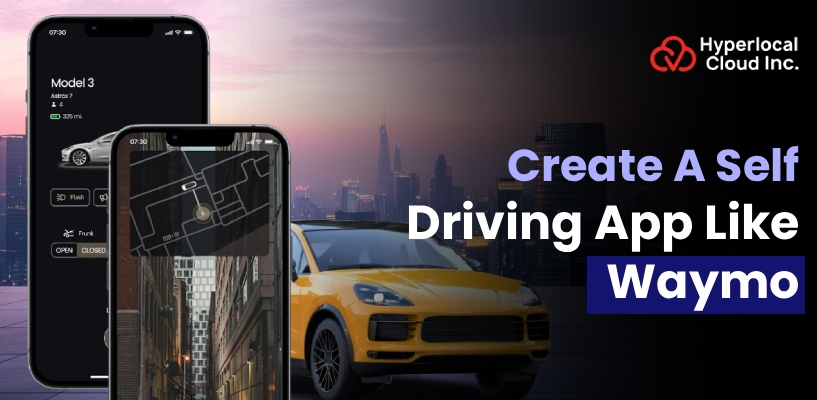
The demand for automatic self-driving for independent experience services is growing rapidly worldwide. It has been seen that many cities are now exploring smart mobility solutions to reduce traffic, improve street safety, and lower pollution levels. Self-driving vehicles are playing a primary role in this transformation. As humans become more comfortable with technology, they’re more open to the usage of driverless journey offerings.
A Waymo clone app is a trip-hailing or transportation app that leverages self-driving automobile technology. It is inspired by Waymo’s working model, which is typically designed to develop self-driving cars that offer driverless riding solutions. This app is designed to offer smart, secure transportation. The main goal of developing a Waymo clone app is to provide a smooth and driverless travel experience while reducing the need for human drivers.
A Brief Insight into The Waymo App
Waymo One is a ride-hailing application that allows people to book self-driving cars for transportation. Users can request a ride, check nearby vehicles, and view the estimated arrival time and fare through the app. Once booked, an autonomous vehicle arrives at the pickup location and drives the passenger to the selected destination using advanced sensors, cameras, radar, and artificial intelligence. The system continuously analyzes road conditions, traffic, pedestrians, and obstacles to ensure safe and efficient travel. This technology aims to make transportation more convenient, reliable, and safer by reducing human driving errors.
Build the future of transportation with AI-powered self-driving technology
Know the Working Mechanism of An App Like Waymo
To get to know about the working process of the self-driving app like Waymo, users are required to go through the information below. Here you will get a step-by-step method to smoothly operate the application.
1. User Registration
Users are required to download the application. To sign up, users should submit their verified contact numbers and email addresses. This will help them access the application for usage.
2. Booking a Ride
Users are required to enter their pick-up location and a destination. The GPS tracking system is integrated into the app, which helps vehicles to detect the user’s location.
3. Vehicle Navigation
Once the ride is confirmed, the independent automobile starts transferring toward the pickup place. The car is managed using advanced software, cameras, sensors, and radar systems.
4. The Ride Experience
When the vehicle arrives, the passenger arrives inside, and the journey starts off evolving. There is no human driving force. Instead, the auto drives itself using integrated systems. The passenger can see the path and experience progress at the app display.
5. Payment and Trip Completion
After achieving the destination, the trip ends routinely. The price is processed via the app using the chosen charge approach, inclusive of credit card, virtual wallet, or online banking. The user gets a digital receipt and can feel the revel in it. The ratings and reviews help enhance the carrier.
What Are The Advantages of The Waymo Clone App?
The advantages of a ride-sharing app like Waymo are mentioned below. These advantages are of the user side panel and the business side panel. Just have a look to know more about the same.
Advantages for Users
1. Improved Safety
One of the most essential pros for clients is protection. Autonomous cars are designed to reduce human mistakes, consisting of distracted use or fatigue. The gadget continuously records video of the surroundings and reacts fast to environmental situations.
2. Convenience and Comfort
Users can book a trip at any time through the app. There is no need to look for a taxi or wait in prolonged queues. The entire process, from booking to charge, takes place inside the app. The trip is smooth and quiet, permitting clients to loosen up in some unspecified time in the future all through the adventure.
3. Transparent Pricing
The app indicates the anticipated fare before confirming the experience. This allows users to plan their budget. There are no hidden charges when pricing is clear and properly managed.
4. Real-Time Tracking
Users can track the vehicle in real time earlier than and throughout the trip. They can also proportion experience info with a circle of relatives or pals. This increases consideration and peace of mind.
Advantages for Businesses
1. Lower Operational Costs
For businesses, one important benefit is the discount on driver-associated expenses. Since the motors are self-driving, groups do no longer want to pay driver salaries or control driver schedules. This can result in long-term price financial savings.
2. Scalable Business Model
A Waymo clone app lets agencies scale operations more easily. Once the era is installed, agencies can extend their offerings to new cities and regions. The app can manage a couple of journey requests concurrently, supporting business growth.
3. Data-Driven Insights
The app collects data that helps businesses use these statistics to enhance services, plan expansions, and raise efficiency. Better facts lead to better decision-making.
4. Strong Market Position
Autonomous vehicle services are nevertheless new in many parts of the sector. By launching a Waymo clone app early, agencies can position themselves as innovative and question-asking. This can help them stand out from conventional experience-hailing offerings.
List of The Compelling Features of The Waymo Clone App
All the required features of the application for each panel, including user, admin, and vehicle management, are mentioned in detail. Just review the information once:
User Panel
1. Easy Registration and Login
Users need to be capable of creating an account quickly. They can sign in using their cell phone number, email address, or social media accounts. The process should be easy so that customers can start reserving rides without confusion.
2. Ride Booking System
The booking machine is the heart of the app. Users can enter their pickup region and vacation spot. The app needs to automatically stumble upon the cutting-edge place using GPS. It should also display the anticipated fare and arrival time before confirming the experience.
3. Real-Time Vehicle Tracking
Once the ride is confirmed, customers must be able to track the automobile on the map. They can see how far the auto is and the way long it will take to arrive. This characteristic gives customers a sense of safety and comfort.
4. Estimated Fare Calculation
The app must show a clear rate estimate earlier than reserving. This facilitates customers to make informed choices. Transparent pricing builds trust among users.
5. Secure Payment Options
The app needs to support more than one fee method, along with credit cards, debit cards, digital wallets, and online transfers. The price process ought to be secure and encrypted.
6. Trip History and Ride Details
Users need to be capable of viewing past rides. They can check info, including date, time, distance, and fare. This is beneficial for monitoring expenses.
7. Ratings and Feedback
After completing a ride, customers can freely share their feedback in order to inform other users regarding the platform.
8. Customer Support
An assist gadget must be available in case users face problems. It can also include live chat, email assist, or an assist center segment.
Admin Panel
1. Dashboard Overview
The admin must have got an entry to a clean dashboard. It must display essential information, including overall rides, active vehicles, sales, and consumer interest.
2. User Management
Admins can view and control personal debts. They can block suspicious users, confirm bills, and handle court cases.
3. Fleet Management
The admin panel should allow monitoring of all self-sustaining automobiles. It needs to display vehicle status, location, battery level (if electric), and protection needs.
4. Fare and Pricing Control
Admins need to be able to modify pricing based on distance, time, or demand. They can also introduce discounts and promotional offers.
5. Reports and Analytics
The system has to generate distinct reports on sales, peak hours, popular routes, and personal conduct. These insights help in making better business choices.
6. Safety Monitoring
Admins must reveal protection reviews and make certain vehicles observe regulations. Alerts have to be available for unusual behavior or technical troubles.
Vehicle Management Panel
1. Real-Time Vehicle Monitoring
The system should track each vehicle’s location and movement. It should display which vehicles are active, idle, or under maintenance.
2. Route Optimization
The fleet panel should support smart route planning. It should guide vehicles through the fastest and safest routes.
3. Maintenance Alerts
The gadget needs to send indicators when a car needs servicing or inspection. Regular upkeep guarantees safety and reliability.
4. Remote Diagnostics
Technical problems can be detected remotely. The system can examine vehicle performance and pick out possible troubles before they become serious.
Let’s build your self-driving app and redefine mobility together
Explore the AI-Driven Features of an App Like Waymo
For the development of a Waymo clone app, experienced software development companies often integrate AI-powered features to enhance its overall functionality. However, all the advanced features of the application are listed below.
1. Self-Driving Decision System
The most important AI characteristic is self-driving. The car uses cameras, sensors, radar, and software to apprehend its environment.
2. Smart Route Planning
AI enables selecting the best course for every experience. It studies site visitors’ styles, avenue situations, and distance. It selects routes that save time and decrease gasoline or battery utilization.
3. Predictive Demand Analysis
AI can look at past experience facts to predict busy hours and high call volumes for places. Businesses can install more motors in their regions to lessen wait times.
4. Automated Fare Adjustment
AI can adjust pricing based on demand, visitors, and availability. During top hours, the system may additionally increase fares slightly. During low-demand hours, it can offer discounts. This facilitates balanced delivery and demand.
5. Real-Time Safety Monitoring
AI continuously assesses unusual styles or dangers throughout rides. If something unexpected occurs, the machine can send signals to the control module. This improves passenger safety.
6. Voice Assistance and Smart Interaction
Some advanced systems include voice-based interaction inside the vehicle. Passengers can ask for route updates or basic information. AI makes communication simple and natural.
7. Continuous Learning System
AI structures improve through the years. They research from each trip. The more data they acquire, the better they grow at riding and coping with rides.
A Complete Process for a Waymo Clone App Development
Know the overall development process that on-demand app development companies utilize to build an app like Waymo. All the steps are discussed below, just have a look once.
1. Market Research and Business Planning
Before starting the improvement, thorough market research is vital. In this step, groups study the target audience, competitors, and legal necessities. This degree actually allows us to outline the enterprise version. It additionally helps in identifying demanding situations together with the authorities’ rules and protection requirements. Without proper planning, even the best era may additionally fail.
2. Defining Features and System Requirements
After the studies, the next step is to define the app’s features. The developers prepare a whole list of functions. They define how ride requests are processed, how automobiles are tracked, and how payments are managed.
3. Design UI and UX
UI and UX layout play an essential role in the app’s achievement. The app must be simple and smooth to use. Users should no longer feel burdened while reserving a ride. Designers create wireframes and prototypes before real development begins. This facilitates visualizing how the app will appear.
4. Begin the Development
The development process starts at this point, where frontend and backend developers play a significant role. To build a Waymo clone app, businesses can choose a white label solution or they can start developing the app from scratch. Both methods differ and offer distinct benefits.
5. Testing and QA
Testing guarantees that the application works smoothly and safely. It reduces the risk of technical issues after launch. Developers check for app performance issues, poor security, payment errors, etc.
6. Deployment and Launch
Once checkout is completed, the app is released on app stores. The backend servers are deployed on cloud systems. The corporation may additionally begin with a small place for testing in actual conditions. After a successful effect, they can extend to extra locations.
7. Regular Updates
After the deployment, continuous updates are needed to:
- Fix bugs
- Improve features
- Enhance security
- Update AI systems
- Comply with new regulations
Outlook of The Tech Stacks Utilized to Build Waymo Clone App
The table shows all the robust tech stacks that are utilized for the development of an app like Waymo. Just have a look at the table once:
| Category | Tech Stacks |
| Frontend | React Native, Flutter, HTML, CSS, JavaScript |
| Backend | Node.js, Django, Ruby on Rails |
| Database Management | PostgreSQL, MongoDB, MySQL |
| Cloud Infrastructure | AWS, Google Cloud, Azure |
| Real-time Navigation | Google Maps API, Mapbox |
| Communication Protocols | MQTT, WebSockets |
| Payment Gateways | Stripe, PayPal, Razorpay |
| Push Notifications | Firebase Cloud Messaging (FCM), OneSignal |
| Authentication | OAuth2.0, Firebase Auth |
| DevOps & Monitoring | Docker, Kubernetes |
| AI & Analytics | Apache Kafka, Google BigQuery |
For Whom is The Waymo Clone App?
Go through the information to know about the key users of the Waymo clone app. As the application is versatile, users from different niches can easily leverage the application.
1. Daily Commuters
Daily commuters are one of the primary users of a Waymo clone app. These are people who travel frequently for work, college, or personal needs. A self-driving journey allows them to relax at some stage in the adventure.
2. Tourists and Visitors
Tourists traveling to a new metropolis may not be familiar with local roads and transportation systems. A Waymo clone app can make its tour less complicated. With real-time navigation and automated use, vacationers no longer need to fear guidelines. They can honestly input their vacation spot and experience the trip.
3. Corporate and Business Travelers
Companies can use a Waymo clone app to manage employee transportation. For instance, groups can set up rides for employees traveling to conferences or company activities. Businesses can also associate with independent trip carrier vendors for long-term transportation solutions.
4. Ride-Hailing Startups and Entrepreneurs
Entrepreneurs who want to go into the clever mobility marketplace can utilize a Waymo clone app as their commercial enterprise version. Instead of constructing a gadget from scratch, startups can expand a customized clone solution.
5. Government and Smart City Projects
Governments working on smart city initiatives can also use a Waymo clone app. Many cities are planning to introduce autonomous public transport systems. A Waymo-style app can help manage:
- Public self-driving taxis
- Airport shuttle services
- City transport solutions
- Electric autonomous fleets
6. Logistics and Delivery Services
Although Waymo is specifically recognised for trip-hailing, a similar era can also be used for deliveries. Logistics companies can use self-reliant automobiles to deliver applications. The app can track routes, monitor automobile performance, and manage schedules.
Build a reliable robo-taxi booking app with powerful real-time feature
Overview of The Key Trends of Waymo Clone App
Here you will get to know about the latest key trends of the Waymo clone app, which has become one of the compelling factors for businesses that are looking to start their business journey by developing the application. Just have a look:
1. Growth of Autonomous Vehicle Technology
Autonomous vehicle technology is enhancing every year. Advanced sensors, cameras, and artificial intelligence structures are becoming extra accurate and dependable. Companies are investing carefully in research and improvement.
2. Rising Demand for Contactless Transportation
After global fitness concerns in recent years, many people have opted for contactless services. A self-driving car gets rid of the need for direct human interaction. Passengers can book, ride, and pay through the app without physical contact.
3. Integration with Electric Vehicles
Many driverless vehicle systems are actually mixed with electric vehicles. This helps environmental sustainability. Electric driverless vehicles help lessen gasoline intake and decrease pollution levels.
4. Expansion of Smart Cities
Cities around the sector are investing in smart infrastructure. This includes clever visitor signals, related avenue structures, and digital monitoring tools. Such infrastructure helps sustain self-generation.
5. Data-Driven Transportation Management
Modern transportation systems depend closely on facts. This record allows organizations to enhance performance and provide high-quality service high-quality.
6. Increased Investment from Tech and Auto Companies
Technology groups and automobile producers are forming partnerships to expand independent automobiles. As large organizations enter this field, competition will increase, mainly to offer better offerings and even greater top-rate solutions.
7. Focus on Safety and Regulations
Governments are growing regulations to ensure the secure use of self-sustaining vehicles. Strict testing and protection tests are getting well known. This awareness of safety builds public self-belief and encourages wider adoption of self-using experience offerings.
Challenges and Considerations in The Development of an App Like Waymo
For the development of a taxi booking application, businesses can face several challenges that they have to consider in a timely manner to avoid last-minute hassles. That’s why all the related challenges and considerations for the development of an app like Waymo are listed below.
1. High Development and Infrastructure Cost
One of the most important demanding situations is the value involved. Developing a normal trip-hailing app already requires an awesome investment. However, constructing a self-driving platform in addition will increase costs.
2. Complex Autonomous Driving Technology
An app like Waymo is predicated heavily on artificial intelligence and machine learning. The vehicle must be capable of recognizing traffic signals, road symptoms, pedestrians, and different vehicles. Developing and integrating this generation is very complex. It requires skilled engineers, AI specialists, and non-stop trying out. Even a small mistake inside the device can cause serious protection troubles.
3. Safety and Security Concerns
Safety is the top priority in self-driving vehicle services. Passengers ought to experience stability whilst riding in a driverless vehicle. In addition to road safety, cybersecurity is also critical. The app should protect personal records, price information, and journey records from hackers.
4. Government Regulations and Legal Compliance
Autonomous vehicles are still new in many regions. Governments have strict rules governing the testing and operation of self-driving vehicles. Regulations may additionally vary from one city to another. Businesses need to cautiously look at these laws before launching their services.
5. Public Trust and User Acceptance
Many people are still uncertain about using a driverless car. Building public acceptance as true is a vital venture. Positive feedback and top reviews can slowly build trust in the application.
6. Continuous Maintenance and Updates
Technology modifications fast. Autonomous structures require everyday updates to improve performance and protection. Vehicles also need everyday preservation checks. If the system is not updated properly, it could turn out to be old or risky.
How to Make Money from an App Like Waymo?
All the essential strategies that can be helpful for businesses to generate a good income from the application are mentioned below. Just follow these revenue models to boost your business ROI.
1. Ride Fare Charges
The primary source of income is journey fares. Passengers pay for each ride based on distance, time, or demand. The app can also introduce dynamic pricing. During peak hours, fares may additionally grow slightly. During low-demand hours, discounts can be presented.
2. Subscription Plans
Businesses can provide month-to-month or yearly subscription plans for everyday users. This model generates consistent, predictable profits.
For example:
- Discounted rides for subscribers
- Priority booking access
- Special membership benefits
3. Corporate Partnerships
Companies can cooperate with businesses to provide transportation for personnel. Corporate contracts can include fixed-pricing agreements or bulk-ride packages.
4. In-App Advertisements
The app can display advertisements inside the mobile interface. Brands may pay to promote their products or services to users. Advertisements can also appear on the vehicle screens during the ride. This creates additional income without affecting ride quality.
5. Data Insights Services
The system collects treasured transportation facts, such as site visitors patterns and famous routes. Businesses can use this data for planning and optimization. In some cases, anonymized information insights may be shared with town planners or transportation corporations for a fee.
6. Delivery and Logistics Services
An app like Waymo can amplify beyond passenger rides. This diversification increases sales opportunities.
Autonomous vehicles can be used for:
- Package delivery
- Grocery delivery
- Logistics business
Bottom Line!
At last, diving into an autonomous ride-sharing industry with an app like Waymo would be a smart decision for businesses that are looking to give a fresh start to their business. For this, all you need to do is partner with an experienced taxi booking app development company to get the mobile app solutions that meet your business needs. At Hyperlocal Cloud, you will get a Waymo clone app at a budget-friendly price with AI advancement and third-party integrations. Any other doubts? If yes, then reach out to our tech experts and start developing your own ride-hailing application now.

Patt Cummins is an experienced content writer with over 10 years of experience creating clear and engaging content for technology-focused industries. He specializes in simplifying complex technical topics into easy-to-understand stories that educate readers, support brand communication, and help businesses effectively share their solutions.

Need Help With
Development?