







Get 30% OFF on All Development Services – Limited Time!
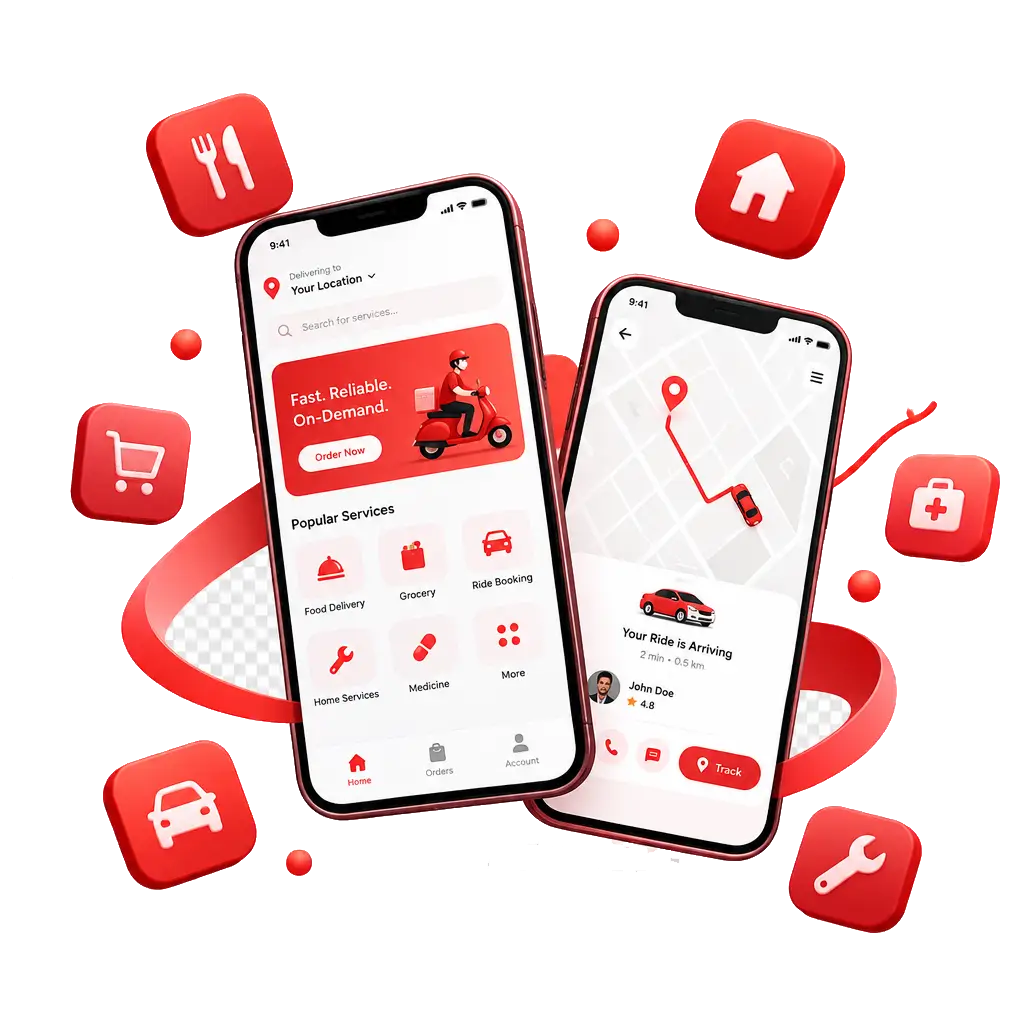
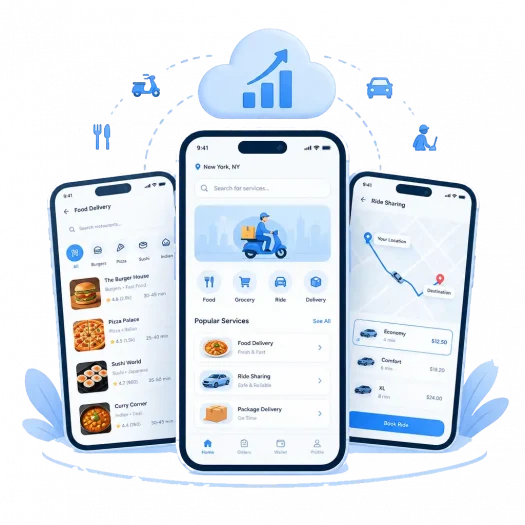
Build a scalable platform with our on-demand app development services for food delivery, grocery, transportation, healthcare, home services, logistics, beauty, and marketplaces. Hyperlocal Cloud offers custom and white-label solutions with customer, provider, and admin apps, featuring payments, GPS tracking, bookings, notifications, ratings, and analytics.
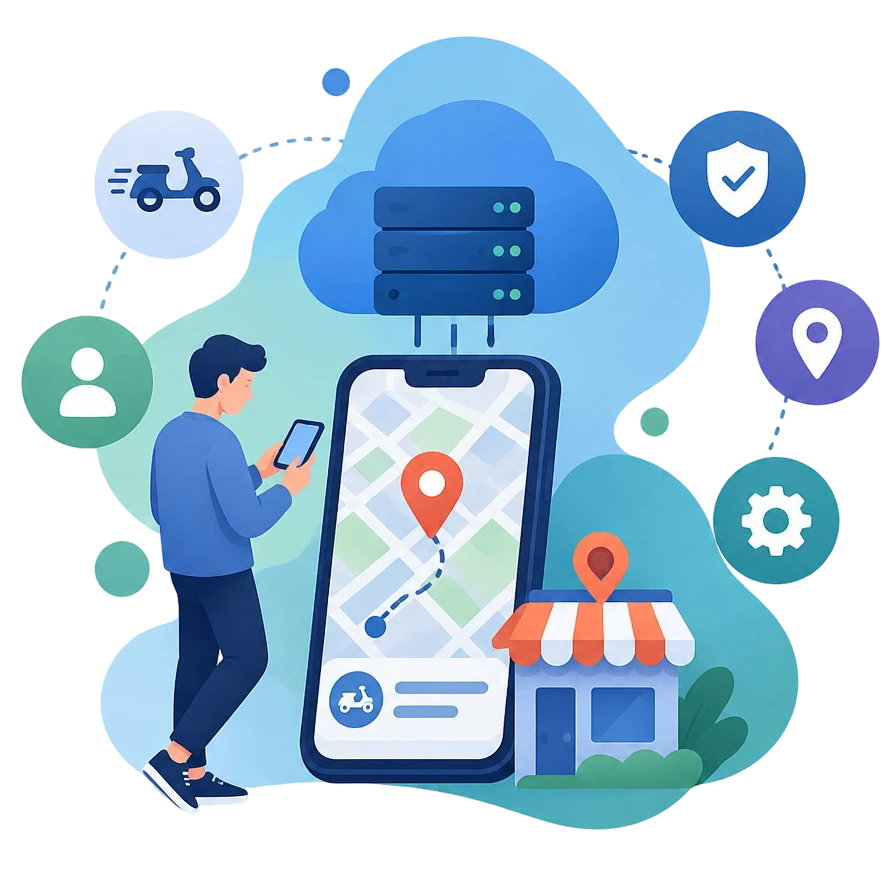
An on-demand application can bring customers, service providers, and administrators together through one connected digital ecosystem. Instead of managing bookings, payments, communication, and service delivery through multiple channels, businesses can centralize these activities within a single platform.
At Hyperlocal Cloud, we build on-demand applications around your target audience, operational workflow, service categories, and revenue model. The platform can be designed to support multiple locations, service providers, pricing structures, payment methods, and business rules as your operations grow.
Hyperlocal Cloud provides on-demand app development solutions for different industries and service models.
Create a platform that connects customers with restaurants, cloud kitchens, and delivery partners. Features can include restaurant discovery, menus, cart management, order tracking, online payments, delivery assignment, ratings, and promotional offers.
Launch a grocery platform where customers can browse products, place orders, select delivery slots, make payments, and track deliveries. Store owners and delivery partners can manage orders through dedicated interfaces.
Build a ride-booking platform that connects passengers with drivers. The solution can support ride requests, driver matching, GPS tracking, fare calculation, online payments, trip history, ratings, and driver earnings.
Connect customers with professionals offering cleaning, plumbing, electrical, repair, maintenance, and other household services. Customers can browse providers, schedule appointments, make payments, and rate completed services.
Develop a healthcare platform that connects users with doctors, clinics, pharmacies, healthcare professionals, and other service providers. Depending on the business model, the application can support appointments, consultations, prescriptions, payments, and notifications.
Create a platform for local deliveries, parcel transportation, courier services, and logistics operations. Businesses can manage delivery requests, assign drivers, track packages, and monitor delivery status.
Build a booking marketplace connecting customers with salons, hairstylists, beauticians, spas, and independent professionals. Users can browse services, check availability, schedule appointments, and make payments.
Develop a laundry and dry-cleaning platform that supports pickup scheduling, service selection, order tracking, payments, delivery management, and customer notifications.
Connect pet owners with groomers, walkers, sitters, trainers, veterinarians, and other pet-care professionals through a centralized platform.
Develop a car rental platform where customers can discover vehicles, compare options, make reservations, complete payments, and manage their bookings digitally.
Build a marketplace that connects multiple service providers or sellers with customers. The platform can support provider profiles, listings, bookings, payments, reviews, commissions, and administrative controls.
Combine multiple service categories into one application. This model is suitable for businesses looking to create a broader local-services ecosystem with transportation, delivery, shopping, home services, and other offerings.
AI can make an on-demand platform more personalized, automated, and data-driven. Depending on your business model, AI capabilities can be integrated into customer-facing and administrative workflows.
Analyze customer activity and preferences to provide relevant services, products, providers, or offers.
Use AI-powered search to help users find relevant services even when they use different words or natural-language queries.
Provide automated assistance for common questions, booking-related queries, order information, and basic customer support.
Analyze historical and real-time data to help businesses understand demand patterns and plan resources accordingly.
Intelligently match customers with suitable drivers, providers, or service professionals based on location, availability, service type, and other business rules.
Pricing systems can be designed to respond to demand, location, availability, service type, time, and other configurable factors.
Location intelligence and optimization algorithms can help improve routes for delivery and transportation operations.
AI-assisted systems can help identify unusual transaction patterns, suspicious activities, or potentially risky behavior for further review.
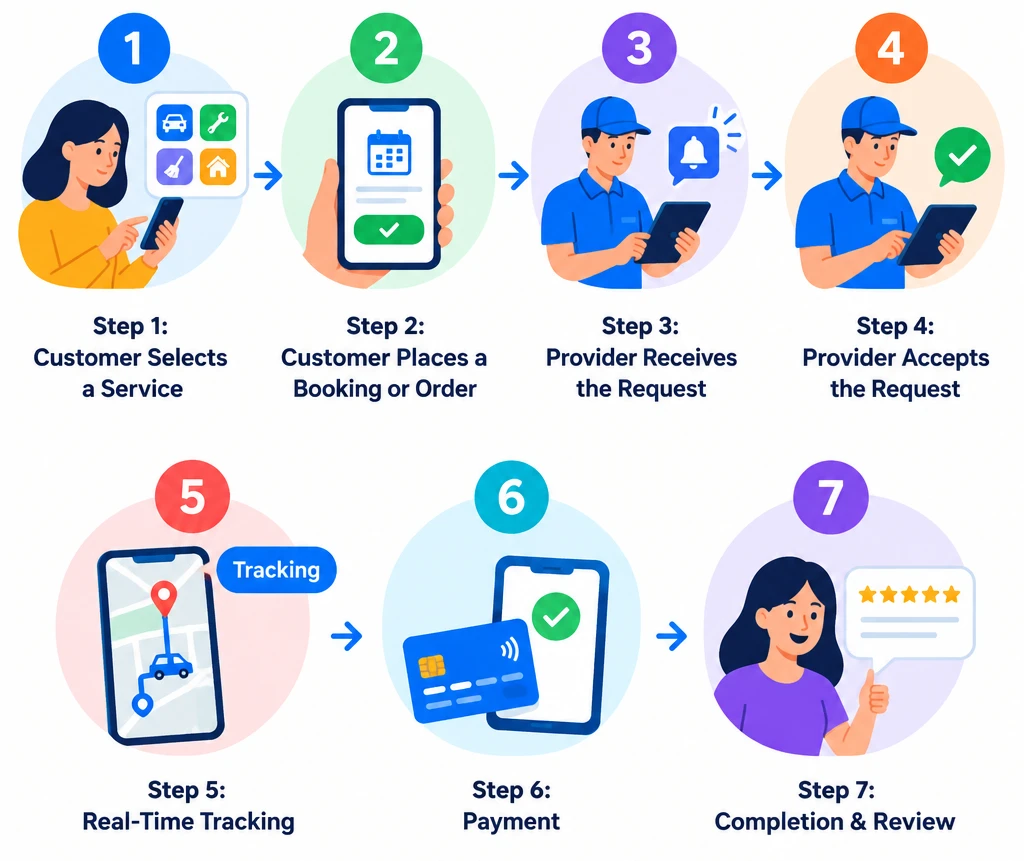
An on-demand application connects customers with businesses or service providers through a centralized platform.

The customer opens the application, selects a service, searches for a provider or product, and reviews the available options.

The customer selects the required service, provides relevant information, chooses a schedule if applicable, and confirms the request.
The request is sent to an eligible service provider, driver, restaurant, store, or professional based on the platform's business rules.

The provider accepts the booking and begins the service or order fulfillment process.

Where applicable, customers can monitor the status and location of their booking, delivery, or ride.
The customer completes payment through the available payment methods. The platform can calculate commissions, fees, taxes, and provider earnings according to the configured business model.

After the service or delivery is completed, customers can provide ratings and reviews. The information can then be used to monitor service quality and provider performance.
Your application can support different revenue strategies depending on the type of service and target market.
The platform charges a percentage of each completed transaction or booking.
Customers, providers, or businesses pay recurring fees to access premium features or platform benefits.
A fixed or variable fee can be added to bookings or transactions.
Delivery fees can be calculated based on distance, location, order value, service type, or other business rules.
Service providers can pay to promote their profiles, products, services, or listings within the platform.
Offer customers or providers additional benefits through paid membership plans.
Our development process is structured to move an idea from initial planning to deployment and ongoing support.
We analyze your business model, target audience, competitors, service categories, operational requirements, and revenue strategy.
The required features, user roles, integrations, platforms, workflows, and technical requirements are documented.
We design intuitive user journeys and interfaces for customers, providers, drivers, and administrators.
A clickable prototype can be created to demonstrate key workflows and user interactions before full development.
The mobile applications, backend systems, APIs, and administrative interfaces are developed according to the approved specifications.
Required payment gateways, maps, notifications, authentication services, analytics tools, and other integrations are connected.
The application is tested for functionality, usability, compatibility, performance, security, and other quality requirements.
After testing and approval, the application is prepared for deployment to the required platforms and production infrastructure.
Post-launch support can include bug fixes, technical assistance, performance improvements, updates, and additional feature development.
The on-demand app development cost depends on the application type, number of platforms, features, integrations, design complexity, backend architecture, and customization requirements.
For businesses looking for a faster launch, a white-label solution can provide a ready-made foundation. Businesses with unique workflows or advanced requirements may choose custom development.
A white-label solution provides a ready-made application foundation that can be customized with your brand, services, pricing, and business requirements.
Custom development is suitable for businesses that require unique features, workflows, integrations, user experiences, and backend functionality.
Choosing the right technology partner can affect your application's scalability, usability, development timeline, and long-term maintenance.Hyperlocal Cloud provides solutions designed around different on-demand business models, from individual service applications to multi-service platforms.

Work with a development team experienced in building mobile applications, web platforms, APIs, dashboards, and marketplace ecosystems.

Choose between a customizable ready-made solution and a fully tailored application based on your business requirements.

Build your platform with an architecture designed to support additional users, providers, services, locations, and transactions as your business grows.

Develop applications and supporting systems for the platforms required by your target customers and service providers.

Connect your platform with payment gateways, maps, notifications, authentication services, analytics, and other external systems.

Continue improving your platform after launch with technical support, maintenance, updates, optimization, and additional functionality.

Configure the platform around commission, subscription, booking fees, delivery charges, premium listings, or other monetization strategies.
Hyperlocal Cloud is a tech leader harnessing the power of state-of-the-art technologies and delivering innovative app solutions to businesses.