Get 30% OFF on All Development Services – Limited Time!
Starting a vacation rental business doesn't have to mean spending months developing the platform from scratch. Our white-label Airbnb clone gives you a practical starting point for taking your vacation rental idea to market under your own brand. You decide how the marketplace should look, who it should serve, and how you want to run the business, without having to start the entire product from scratch.
Our Airbnb Clone App Development expertise helps businesses launch vacation rental platforms with a proven product foundation and a clear focus on their market. With experience across diverse app development projects, we bring the technical capabilities to customize the solution to your brand, business model, and product requirements.
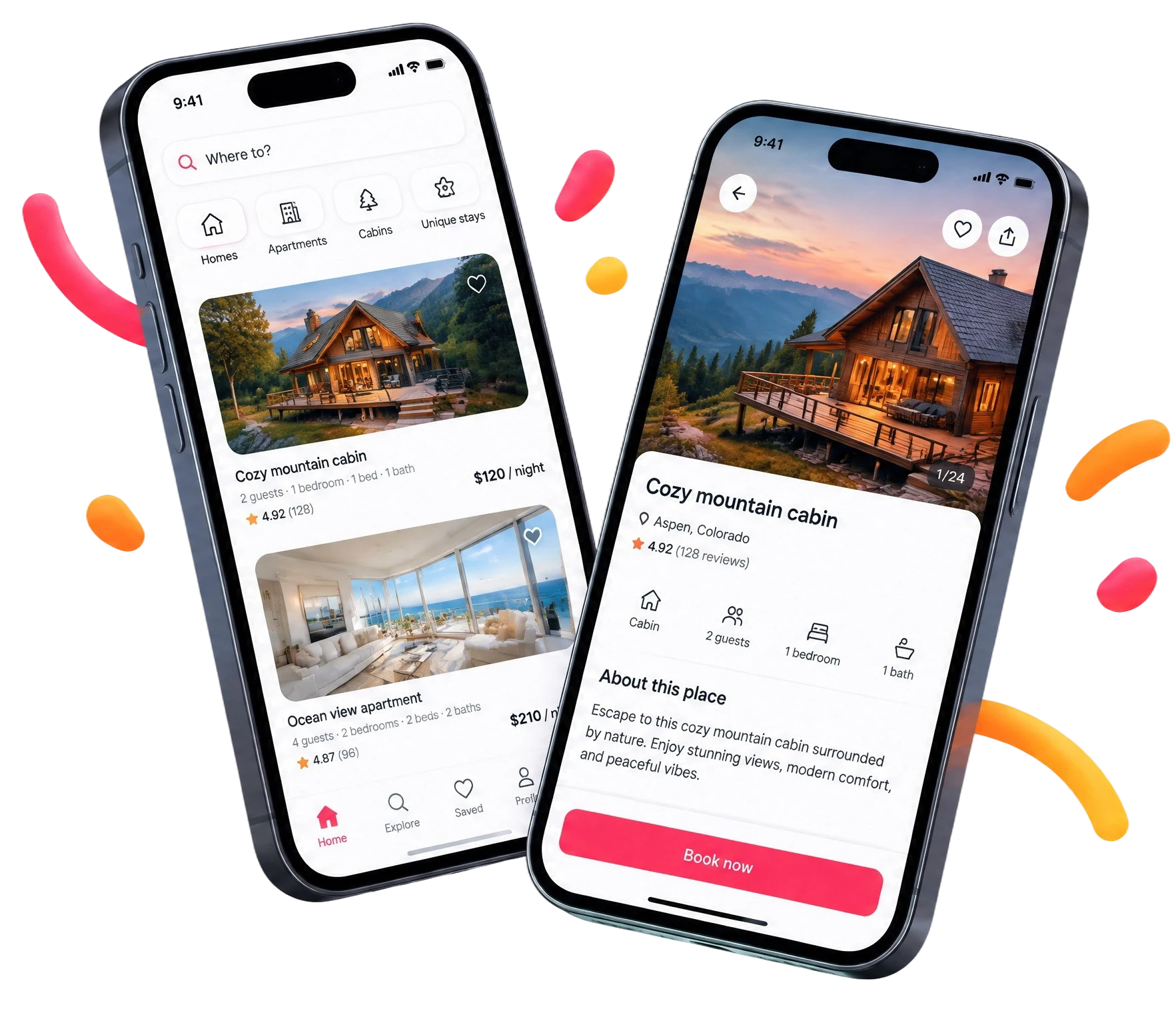
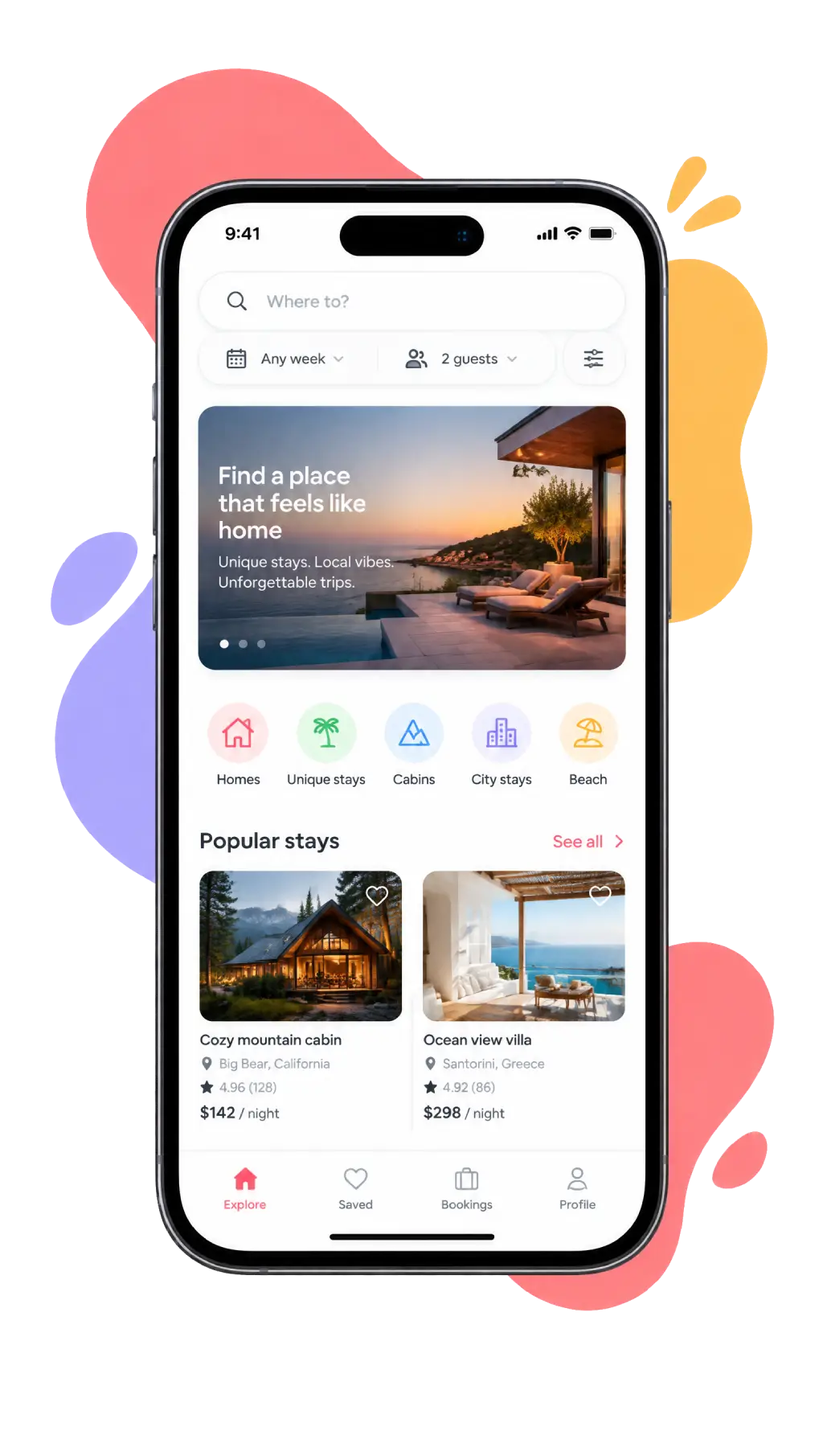
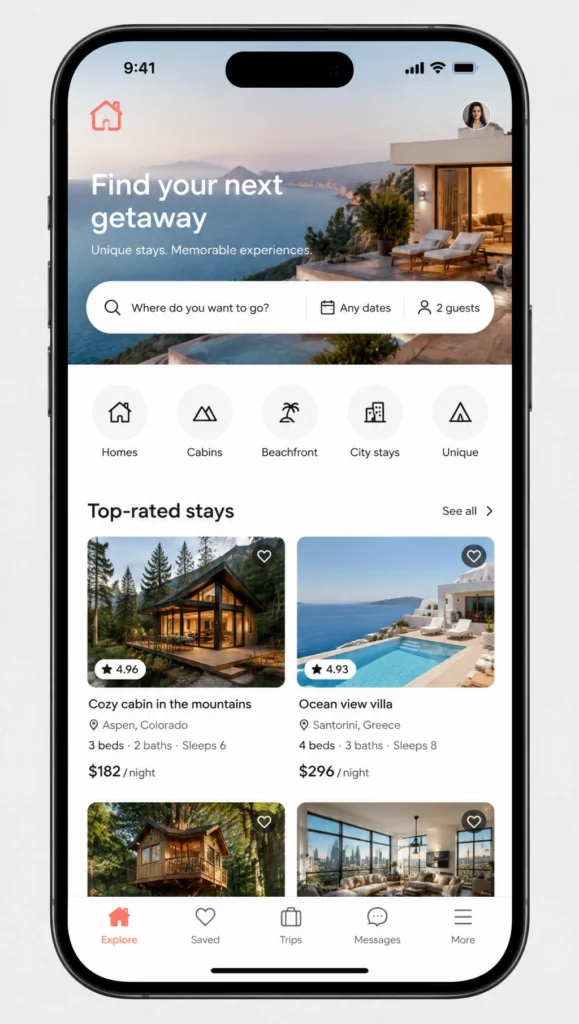
An Airbnb clone app gives you a ready-made foundation for running a vacation rental marketplace. Property owners list houses, villas, rooms, or vacation homes, while guests browse available stays, compare options, and make bookings through a web or mobile platform.
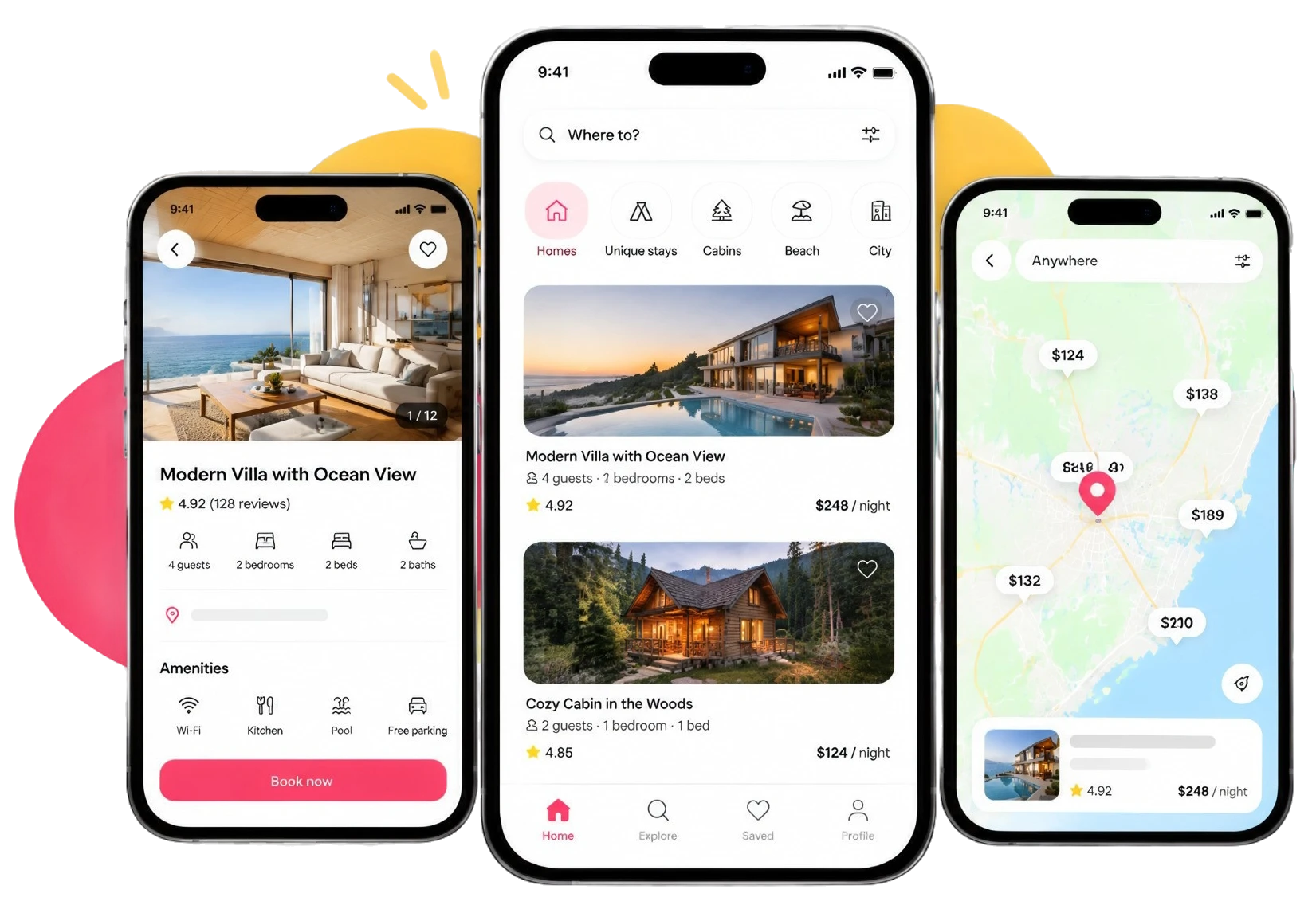
With our Airbnb Clone App Development solution, the core marketplace is already in place, covering registration, property search, payments, reservations, reviews, ratings, and admin management. Your brand stays at the center. Customize the design, features, workflows, and business model to create a rental platform that fits your market.
An Airbnb-like marketplace connects two primary sides of the platform: hosts who offer properties and guests looking for places to stay. The booking journey moves through several connected stages, from account creation and listing management to property discovery, reservation, and payment.

Guests and hosts create accounts based on their role within the marketplace. Registration establishes the profile and permissions required to search for stays, publish properties, manage bookings, or access other platform functions.

Hosts and guests complete their profiles with relevant personal or business information. Profile details help establish identity within the marketplace and give other users useful context before a booking or conversation.

Hosts add property details, photographs, pricing, availability, amenities, house rules, and other relevant information. Listing controls also let them update the property as availability or pricing changes.

Guests enter a destination, travel dates, budget, and other preferences to find suitable stays. Search filters narrow the results, while listing pages provide the information needed to compare available properties.

After selecting a property, guests submit a reservation request or use instant booking when enabled. The platform updates availability and records the booking details for both sides of the transaction.
The platform processes the applicable booking amount through an integrated payment gateway. Payment records, commissions, service fees, and other transaction details remain available through the relevant user or admin interface.

Users can sign in quickly with easy login strategies. The method is clean and requires minimal steps.

Guests can filter homes by price, date, and services. This helps them find the perfect suite without wasting time.

Users can check property availability right away when choosing dates. This reduces booking conflicts and confusion.

The app supports multiple payment methods. All transactions are encrypted for safety and reliability.
Users can easily view, alter, or cancel bookings. All booking details are stored in one convenient place.

Guests can save their preferred properties for future trips. This makes repeat bookings easy and quicker.

Users can chat with hosts without delay before confirming a reservation. This improves verbal exchange and readability.

Guests can leave remarks primarily based on their stay. Reviews help different customers make informed choices.

Users get real-time notifications for bookings and messages. This keeps them updated at every step.

Hosts can update their profiles and contact information anytime. A complete profile increases visibility.

Hosts can easily create, edit, or pause property listings. They have full control over pricing and asset details.

Hosts can easily manage available and blocked dates. This prevents double bookings and scheduling problems.

Hosts can quickly accept or decline reservation requests. This gives them full control over reservations.

Hosts can record their sales and completed bookings. Clear reports help them show increases.

Hosts can alter costs based on demand and season. This helps maximize income and occupancy rates.

Hosts can chat with guests without delay via the app. Quick responses boost booking probabilities.

Hosts can view and reply to guest feedback. This facilitates a strong online reputation.

Hosts receive immediate notifications for brand-new requests or cancellations. This ensures they never miss a crucial update.

Admins get an entire evaluation of users, bookings, and income. This helps in making informed business decisions.

Admins can efficiently manage visitor and host accounts. They can verify, suspend, or delete accounts as needed.

Admins evaluate and approve belongings listings before publishing. This guarantees a satisfactory experience and protects the platform.

Admins can set and manage commission options. This controls average platform sales.

Admins can view all transactions in real time. This ensures transparency and easy financial operations.

Admins can access unique performance and revenue reports. These insights help improve business practices.

Admins can display user opinions and manage disputes. This maintains service requirements and trust.

Admins can replace website content, banners, and pages. This keeps the platform clean and engaging.

Admins can send promotional messages and important updates. This improves user engagement and retention.
AI capabilities add practical personalization and automation to Airbnb Clone App Development. They can improve property discovery, pricing, guest support, fraud monitoring, and other marketplace workflows based on the data and business requirements available.
Recommendation models analyze search activity, saved properties, previous interactions, and preferences to surface relevant stays.
AI-based pricing models use factors such as demand, seasonality, location, and booking patterns to help hosts adjust property rates.
Search results can be prioritized according to a guest's preferences and previous activity instead of relying solely on generic relevance.
An AI assistant handles common questions about properties, bookings, policies, and platform usage, while more complex requests remain available for human support.
AI models can flag unusual booking patterns, suspicious account activity, or other signals that warrant additional review.
Image recognition tools can assess uploaded property images for quality, duplicates, or other predefined listing requirements.
Voice-enabled search lets guests submit property queries with spoken requests instead of typing every search parameter.
Sentiment analysis helps administrators and hosts identify recurring themes in guest feedback and spot issues that may require attention.
AI-based forecasting can analyze booking patterns and help hosts identify periods of higher or lower demand when planning availability and pricing.
The same marketplace foundation can support several rental and booking models. Instead of limiting the product to traditional vacation homes, businesses can adapt the platform around different property types and booking requirements.

List apartments, villas, holiday homes, cabins, and other short-term accommodation for travelers looking for temporary stays. This model works well for businesses that want to build a vacation rental website or app around a specific property category or target market.

Hotels and hospitality businesses can publish rooms, manage availability, and accept online reservations through a centralized booking platform.

Create a platform for apartments, houses, and other properties available for longer stays, with workflows suited to landlords and tenants.

Businesses can list shared offices, meeting rooms, and workspaces for daily, weekly, or monthly bookings.

Venue owners can publish halls, studios, outdoor spaces, and other event locations with availability, pricing, and booking details.

Combine rental bookings with property management functionality, allowing owners and managers to handle reservations, calendars, pricing, guests, maintenance requests, and earnings from one dashboard.

Boat operators can list vessels with availability, pricing, specifications, and booking options for different trip types.
A successful Airbnb clone app development project needs a defined process from the initial business requirements through deployment. Each stage addresses a specific part of the product, ensuring the final marketplace stays aligned with its target users and operating model.
We examine the target audience, rental category, competitors, and market requirements to establish a clear direction for the platform.
The revenue structure comes next. We map commission, subscriptions, booking fees, featured listings, or a combination of models to the marketplace requirements.

We define the functionality required for guests, hosts, and administrators, separating essential launch features from later additions.

The interface is structured around the booking journey, property discovery, listing management, and administrative workflows. Design decisions are aligned with the selected brand and target market.

The technology stack is selected based on required platforms, integrations, expected usage, and long-term product requirements.

Guest, host, and admin interfaces are developed according to their respective workflows, permissions, and responsibilities.

Required payment gateways, maps, notifications, communication services, analytics tools, and other third-party services are integrated according to the project scope.

Functional, performance, security, compatibility, and usability testing help identify issues before the application reaches production.

After final testing and approval, the application is prepared for deployment across the selected platforms and made ready for marketplace operations.
A vacation rental company wanted to create a marketplace where independent hosts could list properties and travelers could find and book short-term stays. The business needed a platform that worked under its own brand while giving guests and hosts a clear, reliable booking experience.
We started with a white-label Airbnb clone and tailored it to the company’s target market, business model, and brand. As an Airbnb Clone development company, we adapted the platform to match the business identity and configured the workflows for property listings, availability, bookings, payments, host management, guest communication, and administration.
The white-label Airbnb clone gave the company its own branded vacation rental marketplace without having to develop the entire platform from scratch. It also provided a foundation for adding new rental categories and expanding into additional markets as the business grew.
increase in completed property searches
growth in host registrations
increase in booking inquiries
improvement in repeat platform visits
The technology stack for Airbnb Clone app development depends on the selected platforms, features, integrations, and expected usage. Our existing stack includes the technologies required for web, mobile, backend, database, cloud, payments, maps, and real-time communication.
React.js and Next.js for web interfaces, property discovery, dashboards, and marketplace pages.
React Native for iOS and Android applications.

Node.js for marketplace logic, user management, bookings, listings, payments, and APIs.
PostgreSQL and MongoDB for user, property, booking, and transaction data.
AWS, Docker, and Kubernetes for hosting, deployment, and infrastructure management.
Stripe for online payment processing and booking-related transactions.

Google Maps for location-based search, property discovery, and map functionality.
Socket.io for messaging, notifications, and other real-time interactions.

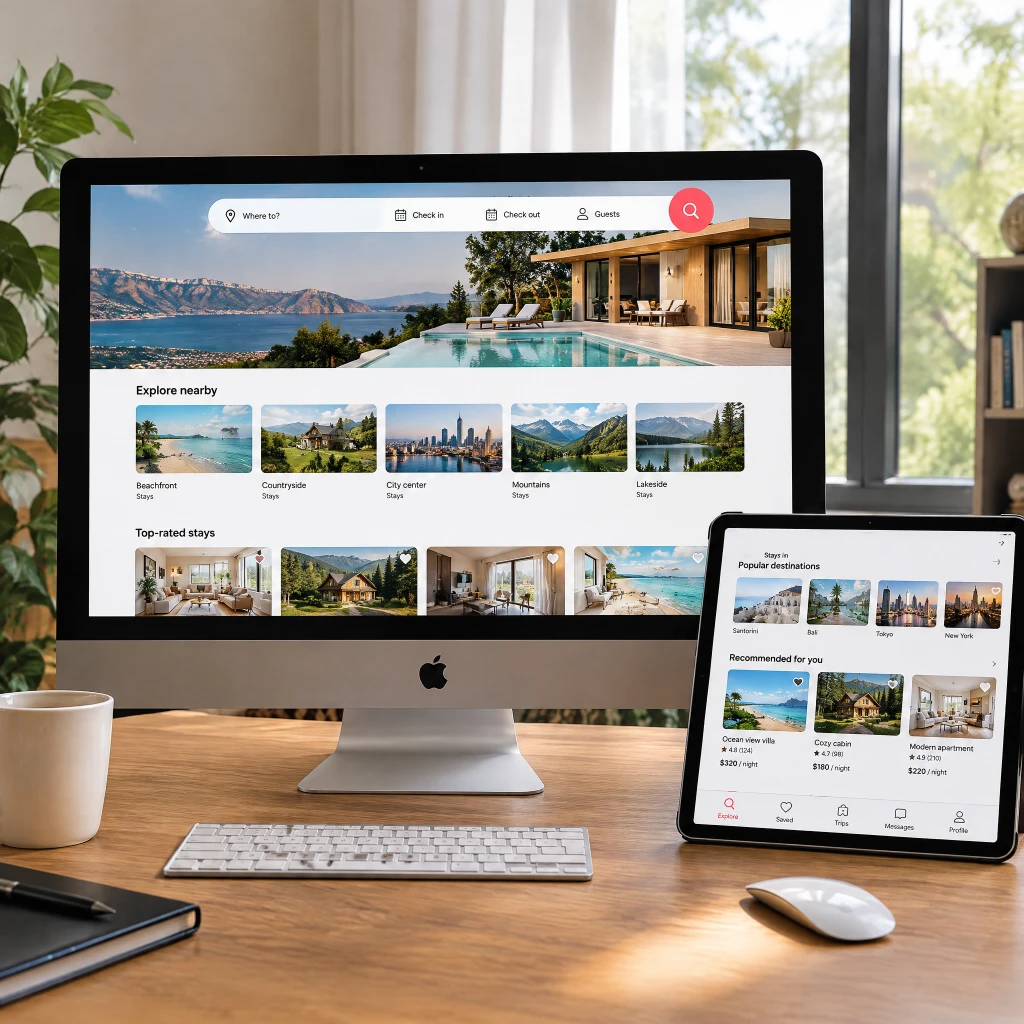
A vacation rental marketplace needs to reach guests and hosts across the devices they already use. Our Airbnb clone development solution supports mobile and web platforms, allowing the marketplace to operate across multiple touchpoints.
The Android application gives guests and hosts access to property discovery, listings, bookings, messaging, notifications, and account management on Android devices.
The iOS application supports the same core marketplace workflows across iPhone and iPad, with interfaces designed around property discovery, reservations, communication, and host management.
A web-based platform gives guests, hosts, and administrators access through a browser. It also gives the business a public-facing channel for property discovery, account management, bookings, and marketplace administration, similar to the approach used when you build a website like Airbnb.
A vacation rental marketplace can combine several revenue models depending on its audience, property category, and business strategy. The most relevant options include:
Charge hosts, guests, or both sides a percentage or fixed fee for completed reservations.

Offer paid plans with additional listing capacity, analytics, promotional tools, or other host-focused features.
Hosts pay to give selected properties additional visibility across search results or promotional areas.
Apply a service fee to eligible reservations made through the platform.
Generate advertising revenue from travel businesses, local services, insurance providers, transportation companies, or other relevant partners.
Apply predefined fees when bookings are canceled under conditions covered by the platform's cancellation policy.
Offer additional services such as cleaning, airport transfers, local experiences, luggage services, or guided activities.
Earn referral commissions from travel, insurance, transportation, experience, or other complementary services.
Choosing an Airbnb Clone development company involves more than selecting a ready-made product. The development partner also needs to understand how the marketplace will operate, how your business model works, and which parts of the solution require customization.
Our approach is built around marketplace workflows involving guests, hosts, properties, bookings, and administrators. This helps keep the product structure aligned with the operational needs of a rental platform.
Your revenue model may rely on commissions, subscriptions, booking fees, featured listings, or a combination of these. The platform is adapted around the commercial model you choose.
A vacation rental platform for one region may have different requirements from a global marketplace. We customize workflows, property categories, user roles, and business rules around your target market.
Designers, developers, and technical specialists work across the different components of the application, keeping product decisions connected throughout development.
Defined requirements, deliverables, reviews, and development milestones provide visibility throughout the project and make it easier to manage changes as the product takes shape.
Your brand, business model, customized workflows, and product direction remain central to the solution, giving you control over how the marketplace evolves.
The cost of Airbnb Clone App Development depends on the development approach and the level of customization required. Factors such as UI/UX design, user panels, booking workflows, payment gateways, maps, third-party integrations, AI features, and custom functionality all affect the final budget. A ready-made solution uses an existing marketplace foundation, while custom development builds the product architecture from the ground up.
| Development Approach | Estimated Cost | Typical Timeline |
|---|---|---|
| White-Label Airbnb Clone | $5,000–$15,000 | 4–8 weeks |
| Customized Ready-Made Solution | $15,000–$40,000+ | Depends on scope |
| Custom Vacation Rental App | $40,000–$150,000+ | 3–12+ months |
Custom screens, branded interfaces, and tailored user journeys require additional design and development work.
Guest, host, property manager, and admin panels add different workflows, permissions, and interfaces to the platform.
Booking rules, availability, payments, refunds, cancellations, and commissions all affect the development scope.
Maps, payment gateways, communication tools, analytics, and other APIs add integration and testing requirements.
Features such as smart recommendations, dynamic pricing, AI search, and fraud detection increase development complexity.
Custom dashboards, pricing rules, notifications, or marketplace workflows require additional development beyond the standard solution.
Take a percentage from each completed reservation made through the platform. This model directly ties your revenue to booking activity, making it a natural fit for a vacation rental marketplace.
Offer paid plans to hosts who want additional tools, higher visibility, or access to advanced marketplace features. Different tiers let you serve both individual property owners and professional property managers.
Let hosts promote their properties in prominent positions across search results or category pages. Hosts pay for increased visibility, while guests get faster access to promoted properties.
Add a service fee to guest reservations. A small fee on each booking creates another recurring revenue stream without changing the core booking experience.
Sell advertising space to travel brands, local businesses, property services, and tourism companies. Sponsored placements and promotional campaigns create opportunities for additional income within the platform.
Apply cancellation charges based on the booking terms and cancellation policy. A defined fee structure helps protect hosts from certain booking losses while creating an additional revenue source for the platform.
Let guests purchase additional services such as airport transfers, guided tours, cleaning, luggage assistance, or local experiences. The platform earns through commissions or service charges on each purchase.
Partner with travel companies, insurance providers, transportation services, and local attractions. You earn a commission when users purchase a partner service through your Airbnb like app.
Create paid promotional or rewards programs for selected brands and service providers. Partners gain access to an engaged audience, while your platform earns through participation fees or referral arrangements.
An Airbnb clone starts with an established vacation rental marketplace foundation, while custom development begins with the product architecture itself. The choice depends on how much of the existing foundation fits your requirements and how much control you need over the product from the beginning.
| Factor | Airbnb Clone | Custom Vacation Rental App |
|---|---|---|
| Starting Point | Established marketplace framework | New product architecture |
| Customization | Extensive room for modifications | Complete control over product decisions |
| Development Cycle | Shorter implementation | Longer development cycle |
| Initial Investment | Lower upfront development effort | Higher upfront development effort |
| Brand Experience | Adapted to your brand identity | Created specifically for your product |
| Core Functionality | Existing rental marketplace functionality | Developed according to requirements |
| Future Expansion | Extensions built around the existing architecture | Expansion planned around the custom architecture |
Hyperlocal Cloud is a tech leader harnessing the power of state-of-the-art technologies and delivering innovative app solutions to businesses.