Get 30% OFF on All Development Services – Limited Time!
Start your ecommerce business with a ready-made app that adapts to the brand and requirements. Hyperlocal Cloud offers a white label ecommerce app solution with customizable features, multi-vendor capabilities, payment integrations, and dedicated dashboards for customers, sellers, and admins.
Launch fully branded, e-commerce marketplaces tailored to the business model. As your technology partner, we handle custom rebranding, system integrations, app store deployment, and ongoing engineering updates to help you scale effortlessly.
A white-label ecommerce app is a ready-built ecommerce solution developed by one company and rebranded by another business as its own. Instead of developing the entire marketplace from scratch, businesses start with an existing ecommerce application, customize its branding and functionality, and launch it under their own name.
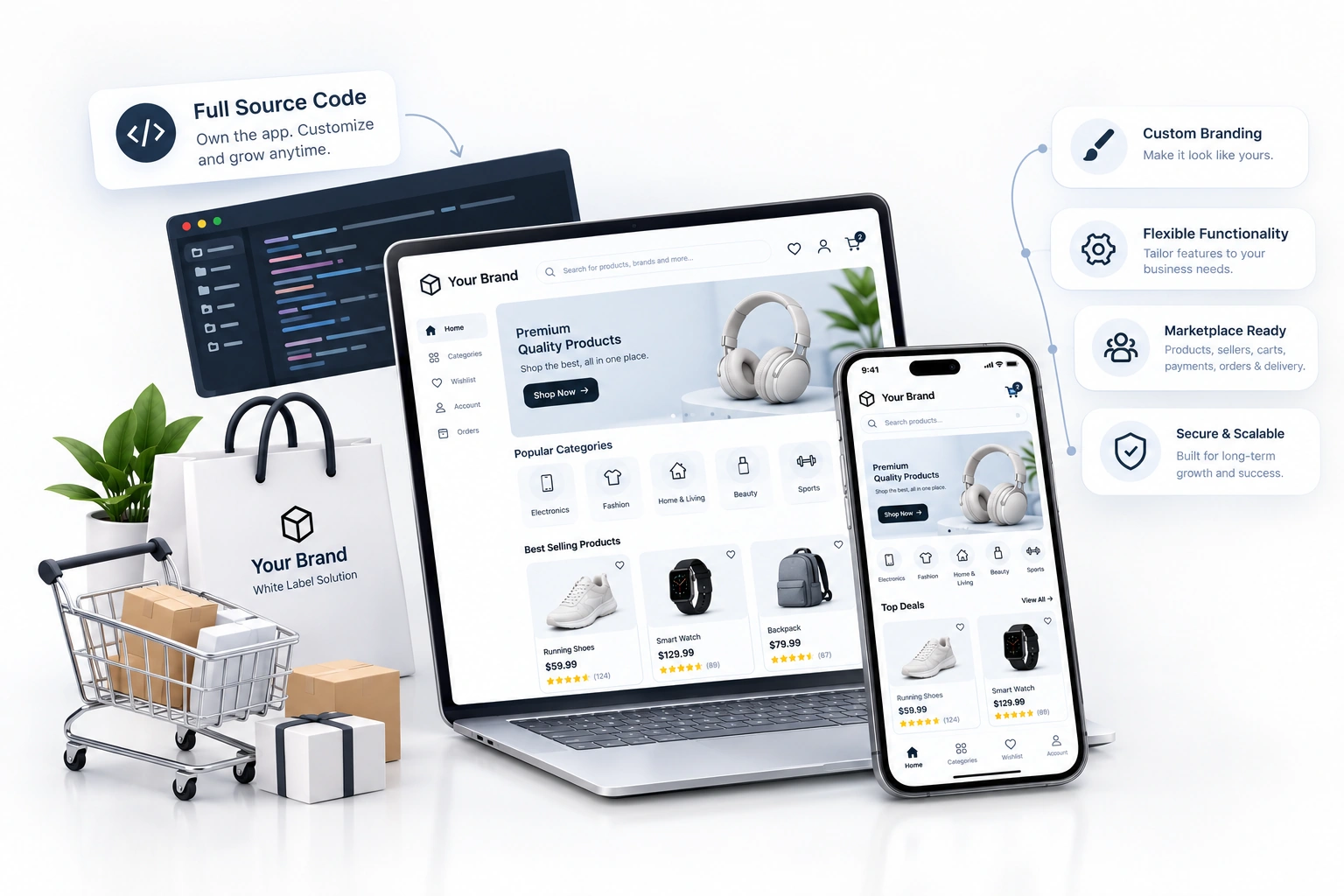
Hyperlocal Cloud provides the full source code, so you own the app and can keep modifying your marketplace as needs change. Our White Label app supports all core eCommerce marketplace functionalities, including products, customer accounts, seller management, carts, payments, orders, and delivery. Now you can build a marketplace that fits your business model, products, and requirements.
White-label apps are quickly becoming popular with companies that want to bypass the software development phase and concentrate on what matters: launching their brand and starting to sell. The main business advantages include:

Get your storefront live in weeks instead of waiting months for custom coding.

Avoid massive, unpredictable app development costs by paying for a proven software foundation.

Use stable infrastructure built to handle spikes in traffic and order volumes from day one.

Keep the platform secure and up to date with new features without paying for expensive maintenance contracts.
We build white-label ecommerce apps that adapt to different products, customers, and business models. Our ecommerce app development services specialize in tweaking the ecommerce platform to suit your target market. Here are some markets we've served.

Manage grocery listings, multiple sellers, orders, payment processing, and local delivery all under a single grocery marketplace.

Create a marketplace to sell clothes, shoes, accessories, and other lifestyle items.
Enable product listings, bidding, seller management, payment collection, and order processing.

Connect electronics sellers and buyers with product catalogues, inventory management, order processing, and payments.

Design and launch a marketplace dedicated to beauty and skincare. Sell cosmetics, haircare products, and personal care items.

Build a furniture marketplace that allows vendors to sell furniture to customers. Manage furniture variations, orders, payments, and delivery.

Start a digital product marketplace to sell your software, courses, templates, subscriptions, or any other digital goods.

Set up a marketplace for sports equipment. You can also sell fitness-related products, sports clothing and more accessories.

Our white label ecommerce app includes powerful, scalable features that simplify online selling, enhance customer experiences, streamline operations, and help businesses launch and grow their digital storefronts faster.
Manage product catalogs, categories, attributes, variants, pricing, images, and seller listings from one place.

Support credit cards, debit cards, digital wallets, cash on delivery, and other payment methods through payment gateway integrations.

Provide localized product listings, categories, checkout, and storefront content across multiple languages.

Configure tax-inclusive or tax-exclusive pricing, regional tax rules, and third-party tax services for automated tax calculation.

Recover incomplete purchases with automated reminders, targeted offers, and discount incentives.

Track sales, revenue, orders, customers, traffic, and seller performance through detailed ecommerce reports.

Manage shipping providers, live shipping rates, shipping labels, order tracking, and flexible delivery rules.

Generate revenue through seller commissions, subscriptions, featured listings, promotional placements, and advertising.

Manage seller onboarding, product approvals, commissions, payouts, listings, and marketplace activity from the admin panel.

Keep checkout short and organized with delivery details, payment selection, order review, and confirmation in a single flow.

Create coupon codes, promotional offers, loyalty rewards, and customer incentives to support repeat purchases and campaign-based sales.

Collect product ratings and written reviews from customers. Review data helps shoppers evaluate products and gives businesses useful feedback.

Let customers save products for future purchases and keep selected items accessible in their account.

Give customers flexible payment options by allowing eligible purchases to be split into scheduled installments at checkout.

Let customers quickly reorder previously purchased products from their order history without searching for the items again.

Track stock quantities, product availability, variants, and inventory changes. Sellers get better control over stock levels across their product catalog.
Manage the order lifecycle from confirmation and processing to shipping, delivery, cancellation, and returns through a structured workflow.

Give sellers promotional space within the marketplace through banner placements, featured products, and targeted campaigns that increase product visibility.

Restrict selected products to specific customers, account groups, or business buyers. This supports exclusive catalogs, negotiated products, and private offers.

Manage product details, images, pricing, variants, attributes, categories, and availability directly from the seller dashboard.

Access sales, order, revenue, and product-performance data to identify high-performing products, track store activity, and make informed sales decisions.

Our pre-built ecommerce app provides a flexible foundation for integrating AI into the marketplace without rebuilding its core infrastructure. AI capabilities fit around the business model, customer experience, and operational requirements as the platform evolves.
Recommend products based on browsing behavior, purchase history, cart activity, and individual preferences to create more relevant shopping experiences.
Help shoppers find suitable products, compare options, answer questions, and get guidance through conversational interactions.
Identify unusual transactions, suspicious buying patterns, and potentially fraudulent activity before it creates financial or operational risk.
Let customers search for products and place orders using voice commands for a hands-free shopping experience.
Automate routine purchases by allowing AI agents to find products, apply discounts, manage payments, and complete repeat orders with minimal user input.
Give shoppers a digital preview of products on themselves or within their surroundings before making a purchase, particularly for fashion, beauty, furniture, and lifestyle products.
Let shoppers upload or capture an image to find matching or visually similar products across the marketplace catalog.
Adjust product pricing based on factors such as demand, inventory, market conditions, and competitive pricing to support smarter pricing decisions.

Forecast product demand and identify potential stock shortages or excess inventory, helping businesses maintain healthier stock levels.
Customization Area | What Can Be Customized |
Branding | Logo, colors, typography, icons, splash screens, and other brand elements. |
UI & UX | Navigation, screen layouts, product pages, menus, search experience, and checkout flow. |
Product Catalog | Categories, attributes, variants, filters, pricing rules, and listing formats. |
Seller Operations | Seller registration, approval processes, commissions, payouts, product approvals, and account controls. |
Orders & Fulfillment | Order statuses, processing rules, cancellations, returns, shipping, and delivery workflows. |
Payments & Checkout | Payment methods, taxes, discounts, shipping charges, checkout steps, and transaction rules. |
Integrations | Payment gateways, shipping providers, CRM, ERP, analytics, tax systems, and other third-party services. |
Admin Controls | Roles, permissions, reports, notifications, moderation controls, and marketplace settings. |
Based on how the platform functions, several monetization models can work well for different ecommerce businesses. For instance, income may come from product sales, seller partnerships, transaction processing, or promotional services. Each model works differently depending on the platform's structure and revenue strategy.
Charges a certain percentage or fixed amount on every successful order processed through the marketplace.
Paid plans for access to more selling tools, increased product limits, advanced analytics, or promotional features.

You charge sellers a fee for publishing their products on your marketplace. Different pricing may apply depending on the product category and/or length of time listed.

Enable sellers to pay for improved product position in our search results/category pages, etc.

Generate income by offering banner placements, sponsored products, and other advertising opportunities for sellers and brands.

Generate additional revenue from paid services such as advanced seller tools, enhanced storefronts, analytics, promotional support, etc., or prioritization of certain services.
Explore popular prebuilt e-commerce apps based on established marketplace and retail models. Each clone is designed around a specific ecommerce concept and can be customized to match the business requirements.
A marketplace model that combines online shopping with rewards and promotional offers, giving businesses scope for product sales, seller listings, loyalty programs, and partner-based promotions.
The cost of a white label ecommerce app depends on the project scope, including branding, integrations, additional functionality, and launch requirements. The package includes the core application along with the required work to prepare it for deployment.
White Label Ecommerce App
$8,000
2–4 weeks
The white label ecommerce app solution follows a structured development process covering app setup, branding, integrations, testing, and deployment. For businesses asking how to develop a white label ecommerce app, the process starts with defining the requirements and ends with a launch-ready application.
The process starts with understanding the business model, target market, branding requirements, integrations, and any specific changes needed for the application. This defines the project scope before development begins.
We select a suitable white-label ecommerce app based on your business requirements. The scope for branding, functionality, integrations, and other required changes is then finalized.
The application is adapted to the brand with the required logo, colors, typography, layouts, and interface elements. Any agreed UI changes are completed at this stage.
Configure required ecommerce features according to the agreed scope. Connect payment gateways, shipping services, analytics tools, and other third-party integrations as required.
The application goes through functional testing before deployment. Core features, user flows, integrations, and performance are checked to identify and resolve issues.
The final application is prepared for deployment, including the required app-store processes. Once the final checks are completed, the ecommerce app is released for launch.
As an ecommerce app development company, Hyperlocal Cloud provides a ready-built ecommerce application along with the technical work required to adapt, test, and deploy it for a specific business. The focus stays on reducing development work while keeping control over the final application.
The complete source code is provided with the white-label ecommerce app. This gives the business control over the application and keeps future modifications, integrations, and feature additions within its scope.
The application is adapted to the required business model, branding, workflows, and functional requirements. Changes are made to the existing application instead of developing the entire ecommerce platform from scratch.
The development team works with ecommerce requirements such as product catalogs, seller operations, orders, payments, commissions, shipping, and marketplace administration. This keeps the application aligned with real ecommerce operations.
The project scope includes integrating required external services, including payment gateways, shipping services, analytics platforms, tax tools, and other business systems.
The existing application foundation reduces the amount of development required before launch. The standard white-label package has a 2–4 week delivery timeline, subject to the agreed project scope.
The application remains open to further development after launch. We can address new integrations, functionality, and other technical changes as business requirements evolve.
The client wanted to launch their own ecommerce app without investing the time and resources required to develop a complete marketplace platform from the ground up. The application needed to support multiple sellers, product listings, inventory, orders, payments, shipping, and marketplace administration.
The project used a white label ecommerce app solution as the foundation for the marketplace. Instead of developing the core ecommerce infrastructure from scratch, the existing application framework was configured around the client's business requirements.
React.js / React Native
Node.js
PostgreSQL / MongoDB
REST APIs
Stripe / PayPal
AWS
Firebase Cloud Messaging
“For us, making the shopping experience simple is a big part of keeping customers comfortable using our app. We especially wanted to make it easier to find the right dress and get through checkout without extra steps. Hyperlocal Cloud worked on the product search and checkout flow, and the changes made both parts of the app easier to use.”
The application can incorporate protections against common vulnerabilities such as SQL injection, Cross-Site Scripting (XSS), Cross-Site Request Forgery (CSRF), broken access control, insecure authentication, and other OWASP Top 10 risks.
Third-party API integrations are configured according to the systems used by the business and the data that needs to be exchanged. Shipping APIs handle order and tracking information, tax APIs support tax calculations, while CRM, ERP, and analytics integrations connect customer, operational, and reporting data with the ecommerce application.
Private cloud or dedicated server deployment provides greater control over server resources, access permissions, security configurations, and application environments. It suits businesses that require dedicated infrastructure or have specific hosting and data-management policies.
Yes. The application achieves PCI-DSS Level 1 compliance by using secure tokenization. Credit card data never touches our application servers; instead, your payment provider processes it through secure, hosted fields.
Payment options depend on the target market, currencies, and transaction requirements. Common integrations include Stripe, PayPal, Razorpay, Authorize.Net, and Square, with additional gateways supported based on API availability and project scope.
Traffic spikes are managed through scalable infrastructure and optimized application processes that distribute high request volumes across available resources. This helps maintain API responsiveness and checkout performance during periods of increased traffic and order activity.
Transaction workflows follow applicable payment and data protection requirements, including PCI DSS for payment card security and GDPR for personal data protection. Refunds, disputes, and transaction records follow configured payment gateway and marketplace rules, with access controls for sensitive customer and payment information.
OTP-based authentication lets customers and sellers verify their identity with a one-time code sent to a registered mobile number or email address. The authentication flow adds an additional verification step during account registration, login, or sensitive account actions.
Hyperlocal Cloud is a tech leader harnessing the power of state-of-the-art technologies and delivering innovative app solutions to businesses.