Get 30% OFF on All Development Services – Limited Time!

Turo-Like App Development for Peer-to-Peer Car Rental Businesses

Launch your own branded Turo-like marketplace with a ready-made solution. Shape the platform around your business with custom rules, features, and workflows. Connect third-party services for payments, maps, identity checks, and more. Start with a proven base, then add new tools and capabilities as your business grows. Build a flexible peer-to-peer car rental platform without starting everything from scratch.

Turo-Like App Development

Our Technical Expertise is Directly Proportional to Dynamic Results

Our Turo-like app development expertise helps businesses establish reliable vehicle-sharing platforms tailored to their market, operating model, and growth plans. With years of cross-market experience and a track record of successful projects, we understand how to build platforms around varied rental models, user expectations, and operational requirements.

150+
App development
Clone App Development
70+
countries served by hyperlocal cloud
Countries Served
250+
more than 250 clients over the world
Clients Worldwide
30+
many more ongoing projects
Ongoing Projects
Build Branded Peer-to-Peer Car Rental

Build Your Own Branded Peer-to-Peer Car Rental Marketplace

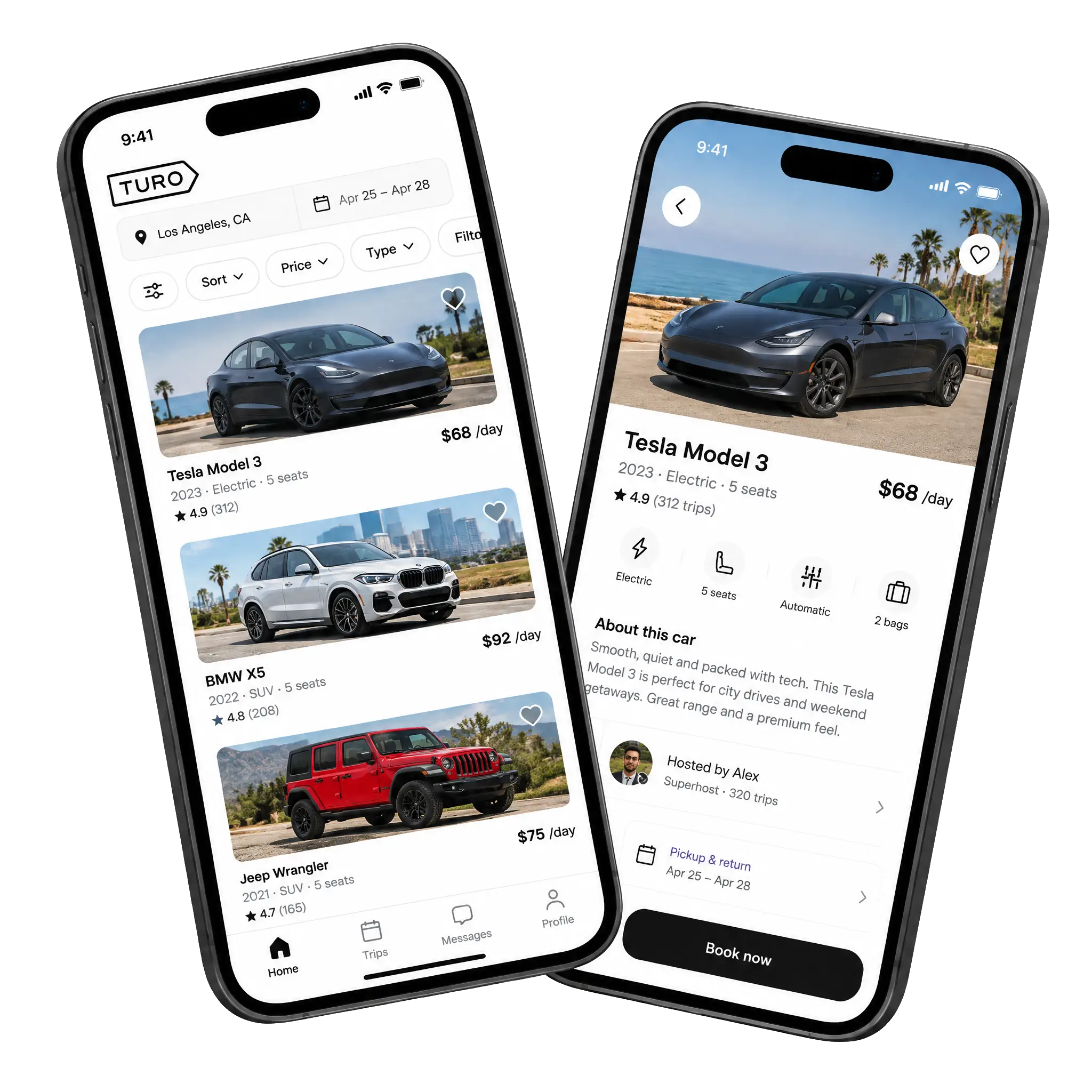
A Turo-like platform is an online marketplace where vehicle owners can list their cars, and renters can find, book, and pay for cars directly. It is ideal for startups, car rental companies, fleet owners, and businesses entering the peer-to-peer rental market.

Hyperlocal Cloud provides a white-label platform that you can launch under your own brand. You can adjust business rules, add features, and connect third-party services based on your needs. It helps reduce development time and cost while giving you a strong starting point. As your business grows, you can expand the platform and move toward a fully custom solution.

Turn Your Car Rental Business Idea Into a Feature-Rich Turo-Like App

How a Turo-Like Car Rental Marketplace Works

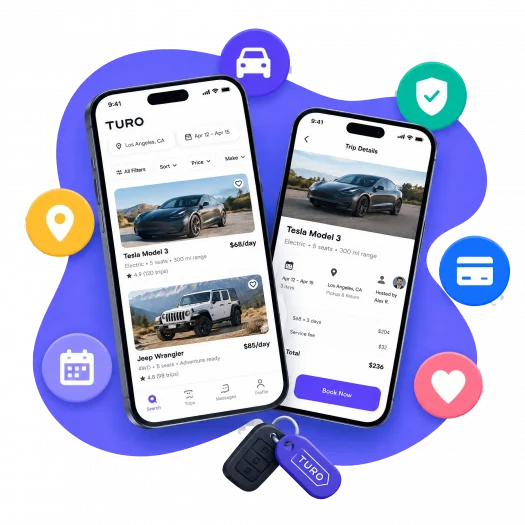
An app similar to Turo typically connects vehicle owners with renters via a simple online process that businesses and users must follow. Here's how it works:

Host Joins & Vehicle Verification

The host creates an account and submits vehicle details and required documents. The platform checks the vehicle and host information before approval.

Vehicle Listing & Availability

Approved hosts are eligible to add photos, descriptions, rental rates, vehicle availability, and pickup options. However, they can update the pricing and availability as per their need.

Renter Search & Booking

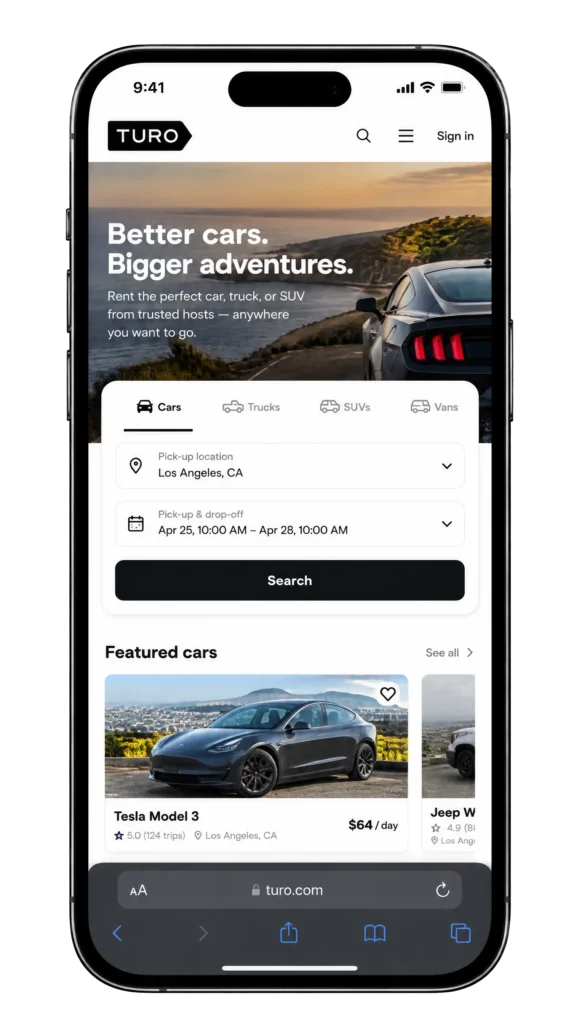
Renters search for cars by location, dates, price, and vehicle type, then select a suitable car, review the details, and book it.
How a Turo-Like Car Rental Marketplace Works

Payment & Trip Start

The renter pays through the platform using a supported payment method. After the booking is successfully completed, the renter collects the vehicle and starts the trip.

Vehicle Return & Review

After the trip, the renter returns the vehicle as agreed, and both sides can leave ratings/reviews to build trust within the marketplace.

Host Payout

After the rental is completed, the platform processes the host's earnings and sends the payout based on the marketplace's payment rules.

Build a Turo-Like Platform Around Your Unique Business Needs

From branding and booking flows to pricing, user roles, and marketplace features, customization helps align your Turo-like platform with specific business requirements while creating a seamless experience for hosts, renters, and administrators.

Improved User Experience (UX)

Brand & User Experience

Set your logo, colors, screens, menus, and user flows to create a consistent experience across web and mobile apps.

Affiliate Marketing

Marketplace Rules

Define who can join, which vehicles can be listed, vehicle eligibility requirements, service areas, and other marketplace conditions.

Pricing & Commission

Set host commissions, platform prices, taxes, discounts, deposits, and dynamic pricing rules based entirely on your business model.

Booking & Cancellation

Control booking approval, trip extensions, cancellation windows, refund rules, and no-show policies from the platform settings.

Verification & Approval Workflows

Create document checks, identity verification, car inspections, and manual approval steps before users or vehicles can participate.

Payment & Payout Rules

Configure fee structure, security deposits, refunds, payment splits, payout timing, and failed-payment management.

Integrations

Connect payment gateways, maps, identity checks, insurance services, notifications, analytics tools, and other third-party systems.

Custom Business Features

Add features built around your operations, such as corporate leases, subscriptions, fleet equipment, loyalty programs, or unique reservation models.

Notifications & Communication

Notifications & Communication

Set automatic alerts for bookings, payments, approvals, cancellations, trip updates, and other critical events through e-mail, SMS, or push notifications.

Key Features That Drive Turo-Like Platform Success

A strong feature set underpins a successful car rental marketplace. Prioritize intuitive booking, secure payments, vehicle management, communication, and administrative controls to deliver convenience, reliability, and marketplace efficiency.

Account & Identity Verification

Renters can register with email, phone, or social login. Renters can upload identity and driving documents for verification through an identity verification service.

Smart Car Search

Search uses filters such as location, dates, price, vehicle type, and features to query available listings and return matching cars.

Map-Based Vehicle Discovery

A map interface displays available cars using location coordinates. Users can move around the map and update results by area.

Vehicle Details & Host Profile

The app loads vehicle photos, specifications, rules, ratings, and host information from the listing database before booking.

Time Freedom & Preventing Burnout

Real-Time Availability

The booking engine checks selected dates against the vehicle calendar to prevent overlapping bookings and unavailable time slots.

Online Booking & Payment

Renters select trip details and pay through an integrated gateway. The system creates the booking only after payment authorization succeeds.

Trip Management

A trip dashboard shows pickup details, booking status, payment records, instructions, and important actions throughout the rental period.

Staff Scheduling

In-App Messaging & Support

Renters can communicate with hosts through a protected chat system while support tools handle disputes, questions, and service requests.

Reviews & Notifications

Ratings & Reviews

After a completed trip, the system opens the review option and links ratings to the renter, host, and vehicle for future users.

Host Registration & KYC

Hosts submit personal details and required documents. The system tracks verification status before rental features become available.

Vehicle Onboarding

Hosts enter vehicle specifications, upload documents and photos, and submit the car for admin review before publishing.

Listing Management

Hosts can edit vehicle details, photos, rules, pickup information, and other listing data without creating a new listing.

Availability Calendar

Hosts can block dates, open time slots, and manage vehicle availability through a calendar linked directly to the booking system.

Pricing Control

Pricing Management

Hosts can set daily or hourly rates, deposits, extra payments, discounts, and other pricing values allowed by marketplace rules.

Service Booking & Ordering

Booking Management

The host dashboard displays new and upcoming bookings, allowing hosts to accept, decline, view details, and manage trip-related actions.

Growth Tools

Trip Handover Tools

Hosts can record pickup and return details, vehicle condition, mileage, fuel level, and supporting photos through the app.

Earnings Dashboard

Earnings & Payout Tracking

Hosts can view rental earnings, platform fees, pending payouts, completed payouts, and transaction details in one place.

Analytics & Security

Host Analytics

The app can show booking volume, utilization, revenue, cancellations, and vehicle performance to help hosts improve rental results.

User & Listing Management

User & Host Management

Admins can view accounts, verification status, activity, documents, regulations, and account records from a centralized dashboard.

Vehicle Approval Management

Submitted vehicles enter an approval queue in which admins can review files, photos, information, and inspection records before publishing.

Content and Policy Control

Marketplace Control

Admins can manage service areas, vehicle classes, rental rules, booking limits, deposits, and other platform-wide settings.

Booking & Trip Monitoring

The panel tracks booking status, pickup and return details, cancellations, extensions, refunds, and live trips in real time.

Commission & Fee Management

Admins can configure host commissions, renter prices, taxes, deposits, discounts, and other fees using defined pricing rules.

Payment & Payout Management

Admins can track payment records, refunds, failed transactions, host balances, and payout status through gateway-connected transaction data.

Dispute Management

Dispute & Incident Handling

Admins can review disputes and trip-related issues, upload evidence and messages, and enter details before applying refunds, fees, or other actions.

Notification Management

Content & Notification Management

Admins can update platform content and customize templates for email, SMS, and push notifications triggered by specific marketplace events.

Reports & Analytics

The app can combine bookings, sales, customers, vehicles, commissions, cancellations, and other metrics into dashboards and exportable reports.

Start Your Turo-Like App Development Trip With an Experienced Team Ready to Build Your Scalable Car-Sharing Platform

Leverage AI to Create a Smarter Car Rental Marketplace

AI can make your Turo-like marketplace smarter by improving recommendations, automating support, optimizing pricing, detecting suspicious activity, and analyzing customer behavior. These capabilities can enhance efficiency while creating more personalized rental experiences.

AI-Powered Dynamic Pricing

AI models can study demand, booking history, season, location, and vehicle data to suggest rental prices. Prices can then adjust based on predicted demand.

Vehicle Damage Detection

Computer vision can evaluate vehicle images taken before and after a trip to detect new dents, scratches, or other visible damage.

Fraud & Risk Detection

AI can analyze booking, pricing, account, transaction, device, and behavioral patterns to detect unusual behaviors and assign risk scores for further review.

Service Personalization

Personalized Vehicle Recommendations

Recommendation systems can review searches, bookings, preferences, budgets, and trip information to suggest vehicles more likely to suit each renter.

AI Customer Support

AI assistants can understand customer questions and provide solutions using platform facts, booking information, guidelines, and support content, while also handing complex cases to agents.

Demand & Utilization Forecasting

AI can analyze bookings, seasonality, locations, vehicle types, and other data to predict future demand and help hosts plan vehicle availability.

Add Advanced Technologies for Greater Efficiency and Scalability

Advanced technologies can extend your platform beyond essential marketplace functionality. Depending on your goals, integrating IoT, telematics, blockchain, biometrics, or connected-car capabilities can improve automation, transparency, security, and operational efficiency.

IoT & Smart Vehicle Access

Connected locks and IoT devices can let approved renters unlock vehicles through the app. Access can be enabled or disabled based on booking status and trip times.

Telematics

Telematics technologies can send vehicle data, including location, mileage, and driving events, to the platform. This data can support trip monitoring and fleet insights.

Blockchain/Web3

Blockchain can provide tamper-resistant records for selected use cases such as ownership or transaction history. Use it only where it offers a clear business benefit.

Create a Trusted, Secure and Verified Car Rental Marketplace

Trust is essential when connecting vehicle owners with renters. Strong identity verification, secure payments, document checks, fraud prevention, insurance workflows, and safety measures can help establish confidence throughout every rental transaction.

Driver Identity Verification

Verify renter identity using personal details, ID documents, and third-party identity checks before allowing bookings.

One-Time License Fees

License Verification

Collect driving license details and validate them through supported verification services before a renter can start a trip.

free-hosting

Host Verification

Check host identity, contact details, and required documents before allowing them to add vehicles to the marketplace.

vehicle-management-converted-from-svg

Vehicle Documentation

Hosts upload registration, coverage, inspection, and other required documents for review and record-keeping.

vehicle-managment

Vehicle Approval

Admins review car info, documents, photos, and eligibility guidelines before approving a vehicle for listing.

fraud

Fraud Detection

Monitor unusual login, booking, price, and account activity to flag suspicious behavior for additional checks.

AI-Powered Vehicle Damage Detection in Turo Clone

Damage Evidence

Hosts and renters can upload time-stamped photos or videos before and after trips to create a clear damage record.

trip-monitoring.svg

Trip Records

Store booking, pickup, return, mileage, fuel, charging, and vehicle-condition records to maintain complete trip records.

dispute

Dispute Management

Provide an established complaints process, with access to trip information, messages, photos, and pricing for review and resolution.

From Concept to Launch: Building Your Turo-Like Car Rental Business

Launching a Turo-like startup requires more than developing an app. Validate your market, define the business model, plan essential features, establish partnerships, and create a scalable technology foundation before entering the market.

Define Target Market

Identify your ideal renters and hosts, along with the locations, vehicle types, and local market requirements you need to serve.

Choose P2P, Fleet or Hybrid Model

Decide whether your platform will connect private vehicle owners, manage your own fleet, or combine both models.

Manufacturing & Industrial Facilities

Define Supply Strategy

Plan how vehicles will enter your marketplace, including host onboarding, fleet partnerships, vehicle approval, and listing requirements.

Define Monetization

Choose how the platform will earn through commissions, booking fees, subscriptions, featured listings, or other suitable revenue streams.

Seller/Landlord Panel

Determine Regulatory Requirements

Review the coverage, tax, vehicle, driver, privacy, and other necessities that apply to your selected markets.

MVP Development

Choose Development Approach

Selecting an approach (white label or custom-based) depends on your budget, launch timeline, feature requirements, and long-term growth plans.

Branded Graphic and Video Production

Configure Product

Set up branding, user roles, pricing guidelines, booking flows, cancellation guidelines, vehicle categories, and marketplace settings.

Integrate Payments and Verification

Connect payment gateways and identity, license, and vehicle verification services to keep the marketplace running smoothly.

Immediate Launch

Launch MVP

Start with the most important capabilities: listing, searching, booking, payments, trips, and basic host and admin management.

Measure Marketplace Performance

Track bookings, vehicle utilization, revenue, cancellations, repeat customers, host interest, and other key market metrics.

Add Advanced Features

Use early consumer feedback and enterprise data to add features like AI pricing, smart gate entry, telematics, and advanced analytics.

Smart Fraud Detection and Risk Analysis

Scale Geographically

Expand into new towns or regions after validating demand, delivery, operations, and neighborhood requirements inside the first market.

Transform Your Car Rental Concept Into a Profitable Turo-Like Marketplace With End-to-End App Development Support

Insurance and Compliance Considerations for a Turo-Like Platform

A Turo-like marketplace may need to address different federal, state, and local rules. The exact requirements depend on the platform.

Peer-To-Peer Car-Sharing Regulations

Car-sharing rules can differ by state and may cover platforms, hosts, renters, vehicles, and trip operations. Check the rules in every market where the service will operate.

Insurance Coverage in Turo Clone Renter App

Insurance Requirements

Insurance needs vary by vehicle, rental model, location, and coverage offered. The platform can collect policy details and track coverage status.

Driver Eligibility

Set rules for age, license status, driving history, and other renter requirements. The platform can collect and verify required information before booking.

Vehicle Eligibility

Define which vehicles can join the marketplace based on age, condition, registration, inspection, or other local rules. The system can block vehicles that fail required checks.

State/Local Requirements

States, cities, and counties may have different licensing, registration, operating, and tax rules. Build location-based checks so you can review the right requirements for each market.

Privacy

The platform architecture can support applicable GDPR and data-privacy requirements. It can also help manage sensitive data such as sensitive data like driver's licenses, real-time GPS tracking, and payment details.

Turo-Like Platforms for Different Business Models

Whether you operate a peer-to-peer marketplace, fleet rental service, dealership platform, or hybrid model, your technology should reflect your operational needs. A flexible architecture makes it easier to support evolving business strategies.

Peer-to-Peer Car Sharing

Connect personal vehicle owners with renters and earn through commissions or booking fees.

cash-app-clone-app-development-trading-commission

Traditional Rental

Help rental businesses manage their fleet, bookings, customers, payments, and day-to-day operations.

fleet-managment

Fleet Marketplace

Let multiple fleet owners list vehicles and manage rentals through one shared marketplace.

fleet-managment (1)

P2P + Fleet Hybrid

Combine private hosts and professional fleet operators to create a wider vehicle supply network.

Diesel and Petrol Vehicle Rentals in Turo Clone

Luxury Car Rental

Build a market centered on premium vehicles with higher rental rates and specialized delivery options.

Luxury Car Rental App

EV Rental

Create an EV-targeted marketplace with functions for charging info, range statistics, and EV-specific charging and range requirements.

Boat and Yacht Rentals (1)

Corporate Rental

Serve corporations with employee bookings, corporate billing, approval flows, payment, and utilization analytics.

Improved Local SEO Visibility

Local Car-Sharing

Focus on short-distance or neighborhood rentals with location-based vehicle discovery and flexible booking periods.

Subscription Plans (2) (1)

Subscription-Based Car Rental

Offer users longer-term vehicle access through recurring plans instead of one-time rental bookings.

Our End-to-End Turo-Like App Development Approach

A structured development methodology helps transform your marketplace concept into a reliable digital product. From discovery and UI/UX design to development, testing, launch, and ongoing support, every stage focuses on measurable business outcomes.


Business Discovery

We understand your target market, rental model, user roles, revenue plan, and key business rules before defining the product.

Marketplace Architecture

We map the renter, host, and admin journeys and plan the core systems for listings, bookings, payments, trips, and data.

Product Configuration

We configure the ready-made approach around your marketplace rules, vehicle types, pricing, commissions, and booking processes.

Branding

Branding & UX

We adapt the interface to your brand and design simple user flows for searching, listing, booking, managing trips, and payments.

Custom Development

We build features that go beyond the standard platform, including custom workflows, dashboards, business rules, and advanced marketplace tools.

Integrations

We connect payment gateways, maps, identity checks, notifications, analytics, and other services needed for daily operations.

QA & Security

We test core user workflows, APIs, payments, device behavior, and access controls to identify issues before the platform goes live.

Launch

We prepare the production environment, configure services, publish applications, and move the marketplace from testing to live operation.

Immediate Launch

Post-Launch Optimization

We use real usage data and business feedback to improve performance, refine workflows, fix issues, and add new capabilities.

A Future-Ready Technology Stack for Turo-Like Apps

Build a future-ready Turo-like app with scalable technologies that support seamless performance, secure transactions, real-time connectivity, and flexible integrations as your marketplace grows.

Mobile Apps

Flutter

Web Application

React.js / Next.js

Backend

Backend

Node.js / NestJS

APIs

REST API / WebSockets

Databases

Database

PostgreSQL

Cache & Sessions

Redis

Cloud

Cloud Infrastructure

AWS

File & Image Storage

Amazon S3

Maps & Location

Google Maps Platform

Payment Gateway

Payments

Stripe

Push Notifications

Firebase Cloud Messaging

Authentication

OAuth 2.0 / JWT

Monitoring

AWS CloudWatch

Source Control

Git / GitHub

Get a Scalable Turo-Like App Solution Tailored to Your Business Model, Target Market, Features, and Revenue Goals

How Much Does It Cost to Build a Turo-Like App?

The cost depends on customization, the number of platforms, integrations, and business rules. A complete cost breakdown from the point of view of both the development approaches ready-made and custom-based are listed below.

White-Label Launch

$5,000

Custom Development Solution

$20,000 - $80,000

How Long Does It Take to Launch a Turo-Like App?

Launch time depends on the solution type, feature scope, customization level, and integrations. A ready-made approach can usually shorten the path to launch.

Discovery & Architecture

Define user roles, marketplace flows, core features, technical needs, and system structure before development begins.

01

Configuration & Branding

Set up the platform, apply your brand identity, configure business settings, and build the primary customer journeys.

02

Customization & Integrations

Add required capabilities and integrate services such as payment gateways, maps, identity verification, notifications, and analytics.

03

QA & Security Testing

Test booking, payment, renter, host, admin, and API workflows at the same time as checking the platform for security and performance issues.

04

Deployment & Launch

Prepare production infrastructure, publish the apps, configure monitoring, and make the marketplace available to users.

05

Post-Launch Optimization

Track user activity, fix early issues, improve key workflows, and add features based on real marketplace needs.

06

Smart Pricing & Revenue Strategies for Turo-Like Apps

Along with the core revenue streams, a Turo-like marketplace can use several models to create steady income from bookings and related services.

01

Renter Payments

Renters pay the booking amount through an integrated payment gateway. The platform can collect the full amount before the trip begins.

02

Host Payouts

After deducting applicable fees and commissions, the system calculates the host's earnings and releases the payout based on set rules.

03

Platform Commission

The platform keeps a fixed amount or percentage from each completed booking as its primary marketplace revenue.

04

Booking Fees

Add a separate service or booking fee to the renter's checkout amount, based on booking value, trip type, or other rules.

05

Deposits

Collect a refundable security deposit before a trip. The platform can release it after the trip if no valid claim is raised.

06

Refunds and Chargebacks

Automated refund rules can return eligible amounts, while chargeback workflows help track payment disputes and protect marketplace revenue.

07

Subscription Plans

Offer hosts paid monthly or yearly plans with benefits such as lower commissions, advanced tools, or higher listing limits.

08

Featured Listings

Charge hosts to promote selected vehicles in search results or dedicated sections for better visibility.

09

Add-On Services

Earn additional revenue from optional services such as delivery, insurance-related services, roadside assistance, or trip add-ons.

Ready to Launch Your Own Turo-Like App? Get a Quote From Our Experts Today

Why Businesses Choose Hyperlocal Cloud for Turo-Like App Development

With the right technology partner, you can accelerate development while maintaining flexibility, scalability, and quality. Hyperlocal Cloud helps turn your Turo-like marketplace concept into a feature-rich platform built around your business objectives.

Ready-Made Marketplace Approach

HLC provides a ready-made solution covering core marketplace workflows, helping businesses avoid building standard rental functions from scratch.

White-Label Branding

Launch the marketplace under your own brand with customized visual elements, user-facing screens, and platform identity.

Business-Specific Customization

Our experts can adapt pricing, commissions, approval flows, user roles, and other workflows around your operating model.

Third-Party Integrations

Utilize third-party integrations to connect services for payments, maps, notifications, analytics, and other marketplace requirements.

Advanced Search Options

Advanced Technology

Leverage advanced technologies such as AI-driven pricing, vehicle damage detection, AI-powered recommendations, demand forecasting, and telematics to build a robust marketplace platform.

Post-Launch Development

Continue improving the platform after launch with new features, workflow changes, integrations, performance updates, and expansion support.

Expert Social Media Promotion

Relevant Experience & Evidence

You can assess our work through relevant marketplace projects, product capabilities, technology approach, implementation process, and relevant solutions delivered for businesses with similar needs.

Scalable Product Approach

Start with a ready-made marketplace and progressively move toward deeper customization as your users, vehicle supply, and operating requirements grow.

Dedicated Product Ownership

Hyperlocal Cloud can align with your business goals, translating marketplace requirements into product features instead of limiting the solution to fixed software functions.

Frequently Asked Questions

Yes. A white-label solution can be branded with your business name, logo, colors, domain, and user-facing design.

Not always. White-label refers to branding and ownership of the customer-facing platform, while SaaS usually means using software as a hosted service under a subscription or usage model.

A clone aims to reproduce the main features of an existing platform. A white-label solution provides a ready-made solution you can brand and adapt to your business rules.

The cost depends on the solution type, number of apps, features, custom development, integrations, and technology requirements. White-label solutions generally require less initial development than fully custom platforms.

Launch time depends on the scope and level of customization. A ready-made platform can usually launch faster, while extensive custom development takes longer.

Yes. You can configure commissions, booking fees, deposits, cancellation rules, pricing, payouts, vehicle types, and other marketplace settings around your revenue model.

Yes. The platform can support private vehicle owners and professional fleet operators with different onboarding, listing, pricing, and management workflows.

The platform can calculate commissions and fees automatically when a booking is paid. The platform can then record the remaining eligible earnings and send it to the host based on your payout rules.

Common checks include identity, driving license, host, vehicle, registration, insurance, and document verification. The exact checks depend on your business model and operating location.

Yes. APIs can connect the platform with payment gateways, identity verification providers, maps, GPS or telematics systems, insurance services, notifications, and other third-party tools.

Yes. You can use a ready-made approach for the initial launch, then add custom features as your marketplace grows. The long-term approach depends on the platform architecture and business needs.

A basic MVP should cover user registration, vehicle listings, search, availability, booking, payments, host management, trip management, reviews, verification, and an admin panel.

We Are Trusted By The Best In The World

Hyperlocal Cloud is a tech leader harnessing the power of state-of-the-art technologies and delivering innovative app solutions to businesses.

Get Free Consultation From Top Industry Experts