


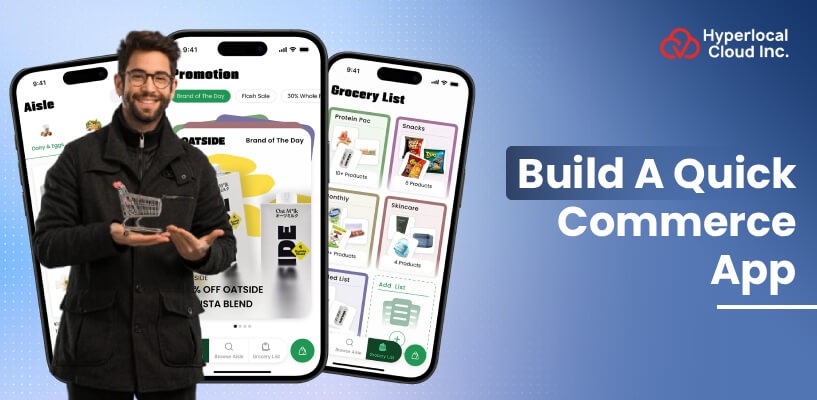
In today’s era, everyone wants their desired items or essential goods quickly, without any delay. Whether it is snacks, choosing up groceries, or shopping for the cutting-edge system, comfort is fundamental. This is where Quick Commerce, or Q-Commerce, steps in. The app is revolutionizing the manner in which people shop, mainly in city areas where rapid deliveries are crucial. It’s all about getting items delivered as quickly as feasible, regularly within an hour or less.
These apps let customers purchase regular necessities with lightning-speedy shipping, making purchasing more convenient than ever. Market traits display that Q-commerce is gaining momentum. More and more startups are coming to develop their own Q-commerce application to get massive business growth.
What is a Q-Commerce App?
A Quick Commerce app is a mobile platform designed to let customers shop for products and have them added in an exceptionally short time, typically within half-hour to an hour. The main motive of the app is convenience, speed, and simplicity. These apps are commonly used for regular items together with groceries, snacks, personal care merchandise, or even household essentials.
Enter the quick commerce market with confidence
How Does a Quick Commerce App Work?
Here is a complete guide that lets you know how to operate the application in order to get a seamless user experience. Just have a look:
1. User Browses and Orders
Once a customer opens the app, they can rapidly browse a huge variety of products, which include groceries, snacks, personal care, and many more. The app is designed to make product seeking as brief and easy as possible.
2. Real-Time Inventory Check
As the client completes their order, the app checks object availability in real time. Q-commerce apps generally partner with nearby warehouses or shops to maintain a properly-stocked inventory close to the customers.
3. Efficient Fulfillment Process
Once the order is confirmed, the app’s backend system right away notifies the closest warehouse or associate to choose the gadgets. The app makes use of algorithms to decide which place can satisfy the order fastest.
4. Order Hand-Off to Delivery Partners
After the objects are picked and packed, they’re delivered to a transport driver. This driver could be both an in-residence employee or a third-party shipping accomplice. The app makes use of a GPS tracking system to calculate the most efficient path, making sure the gadgets reach the patron’s area as fast as possible.
5. Tracking and Notifications
Throughout the procedure, the consumer can track their order in real time. The app sends notifications about the order’s progress, including when it’s being packed, picked up, and nearing delivery.
6. Final Delivery and Customer Feedback
The very last step is the shipping of the order. Upon arrival, the patron can be requested to affirm receipt of the items and price the carrier. These ratings help improve the provider and provide valuable feedback that may be used to refine the app’s capabilities.
List of the Factors That Make a Q-Commerce App Stand Out
Several reasons exist that are enough to make the application stand out. Let’s review all the vital factors below that make the statement true.
1. Ultra-Fast Delivery Times
The biggest factor that sets a Q-commerce app apart is shipping velocity. If the app guarantees transport inside half-hour, it better deliver on that promise.
2. Smart Logistics
Customers need to understand exactly when their order will arrive and monitor it at each step of the process.
3. Diverse Payment Options
Providing an extensive variety of payment alternatives, along with credit score playing cards, digital wallets, and cash on delivery, could make your app greater available to a larger target market. Customers have to additionally be able to shop their fee methods for future purchases, speeding up the checkout process.
4. Loyalty Programs
Offering everyday reductions, promotions, and loyalty applications is a super way to attract new users and maintain current ones. Many Q-commerce apps run unique deals or reward users with points redeemable for discounts or free deliveries.
A Differentiation Between: Quick Commerce & Traditional E-Commerce
There is a huge difference between a Quick Commerce and an e-commerce application, or you can say, service. Both are completely different from each other in several ways. Have a look and understand how.
1. Speed of Delivery
In conventional e-commerce, deliveries can take numerous days or maybe a week to reach the patron, relying on the delivery method. Q-commerce, then again, makes a speciality of lightning-fast shipping, frequently within 30 minutes to an hour.
2. Product Range and Availability
Traditional e-commerce structures normally provide an extensive range of merchandise, including electronics, clothing, domestic goods, and extra. The goal is to cater to a huge variety of client wishes and possibilities. In comparison, Q-commerce apps typically focus on providing a restricted, yet distinctly in-demand selection of products. These are often everyday essentials like meals, drinks, personal care products, and family objects.
3. Business Model
Traditional e-commerce agencies regularly perform large warehouse operations to stock their inventory. These platforms deliver items from a crucial region, which may take time, especially if the goods want to travel long distances. Q-commerce apps, alternatively, raise awareness of nearby success.
4. Customer Experience
When shopping on traditional e-commerce platforms, customers usually spend extra time surfing, evaluating options, and analyzing critiques earlier than creating a buy. In evaluation, the Q-commerce experience is all about velocity and simplicity. Customers expect to discover what they want quickly, purchase with minimal effort, and receive their orders almost right away.
Build your branded quick commerce platform
The Compelling Features of the Quick Commerce Application
All the relevant features of a Q-commerce application are discussed below. Businesses can integrate all these features in order to deliver a user-friendly app to their target audience.
1. Instant Search and Easy Navigation
Since customers use a Q-commerce app to buy items quickly, the app ought to permit speedy, easy product discovery. This manner enforces an intuitive seek characteristic, easy classes, and smooth-to-navigate menus.
2. Real-Time Inventory Updates
The app must update product availability right away when an item is bought or when inventory ranges alternate.
3. Quick Checkout Process
The checkout technique ought to be as streamlined as feasible. Customers count on an easy, one-click checkout experience that calls for a few steps. The app has to have shop price information, offer multiple charge strategies, and allow for easy access.
4. Order Tracking and Notifications
The app should permit customers to manage their orders in real time, from the moment they are placed to the moment they arrive at their door. Notifications must keep customers informed about every step of the process, whether it is when the gadgets are being packed, while the transport is on its way, or while the package is set to arrive.
5. Fast and Reliable Delivery Network
A reliable shipping network, whether drivers or third-party couriers, is crucial to ensuring merchandise arrives within the promised time frame.
6. Recommendations
Personalization plays a large position in the achievement of Q-commerce apps. By leveraging information and AI, the app can advise products based on a user’s previous purchases, browsing records, and preferences.
7. Multi-Vendor Support
Many Q-commerce apps collaborate with a few providers to offer a wide variety of products from nearby stores. This multi-supplier device lets clients choose from distinct manufacturers and assets, making sure they get the best offers and a wide product variety.
8. Customer Support and Help Center
Even with a seamless app experience, clients may every so often face problems. That’s why integrating a clean-to-get right of entry to the customer service system is important.
How Does AI Positively Impact Q-Commerce App Development?
AI is evolving in every industry for the sake of advancement and enhancement; that’s the reason businesses should utilize AI-driven technologies to create a robust application.
1. Predictive Analytics for Inventory Management
AI-powered algorithms can examine historical statistics to predict which objects are in all likelihood to be in demand. Using professional trends and purchaser behavior, the app can manage inventory levels appropriately, making sure popular gadgets are stocked in nearby warehouses to fulfill demand.
2. Smart Delivery Routing
AI enables optimizing shipping routes by way of studying traffic styles, weather conditions, and transport locations. By predicting the most green routes, the app can reduce delivery instances and ensure that merchandise arrives faster. This not only improves the consumer level but also allows lessen commercial enterprise costs by means of the use of fuel and assets more efficiently.
3. Personalized Shopping Experience
AI can have a look at a client’s browsing history, beyond purchases, or even options to endorse products most probably to interest them.
4. Chatbots for Customer Support
AI-powered chatbots can handle patron queries without delay, imparting aid at any time of day or night. These bots can solve requested questions, monitor orders, or even help with returns or refunds.
5. Dynamic Pricing
AI can also assist in dynamically regulating fees primarily based on elements including demand, inventory ranges, and competitor pricing. This allows Q-commerce apps to live progressively and offer the lowest possible fee to customers, whilst also maximising profits for the company.
6. Fraud Detection and Security
AI can display transactions in real time, detecting any uncommon styles or fraudulent activity. By reading large amounts of facts, AI can flag potential safety dangers, allowing corporations to take immediate action and protect their clients’ personal and financial information.
7. Improved Customer Retention
AI enables enhancing the customer experience by using predictions, while a consumer is likely to go back and proactively provide or send reminders. For instance, AI can ship personalized push notifications about offers or promotions on products a consumer has previously viewed or purchased.
A Complete Roadmap to Develop a Q-Commerce App for Businesses
You will get a complete guide, which helps you to develop your own application to attract a wide range of audiences. Get the information and start building.
1. Market Research and Ideation
The first step in growing a Q-commerce app is engaging in thorough marketplace research. Remember that only a strong research part will enable you to find your target audience and competitors. That’s why businesses should make a blueprint for precise implementation.
2. Define Core Features
Based on your research, it’s time to outline the core functions of your app. These must align with your goal marketplace’s needs and attention on handing over an amazing consumer experience.
3. Choose the Right Technology Stack
All the tech stacks are mentioned in the table that are used by a mobile app development company for the development of the application.
| Category | Tech Stack |
| Mobile App Frameworks | React Native, Flutter, or Swift (for iOS) and Kotlin (for Android) |
| Backend & Database | Cloud platforms like AWS, Google Cloud, or Microsoft Azure, and databases like MongoDB or PostgreSQL |
| Real-Time Data Processing | Firebase or WebSockets |
| Payment Gateway Integration | Stripe or PayPal |
| Logistics & Route Optimization Tools | APIs like Google Maps or third-party delivery management solutions |
4. UI and UX Design
UI/UX layout is essential for the achievement of your Q-commerce app. The layout has to prioritize simplicity, speed, and usefulness. It must be smooth for customers to navigate the app, place an order, and schedule their transport. The checkout method should be short and feature as few steps as possible.
5. Start Development Process
Start a development process with the expertise of frontend and backend developers. The integration of programming languages and required technologies ensures the application is top-notch. However, to build the application, businesses can either choose a custom-based method, or they can simply build a Quick Commerce application with a white label solution. Additionally, the whole process is crucial because it defines the overall working of the application.
6. Implement Security Features
Security is a top priority, particularly when managing customer records and transactions. Ensure that your app uses encryption for touchy data, such as charge info and personal facts. Implement steady authentication strategies, including 2FA, to shield user accounts.
7. Test, Launch, and Monitor
Test the application with every possible method, including automatic and manual. Only then launch the application so that users can download it and enjoy the user-friendly app. Once done with everything, monitor the progress of the application and even update the app so that it performs well.
Launch your own quick commerce app in days
Who Can Utilize a Quick Commerce App?
Review the list that lets individuals utilize the application in order to automate their services. Get to know a brief breakdown of all key users.
1. Grocery Stores and Supermarkets
Supermarkets and grocery stores can use Quick Commerce apps to provide quick deliveries of fresh produce, liquids, snacks, and other necessities.
2. Restaurants and Food Delivery Services
Restaurants and food chains are ideal candidates for Q-commerce applications. With the growing trend of on-demand food delivery apps, restaurants can leverage them to deliver meals quickly, particularly during peak hours.
3. Local Retailers and Convenience Stores
Local shops, convenience stores, and small stores can gain from Q-commerce through presenting fast transport of everyday items, which include toiletries, cleansing merchandise, and snacks.
4. E-commerce Startups and Small Brands
Startups and small groups that want to provide fast shipping services can also utilize the apps. These businesses may promote niche products that require pressing shipping, such as cosmetics, medicinal drugs, or fitness supplements.
5. Consumers and End-Users
Ultimately, the main customers of Q-commerce apps are customers. Busy people who need products quickly, whether it is groceries, snacks, or non-essential care items, are the number one target market.
Trending Aspects That Make the Q-Commerce App A Popular Business Idea in 2026
Have a look at all the latest trending aspects of the application, which make it even more popular among people and in the market in 2026. This approach will encourage businesses to invest in the application to achieve proficient results with a massive user base. Just review the points below.
1. Demand for Instant Gratification
Consumers are more and more impatient and count on short solutions for their wishes. Whether it’s ordering meals, getting groceries, or buying family merchandise, people don’t want to wait days for delivery. This call for immediate gratification is driving the popularity of Q-commerce apps.
2. Advancements in Delivery Technology
In the coming years, advancements in shipping technology will make Q-commerce even quicker and greener. These technologies will lessen shipping instances, decrease operational costs, and increase the scale at which the Quick Commerce apps can perform.
3. Urbanization and Changing Lifestyles
As more people move into city regions, demand for short, handy offerings continues to grow. Urban residents often have much less time for conventional buying, so they turn to Q-commerce apps for their ordinary needs.
4. Integration with AI and ML
AI and systems gaining knowledge are predicted to play a much larger role in Q-commerce in 2026. As those technologies evolve, they’ll make Q-commerce apps even greater, non-public, and responsive to user needs.
5. Growing Popularity of Subscription-Based Models
Subscription-based services have become an increasing number of popular, and Q-commerce apps are jumping on this trend.
6. Customer Loyalty
In 2026, personalized buying experiences will be a giant trend in the Q-commerce space. Apps that use data and AI to advocate products based on beyond purchases or surfing records will attract extra dependable customers.
Challenges and Considerations in Quick Commerce App Development
Get a brief lookout at the complex challenges that businesses should consider while developing the application. Let’s have a look:
1. Ensuring Fast and Reliable Delivery
The primary promoting point of a Q-commerce app is its ability to supply merchandise quickly, often within an hour or less. However, making sure rapid deliveries require a properly-organized delivery infrastructure. This consists of dealing with warehouses, partnering with local carriers, and having dependable transport employees or offerings.
2. Real-Time Inventory Management
When products are shifting quickly from warehouses or retail partners to clients, having correct real-time inventory management will become crucial. Imagine a client ordering an object that appears available, only for the app to later notify them that it’s out of inventory.
3. Handling High Traffic Volumes
The apps regularly see fluctuating, excessive traffic, specifically at some point during peak hours. During those times, making sure that the app remains stable and plays properly is vital. The app has to cope with a huge variety of customers simultaneously without crashing or slowing down.
4. Customer Data Security
Given that Quick Commerce apps handle a number of sensitive client records, securing this data needs to be a top priority. The app needs to observe facts, safety, and legal guidelines.
5. Balancing Speed and Quality of Service
While velocity is a key promoting point for Q-commerce apps, you also need to make sure the provider is high-quality. In this manner, in addition to handing over fast, you need to provide a terrific consumer experience.
How to Make Money from a Quick Commerce Application?
Follow the comprehensive ways discussed below, which help your business to generate a massive income from the application. Just have a look at the information first.
1. Delivery Fees
The most effective revenue model for a Q-commerce app is charging a delivery fee based on the order. This fee might be a flat price or a range relying on the gap, order size, or delivery time.
2. Subscription-Based Models
Many Q-commerce apps provide subscription plans that let clients pay a recurring rate for perks consisting of free transport, one-of-a-kind discounts, or priority delivery.
3. Commissions from Vendors
If your Q-commerce app connects customers with local shops or companies, you could earn a commission for every sale made through the app. Typically, this commission is a percentage of the product fee and varies depending on the vendor settlement.
4. In-App Advertising
In-app advertising and marketing is any other ability sales stream. You can partner with manufacturers to show advertisements within the app or offer promotions that generate revenue.
5. Premium Listings or Featured Products
For carriers, you may charge a fee to have their products featured at the pinnacle of search outcomes or displayed extra prominently on the app. This is a powerful way to monetize the platform while giving agencies extra visibility.
Turn your business idea into a 10-minute delivery app
How Much Does It Cost to Build a Q-Commerce App?
The cost to develop the Q-commerce application starts at $7,000. The cost is a rough estimation, because the final cost breakdown depends on various technical factors as well as the development approach. This means businesses have to consider the cost for the technical factors, including team expertise, team size, app complexity, and platform choice. Also, development from scratch and with white label solutions fluctuates the development cost. Because both the development approaches are different from each other and come with comprehensive features and functionalities.
Wrapping Up!
The Q-commerce applications are the current delivery market. To enter into the market with a mobile application, businesses or startups need to approach an experienced on-demand app development company. Hyperlocal Cloud has years of expertise in developing and delivering on-demand apps worldwide. We have an experienced team, several ongoing projects, and a track record of delivering projects on-time. All you need to do is partner with us to start your business journey with a Quick Commerce application that provides a user-centric approach to your business. Without delay, contact us for complete details.

Patt Cummins is an experienced content writer with over 10 years of experience creating clear and engaging content for technology-focused industries. He specializes in simplifying complex technical topics into easy-to-understand stories that educate readers, support brand communication, and help businesses effectively share their solutions.

Need Help With
Development?