


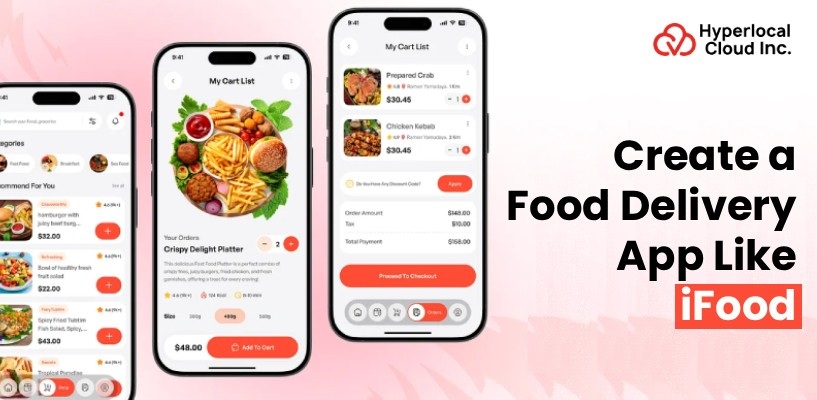
It has been seen that the on-demand food delivery market is at its peak by offering an easy option to users to get their desired food. Customers are moving to order food online through their mobile phones rather than dining out. This is the time when an iFood application was introduced to the market, offering exactly the features that users are looking for.
The iFood application has an impactful demand in Brazil and specific regions of Latin America, which makes it even more popular worldwide. The huge demand for the application compels many entrepreneurs and startups to invest in a food delivery app similar to iFood. This is where developing the iFood clone app becomes crucial, because businesses are looking to deliver a user-friendly application.
A Brief Conception on A iFood App
iFood is a digital application that is designed to transform the food delivery market with a wide range of features and functionalities. The main goal of this application is to connect users, restaurants, and delivery drivers on a single platform. With the help of this app, users can search and order food with ease right to their doorsteps. This is where the application gets popular among businesses that are looking to start their business journey with an app similar to iFood.
Turn your food delivery idea into an iFood-style app
How Does a Food Delivery App Like iFood Work?
A complete guide about the working mechanism of an app like iFood is discussed below. Users can follow the working process to operate the application. Just have a look:
1. User Registration and Location Access
Firstly, users are required to provide their contact details and email address to get access to the application. Once done, they can order their favorite food from the restaurants.
2. Browsing Restaurants and Food Menus
Users can select an eating place from where they want to order the food and check out the image, price, and delivery time of the food to order.
3. Placing an Order
Once customers pick out their meal items, they upload them to the cart and proceed to checkout. At this stage, customers can review their order, observe cut price codes, and select a price technique.
4. Order Acceptance
Once the order is located, it is dispatched to the selected restaurant. The restaurant gets the order through its accomplice app or dashboard.
5. Delivery Partner Assignment
Once the meal is ready, the app assigns the order to a nearby delivery accomplice. The transport agent gets the order from the eating place and delivers it to the customer’s place.
6. Order Completion and Feedback
Once the food is delivered, users get a notification confirming that the order has been finished. They can rate the restaurant and the shipping service based on their experience.
Understand the Lucrative Benefits of an App Like iFood
Here is a list of all the benefits that users and businesses will get from the food delivery application, which works as a lucrative aspect for both of them. Let’s have a look:
Benefits for Users (Customers)
1. Easy and Hassle-Free Food Ordering
One of the most important blessings for users is the ease of ordering meals. Customers can order their favorite meals in just a few steps the usage of their phones. They do no longer need to wait in line or call restaurants.
2. Wide Variety of Food Choices
Food delivery apps, which include iFood, provide users with the right of entry to numerous eating places and cuisines in a single location. Users can select from local eateries, famous food chains, and speciality eating places.
3. Multiple Payment Options for Convenience
Users can pick from numerous fee techniques, such as credit cards, debit cards, digital wallets, and cash-on-delivery. This flexibility makes the app suitable for users with distinctive fee possibilities.
4. Real-Time Order Tracking and Updates
With stay order monitoring, customers can see precisely where their meals are and the way lengthy it will take to reach. Notifications about order affirmation, food instructions, and transport hold customers informed.
Benefits for Restaurants
1. Increased Online Visibility
Restaurants benefit from greater visibility through lists on an iFood-like platform. Even small or newly opened restaurants can reach a wide variety of clients without making an investment in costly advertising campaigns.
2. More Orders and Higher Revenue
By partnering with a food transport app, eating places can get extra orders for the duration of the day. Online ordering increases sales, specifically during peak hours and weekends. This constant flow of orders ends in higher sales possibilities.
3. Simple Order and Menu Management
Restaurants receive orders digitally, decreasing errors and expediting the process. They can, without difficulty, update menus, charges, meal availability, and unique offers via the app. This provides eating places with greater control over their operations.
4. Valuable Customer Insights
Food delivery apps offer restaurants with beneficial records, including order histories, famous dishes, and client choices.
Outlook of the Foremost Features of the iFood Clone App
Complete information about the emerging core features of a food delivery app like iFood is briefly explained below. All features are secure and integrated to meet the needs of users, vendors, delivery drivers, and admins.
1. Easy Sign-Up and Login Process
The user panel allows clients to create an account quickly using their phone number, email address, or social media accounts. A simple and fast login method allows customers to begin ordering food without confusion.
2. Restaurant Search and Smart Filters
Users can search for eating places by using region, cuisine type, rankings, charge variety, and shipping time. Filters allow users to locate precisely what they want. This saves time and improves the overall ordering experience.
3. Detailed Menu Display
Each eating place has an in-depth menu with photographs of dishes, descriptions, prices, and upload-on options. A clear menu helps users recognize what they’re ordering and make better meal picks.
4. Multiple Payment Options
The app supports numerous payment methods, which include credit cards, debit cards, digital wallets, UPI, and cash-on-delivery. Having more than one payment selection makes the app appropriate for a wider target market.
5. Real-Time Order Tracking
Users can sign their food order from instruction to shipping using live GPS monitoring. Notifications keep customers updated at each stage, building consideration and transparency.
6. Ratings, Reviews, and Order History
Users can find eating places and transport companions after each order. They can also view past orders and reorder their favourite food easily. This function provides comfort and improves service satisfaction.
7. Simple Restaurant Registration
Restaurants can without difficulty sign up and add the specified documents for verification. Once accepted, they can start accepting orders via the app. This smooth onboarding manner encourages more restaurants to sign up for the platform.
8. Menu and Price Management
Restaurant proprietors can add, edit, or remove menu items at any time. They can update charges, mark items as available or unavailable, and add unique gifts. This offers eating places full access to their listings.
9. Order Management Dashboard
Restaurants obtain orders in real time and can accept or reject them based on availability. The dashboard allows them to track order reputation, education time, and daily sales.
10. Sales Reports and Performance Insights
Restaurants can view reviews on overall orders, profits, and popular meal items. These insights assist them in comprehending customer calls for and enhancing their business strategy.
11. Easy Profile Creation and Verification
Delivery companions can register through the app and post the desired files for verification. Once accredited, they could begin accepting transport requests.
12. Smart Order Assignment
The app mechanically assigns orders to close by shipping partners. This reduces shipping time and improves efficiency. Delivery sellers can accept or decline orders primarily based on their availability.
13. GPS Navigation and Route Guidance
Built-in navigation helps delivery partners locate the quickest course to restaurants and client locations. This reduces delays and improves delivery accuracy.
14. Earnings Dashboard and Incentives
Delivery partners can see day-by-day income, finished deliveries, and incentives. Transparent payment info increases acceptance and motivation.
15. Complete App Management Control
The admin panel lets business owners handle users, eating places, and delivery partners from a single dashboard. Admins can approve or block orders as needed.
16. Commission and Pricing Management
Admins can set fee quotes for restaurants and transport prices for users. This enables management of sales and pricing strategies.
17. Order Monitoring and Issue Handling
Admins can track all ongoing and finished orders. They can take care of patron proceedings, refunds, and disputes quickly, ensuring smooth operations.
18. Data Reports and Analytics
The admin panel offers specified reviews on the app’s overall performance, revenue, user interest, and high-order instances. These insights help make better enterprise decisions.
Transform your food business with a high-performance delivery app
How Does Advanced Technology Reshape the iFood Clone?
In this section, businesses will get an insight into how advanced technologies reshape a food delivery app like iFood. Integrate all the advanced features to get proficient results for your business.
1. Artificial Intelligence for Personalized Experience
Artificial Intelligence facilitates analyzing personal behavior, order records, and the possibilities of users. This personalization will increase user experience and satisfaction.
2. Machine Learning for Demand Prediction
Machine Learning allows expect top order instances and popular dishes. This allows eating places and delivery companions to prepare earlier. It additionally allows admins to control resources more efficiently during busy hours.
3. GPS and Location-Based Technology
The GPS tracking system permits real-time monitoring of orders and driving partners. Accurate region monitoring enables shorter delivery times and improves transparency for users.
4. Secure Cloud Infrastructure
Cloud infrastructure is secure and stores information to permit the platform to assist a large number of customers. It also helps scale the app because it expands to new places.
5. Digital Payment and Security Technologies
Advanced fee gateways make certain secure, rapid transactions. Encryption and steady authentication defend personal data and save you from fraud, constructing trust amongst customers.
6. Automation for Smooth Operations
Automation reduces manual work by way of managing operations along with order projects, notifications, and fee processing. This improves speed, reduces mistakes, and ensures a smooth app for all customers.
Follow the Steps to Create a Food Delivery App Like iFood
Here, you will get a complete breakdown of the steps to build a multivendor food delivery app. Businesses can follow all these steps to get a reliable and secure application.
1. Understand the Market Needs
The first step is to observe the food delivery market in detail. It is critical to recognize what users expect from a meal shipping app and what issues they face with existing systems. This includes getting to know about famous meal selections, transport time expectations, pricing sensitivity, and price alternatives.
2. Select a Business Model
Before any improvements begin, it’s essential to determine how the app will generate revenue. This might also consist of commissions from eating places, shipping costs, subscription plans, or commercials. A clear commercial enterprise version facilitates keeping away from confusion during improvement.
3. Choose the Right Features
An iFood-like app consists of panels for the consumer app, the restaurant app, the driver partner app, and the admin dashboard. Each panel has to include features that align with the target user institution’s desires. Selecting the right features guarantees high-quality performance and consumer satisfaction.
4. Design a UI/UX
The app’s design should be easy to use. Users ought to be capable of finding eating places, region orders, and making payments without confusion. Clear icons, readable text, and easy navigation enhance the user experience.
5. App Development
Development begins at this step, which means that at this point, the highly-skilled developers integrate the application with robust programming languages. However, businesses can choose the development method at either a ground-up level or they can simply move forward with a white label food delivery app. Additionally, the cost-breakdown and deployment timeline for both methods are different from each other. Although the development cost for the iFood clone app starts at $6,000, this is a rough estimate.
6. Testing and QA
Testing is a vital step in developing the iFood clone app. The app is examined for overall performance, security, and usefulness. Bugs and mistakes are diagnosed and fixed before the app is launched. Testing ensures customers do no longer come across issues when ordering food or making bills.
7. App Launch
After a successful trial, the app is released to the app stores. A proper release method, which includes advertising campaigns and promotional offers, allows enticing users and eating places.
8. Continuous Support and Updates
Regular updates are required to add new capabilities, improve performance, and connect issues. Continuous guide facilitates making sure the app stays secure, up to date, and aligned with evolving consumer desires.
Explore the Technical Stack for an iFood Clone App Development
Get to know about the technological stacks that are utilized by an on-demand app development company for the development of an iFood clone app.
| Category | Tech Stack |
| Front-End Technologies | React Native, Flutter, or Swift and Kotlin |
| Back-End Technologies | Node.js, Python, or Java |
| Database Management Systems | MySQL, PostgreSQL, and MongoDB |
| Cloud Hosting and Server Infrastructure | AWS, Google Cloud, or Microsoft Azure |
| Payment Gateway Integration | Stripe, PayPal |
| GPS and Map Integration | Google Maps API |
| Notification and Communication Tools | Firebase Cloud Messaging |
Launch a food delivery app like iFood faster with our experts
An Overview of Who Can Utilize A Food Delivery App Like iFood
Here is a complete overview of which businesses will get the idea about the key users of an app like iFood. Look at the list mentioned below.
1. Individual Customers and Families
Individual customers are the number one users of an app like iFood. This consists of working specialists, students, homemakers, and households. They use the app to reserve meals from nearby eating places without leaving their homes.
2. Restaurant Owners and Food Businesses
Restaurant proprietors, which include small nearby eateries, cloud kitchens, and big food chains, can use an app, including iFood, to reach extra customers. The app allows them to list their menu, receive online orders, and manage deliveries.
3. Cloud Kitchens and Virtual Food Brands
Cloud kitchens function best via online orders and do not have dine-in facilities. An app like iFood is good for these businesses because it enables them to connect immediately with customers. Virtual meal brands can register and grow quickly on the platform, making it easier to test new food standards at a lower cost.
4. Delivery Partners and Drivers
Delivery companions use the app to accept shipping requests, choose up food from restaurants, and supply it to clients. They benefit from flexible operating hours and transparent income.
5. Entrepreneurs
Entrepreneurs in search of a way to go into the meals transport market can use an iFood-like app to launch their own platform. By handling eating places, users, and delivery partners through the admin panel, commercial enterprise owners can construct a scalable and worthwhile online food transport enterprise.
6. Corporate Offices and Workplaces
Corporate workplaces can also use the app to order food for conferences, team lunches, and occasions. Bulk ordering and scheduled deliveries streamline meal control in expert settings.
7. Event Planners and Group Organizers
Event organizers, birthday party hosts, or event planners can use the app to place large food orders earlier. This helps make sure timely transport and smooth meal preparations for unique occasions.
The Top Strategies to Monetize an App Like iFood
Businesses that are looking to generate income from the application can follow and implement the monetization strategies discussed below. All these strategies are a good source of additional income, which helps businesses to get an increased ROI.
1. Commission Fees from Restaurants
One of the main assets of profits for a food delivery app is the commission charged to restaurants. Whenever a consumer places an order through the app, the platform takes a small percentage of the entire order price as commission.
2. Delivery Charges from Customers
Another monetization approach is charging customers for shipping expenses. This fee commonly depends on the gap among the restaurant and the shipping location. Some apps additionally regulate transport costs throughout peak hours or in bad weather.
3. Featured Listings and Promotional Ads
Restaurants frequently want better visibility on the platform. An iFood clone app can offer featured listings where restaurants seem on the top to seek attention or in unique sections.
4. Subscription Plans for Restaurants
Subscription methods are an increasing number of typical meal delivery structures. Restaurants can pay a monthly or annual subscription fee to access premium benefits.
5. Surge Pricing During High Demand
During peak hours, weekends, or special occasions, food transport calls will increase. An iFood clone application can put into effect surge pricing at some point during these intervals.
6. Partnerships and Brand Collaborations
Collaborating with meal manufacturers, beverage companies, or nearby businesses can open new sales opportunities. Sponsored campaigns, co-branded gives, and exclusive deals help increase brand visibility and generate profits for the app.
Know the Latest Trends of the iFood Clone App to Start Your Online Food Delivery Business
Startups or well-established businesses can start their online food delivery business by developing an advanced iFood clone app that comes with the future-ready trends. Know all the latest trends of the same.
1. Growing Demand for Contactless Delivery
This trend permits shipping partners to deliver food to the doorstep without direct contact. Adding contactless delivery alternatives builds user confidence and meets present-day safety expectations.
2. Rise of Cloud Kitchens and Virtual Restaurants
Cloud kitchens are getting increasingly popular due to the fact that they focus solely on online meal orders. These kitchens do not have dine-in areas, which reduces costs. iFood clone apps that help cloud kitchens appeal to extra food businesses and expand menu alternatives for customers.
3. Personalized Food Recommendations
By analyzing orders and browsing behavior, food delivery apps can recommend relevant restaurants and dishes. Personalized guidelines enhance consumer enjoyment and increase order frequency.
4. Increased Use of Digital Payments
Digital payments are more and more popular because of their speed and convenience. Users decide on wallets, UPI, and card payments over cash. Supporting multiple virtual fee alternatives is now a basic requirement for any iFood-like app.
5. Focus on Faster Delivery and Smart Logistics
Fast delivery has become a major factor for customers. Apps are now specializing in smart shipping partner tasks and optimized routes. This reduces transport time and improves customer satisfaction.
6. Integration of Loyalty Programs and Subscriptions
Loyalty packages reward regular users with rewards, discounts, and access to loyalty programs. Subscription models provide benefits like free delivery or unique offers. These functions assist in holding customers and growing long-term engagement.
7. Use of Data Analytics for Better Decisions
Food shipping apps use records to apprehend customer behavior, shorten order times, and popularize dishes. These insights assist businesses in enhancing services, planning promotions, and managing resources more successfully.
8. Expansion into Grocery and Daily Essentials Delivery
Many meal delivery apps are increasing their offerings to include groceries and daily essentials. This trend facilitates organizations to reach a much broader target audience and increase sales streams.
Final Verdict!
For the development of an app like iFood, businesses can approach Hyperlocal Cloud, a reputable food delivery app development company. We have expertise to build on-demand food delivery apps with the integration of advanced technologies. Businesses or startups can choose us as their trusted development partner, because our team is experienced in developing mobile apps from scratch as well as with a white-label solution. Give a fresh start to your business journey and enter the online food delivery market with a top-notch application. Contact us to know more!

Patt Cummins is an experienced content writer with over 10 years of experience creating clear and engaging content for technology-focused industries. He specializes in simplifying complex technical topics into easy-to-understand stories that educate readers, support brand communication, and help businesses effectively share their solutions.

Need Help With
Development?