


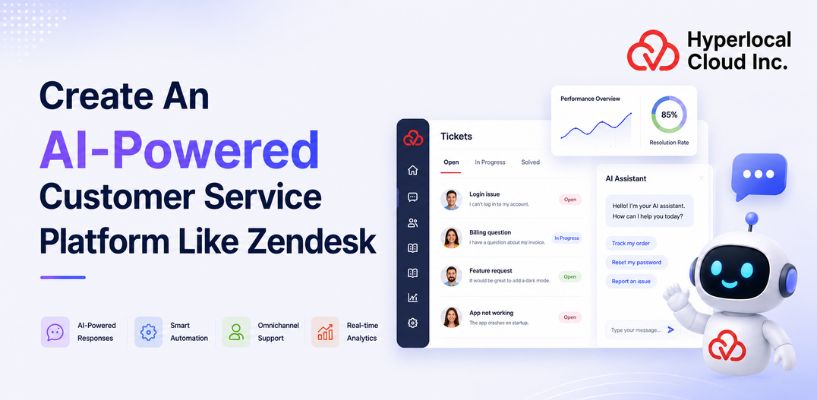
- The customer service platforms with AI-driven technologies will help businesses to automate and deliver a better customer experience to users.
- With the combination of ticket management, AI-driven automation, and self-service tools, a platform like Zendesk is considered a leading customer service platform.
- The rapid utilization of AI-powered technologies has totally transformed the way businesses interact with their customers by providing omnichannel support.
- In order to reduce the overall operational cost, businesses are now looking to invest in an AI-powered customer service platform to maintain high-quality communication.
- Development of a Zendesk-like platform requires a proper integration of AI-centric technologies, customer support features, data analytics functionalities, and cloud infrastructure.
- A fully functional and feature-rich platform helps businesses to handle a large number of customer requests at once.
Customer service has gone through several emerging changes in the past few years. Unlike older days when people usually utilized phone calls or email in order to communicate with customers, now users are looking for instant support. This can be done only with an omnichannel customer service platform that comes with advanced technologies.
Businesses are moving to invest in AI-powered customer service platforms that are integrated with all the necessary technologies like ML, NLP, and automation technologies that can easily streamline and improve overall customer interactions.
An AI-driven customer service platform like Zendesk helps businesses to manage conversations with their customers rather than handling the process manually. Thus, businesses looking to start a startup can easily opt for the customer service platform, as it is the demand of the modern world.
Current Market Trends Driving AI-Powered Customer Service Platforms
- Increasing Demand for Instant Support
- Growing Adoption of Omnichannel Communication
- Rise of Conversational AI
- Focus on Cost Optimization
- Increased Use of Predictive Analytics
- Expansion of Self-Service Solutions
- Data-Driven Customer Experiences
A Complete Definition of Zendesk
Zendesk is a customer service platform that is completely cloud-based and works to help businesses manage, track, and resolve customer queries. The platform supports omnichannel communication, which is why it has become more popular among businesses looking for a reliable and efficient platform to deliver a personalized customer support experience to their users.
The platform acts as a centralized hub where support teams can easily manage customer interactions that typically come from email, live chat, and calls. Thus, this approach makes the platform stand out across industries and customers who are looking for seamless support.
Launch Your AI Customer Service Platform Today
How Does a Platform Like Zendesk Work?
The Zendesk-like platform works to manage the communication between businesses and customers. To know a detailed explanation of the working model of the platform, go through the information below.
1. Capturing Customer Requests
Customer service begins when the customer reaches out to the company through channels that include email, social media, phone calls, or messaging apps. A platform like Zendesk centralizes these communications with the help of messages from multiple channels and brings them right into a seamless interface.
2. Creating and Managing Tickets
Once a customer request is received, the platform automatically converts it into a help ticket. Each ticket serves as a case report and contains important data, including information, communication history, priority level, and current status.
3. Routing and Assignment
After creating a ticket request, the platform determines the most appropriate team or agent to deal with it. Management may be based primarily on predetermined rules of case type, discipline, case preference, or customer preference.
4. Automation and AI
The modern customer support platform relies on AI-driven technologies and automation. Both these functionalities are helpful in improving customer service performance. This simply means that a platform like Zendesk can easily automate the queries and handle them without human intervention.
5. Agent Collaboration and Resolution
Many queries need clear data or input from different sources before they can be resolved. The customer support platform allows businesses to collaborate in order to improve ticket management and communication without exposing customers to internal discussions.
6. Analytics and Reporting
Each user interaction provides valuable information that can be used to improve the platform’s performance. Analytics and reporting help businesses track key metrics such as ticket volume, average response time, patron satisfaction score, and agent productivity.
Benefits of an AI-Powered Customer Service Platform Like Zendesk
An AI-centric customer service platform like Zendesk offers a wide range of benefits to both businesses and customers. This will make the platform more in demand in the market. Have a look at each benefit you can get from the platform.
1. Faster Response Times
One of the biggest benefits of AI-powered customer service systems is the ability to respond to their customers instantly. In traditional support systems, customers often wait for an agent to answer their questions, which, however, causes frustration and reduces patron satisfaction.
2. 24/7 Customer Support Availability
Customers may also need assistance outside of normal business hours. Hiring assistants to provide a 24-hour service can be high-priced and difficult to manage. The AI-driven customer support platform ensures that customers always have access to help when they want it.
3. Reduced Operational Costs
Managing a large customer support team often requires significant funding in terms of staff, training, and infrastructure. However, the platform provides support teams with knowledge to handle more complex queries, reducing human intervention.
4. Improved Customer Experience
The foremost benefit of a customer support platform is that it improves the customer experience by providing them with on-time solutions. Thus, when customers get helpful support, they will remain consistent with your business.
5. Better Ticket Management and Prioritization
Businesses and support teams will get a wide range of ticket requests on a daily basis. However, ticket management manually can be challenging; that’s why the AI-powered customer service platform ensures to prioritize each ticket.
6. Increased Agent Productivity
Support agents typically spend a lot of time resolving customer queries. However, AI automation reduces their workload by automating everything effortlessly. The platform will easily resolve complex queries, too.
7. Data-Driven Decision Making
AI-powered customer support platforms collect and analyze large amounts of interaction information. Businesses can use this information to identify user preferences, understand common issues, provide overall performance support, and improve the user experience.
8. Scalability for Business Growth
As businesses evolve, so do customer service requirements. Traditional customer service programs may also struggle to deal with the queries. The modern world technologies and AI-powered solutions make a customer service platform suitable for startups, medium-sized groups, and large enterprises.
List of AI-Powered Features in a Platform Like Zendesk
Here is a list of the top AI-powered features that enhance the overall functionality of the Zendesk-like platform. Just have a look:
1. AI Chatbots
AI chatbots, the most common feature of the platform that acts as digital assistants in order to interact with customers. The chatbots resolve customer queries and help customers with troubleshooting steps.
2. Intelligent Ticket Routing
AI can regularly analyze incoming requests and assign them to the most appropriate assistant or department. This feature removes manual ticket management and ensures user issues get to the right team quickly.
3. AI-Powered Knowledge Base
A knowledge base allows customers to set responses freely without contacting helpful marketers. AI can suggest relevant articles, publications, and responses primarily based on customer questions and behavior.
4. Sentiment Analysis
Sentiment assessment enables the platform to learn customer sentiment from messages and conversations. The tool can detect whether customers are happy, annoyed, angry, or stressed.
5. AI-Powered Agent Assist
The agent assistant provides real-time advice to support all agents through user interactions. This can provide solutions, knowledge-base accounts, troubleshooting steps, and follow-up transfers as agents interact with customers.
6. Predictive Customer Support
Predictive AI analyzes user behavior and past information to be aware of capacity issues before they arise. Businesses can proactively meet issues and prevent buyer dissatisfaction.
7. Automated Workflow Management
AI-powered workflow automation facilitates the streamlining of repetitive guidance methods. The tool can automate ticket updates, notifications, escalation, and customer survey matches.
8. Voice and Speech Recognition
The feature allows customers to engage with support systems in multiple languages. Speech recognition technology can convert voice calls to text, analyze requests, and resolve queries in real time.
9. Multilingual Customer Support
AI-powered language processing allows companies to help customers from different regions and language backgrounds. The platform can translate messages on a regular basis and provide multilingual communication.
10. AI Analytics and Reporting
AI-powered analytics provide targeted insights into overall customer support performance and user behavior. Businesses can track critical metrics, capture symptoms, and use recommendations to optimize support activities.
11. Conversational AI and Virtual Assistants
Conversational AI enables more natural and human-like patron interactions. Virtual assistants can handle complex conversations, maintain context, and guide users through any support steps. This function also creates an attractive support that users can look forward to.
Build a Smarter Zendesk-Like Platform Powered by AI and Automation
Steps to Build an AI-Powered Customer Service Platform Like Zendesk
For the development of a Zendesk-like platform, businesses are required to follow the steps we have mentioned below. All these steps are useful for the development of a robust and user-friendly customer service platform.
1. Define Your Business Goals and Requirements
The first step is to really define the purpose of your platform. Before you start improving, identify the goals of your platform and determine the needs of your target customers. A clear roadmap makes it easier to ensure successful product development. Proper formulation of plans reduces the risk of correction and allows the creation of a product that matches the market requirements.
2. Conduct Market Research and Competitor Analysis
After defining your preference, analyze existing customer support platforms. Study their skills, strengths, weaknesses, and customer comments. This research helps identify opportunities for innovation and functional improvement.
3. Design the Platform Architecture
The next step is to develop a scalable, bendable platform structure. As customer service organizations deal with vast amounts of data and individual interactions, the infrastructure has to help with the rise of eternity. A robust architecture ensures reliability and scalability.
4. Build an Omnichannel Communication System
Customers communicate in multiple ways, and modern support platforms need to integrate omnichannel support. This will help teams manage all user interactions from a single unified dashboard. This function improves stability and simplifies communication management.
5. Develop AI-Powered Chatbots and Virtual Assistants
AI chatbots are one of the most important components of a platform like Zendesk. These smart assistants can answer user questions and provide product information and manuals to users in a troubleshooting manner. Well-designed chatbots increase customer satisfaction and reduce overall workload.
6. Implement Intelligent Ticket Management
Ticket management serves as the basis for customer service operations that automatically create, prioritize, and manage customer tickets. This ensures that requests for assistance are handled efficiently and appropriately.
7. Integrate a Smart Knowledge Base
The database makes it easier for customers to search for solutions independently. AI can improve this selection by recommending accounts based entirely on customer queries and interaction history. A smarter knowledge base reduces the manual way of ticket management and improves customer comfort.
8. Add Analytics and Reporting Capabilities
Professionals want a unique view of overall customer support performance. Analytics dashboards help businesses monitor key metrics and make informed choices. These insights guide further development efforts.
9. Ensure Security and Compliance
Customer service systems manage sensitive customer statistics, making security a top priority. The platform must have strong security measures to protect customer data. Robust security recognizes customer authenticity and protects commercial business operations.
10. Test, Launch, and Improve the Platform
Before launch, conduct extensive testing to ensure the platform performs reliably under real-world conditions. Testing should cover:
- AI accuracy
- System performance
- Security
- User experience
- Scalability
After launch, continue to gather user feedback and monitor platform performance.
- Post-Launch Improvement Activities
- AI model updates
- Feature enhancements
- Performance optimization
- Customer feedback analysis
- Security updates
Continuous improvement helps the platform remain competitive and relevant in the evolving customer service landscape.
Tech Stacks to Implement in the Development of a Platform Like Zendesk
A complete list of the tech stacks that are utilized in the development of AI-powered solutions is mentioned in the table. All you need to do is review it and implement it according to your business needs. However, all these advanced technologies are helpful in creating a fully functional customer service platform.
| Categories | Tech Stacks |
| Frontend Development Technologies | React.js, Angular, Vue.js |
| Mobile Application Development | React Native, Flutter |
| Backend Development Technologies | Node.js, Java, .NET |
| Database Technologies | PostgreSQL, MySQL, MongoDB, Cassandra |
| Artificial Intelligence and Machine Learning Technologies | TensorFlow, PyTorch |
| Natural Language Processing Technologies | OpenAI Models, spaCy, NLTK |
| Cloud Infrastructure Technologies | Amazon Web Services, Microsoft Azure, Google Cloud Platform |
| Communication and Messaging Technologies | WebSocket, Twilio, SendGrid |
| Analytics and Reporting Tools | Google Analytics, Power BI, Tableau |
| Security Technologies | OAuth 2.0, JWT Authentication, SSL Encryption |
How AI-Driven Technologies Transform Customer Service Platform Development
There are so many ways that AI-driven technologies help transform the overall process of customer support services. Integration of artificial intelligence in the development of a customer service platform completely changes the way businesses or support agents handle customer queries. Here are all the reasons that make AI-powered technologies stand out in the development of a customer service platform you can review.
1. Enhancing Customer Interactions Through Conversational AI
One of the biggest changes provided by artificial intelligence is the advent of conversational AI. This will allow customer support systems to interact with customers in human-like ways. Instead of calculating complete answers based on simple rules, AI structures can recognize customer behavior, capture context, and provide relevant answers.
2. Automating Repetitive Customer Support Tasks
Customer support teams often spend a large portion of their time handling repetitive commitments. This helps companies be mindful of their focus on complex customer problems that require human knowledge.
3. Improving Decision-Making with Machine Learning
ML continuously checks buyer interactions and analyzes based on historical records. This helps businesses make smarter decisions in managing buyer requests.
4. Delivering Personalized Customer Experiences
Modern customers assume that companies understand their priorities and provide relevant assistance. AI technology makes this possible by analyzing consumer behavior, purchase records, previous conversations, and interaction patterns. Using this data, customer support systems can deliver remarkably personalized experiences that make customers feel valued and understood.
5. Strengthening Self-Service Capabilities
AI-driven customer support platforms help users by presenting intelligent self-service tools such as knowledge bases, virtual assistants, automated assistance features, and so on. These functionalities help customers solve unconventional problems independently and quickly.
6. Enhancing Customer Insights Through Data Analytics
Customer interactions generate large amounts of valuable data every day. AI-powered analytics tools help companies to analyze and interpret this data to provide deeper insights into customer behavior and aid performance. These insights enable groups to improve their services and make informed business choices.
7. Enabling Predictive Customer Support
Traditional customer support often involves dealing with problems as they arise. AI-powered predictive assistants take a proactive approach using to identify capacity issues before customers document them. Using historical information and behavioral assessments, AI systems can anticipate future buyer needs and advise on preventative measures.
Create an AI-Powered Support Platform That Works Around the Clock for Customers
Industries Facilitated by an Customer Service Platform Like Zendesk
Customer service is quietly common across industries, which means almost all the niches in the market can benefit from an AI-powered customer service platform like Zendesk. Have a look at the information and understand how versatile the platform is for different industries.
1. E-Commerce and Retail
E-commerce industries deal with a high number of customer inquiries related to their order, deliveries, refunds, returns, and item information. A Zendesk -like platform automates the workload, and with the help of AI-driven technologies, it handles those interactions seamlessly.
2. Banking and Financial Services
Fintech industries often handle customer queries that are related to accounts, transactions, credit cards, loans, and investments. Utilization of the platform can easily handle all these things at once while maintaining security.
3. Healthcare and Telemedicine
Healthcare industries leverage the platform in order to support patients and healthcare professionals. However, with the platform, it will become easier to automate appointments, inquiries, and healthcare information.
4. Travel and Hospitality
Travel and tourism businesses regularly get a wide number of inquiries regarding airlines, hotels, or packages. The Zendesk-like platform acts as a virtual assistant that automates all travel-related inquiries.
5. Software and SaaS Companies
Software companies must provide ongoing support to customers using their products. However, a customer service platform can help manage technical support requests efficiently.
6. Telecommunications
The telecom industry manages user-related queries on a daily basis that are related to billing or network issues. That’s why the industry should use an AI-driven customer service platform to streamline customer interactions by reducing the workload.
7. Education and eLearning
Educational institutions typically require a reliable customer service platform that helps them to manage academic and administrative inquiries, and a Zendesk-like platform stands out in this regard, on which eLearning systems can show trust.
8. Logistics and Supply Chain
The logistics industry uses customer service platforms in order to streamline the process of managing shipment tracking requests, delivery updates, and inquiries. The platform, however, simplifies the communication process.
9. Real Estate
Real estate companies can easily use the customer service platform to automate the overall interaction with buyers, tenants, investors, and sellers. As the platform is AI-powered, it can effortlessly manage all the property-related queries.
10. Media and Entertainment
The media and entertainment industry requires an efficient platform that provides its customers with instant support by managing their inquiries. At this point, the industry should shift toward a modern world customer service platform like Zendesk.
Factors Affecting the Development of a Platform Like Zendesk
While developing a customer service platform like Zendesk, several factors exist that affect the overall performance of the platform. Rather than ignoring these factors, businesses must consider all of them to avoid mistakes and maintain the platform’s quality and performance. Here is a list of all the factors that businesses must know.
1. Integrating Advanced AI Technologies
AI is the main component in the development of a modern world customer service platform. But integration of AI-driven technologies that can easily understand customer requests and provide instant responses requires a lot of experience, data, and regular training.
2. Managing Large Volumes of Customer Data
The customer service platform collects and manages a large amount of information every day, but it will become complex once the platform starts growing. For long-term success or results, it is essential to properly plan data management strategies.
3. Delivering Seamless Omnichannel Support
Customers are relying on several different platforms in order to get an answer to their queries. So creating an omnichannel platform that fulfills the communication needs in a single dashboard can be technically demanding.
4. Ensuring High Scalability
A customer service platform should be capable enough to handle customer queries, tickets, AI requests, and conversations simultaneously. Poor scalability leads to inappropriate performance of the system. Thus, for long-term growth, scalable cloud infrastructure is essential.
5. Maintaining Data Security and Privacy
Customer service platforms often store sensitive customer information, making security one of the most important considerations in development. Security failure may lead to data threats and unwanted breaches.
6. Developing Accurate NLP Models
NLP enables AI systems to understand and respond to human language. However, customers often communicate using different writing styles, slang, abbreviations, and languages. This makes language understanding more challenging.
7. Integrating Third-Party Systems
Most businesses use multiple software solutions such as CRM systems, marketing tools, payment gateways, analytics platforms, and communication applications. A customer service platform must integrate smoothly with these systems.
8. Delivering Consistent User Experiences
Customer service platforms should be easy to use, because a complex workflow or navigation can cause low productivity. User experience design plays a major role in platform success.
9. Managing Development Costs
During the development of an AI-powered customer service platform, investment is required in particular niches such as software development, AI integration, cloud infrastructure, security, and maintenance. Thus, without the planning of a complete roadmap, the cost factor can be a big obstacle during the development process.
Strategies to Earn Money from a Platform Like Zendesk
Numerous strategies exist that help businesses earn money from a platform like Zendesk. We have discussed some of the most common ways that are enough for businesses to boost their income and ROI. Let’s have a look:
1. Subscription-Based Pricing Model
The most common yet effective way to generate income from the customer service platform. In this, businesses pay a certain amount of fees on a monthly or annual basis in order to get full access to the platform and its features.
2. Tiered Pricing Plans
This model is for both startups and well-established businesses, such as those that just want to resolve the customer query, and can get the basic version of the features. Whereas, well-established businesses that want advancement can get AI-powered functionalities in return for a specific amount of fee. Thus, the tiered pricing plans work differently for each business size.
3. Pay-Per-Agent Pricing
Many customer service platforms charge customers based on the number of support agents using the system. As businesses expand their support teams, platform revenue grows accordingly.
4. AI Feature Add-Ons
Businesses that are looking for a premium version of the platform can pay extra for the AI feature add-ons. This is an additional way to generate income via a platform.
5. Custom Integration Services
Many organizations require integrations with their existing software systems. Platform providers can charge fees for developing custom integrations and implementation services.
Launch an Omnichannel Customer Service Platform Built for Business Growth
Bottom Line
The growing demand for customer support platforms encourages businesses to start developing their own Zendesk-like platform. These platforms integrate with modern generation advanced technologies that support automation and omnichannel communication in order to provide a personalized customer experience. To continue with the idea, businesses are required to partner with experienced AI app development companies to get a cutting-edge platform tailored to their business requirements.

Patt Cummins is an experienced content writer with over 10 years of experience creating clear and engaging content for technology-focused industries. He specializes in simplifying complex technical topics into easy-to-understand stories that educate readers, support brand communication, and help businesses effectively share their solutions.

Need Help With
Development?