

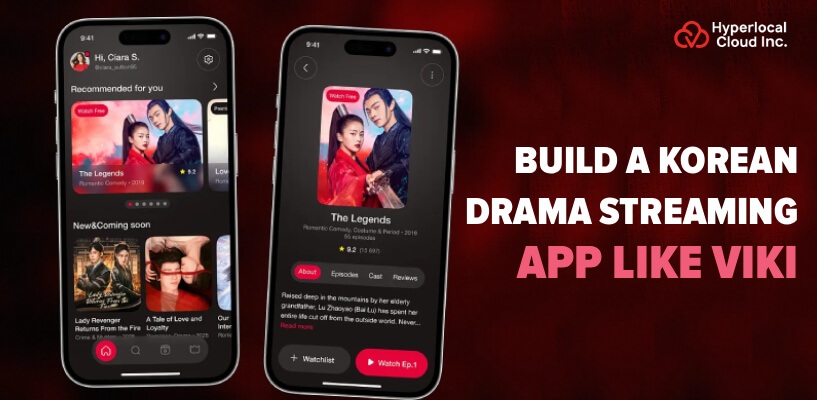
- Build a feature-rich Korean drama streaming app with video streaming, multilingual subtitles, and personalized recommendations.
- Choose a white-label solution starting at $8,000 for web or $12,000 for web + mobile apps.
- Custom development starts at $15,000, depending on features and customization.
- Generate revenue through subscriptions, advertising, rentals, or hybrid monetization.
- Secure content licensing and invest in reliable streaming infrastructure for long-term growth.
Korean dramas have built a global audience among viewers who enjoy engaging storylines, romantic dramas, thrillers, historical series, and diverse Asian entertainment. This growing interest creates opportunities for entrepreneurs and media businesses to launch streaming platforms dedicated to Korean dramas and other international content.
Building a platform like Viki requires more than a video player. It needs a complete streaming ecosystem with user accounts, content discovery, video delivery, multilingual subtitles, subscription management, payment integration, and administrative tools. Businesses must also plan content licensing, platform security, and monetization before launching.
If you want to enter this market, Korean drama streaming app development can help you establish your own branded entertainment platform. You can choose a white-label streaming solution to launch faster with a ready-made solution or invest in custom development to create a platform around your specific business requirements.
In this guide, we explain how to build a Korean drama streaming app like Viki, the essential features, technology stack, development process, monetization strategies, and estimated development costs.
What Is a Korean Drama Streaming App Like Viki?
A Korean drama streaming app is a digital platform that allows users to discover, watch, and enjoy Korean television series, films, and other Asian entertainment through connected devices. Depending on its business model, the platform can offer free content, paid subscriptions, advertisements, or a combination of these options.
A Viki-like streaming platform can serve viewers across multiple countries by providing localized interfaces, subtitle options, personalized recommendations, and convenient access to licensed content.
Businesses can launch these platforms as websites, mobile applications, or complete streaming ecosystems that support web, Android, and iOS users.
How Does Rakuten Viki Work?
Rakuten Viki is an example of a streaming service focused on Asian entertainment, including Korean dramas, Chinese dramas, and other international content. Its platform combines content discovery, video streaming, subtitles, user engagement, and subscription-based access.
A similar platform can include the following capabilities:
- Content library: Organize dramas, films, episodes, genres, and featured collections.
- Video streaming: Allow users to watch available content on supported devices.
- Multilingual subtitles: Help international audiences understand shows in their preferred languages.
- Personalized recommendations: Suggest content based on viewing behavior and preferences.
- Subscription management: Provide premium plans and manage access to paid content.
- Community engagement: Support reviews, watchlists, ratings, and other interaction features.
Your platform can adopt similar functional concepts while maintaining its own brand identity, user experience, content partnerships, and business model.
Difference Between a General OTT App and a K-Drama Streaming Platform
A general OTT platform may distribute content across multiple entertainment categories, such as films, documentaries, sports, and television shows. A Korean drama streaming platform focuses more specifically on Korean entertainment and audiences interested in Asian storytelling.
This specialization creates opportunities to offer curated collections, Korean drama categories, multilingual subtitles, actor-based discovery, and recommendations tailored to K-drama fans.
Launch Your Korean Drama Streaming App
Why Invest in Korean Drama Streaming App Development?
Launching a Korean drama streaming platform can provide businesses with an opportunity to build a specialized entertainment brand. However, success depends on content availability, licensing agreements, audience acquisition, platform quality, and a sustainable monetization strategy.
Growing Interest in Korean Entertainment
Korean entertainment attracts viewers through romance, action, suspense, comedy, historical storytelling, and other genres. A dedicated platform can make it easier for fans to discover relevant shows instead of navigating a broad entertainment catalog.
Businesses can differentiate their services by focusing on specific audiences, exclusive licensed collections, niche genres, or underserved language markets.
Reach an International Audience
A web-based streaming platform can make content accessible to users across different regions, subject to distribution rights and territorial restrictions.
Supporting multiple languages, currencies, payment methods, and subtitle options can improve the experience for international viewers. Businesses can initially focus on one market and expand into additional regions as their content library and operations grow.
Create Multiple Revenue Streams
A Korean drama streaming app can generate revenue through subscriptions, advertising, rentals, premium content, and partnerships.
For example, a business could provide selected episodes for free and charge users for access to premium content. Alternatively, it could offer an ad-free subscription alongside an advertising-supported plan.
The appropriate model depends on audience preferences, content licensing costs, competition, and the expected cost of acquiring and retaining subscribers.
How Does a Viki-Like Streaming App Work?
A streaming platform connects viewers, content owners, payment services, video infrastructure, and administrators through a centralized system.
The process generally begins when users register or open the application. They browse the available catalog, select a show, and start watching content permitted under their access level and geographic rights.
User Registration and Content Discovery
Users can create accounts using email addresses or supported social login options. After registration, they can select preferences, browse categories, save favorite shows, and receive recommendations.
The platform’s search and discovery tools should help viewers find dramas by title, genre, release year, language, cast, and other relevant attributes.
Video Streaming and Subtitle Selection
When a user selects an episode, the streaming system delivers the video through a suitable playback service and content delivery network.
Adaptive bitrate streaming can adjust video quality according to the user’s internet connection and device capabilities. Subtitle controls allow users to choose from available language tracks.
Video availability, playback quality, and subtitle options depend on the content assets and distribution rights secured by the platform owner.
Subscription and Payment Management
If the platform offers premium content, its payment system manages subscription purchases, renewals, cancellations, and access permissions.
The backend verifies whether a user has the required entitlement before granting access to restricted content. Administrators can manage subscription plans, promotional offers, and payment-related settings through the control panel.
Must-Have Features of a Korean Drama Streaming App
A successful Korean drama streaming app needs features that make content discovery simple, video playback reliable, and account management convenient. The feature set should also support the business operations required to manage a growing entertainment catalog.
User Panel Features
1. User registration and login
Provide secure account creation, login, password recovery, and profile management. Social sign-in can reduce registration friction where supported.
2. Personalized home screen
Display featured dramas, recently added episodes, trending titles, and recommendations based on viewing preferences.
3. Advanced search and filters
Allow viewers to search by title, genre, cast, year, language, and availability. Effective filters help users find relevant content more quickly.
4. Video player
Provide playback controls, subtitles, audio options where available, playback progress, and quality selection. Features such as resume watching can improve convenience.
5. Watchlist and favorites
Let users save dramas and episodes to revisit later. Notifications can alert viewers when new episodes become available.
6. Viewing history
Maintain a history of watched content and allow users to resume episodes from their previous stopping point.
7. Subscription management
Allow users to view available plans, update subscriptions, review billing information, and cancel subscriptions according to the platform’s policies.
8. Ratings and reviews
Enable viewers to rate content and submit reviews, subject to moderation rules.
9. Multi-language subtitles
Offer available subtitle tracks in different languages. Subtitle availability depends on the rights and language assets secured for each title.
10. Cross-device access
Support consistent account experiences across the web and compatible mobile applications, including synchronized watchlists and viewing progress where implemented.
Admin Panel Features
The administrator panel helps the business manage content, customers, subscriptions, and platform operations.
Content management: Add shows, seasons, episodes, thumbnails, descriptions, genres, and metadata.
Video management: Upload or connect authorized video assets, manage transcoding workflows, and configure streaming delivery.
User management: Review accounts, handle access issues, and manage account permissions.
Subscription management: Configure plans, pricing, trial periods, promotions, and subscription entitlements.
Payment management: Monitor transactions, payment status, refunds, and billing events.
Analytics and reporting: Track viewing activity, engagement, subscription performance, and content popularity.
Content scheduling: Schedule releases and publish episodes according to availability windows and regional restrictions.
Moderation tools: Review reported content, comments, and other user-generated material.
Security controls: Manage administrative roles, access permissions, audit records, and security settings.
Advanced Features for a Better Streaming Experience
Once the core platform is established, you can introduce advanced capabilities to improve engagement and operational efficiency.
- AI-based recommendations: Suggest dramas based on viewing patterns and user preferences.
- Smart notifications: Notify users about new episodes, upcoming releases, and relevant content.
- Watch parties: Let users watch supported content together with synchronized playback.
- Offline downloads: Allow downloads only where the relevant content agreements and technical protections permit them.
- AI-assisted subtitle workflows: Help prepare or review translations while maintaining human quality control.
- Multi-profile support: Let households maintain separate viewing preferences.
- Smart TV compatibility: Expand access to supported connected television devices.
- Content personalization: Arrange home screens and collections around audience interests.
Start with features that directly support your business model. Additional functionality can be introduced as user demand and revenue justify the investment.
Technology Stack for Korean Drama Streaming App Development
The technology stack influences the platform’s scalability, performance, security, maintenance, and development cost. The right choices depend on the required devices, video workload, expected audience, and available development resources.
Frontend and Mobile App Technologies
The frontend handles the interface users interact with while browsing content and watching videos.
A business can use modern web technologies such as React or Next.js for a web platform. Mobile applications can be developed using native technologies or cross-platform frameworks such as Flutter or React Native.
The choice should consider playback requirements, device compatibility, accessibility, application performance, and long-term maintenance.
Backend, Database, and APIs
The backend manages authentication, catalog information, subscriptions, payment events, recommendations, and user activity.
Possible technologies include Node.js, Python, Java, or other suitable backend frameworks. PostgreSQL and other relational databases can manage structured information, while caching systems can improve response times for frequently requested data.
APIs connect the frontend, backend, payment provider, video service, notification system, and administrative panel.
Cloud Hosting, CDN, and Video Transcoding
Video delivery is one of the most important parts of a streaming platform.
Cloud infrastructure can host application services, databases, content metadata, and related assets. A content delivery network (CDN) helps distribute video to viewers from geographically suitable locations.
Video transcoding converts source files into formats and resolutions appropriate for supported devices and network conditions. Adaptive bitrate streaming technologies, such as HLS or MPEG-DASH, can help provide smoother playback across different connection speeds.
Infrastructure should be planned around expected concurrent viewers, video quality, storage requirements, and geographic reach.
DRM, Streaming Security, and Scalability
A streaming business must protect user accounts, payment information, administrative access, and licensed video content.
Security measures may include HTTPS, role-based access controls, secure authentication, rate limiting, monitoring, and appropriate payment security practices.
Digital rights management (DRM), signed playback URLs, and geographic restrictions can help enforce content access policies when supported by the licensing agreements and playback environment.
The platform should also be designed to handle growing traffic through caching, scalable infrastructure, performance monitoring, and load testing.
Start Your OTT Streaming Business With Our White-Label Solution
How to Build a Korean Drama Streaming App Step by Step
Developing a Viki-like platform requires coordinated planning across business strategy, product design, content acquisition, engineering, testing, and launch operations.
Step 1: Research the Market and Define Your Business Model
Identify your target audience, preferred regions, content categories, and competitors. Determine whether the platform will focus exclusively on Korean dramas or include other Asian entertainment.
Define how users will access content and how the business will earn revenue. These decisions affect the required features, licensing agreements, and technical architecture.
Step 2: Secure Content Rights
Identify content owners, distributors, or authorized licensing partners. Confirm the permitted territories, platforms, languages, distribution periods, and monetization conditions for each title.
Do not assume that publicly available videos can be redistributed through a commercial application. Content rights should be addressed before launch planning is finalized.
Step 3: Choose White-Label or Custom Development
Select a development approach according to your budget, launch timeline, feature requirements, and long-term product goals.
A white-label streaming solution offers a ready-made solution that can be configured for your brand. Custom development is more suitable when you require specialized workflows, unique integrations, or substantial architectural flexibility.
Step 4: Plan UI/UX Design
Create wireframes and prototypes for registration, content discovery, show details, video playback, subscriptions, and account settings.
Keep navigation straightforward and make it easy for viewers to discover new dramas. Design responsive web layouts and device-specific mobile experiences where required.
Step 5: Develop and Integrate Core Features
Implement the frontend, backend, content management system, authentication, video playback, subscriptions, payments, and analytics.
Integrate video hosting, transcoding, and CDN services. Configure subtitles, access permissions, and content availability rules.
The exact development scope will depend on whether you are adapting a ready-made platform or building a custom system.
Step 6: Test the Platform
Test the application across supported browsers, mobile devices, and screen sizes. Verify video playback, subtitle synchronization, account access, payment workflows, and subscription renewals.
Performance testing should assess streaming quality under different network conditions and expected traffic levels. Security testing should cover authentication, administrative permissions, and payment-related workflows.
Step 7: Launch and Maintain the Platform
Deploy the platform, publish authorized content, configure monitoring, and prepare customer support processes.
After launch, track user engagement, viewing completion, subscription conversions, churn, and playback errors. Use these findings to improve the product and prioritize future enhancements.
How Much Does It Cost to Develop a Korean Drama Streaming App?
The cost of Korean drama streaming app development depends on the development approach, supported platforms, streaming functionality, integrations, security requirements, and degree of customization.
For businesses looking to enter the market with a defined starting budget, Hyperlocal Cloud offers the following indicative development options.
White-Label Korean Drama Streaming App Cost
A white-label solution is suitable for businesses that want to launch a branded streaming platform using an existing software solution instead of building every component from scratch.
Hyperlocal Cloud’s starting prices are:
- White-label web streaming platform: $8,000
- White-label web + mobile app solution: $12,000
The $8,000 option is intended for a web-based streaming platform, while the $12,000 option is intended for a broader solution covering the web and mobile app experience.
With a white-label solution, businesses can start with an established solution and configure branding, supported features, and workflows according to the agreed scope.
Potential capabilities include content management, user registration, video playback integration, subscription management, and administrative controls. The exact feature set, integrations, and supported devices should be confirmed in the project proposal.
The final quotation may vary if the business requires additional functionality, specialized integrations, or significant modifications. Video infrastructure, third-party service fees, content licensing, and ongoing operating expenses should also be considered separately unless explicitly included in the agreement.
Why choose a white-label streaming solution?
- Launch using an existing software solution.
- Reduce the need to develop every core component from scratch.
- Establish your own streaming brand.
- Start with a defined initial development budget.
- Customize supported features according to business requirements.
- Plan future improvements as your platform grows.
For startups and businesses validating a streaming concept, a white-label platform can provide a practical starting point without requiring the full investment associated with building a completely new system.
Custom Korean Drama Streaming App Development Cost
Custom Korean drama streaming app development starts from $15,000.
This starting price applies to a defined initial scope. The actual project cost depends on the features, platform coverage, integrations, architecture, and customization requirements.
Custom development can be appropriate for businesses that need a unique user experience, specialized content workflows, advanced recommendation systems, complex subscription rules, or integrations with existing business infrastructure.
The overall investment may increase when the project includes advanced video infrastructure, smart TV applications, sophisticated DRM requirements, extensive localization, offline playback, or complex analytics.
Custom development may also require more planning, design, engineering, and testing than configuring an existing solution.
White-Label vs. Custom Streaming App Development
White-label development is generally the practical option when your priority is a quicker launch and a more predictable starting budget. Custom development is worth considering when your business requires capabilities that cannot be accommodated effectively within the available white-label solution.
Choose a white-label platform when you want to establish your brand, validate demand, and launch with an existing software solution.
Choose custom development when you need extensive control over product behavior, specialized integrations, or a platform architecture designed around distinct requirements.
The best option depends on your actual feature requirements rather than the development approach alone. Request a scope-based proposal before making the final decision.
Factors That Affect Streaming App Development Cost
1. Number of supported platforms: A web-only product has a different scope from a platform covering web, Android, iOS, and smart TVs.
2. Video streaming requirements: Transcoding, adaptive bitrate playback, live streaming, offline downloads, and advanced playback controls affect implementation complexity.
3. Content management: Large catalogs, episode scheduling, metadata management, and regional availability rules can increase the scope.
4. Subscription and payment integrations: Multiple payment providers, billing rules, promotions, refunds, and subscription entitlements require additional work.
5. Localization: Multiple interface languages, subtitle management, translation workflows, and region-specific settings can affect cost.
6. AI and personalization: Recommendation systems, search improvements, and personalization features may require additional data processing and engineering.
7. Security and compliance: Authentication, DRM integrations, administrative access controls, and applicable regulatory requirements influence implementation.
8. Third-party services: Cloud hosting, video delivery, storage, monitoring, and payment services may introduce recurring fees.
Ongoing Costs to Consider
The initial development price is only one part of operating a streaming business. Plan for ongoing expenses such as:
- Cloud hosting and infrastructure.
- Video storage, transcoding, and CDN bandwidth.
- Content licensing and distribution rights.
- Payment processing fees.
- Software maintenance and technical support.
- Security monitoring and updates.
- Marketing, customer acquisition, and customer support.
Actual operating costs depend heavily on video consumption, audience size, content agreements, and the number of supported markets.
How to Monetize a Korean Drama Streaming Platform
A sustainable monetization strategy should balance viewer affordability with the costs of content acquisition, video delivery, customer support, and platform maintenance.
Advertising-Based Video on Demand (AVOD)
AVOD provides free or advertising-supported viewing. Revenue can come from pre-roll, mid-roll, display, or other supported advertising placements.
This model can help attract viewers who do not want to pay for a subscription. However, advertising revenue depends on audience size, viewer engagement, ad demand, and the permitted advertising format.
Subscription-Based Video on Demand (SVOD)
SVOD allows users to pay a recurring fee for access to premium content or additional platform benefits.
You can offer monthly and annual plans, with benefits such as an ad-free experience or access to selected premium titles. Pricing should account for content costs, payment fees, and customer retention.
Transactional Video on Demand (TVOD)
TVOD lets users pay for individual titles, episodes, or defined viewing periods where the content agreements allow it.
This model may work for premium releases or content that viewers want to access without purchasing a full subscription.
Hybrid Monetization Models
A hybrid model combines multiple revenue streams. For example, a platform can offer free ad-supported titles, a premium subscription, and paid access to selected releases.
This approach gives the business flexibility to serve different audience segments, provided the licensing agreements support the intended distribution and monetization methods.
Content Licensing and Legal Considerations
Content rights are essential to operating a legitimate streaming platform. Developing the technology does not automatically provide permission to distribute Korean dramas or other copyrighted entertainment.
Secure Distribution Rights
Work with authorized rights holders, studios, distributors, or licensing partners to obtain permission to stream the intended content.
Review the territories, duration, platforms, monetization methods, language rights, and other conditions covered by each agreement.
Manage Subtitles and Localization Rights
Subtitles and translated materials may have separate ownership or licensing requirements. Confirm that your agreements permit the intended subtitle languages, translation workflows, and commercial distribution.
Protect Copyrighted Content
Use appropriate security controls and supported DRM solutions to help enforce access restrictions. Implement regional availability rules where required by the licensing agreements.
Also establish procedures for handling copyright complaints, content removal requests, and applicable legal obligations in the markets where you operate.
Challenges in Building a Korean Drama Streaming App and How to Overcome Them
Securing Quality Content
Content acquisition can be one of the most significant business challenges. Without an appealing and properly licensed catalog, even a well-built app may struggle to retain viewers.
Solution: Build relationships with authorized distributors, prioritize content that fits your target audience, and plan licensing expenses before committing to a launch schedule.
Delivering Smooth Video Playback
Buffering, playback failures, and inconsistent quality can negatively affect user satisfaction.
Solution: Use suitable transcoding workflows, CDN delivery, adaptive bitrate streaming, monitoring, and performance testing. Plan infrastructure according to expected viewing patterns.
Attracting and Retaining Users
A new streaming service competes for viewers’ time and entertainment budgets. Acquiring subscribers does not guarantee long-term retention.
Solution: Offer effective content discovery, consistent releases, reliable playback, useful recommendations, and transparent subscription plans. Measure retention and viewing engagement to identify improvement opportunities.
Managing Multilingual Content
International audiences may expect subtitles and interfaces in their preferred languages. Poor translations can reduce engagement and make content less accessible.
Solution: Build a structured subtitle management workflow, review translation quality, and prioritize languages based on your audience and content agreements.
Controlling Infrastructure Costs
Video storage, processing, and delivery expenses can grow as viewing hours increase.
Solution: Monitor bandwidth consumption, optimize video encoding, select appropriate cloud services, and track infrastructure costs alongside engagement and subscription revenue.
Build Your Korean Drama Streaming Platform With Hyperlocal Cloud
Future Trends in Korean Drama Streaming Apps
AI-Powered Content Recommendations
Recommendation engines can help users discover shows that match their interests. Better discovery can support engagement, but recommendations should be evaluated using relevant performance metrics rather than assumed to improve retention automatically.
Improved Subtitle and Translation Workflows
AI-assisted translation can help accelerate subtitle preparation. Human review remains important for accuracy, cultural context, character names, and dialogue quality.
Personalized Viewing Experiences
Personalized collections, watchlists, viewing history, and notifications can help viewers navigate large catalogs and return to relevant content.
Cross-Device Streaming
Viewers may expect to switch between mobile devices, browsers, and connected televisions. Consistent account management and synchronized viewing progress can improve convenience across supported platforms.
Data-Driven Content Decisions
Viewing behavior, search activity, subscription conversions, and churn data can help businesses understand audience preferences. These insights can inform content acquisition, release schedules, and marketing campaigns.
Why Choose Hyperlocal Cloud for Korean Drama Streaming App Development?
Launching a streaming platform requires coordination across product development, video integration, user management, payments, and operational planning. Hyperlocal Cloud can help businesses evaluate a suitable development approach based on their requirements.
White-Label and Custom Development Options
Choose a white-label solution for a more direct path to launching your branded platform or custom development for requirements that need a more tailored implementation.
Flexible Platform Scope
Plan a web-only solution or a broader web and mobile application experience according to your audience and business objectives.
Essential Streaming Functionality
Define requirements for content management, user accounts, video playback, subscriptions, payment integration, and administration according to the selected solution and project scope.
Business-Focused Planning
Align feature priorities with your monetization strategy, content acquisition plans, target markets, and launch budget.
Room for Future Enhancements
Plan additional functionality such as advanced recommendations, expanded localization, and new device support as your platform and audience evolve.
If you are planning to launch a Korean drama streaming platform, discuss your requirements with Hyperlocal Cloud to determine the appropriate solution, feature scope, and development estimate.
FAQs (Frequently Asked Questions)

Patt Cummins is an experienced content writer with over 10 years of experience creating clear and engaging content for technology-focused industries. He specializes in simplifying complex technical topics into easy-to-understand stories that educate readers, support brand communication, and help businesses effectively share their solutions.

Need Help With
Development?