

Choosing the right tech stack to build a subscription-based content platform is one of the most important decisions for startups and enterprises entering the subscription economy. From online learning portals and media websites to creator subscription products and SaaS-driven content ecosystems, these platforms are built around a simple idea deliver valuable content behind a recurring payment model. However, unlike traditional websites, they depend heavily on consistent user retention, seamless payments, and controlled content access, making their technical foundation far more critical than it initially appears.
The choice of tech stack in such platforms is not just a development decision it is a business decision. It directly impacts key outcomes such as revenue stability, churn rate, platform scalability, and operational costs. A poorly chosen architecture can lead to issues like slow performance under load, payment failures, or expensive scaling bottlenecks, all of which directly affect user experience and revenue growth. On the other hand, a well-designed stack ensures smooth subscription handling, fast content delivery, and the flexibility to scale as the user base grows.
This guide is designed for founders, CTOs, product leaders, and business stakeholders who are responsible for building or scaling subscription-based platforms. Whether the goal is to launch a lean MVP for market validation or to architect a large-scale system capable of supporting millions of users, understanding the right technology choices early can significantly reduce risk, control costs, and accelerate time to market.
Transform Your Subscription Idea Into a High-performing Platform
Core Business Models That Influence Your Tech Stack
Not all subscription-based platforms are built the same. The underlying business model significantly shapes how your system handles content delivery, user access, payments, and scalability. Choosing the wrong architecture without aligning it to your model often leads to performance bottlenecks, costly rewrites, or monetization limitations later.
Content Subscription Platforms (OnlyFans Style)
These platforms focus on delivering high-volume, media-rich content such as videos, podcasts, or digital libraries. The primary technical challenges here are scalable content delivery, streaming performance, and bandwidth optimization. You typically need a strong CDN strategy, efficient media storage (like object storage), and support for adaptive streaming formats. For businesses looking to build an app like OnlyFans, user experience, especially playback speed and reliability, directly impacts retention and churn.
SaaS + Content Hybrid Platforms (Learning + Tools)
These platforms combine structured content (courses, documentation, training material) with functional software tools. The tech stack must support both content management and application logic, often requiring a more complex backend architecture. You’ll likely need role-based access control, progress tracking, interactive modules, and tight integration between the product layer and content layer. This model benefits from a modular backend design and scalable APIs.
Creator Monetization Platforms (Membership Communities)
Platforms like Fansly enable creators to monetize directly through subscriptions, memberships, and exclusive content. The key technical focus is flexible monetization logic and granular access control. Features like tiered memberships, paywalled posts, community interactions, and real-time notifications are essential. The stack must also handle frequent content updates and dynamic pricing models without breaking the user experience.
Enterprise Knowledge Platforms (Internal Subscriptions)
These are internal-facing systems used by organizations to distribute knowledge, training, or documentation across teams. Unlike consumer platforms, the focus here is on security, permissions, and compliance. The architecture must support strict access control, audit logs, integration with identity providers (like SSO), and high reliability. Scalability is important, but data security and governance are the primary priorities.
How to Choose the Right Tech Stack for Your Business
Choosing the right tech stack for a subscription-based content platform is less about “what is trending” and more about aligning engineering decisions with business outcomes. The wrong choice often leads to either delayed launches (overengineering) or expensive rebuilds (underengineering). A structured evaluation approach helps avoid both.
Key Evaluation Criteria
Before selecting any technology, founders and CTOs should evaluate the platform through these business-critical lenses:
Time-to-Market (Speed vs Scalability Tradeoff):
How quickly do you need to launch? Early-stage validation requires speed, while mature platforms prioritize long-term scalability and maintainability.
Expected User Growth (0–10K vs 1M+ Users):
Your architecture should reflect realistic growth expectations. Designing for millions of users on day one often leads to unnecessary complexity and cost.
Content Type (Video-heavy vs Text-based):
Video-first products, including OnlyFans-like app development projects, require CDN, streaming pipelines, and storage optimization, while text-based platforms can operate with simpler infrastructure.
Monetization Complexity (Simple vs Tiered vs Usage-based):
Basic subscriptions require straightforward billing, but advanced models (tiered pricing, usage-based billing, and trials) require more robust subscription management systems.
Internal Team Capability (Junior Developers vs Senior Architects):
The stack must match your team’s ability to maintain and scale it. Overly complex systems without experienced engineers lead to technical debt.
Recommended Stack Based on Business Stage
The ideal tech stack for a subscription-based platform should align with your business goals, content type, and expected user growth. Instead of following trends, choose technologies that support scalability, performance, and a seamless subscription experience from day one.
Early-Stage MVP (Validation Phase):
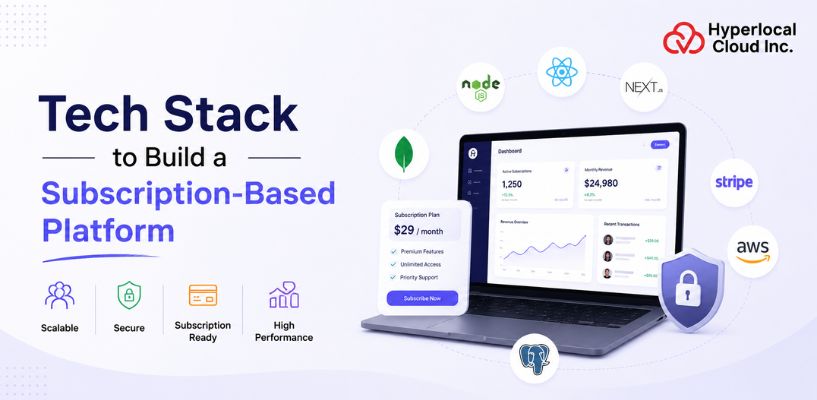
Next.js + Node.js + PostgreSQL + Stripe
Focus is on rapid development, simple architecture, and fast market feedback. A modular monolith works best here.
Growth Stage (Scaling Users & Revenue):
Microservices + Redis + CDN + Event Queues
At this stage, performance optimization, caching, and system decoupling become important to support increasing traffic and subscription volume.
Enterprise Stage (Large-Scale Platforms):
Kubernetes + Distributed Services + Multi-region Databases
Designed for high availability, global user bases, fault tolerance, and strict SLAs across services.
Decision Framework (Simple Rule of Thumb)
Instead of overanalyzing technologies, most platforms can be guided by a simple decision model:
If you are validating an idea → use a speed-first stack
Prioritize fast development, simple architecture, and quick deployment over scalability.
If you are scaling revenue → focus on performance and billing robustness
Ensure your system can handle growth in users, payments, and content without breaking.
If you are enterprise-ready → prioritize security and modular architecture
Focus on compliance, system reliability, and long-term maintainability over speed.
One of the most critical decisions in building a subscription-based content platform is understanding the difference between a true MVP architecture and a prematurely “over-scaled” system. Many startups fail not because they build too little, but because they build too much, too early, slowing down validation and increasing costs without adding real business value.
Launch Your Content Subscription Platform Faster With Expert Developers
MVP vs Scalable Architecture: What Should You Build First?
An MVP (Minimum Viable Product) is not a low-quality system—it is a focused, functional architecture designed for fast learning and rapid iteration.
In the context of a subscription-based platform, MVP-ready means:
1. A working end-to-end subscription flow (signup → paywall → access → content delivery)
2. A simple but reliable monolithic or modular backend
3. Basic role-based access control (admin, user, creator)
4. A functional payment integration (Stripe or Razorpay)
5. A straightforward content management approach (basic CMS or database-driven content)
The goal is not architectural perfection; it is market validation with minimal engineering overhead. Every component should exist only if it directly contributes to user acquisition, retention, or revenue generation.
Complete Tech Stack to Build a Subscription-Based Content Platform
Once the business model and architecture direction are clear, the tech stack becomes an execution blueprint rather than a set of isolated technology choices. For subscription-based content platforms, the goal is to build a stack that supports fast development, reliable monetization, and scalable content delivery without unnecessary complexity in the early stages.
| Layer | Recommended Technologies | Purpose |
| Frontend | Next.js, React | User interface and SEO |
| Backend | Node.js (NestJS), FastAPI | Business logic and APIs |
| Database | PostgreSQL, Redis | Data storage and caching |
| Storage | AWS S3 | Media and file storage |
| CDN | Cloudflare | Faster global content delivery |
| Payments | Stripe, Razorpay | Subscription billing |
| Infrastructure | AWS, GCP | Hosting and scaling |
Cost of Building a Subscription-Based Platform
Understanding cost is not just a budgeting exercise; it is a strategic decision driver that influences how fast you can launch, how aggressively you can scale, and how much technical debt you are willing to accept early on. For subscription-based platforms, costs vary significantly based on complexity, team structure, and scalability expectations.
MVP Cost Range
At the MVP stage, the focus is on validating the business model, not building a perfect system. Costs are typically driven by speed of execution and minimal viable features such as authentication, subscription flow, content delivery, and basic admin tools.
$8,000 – $20,000 (outsourced MVP)
Suitable when working with a development agency or small product team to deliver a functional, production-ready MVP within a short timeline (6–12 weeks).
$3,000 – $15,000/month (team-based MVP)
Applicable when hiring freelancers or a lean in-house team. Costs depend heavily on developer experience, geography, and development speed.
At this stage, spending should be optimized for speed to market and validation, not architectural perfection.
Scalable Product Cost
Once the platform moves beyond validation and starts focusing on growth, the cost structure increases significantly due to requirements like scalability, security, performance optimization, and system reliability.
$25,000 – $50,000+
This range typically includes:
1. Scalable backend architecture (modular or microservices-based systems)
2. CDN and advanced content delivery setup
3. Robust subscription and billing systems with edge-case handling
4. DevOps, CI/CD pipelines, and infrastructure automation
5. Performance optimization for high user concurrency
6. Enhanced security and compliance measures
At this stage, investment is no longer just about building features—it is about ensuring revenue stability and system resilience under scale.
Get Expert Guidance to Develop a Scalable Subscription Platform
How Long Does It Take to Build a Subscription Platform?
Building a subscription-based content platform involves more than developing features—it requires careful planning around architecture, integrations, testing, and deployment. The overall timeline depends on factors such as project scope, customization requirements, third-party integrations, team size, and the level of scalability required. Starting with a lean MVP allows businesses to validate their idea quickly before investing in advanced capabilities.
As the platform matures, development efforts shift toward improving performance, reliability, security, and infrastructure to support a growing user base. This phased approach helps control development costs, reduces technical risks, and ensures the platform can evolve alongside business growth.
| Development Stage | Estimated Timeline | Primary Focus |
| MVP |
6–12 weeks |
Core features, rapid launch, market validation |
| Growth-Ready Platform |
3–6 months |
Performance optimization, scalability, advanced subscription features |
| Enterprise Platform |
6–12+ months |
High availability, security, global scalability, and complex integrations |
Common Mistakes That Kill Subscription Startups
Many subscription platforms struggle not because of a lack of demand, but because of avoidable technical and product decisions made early in the development process. Identifying these mistakes before development begins can save months of rework and significantly reduce costs.
Overengineering the architecture: Building microservices, Kubernetes, or complex distributed systems before validating the product increases development time and maintenance costs without delivering immediate business value.
Ignoring subscription billing edge cases: Failing to account for payment retries, failed transactions, upgrades, downgrades, cancellations, and renewals can lead to revenue leakage and poor customer experiences.
Weak paywall enforcement: Inadequate access control can expose premium content to unauthorized users, directly impacting subscription revenue.
Poor onboarding experience: Complicated sign-up and payment flows increase user drop-offs and reduce subscription conversion rates.
Choosing technologies based on popularity instead of business needs: Selecting a tech stack because it’s trending, rather than because it fits your team’s expertise and product requirements, often creates unnecessary complexity and technical debt.
How to Choose the Right Development Partner for Your Subscription Platform
If you’re planning to outsource development or work with a technology partner, choosing the right vendor is just as important as selecting the right tech stack. A capable development partner should understand both the technical and business aspects of subscription-based platforms.
Before making a decision, evaluate whether the vendor can answer yes to the following questions:
1. Do they have experience building subscription-based platforms, not just general web applications?
2. Can they design and implement recurring billing, payment retries, and subscription lifecycle management?
3. Have they built secure paywall and content access control systems?
4. Do they have expertise in video streaming, CDN integration, and scalable content delivery if your platform includes media content?
5. Will they provide architecture documentation, API documentation, and deployment processes?
6. Do they offer post-launch maintenance, performance optimization, and scaling support as your platform grows?
7. Can they demonstrate relevant case studies, technical expertise, and a clear development methodology?
Choosing a partner with proven experience in subscription platforms can reduce project risks, accelerate time to market, and ensure your platform is built to support long-term business growth.
Choose the Right Technology Stack and Build a Subscription Platform Ready to Scale
Final Thoughts
Choosing the right tech stack for a subscription-based content platform is about much more than selecting popular technologies. Every decision—from frontend frameworks and backend architecture to payment systems and cloud infrastructure—should align with your business goals, expected user growth, and monetization strategy. A well-planned technology foundation not only accelerates development but also reduces long-term maintenance costs and prepares your platform for future scaling.
For most startups, the smartest approach is to build a lean MVP using a proven, scalable stack, validate the business model, and then invest in architectural improvements as the platform grows. Avoid overengineering in the early stages, prioritize a seamless subscription experience, and partner with experienced developers who understand recurring billing, content delivery, and platform scalability. By making informed technology decisions from the outset, you can build a subscription platform that delivers a great user experience, supports sustainable growth, and generates long-term recurring revenue.

Patt Cummins is an experienced content writer with over 10 years of experience creating clear and engaging content for technology-focused industries. He specializes in simplifying complex technical topics into easy-to-understand stories that educate readers, support brand communication, and help businesses effectively share their solutions.

Need Help With
Development?