


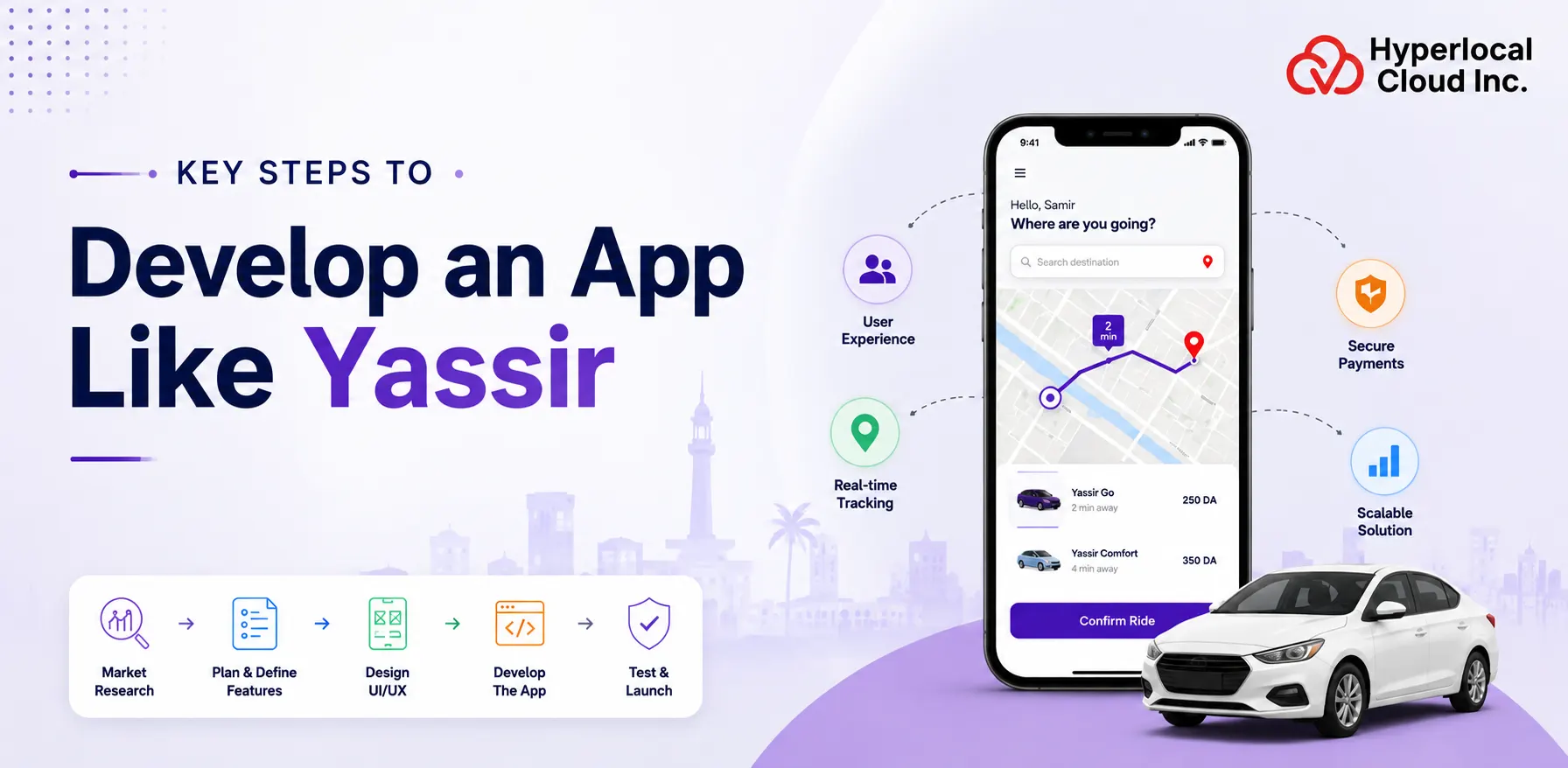
- Yassir is a multi-service super app combining ride-hailing, food delivery, grocery shopping, payments, and business services.
- Its all-in-one model gives users convenient access to multiple everyday services through a single mobile platform.
- The growing adoption of smartphones, digital payments, and mobile-first services is creating opportunities for super apps across Africa and MENA.
- Businesses can build a Yassir-like app by integrating essential services, location-based features, secure payments, real-time tracking, and personalized user experiences.
- Multiple revenue streams, including commissions, delivery fees, service charges, subscriptions, and business partnerships, can support long-term growth.
The traditional methods used by individuals for different services are being transformed by the evolution of digitalization. This means that, in the past few years, one app was used to book a ride, one for food delivery, and another to buy groceries. This approach has been completely revolutionized by super apps, also known as all-in-one applications, which are popular for bringing all the required services together on one platform.
In this market, the Yassir application secured a place and became the most demanding application among users. According to a study by Grand View Research, the managed services market is valued at $401.2 billion in 2025, projected to grow to $437.3 billion in 2026, and expected to reach $847.4 billion by 2033, at a CAGR of 9.9% from 2026-2033.
However, businesses that are ready to initiate their business journey by developing their own application similar to Yassir can review the blog to get to know about its development method, cost, features, advanced integrations, future trends, and monetization strategies.
What Is a Super App Like Yassir?
A super app is a mobile application that provides several different services through one platform. Instead of downloading and managing many separate apps, users can access a range of everyday services from a single application. Yassir follows this model by combining transport, food, grocery, payment, and other services. This makes the app more than just a ride-hailing or delivery platform. It works as a wider digital platform that can support several parts of a user’s daily routine.
How Does a Yassir-Like App Work?
A Yassir-like super app connects multiple everyday services on one platform, simplifying access, payments, bookings, and deliveries while creating a seamless user experience.
1. The User Creates an Account
The user downloads the app and creates an account using their phone number, email address, or basic information, including required details. Once the account is created, the same access can be used for various offers on the platform.
2. The User Selects a Service
After logging in, the user can select the service they want. Depending on the market, it can be an experience booking, food delivery, grocery purchase, or payment.
3. The Platform Connects the User With a Service Provider
Once a user has selected a provider, the platform connects them with the appropriate service company. For travel, this will mean having a driver nearby. For food delivery, that can mean connecting the consumer with the restaurant and delivery company. For grocery stores, the platform lets shoppers sign up with retailers and distribution partners.
4. The Service Is Managed Through the App
Once the provider is displayed, the person can control it from the same utility. They may be able to see the provider’s location, check the order status, receive updates, or contact the current supplier.
5. Payment Is Completed
After the trip ends, the individual pays through the platform’s supported payment methods. Depending on the market, options may include digital wallets, cards, currencies, or neighborhood value options.
6. The Platform Stores the Service History
The platform can often store advance notifications about tours, reservations, payments, and other services. This allows customers to explore their history and helps provide a more personalized experience on the platform.
Turn Your Super App Idea Into Reality With Expert Development Support
What Makes Yassir-Style Platforms Different?
Yassir-like platforms stand out by combining diverse services, localized solutions, convenient payments, and a unified user experience within one scalable digital ecosystem.
1. Multiple Services Under One Application
One of the biggest differences is the number of services available through a single application. A Yassir-style platform can combine services such as ride-hailing, food delivery, grocery delivery, payments, and business solutions. The exact services can vary by market.
2. One Registration and Authentication System
Another important feature is a common registration and login system. In a Yassir-style platform, users can create one account and use it across the available services. They do not need to register separately for ride booking, food delivery, grocery shopping, and other services.
3. Integrated Payments
Payments are another major part of a super app. A Yassir-style platform can connect its payment system with several services. This means users can pay for different products and services without leaving the application.
4. Real-Time Tracking
Real-time tracking is especially important for services such as ride-hailing and delivery. When a customer books a ride, they may want to know where the driver is and how long it may take to arrive. Similarly, a food or grocery customer may want to see the progress of their delivery.
5. Shared Customer Data and Profiles
A super app can also use a shared customer profile across its different services. When a customer uses several services on the same platform, the application can keep relevant information connected to their account. This may include saved addresses, previous orders, preferred payment methods, service history, and other user preferences.
6. Centralized Promotions and Loyalty
Another feature that can make a Yassir-style platform different is the ability to manage promotions and loyalty programs across several services. A traditional application may offer discounts only for its main service. A super app can potentially connect promotions across different parts of its ecosystem.
Business Benefits of an All-in-One Super App
An all-in-one super app can expand revenue opportunities, improve customer retention, increase cross-service engagement, and help businesses build a stronger presence in competitive markets.
1. Diversified Revenue
One of the biggest benefits of a super app is that it can create multiple revenue streams. A single-service platform may depend mainly on one type of transaction. For example, a ride-hailing business may earn money from ride bookings. If demand for rides falls, the business may see a direct impact on its revenue.
2. Improved Customer Lifetime Value
Customer lifetime value refers to the total value a customer can bring to a business during the time they continue using its services. A super app can increase this value by giving customers more reasons to return to the same platform.
3. Lower Customer Acquisition Costs
Acquiring a new customer can require significant investment. Businesses may spend on advertising, promotions, discounts, partnerships, and other marketing activities to attract new users. A super app can make better use of each customer it already has.
4. Centralized Operations and Analytics
A super app can bring different business operations together under one technology platform. Instead of maintaining completely separate systems for every service, the business can create shared systems. This can make it easier for the company to manage its growing operations.
5. Scalable Marketplace Infrastructure
A super app can be built using a shared technology foundation that supports several services. This can make it easier for the business to expand as it grows. New services can then connect to the existing platform instead of building an entirely separate digital system from the start.
6. Stronger Customer Engagement
A super app can give businesses more opportunities to stay connected with their customers. When an application provides only one service, customers may open it only when they need that particular service. A ride-hailing application, for example, may be used mainly when someone needs transportation.
Services You Can Include in a Yassir-Like Super App
From ride-hailing and food delivery to grocery shopping, logistics, payments, and other on-demand services, businesses can customize offerings around their target audience.
1. Ride-Hailing Services
Ride-hailing can be one of the main services in an all-in-one super app. Through this service, customers can request a ride from their current location to their preferred destination. The platform can connect the customer with an available driver nearby.
2. Taxi Services
Taxi services can be another useful part of a super app. While taxi and ride-hailing services may appear similar, they can work with different types of service providers and business models. A platform can connect users with licensed taxi drivers or taxi companies, letting customers request a taxi through the app.
3. Food Delivery
Food delivery is another popular service that can fit naturally into a super app. Through the application, users can browse restaurants, check menus, select meals, place orders, make payments, and track deliveries.
The platform can connect three main groups:
- Customers
- Restaurants
- Delivery partners
4. On-Demand Delivery
On-demand delivery allows customers and businesses to send products or packages from one location to another. This service can be useful for individuals and businesses. A customer may need to send a package across the city, while a local business may need a delivery partner to take an order to its customer.
Essential Features for a Yassir-Inspired Super App
Essential features should prioritize convenience, reliability, security, and smooth navigation, ensuring users can discover services, place orders, make payments, and track activities effortlessly.
Customer-Side Features
1. One Account for all Services
Allow customers to use one account and login details to access every service available on the platform.
2. Service Marketplace/Home Screen
Provide a simple home screen where customers can easily view and select different services.
3. Search and Filters
Help customers quickly find the right service, restaurant, product, or provider by using search options and filters.
4. Location Services
Use location technology to identify the customer’s position and provide accurate pickup/delivery and service options.
5. Booking/order Management
Allow customers to easily create, view, change, cancel, and manage their bookings or orders.
6. Real-Time Tracking
Let customers follow their ride, delivery, or order in real time and view its expected arrival time.
7. Secure Payments
Provide secure payment options that let customers pay for services without leaving the app.
8. Wallet
Give customers a digital wallet where they can add funds, make payments, receive refunds, and manage their available balance.
9. Promo Codes
Allow customers to apply promotional codes and receive discounts on eligible services or orders.
10. Loyalty/Rewards
Reward regular customers with points, discounts, special offers, or other benefits based on their activity.
11. Ratings and Reviews
Allow customers to rate services and providers and share feedback about their experience.
12. Push Notifications
Send timely updates about bookings, orders, payments, promotions, and other important account activities.
13. In-App Support
Give customers access to help and customer support directly within the application.
Provider-Side Features
1. Profile and Verification
Allow providers to create profiles and submit the required documents for identity and service verification.
2. Availability Management
Let providers set their working status, available hours, and service availability from the app.
3. Request Management
Allow providers to receive, accept, reject, and manage incoming ride, delivery, or service requests.
4. Navigation
Provide route and navigation support so providers can easily reach pickup, delivery, and customer locations.
5. Earnings
Give providers a clear view of their earnings from completed rides, deliveries, or other services.
6. Payouts
Allow providers to view their payout information and receive their earnings through supported payment methods.
7. Performance Analytics
Show providers useful information about their completed requests, earnings, ratings, and overall performance.
8. Ratings
Allow providers to view customer ratings and feedback so they can understand and improve their service quality.
9. Notifications
Send providers alerts about new requests, booking changes, payments, promotions, and other important updates.
10. Support
Provide an easy way for providers to contact the platform and receive help with account, service, payment, or technical issues.
Admin Features
1. Centralized Dashboard
Give administrators a single dashboard to manage and view services, users, providers, and business activities.
2. Real-Time Operations Monitoring
Allow administrators to monitor rides, deliveries, orders, providers, and other activities in real time.
3. User/Provider/Merchant Management
Provide tools to create, update, verify, suspend, and manage customer, provider, and merchant accounts.
4. Pricing Controls
Allow administrators to set and adjust service prices, fees, surge pricing, delivery charges, and other pricing rules.
5. Commission Management
Enable the business to set, manage, and track commissions charged to providers, merchants, or other partners.
6. Financial Reporting
Provide detailed reports on revenue, payments, commissions, refunds, payouts, and other financial activities.
7. Marketing Tools
Give administrators tools to create promotions, discounts, promo codes, campaigns, and customer offers.
8. Analytics
Provide reports and insights about users, bookings, orders, revenue, service performance, and customer activity.
9. Content Management
Allow administrators to manage application content such as banners, service information, offers, announcements, and help pages.
10. Fraud and Risk Monitoring
Help administrators identify unusual activity, suspicious transactions, fake accounts, payment risks, and other potential security issues.
Start Building Your Multi-Service App With Essential Features Today
Advanced Features to Make the Super App Competitive
Advanced capabilities such as AI personalization, smart recommendations, real-time analytics, automation, loyalty programs, and intelligent routing can significantly strengthen competitiveness and user engagement.
1. AI-Powered Recommendations
AI can observe consumer behavior and opportunities to suggest applicable rides, restaurants, merchandise, offers, or deals based on what customers are likely to need.
2. Intelligent Driver/Order Matching
A smart matching tool can connect customers with suitable drivers or transportation partners based on region, availability, distance, and leading calls.
3. Dynamic Pricing
Dynamic pricing can manage fares or supplier charges primarily based on calls, availability, distance, time, and neighboring market conditions.
4. Demand Forecasting
Demand forecasting can use past interests and current trends to predict which and more drivers, delivery partners, or services may be needed.
5. Personalized Offers
The platform allows customers to offer support entirely based on their service records, preferences, regions, and past interests, rather than displaying the same offers for everyone.
6. Route Optimization
Route optimization can help drivers and delivery partners identify suitable routes that can reduce travel time, distance, fuel consumption, and delivery delays.
7. Fraud Detection
Fraud detection systems can detect unusual account interests, suspicious invoices, fake orders, and other patterns that may indicate fraudulent behavior.
8. Automated Customer Support
AI-powered assistance can resolve common buyer questions, provide order updates, handle simple issues, and transfer more complex issues to salespeople for human assistance.
9. Predictive Delivery ETAs
Predictive ETA generation can estimate arrival events by considering factors such as distance, visitors, weather, road conditions, and current popularity.
10. Multi-Language Support
Multilingual support allows customers, sellers, and merchants to use the platform in their preferred language, making the app easier to use in specific marketplaces.
11. Multi-Currency Support
Multi-Currency Guide: We display the platform fees and process invoices in specific currencies when the company operates in multiple international locations.
12. Subscription Plans
Membership plans may offer benefits to regular customers, including reduced carriage fees, reduced service prices, unique gifts, or discounts on changes to regular charges.
13. Loyalty Programs
Loyalty apps can encourage customers to maintain their use of the platform by helping them earn points, discounts, rewards, or special benefits when they complete eligible transactions.
14. Corporate Accounts
Corporate loans can help companies manage worker trips, deliveries, invoices, spending limits, and travel excursions through linked corporate profiles.
Top Integrations in the Development of An App Like Yassir
Integrating payment gateways, maps, communication tools, analytics, cloud services, CRM systems, and third-party APIs helps create a connected, reliable, and scalable super app.
1. GPS Integration
GPS integration allows the application to understand the real-time location of drivers and delivery partners. This information can be used for driver matching, trip tracking, delivery tracking, route planning, and estimated arrival times.
2. Cloud Integration
Cloud services can provide the computing power and storage needed to operate a large super app. A cloud-based setup can help the platform manage user accounts, service data, transactions, images, documents, and other information while allowing the technology infrastructure to grow as the number of users increases.
3. AI and Machine Learning Integration
AI and machine learning services can support advanced features such as personalized recommendations, demand forecasting, intelligent matching, fraud detection, dynamic pricing, and automated support.
Key Steps to Develop an App Like Yassir
Successful development requires market research, service planning, UI/UX design, technology selection, development, testing, deployment, and continuous optimization based on user feedback and analytics.
1. Define the Business Model
The first step is to outline how a good app will function as a business. The business needs to decide which customers it wants to serve, what services to provide, how to make money, and which markets to invest in. A clean business model lets the improvement team know what helps the software.
2. Conduct Market and Competitor Research
It is important to consider the target market and existing competition before starting development. Research can help the company to know about customer expectations, popular services, pricing, cost options, neighborhood guidelines, and features offered using competitive structures. This research can help the consumer understand gaps and opportunities in the marketplace.
3. Select the Services for the MVP
A good app can ultimately consist of multiple offerings; however, launching everything without delay can make development intensely valuable and difficult to manage. That is why teams must first decide which services to include in the MVP. Starting with a smaller set of proposals is easier to scale before the idea is tested, feedback is gathered, and the platform grows.
4. Design the User Experience
For a first-class app, the user experience is especially important, as customers can also access many unique offers. The work should make it clear to users what they are able to do and how to access each mobile phone company. While the platform offers many features, setup should be easy. Clients should have the ability to go through multiple levels and not perform unusual responsibilities.
5. Choose the Technology Stack
The technology stack includes programming languages, frameworks, databases, cloud offerings, and various technologies used to build the platform. The right choice depends on project duration, expected site traffic, development budget, security needs, market tools, and sustainability plans.
6. Build the Core Architecture
Once the development team has selected the right technology, it can start building the central structure. The structure acts as the muse for a quality app. It helps the different components on the platform communicate with each other. A well-thought-out structure can also make it less difficult to add new offerings in the future without redesigning the entire application.
7. Develop the Customer App
The buyer application is the part of the platform users engage with immediately. It should allow customers to register, select services, order or reserve, pay, track services, manipulate their profiles, and contact support. Usability should be tested on devices and operating systems used by the target market.
8. Develop Driver/Delivery Partner Applications
Drivers and transportation partners need their own utilities or interfaces to manage their tasks. Provider-side software needs to create and validate profiles, manage availability, accept requests, accept or decline delivery tasks, use navigation, track revenue, and manage payments.
9. Develop Merchant/Restaurant Interfaces
Whether the platform includes food delivery or other border services, merchants and restaurants will want their own interfaces. These interfaces allow organizations to manage their profiles, upload products or menus, update prices, receive orders, track order reputation, manage availability, and view revenue statistics.
10. Build the Admin Panel
The admin panel provides business management over the entire wonderful app. Administrators must be able to manipulate customers, drivers, shipping companies, merchants, services, reservations, payments, quotes, and help requests from a central device.
Yassir Clone App vs. Building a Custom Super App
When planning a Yassir-like platform, businesses usually have two broad development approaches. They can use a Yassir app clone solution as a starting point, or they can build a fully custom super app from the beginning.
About Yassir-Like App
A Yassir-like app is a ready-made or pre-built solution inspired by the leading features of a platform like Yassir and its commercial enterprise version. Instead of building every feature from the ground up, the company starts with the existing foundation and adapts it to its needs.
Benefits of a Yassir Clone App
- Faster development
- Lower initial development cost
- Pre-built features
- Useful for testing an idea
Limitations of a Yassir Clone App
- The possibilities for changing middleware functions on a commercial enterprise platform may be even less. Some well-designed solutions won’t help specific business enterprise policies or advanced features without additional enhancements.
- Code niceness, protection, scalability, integration, and technical support can vary between clone providers. For a company that wants to build a large, properly differentiated, gorgeous app, these limitations can matter even more as the platform grows.
About Custom Super App
A custom high-quality app is designed specifically for a business and its target market. Instead of starting with a well-built clone, the beta team designs the platform around the company’s business model, services, customers, and long-term goals.
Benefits of Building a Custom Super App
- Complete flexibility
- Better scalability
- Unique user experience
- Custom integrations
- Long-term control
Limitations of a Custom Super App
- The bottom line is that improving practice usually takes more time, planning, and funding.
- The business needs to design, expand, test, stabilize, release, and maintain specific platform elements.
- It may additionally require a larger development team with talent in mobile improvements, backend systems, cloud infrastructure, databases, payments, cards, security, and other areas.
Common Challenges in Super App Development & How to Overcome Them
Scalability, security, complex integrations, performance, and regulatory requirements can create challenges, making careful architecture, robust testing, monitoring, and experienced development essential.
| Challenges | What it Causes | How to Overcome |
| Managing Multiple Service Workflows | Each service, such as ride-hailing, food delivery, and package delivery, can have different booking, order, payment, and cancellation processes. Managing them all in one platform can become difficult. | Build a flexible system where each service can have its own workflow while still using shared features such as accounts, payments, notifications, and support. |
| Maintaining Consistent UX | Customers may use several services within the same app, and a different design or process for every service can make the platform confusing. | Create common design rules for navigation, buttons, colors, forms, payments, and other important parts of the application while allowing each service to have the features it needs. |
| Real-Time Location Accuracy | Ride-hailing and delivery services depend on accurate location information, but GPS signals can sometimes be affected by buildings, poor network connections, or device settings. | Use reliable location services, update location data regularly, handle weak signals properly, and combine location data with route and traffic information where needed. |
| Driver/Provider Availability | Customers expect to find an available driver or delivery partner quickly, but providers may not always be available in the required area. | Use availability tracking, smart matching, incentives, and demand information to encourage providers to work in areas with high service demand. |
| Demand and Supply Balancing | Too many service requests with too few providers can lead to delays, while too many providers with low demand can reduce provider earnings. | Use demand forecasting, intelligent matching, dynamic pricing where suitable, and real-time monitoring to maintain a better balance between demand and supply. |
| Payment Failures | Payments may fail because of poor network connections, expired cards, bank issues, incorrect payment details, or problems with payment providers. | Support multiple payment methods, provide clear error messages, retry failed transactions safely, and maintain proper payment records and refund processes. |
| Fraud Prevention | A large platform may face fake accounts, suspicious payments, false bookings, promotional abuse, and other types of fraud. | Use identity checks, transaction monitoring, fraud detection tools, account protection, and manual review for unusual or high-risk activity. |
| High Transaction Volumes | As the number of users grows, the platform may need to handle many bookings, orders, payments, location updates, and other activities at the same time. | Build a scalable backend, use suitable cloud infrastructure, improve database performance, and regularly test the platform under high loads. |
| Data Synchronization | Different services need to share information correctly, such as user details, order status, payments, locations, and availability. Incorrect or delayed data can create a poor customer experience. | Use reliable APIs, well-designed databases, event-based systems where appropriate, and proper checks to keep information accurate across different parts of the platform. |
| Customer Support at Scale | As the number of users and services increases, customer questions and complaints can also rise quickly. | Provide self-service help, automated support for simple questions, clear issue categories, and trained support teams for problems that need human assistance. |
Ready to Overcome Super App Challenges? Start Building With Experts Today
Future Scope of a Multi-Service Super App
The future of multi-service apps lies in AI-driven personalization, digital payments, automation, connected services, and emerging technologies that continuously enhance convenience and customer experiences.
1. AI-Powered Personalization
By learning from user activity and preferences, artificial intelligence can make first-class apps more personalized. Instead of showing the same offers to everyone, the platform can suggest services that are more relevant to each buyer.
2. Autonomous and Optimized Logistics
As the generation evolves, logistics can become more automated. Super apps can leverage AI, route optimization, automation, and other technologies to improve how deliveries are planned and completed.
3. Smart Mobility
The future of mobility may go beyond traditional ride-hailing and taxi services. A fantastic app can provide unique transportation options and help customers choose the first class they need.
4. Embedded Financial Services
Payments may be a bigger part of the Super App experience. Instead of using the most efficient fee to run a ride or food system, the structure can also provide additional financial services where policy and market conditions allow.
5. Connected Commerce
Super apps can combine certain parts of e-commerce within a single platform. Customers can create products, reserve zones, make payments, and launch ships without switching to multiple applications.
6. Subscription Ecosystems
Subscription plans can become an important part of the best app release. Instead of paying for a single benefit, customers can enroll in a plan that offers many benefits in one type of deal.
7. Hyperlocal Services
Super apps can also extend offers that are gently linked to the shopper’s immediate location. Hyperlocal services can include local grocery delivery, pharmacy delivery (where permitted), home services, nearby couriers, and various neighborhood-based services.
8. Business-to-Business Services
The future of great apps is not limited to individual customers. Businesses can also use these platforms for transportation, delivery, worker travel, payments, logistics, and various day-to-day operations.
9. Automated Customer Support
AI can also change the way customer service works. Instead of needing an agent to answer every simple question, an automated support system can handle common requests, including checking order status, clarifying payment issues, or providing order information.
10. Predictive Demand Management
The best apps of the future can use AI and information assessment to anticipate demand before it happens. The platform can track factors that include previous calls, time of day, region, weather, events, holidays, and other useful data.
Why Choose an Experienced App Development Partner?
An experienced development partner brings technical expertise, proven methodologies, industry knowledge, and scalability-focused solutions, helping reduce risks while accelerating the journey from concept to launch.
1. Experience with Marketplace Applications
A multi-service super app works like a marketplace because it connects different user groups. An experienced development partner should understand how these different groups interact and how the platform needs to manage their activities.
2. Expertise in Real-Time Systems
Real-time features are important for services such as ride-hailing and delivery. An experienced team should know how to build systems that can handle real-time location updates, booking changes, notifications, and other time-sensitive activities without creating delays.
3. Payment Integration Capabilities
Payments are a major part of a super app because users may need to pay for several different services. The development partner should have experience integrating payment gateways, digital wallets, cards, and other payment methods that are relevant to the target market.
4. Cloud and DevOps Expertise
A super app needs reliable infrastructure because it may need to handle a large number of users, bookings, orders, payments, and location updates. Cloud and DevOps expertise helps the development team build infrastructure that can scale as the platform grows in popularity.
5. Security Knowledge
A super app can handle sensitive information such as customer details, payment information, location data, provider documents, and business records. Security should therefore be considered from the beginning of development rather than added only after the application is completed.
6. Cross-Platform Development Experience
A super app may need to work across different devices and operating systems. Cross-platform development helps businesses create applications that work across multiple platforms while sharing much of the development work.
7. Post-Launch Maintenance
The development process does not end when the application is launched. A development partner that provides post-launch maintenance can help keep the application stable and up to date as the business grows.
8. Ability to Build Modular, Scalable Architecture
A super app may start with only a few services but can grow into a much larger platform. The development partner should therefore build the application in a modular way. This means different services and functions can be developed and improved without affecting the entire platform.
9. Understanding of Multi-Sided Platforms
A super app serves several groups at the same time. An experienced development partner should understand how to balance these different requirements while keeping the platform easy to use.
How to Earn Money from A Super App Like Yassir?
A super app can generate revenue through commissions, service fees, subscriptions, advertising, premium features, partnerships, and transaction-based models tailored to different services and markets.
1. Commission from Drivers
The platform can take a commission from each completed ride or booking made through the service. For example, when a customer pays for a ride, a percentage of the transaction can go to the platform while the remaining amount is paid to the driver, based on the agreed business model.
2. Commission from Restaurants/Merchants
Food delivery and marketplace services can generate revenue by charging restaurants or merchants a commission on orders completed through the platform.
3. Delivery Fees
The platform can charge customers a delivery fee when they order food, groceries, packages, or other products.
4. Booking/Service Fees
A platform can charge an additional service or booking fee for certain transactions. This fee can help cover operating costs, including technology, customer support, payment processing, and other services.
5. Surge or Dynamic Pricing
During periods of high demand, the platform may adjust prices based on demand and provider availability.
6. Advertising
Advertising can create another revenue stream for a super app. Restaurants, stores, brands, and other businesses can pay to promote their products or services to relevant customers within the platform.
7. Sponsored Listings
Restaurants, merchants, and service providers can pay to appear in more visible positions within search results or service listings.
8. Subscription Memberships
The platform can offer subscription plans that provide customers with regular benefits. Depending on the services available, membership benefits could include reduced delivery fees, special ride prices, exclusive offers, loyalty rewards, or other discounts.
9. Premium Services
A super app can offer premium versions of selected services for customers who are willing to pay more.
10. Corporate Accounts
Businesses can use the platform for employee transportation, deliveries, business travel, and other services. The super app can charge companies based on their usage or offer corporate plans with specific features.
How Much Does It Cost to Build an App Like Yassir?
The development of an all-in-one app like Yassir starts at $8,000, which is a rough estimate. Due to the involvement of several cost-influencing factors, the overall cost can be estimated by an experienced and reliable custom software development company. That’s why businesses are required to consult with the provider first before investing in the application.
Factors Affecting Development Cost
- Number of Services
- Number of Applications Required
- UI/UX Complexity
- Technology Stack
- Backend Architecture
- Third-Party Integrations
- Payment Infrastructure
- Real-Time Tracking
- Admin Dashboard Complexity
- Security and Compliance
- Development Team’s Location and Expertise
- Post-Launch Maintenance
Get a Tailored Cost Estimate Based on Your Super App Requirements
Conclusion
Building a Yassir-like super app is a major technology and business project. The platform needs to bring different services together while providing a simple experience for customers, drivers, delivery partners, restaurants, merchants, and business users. Choosing an experienced development partner can make an important difference.

Patt Cummins is an experienced content writer with over 10 years of experience creating clear and engaging content for technology-focused industries. He specializes in simplifying complex technical topics into easy-to-understand stories that educate readers, support brand communication, and help businesses effectively share their solutions.

Need Help With
Development?