

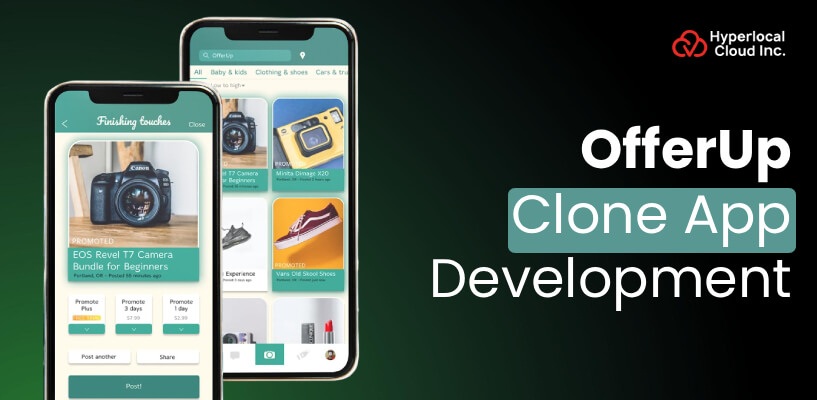
Launch your own online marketplace with an OfferUp clone app that enables users to buy, sell, and discover products through a convenient digital platform. Hyperlocal Cloud helps businesses explore marketplace software solutions designed around their branding, business model, and target audience.
Whether you want to create a local classified marketplace, a secondhand goods selling platform, or a peer-to-peer shopping app, choosing the right development approach can help you establish your presence in the online marketplace industry.
With an OfferUp clone app, you can build a platform where buyers discover products, sellers publish listings, and users communicate to complete transactions. Depending on your requirements, you can choose a white-label solution for a faster launch or custom app development for more specialized functionality.
What Is an OfferUp Clone App?
An OfferUp clone app is a buy-and-sell marketplace application inspired by the core functionality of platforms like OfferUp. It allows users to list products, browse available items, communicate with sellers, and arrange purchases through a centralized digital marketplace.
Businesses can use this type of application to create platforms for secondhand products, electronics, furniture, clothing, collectibles, and other consumer goods. Depending on the business model, the marketplace can focus on a particular city, serve a wider geographic area, or target a specific product category.
An OfferUp clone app can include buyer and seller interfaces, product listing management, location-based search, messaging, notifications, and an administrative dashboard. Additional features can be configured or developed according to the selected software solution and project requirements.
For entrepreneurs, startups, and established businesses, an OfferUp-like marketplace provides an opportunity to build a branded platform without relying exclusively on third-party marketplaces to reach customers.
Ready to Build Your Own Social App?
How Does an OfferUp-Like Marketplace Work?
An OfferUp-like marketplace connects buyers and sellers through a structured digital experience. The typical workflow includes the following steps:
-
User registration: Buyers and sellers create accounts and complete the required profile information.
-
Product listing: Sellers upload product images, descriptions, prices, and relevant categories.
-
Product discovery: Buyers search for items, apply filters, and browse listings based on their preferences or location.
-
Buyer-seller communication: Interested buyers contact sellers through messaging or other supported communication features.
-
Purchase coordination: Users agree on pricing, delivery, shipping, or local pickup arrangements, depending on the marketplace model.
-
Transaction completion: Buyers and sellers complete the purchase using the supported payment or exchange process.
-
Feedback and moderation: Reviews, reports, and administrative controls help support marketplace quality and user trust.
The exact workflow depends on whether your marketplace supports in-app payments, offline transactions, shipping, or local meetups.
Who Can Benefit From an OfferUp Clone App?
An OfferUp clone app can support different business models and customer segments.
-
Startups and entrepreneurs: Launch a branded marketplace without building every standard marketplace component from scratch.
-
Local businesses: Create a digital platform for buying and selling products within a specific community.
-
Resale businesses: Connect sellers of pre-owned products with buyers looking for affordable alternatives.
-
Niche marketplace operators: Focus on categories such as electronics, furniture, fashion, sports equipment, or collectibles.
-
Established companies: Expand existing commerce operations with peer-to-peer listings or localized marketplace services.
The best business model depends on your target market, product categories, seller acquisition strategy, and monetization plan.
Essential Features of an OfferUp Clone App
A successful buy-and-sell marketplace needs more than product listings. It should provide a convenient experience for buyers, practical tools for sellers, and sufficient administrative control to manage marketplace operations.
When planning OfferUp clone app development, organize features into three main areas: the buyer application, seller functionality, and admin dashboard.
Buyer App Features
User registration and profile management
Allow users to create accounts, manage profile details, update preferences, and access their activity history. Supported sign-in methods can be selected according to the project’s requirements.
Product discovery and advanced search
Help buyers find relevant items through keyword searches, categories, location filters, and sorting options such as price or listing date.
Detailed product listings
Display product images, descriptions, prices, condition, seller information, and location details to help buyers evaluate listings.
In-app messaging
Enable buyers to ask sellers about product availability, condition, pricing, and collection arrangements without switching between applications.
Favorites and saved listings
Allow users to bookmark products and revisit listings they may want to purchase later.
Ratings and reviews
Where appropriate, let users share feedback about completed interactions to support transparency and improve marketplace confidence.
Seller App Features
Product listing management
Enable sellers to create listings, upload images, add descriptions, set prices, and select relevant categories.
Inventory and listing controls
Give sellers the ability to edit listings, update availability, mark items as sold, and remove products that are no longer available.
Buyer communication
Provide tools for responding to inquiries, discussing prices, and coordinating pickup or delivery.
Sales and activity tracking
Offer visibility into listing views, inquiries, and sales-related activity where supported by the platform.
Listing promotion
Allow sellers to purchase optional promotional placements or featured listings if these monetization features are enabled.
Admin Panel Features
User management
Review accounts, manage reported users, and enforce marketplace policies.
Product moderation
Review listings, remove prohibited content, and manage reported products.
Category management
Organize product categories, subcategories, and marketplace attributes.
Marketplace analytics
Monitor listings, registrations, engagement, and other available performance indicators.
Transaction management
Review relevant payment or transaction records when supported by the business model.
Reports and dispute management
Provide processes for reviewing complaints, handling reported activity, and maintaining marketplace standards.
The final feature set should be defined according to the chosen white-label package or custom development scope.
Advanced Features to Make Your OfferUp Clone Stand Out
Once the core marketplace functionality is established, additional capabilities can improve product discovery, user experience, and operational efficiency.
AI-Powered Product Recommendations
Recommendation functionality can suggest relevant products based on browsing behavior, saved listings, categories, and user preferences. The objective is to help buyers discover suitable items without manually searching through every listing.
Location-Based Product Discovery
Location-based search allows buyers to find products in selected cities, neighborhoods, or nearby areas. Distance filters and map-based browsing can make local buying and selling more convenient.
Secure Payments and Transaction Management
For marketplaces that support online transactions, payment integration can help manage checkout, payment confirmation, refunds, and transaction records. The selected payment provider and applicable compliance requirements should be considered during implementation.
User Verification and Fraud Prevention
Verification workflows, reporting tools, suspicious activity monitoring, and listing moderation can help reduce fraudulent behavior. These capabilities should complement clear marketplace policies and appropriate customer support processes.
Real-Time Chat and Push Notifications
Messaging and notifications help buyers and sellers respond to inquiries, receive listing updates, and stay informed about relevant marketplace activity.
AI-Based Listing Moderation and Search
AI-assisted tools can help categorize listings, identify potentially inappropriate content, and improve search relevance. Their accuracy, review requirements, and availability depend on the chosen implementation.
White-Label OfferUp Like App Solution
A white-label OfferUp-like solution enables businesses to launch their own branded marketplace using an existing software solution. Rather than developing every standard feature from scratch, businesses can configure available functionality, apply their branding, and adapt supported features to their business requirements.
For startups and entrepreneurs, this approach can reduce the amount of initial engineering work required to establish a marketplace. It also provides an opportunity to focus on business planning, seller onboarding, customer acquisition, and marketplace growth.
Hyperlocal Cloud’s white-label OfferUp app offering should be evaluated according to its actual feature set, customization options, deployment model, and included services.
Key Benefits of a White-Label OfferUp App
Faster route to market
An existing software solution can reduce the time required to build standard marketplace functionality compared with developing the entire platform from the beginning.
Reduced initial development effort
Core components may already be available, reducing the need to create common features such as product listings, user accounts, and administrative tools from scratch.
Custom branding
Businesses can establish their own marketplace identity through supported branding options, including the application name, logo, and visual design.
Configurable marketplace functionality
Available features and settings can be adapted to match the target audience, product categories, and operating model, subject to the solution’s capabilities.
Room for future enhancements
As the business grows, additional integrations and features may be introduced if supported by the software architecture and development scope.
Who Should Choose a White-Label Solution?
A white-label solution is particularly suitable for businesses that want to launch a marketplace using established functionality rather than investing in a completely bespoke application.
It may be the right choice if you have a clearly defined target audience, your required features align with the existing product, and you want to concentrate your resources on building marketplace participation.
Custom OfferUp-Like App Development
Custom OfferUp-like app development is an alternative for businesses that require a marketplace designed around specialized business processes, unique user experiences, or functionality beyond what an existing solution provides.
Instead of starting with a fixed software solution, the development team defines the architecture, features, interfaces, integrations, and workflows according to the approved project requirements.
This approach offers greater control over the product but generally requires more planning, development effort, testing, and investment.
Benefits of Custom Marketplace App Development
Tailored user experience
Design buyer, seller, and administrative interfaces around your audience’s needs, branding, and preferred customer journey.
Specialized marketplace workflows
Create business-specific listing rules, approval processes, product attributes, or transaction flows that fit your operating model.
Custom integrations
Integrate selected payment providers, shipping services, CRM systems, analytics tools, and other third-party platforms as required.
Greater architectural control
Select technical components and architecture based on your performance, security, integration, and scalability requirements.
Unique marketplace functionality
Develop features that distinguish your platform from competing marketplaces, such as specialized discovery experiences or industry-specific selling tools.
When Should You Choose Custom Development?
Custom development may be appropriate when your business needs complex workflows, proprietary functionality, specialized integrations, or technical requirements that an existing product cannot meet.
It can also be a suitable option for established companies with detailed product specifications and a long-term development roadmap.
However, custom development should not automatically be considered the better option. If existing white-label software already meets your needs, a fully bespoke build may introduce unnecessary cost and complexity.
Launch Your Marketplace With a White-Label Solution
How Much Does It Cost to Develop a Buy and Sell Marketplace App Like OfferUp?
The cost of developing a buy and sell marketplace app like OfferUp depends on your business model, required features, customization needs, and technology requirements. Whether you want to launch quickly with a ready-made solution or build a platform from scratch, choosing the right development approach can help you manage your budget and launch timeline.
White Label App Like OfferUp – Starting at $8,000
A white label app like OfferUp starts at $8,000 and is an ideal option for businesses that want to launch a buy and sell marketplace without the time and expense of building everything from scratch.
With a white label solution, you can use a ready-made marketplace foundation and customize it with your brand identity, logo, colors, and selected features. The platform can include essential functionalities such as user registration, product listings, search filters, in-app chat, seller profiles, and listing management.
This approach helps reduce initial development costs and speeds up time to market, making it suitable for startups, entrepreneurs, and businesses looking to establish their own marketplace.
What you get with a white label solution:
- Ready-made buy and sell marketplace functionality
- Custom branding and UI adjustments
- Buyer and seller profiles
- Product listing and search functionality
- In-app messaging and listing management
- Faster deployment compared with building from scratch
Custom Buy and Sell Marketplace App Development – Starting at $15,000
Custom buy and sell marketplace app development starts at $15,000 for businesses that need a platform designed around their specific requirements. Unlike a white label solution, custom development involves building and tailoring the marketplace architecture, features, workflows, and integrations to match your business goals.
This option is suitable for businesses that require unique marketplace functionality, specialized user journeys, advanced integrations, or greater control over future product development.
The final cost depends on the complexity of the application, the number of platforms, third-party integrations, security requirements, and ongoing scalability needs.
What you can include with custom development:
- Custom-designed buyer and seller experiences
- Unique product listing and discovery features
- Advanced search, filters, and recommendation capabilities
- Custom chat, notifications, and transaction workflows
- Third-party payment and identity verification integrations
- Tailored admin dashboard and analytics
- Scalable architecture based on business requirements
White Label vs. Custom Marketplace App Development: Which Is Better?
If your priority is to launch quickly while keeping the initial investment manageable, a white label marketplace app starting at $8,000 can be the right choice. It provides a ready-made foundation that can be branded and configured for your business.
However, if you have a unique business model or need specialized functionality that goes beyond the available solution, custom development starting at $15,000 may be more suitable.
Before choosing, evaluate your feature requirements, launch timeline, and long-term business objectives. Both approaches can help you launch a marketplace like OfferUp, but the best option depends on how much customization and control your business needs.
Note: The prices above are starting estimates. The final project cost may vary depending on the selected features, platform coverage, integrations, and customization requirements.
Factors That Affect Marketplace App Development Costs
Feature complexity: Basic listings and search generally require less work than complex payment workflows, advanced recommendations, or multi-step verification.
Platform coverage: Developing for Android, iOS, and web can require additional design, engineering, and testing effort.
Design requirements: A standard interface configuration differs in cost from a fully bespoke user experience.
Third-party integrations: Payment providers, maps, messaging, analytics, and shipping services may involve integration fees or usage charges.
Security and testing: Authentication, access controls, data protection, and quality assurance are important parts of a production-ready marketplace.
Maintenance and upgrades: Hosting, software updates, technical support, and new features should be included in the long-term budget.
How to Optimize Your OfferUp Clone Development Budget
Start by defining the minimum set of features needed to validate your marketplace idea. Prioritize registration, listings, search, communication, and the administrative tools required to operate the platform.
Evaluate white-label software before commissioning a fully custom build. Compare the total cost of ownership rather than looking only at the initial price, and account for licensing, integrations, maintenance, and future changes.
For custom projects, request a scope-based estimate and separate essential launch features from enhancements that can be introduced later.
Monetization Models for an OfferUp-Like Marketplace
A buy-and-sell marketplace can generate revenue through several models. The best choice depends on transaction volume, seller needs, customer expectations, and the level of value provided by the platform.
Commission on Transactions
Charge a percentage or fixed fee on eligible transactions processed through the marketplace. This model works best when transactions can be reliably tracked, and the platform provides meaningful transaction services.
Featured and Promoted Listings
Allow sellers to pay for increased listing visibility, featured placement, or promotional campaigns.
Seller Subscription Plans
Offer paid subscription tiers with benefits such as enhanced listing limits, seller analytics, or additional business tools.
In-App Advertising
Generate revenue through relevant advertising placements, provided they do not undermine the browsing experience.
Premium Seller Tools
Offer optional services such as enhanced storefronts, performance reports, or bulk listing management for professional sellers.
Technology Stack for OfferUp Clone App Development
The technology stack should reflect the marketplace’s functional requirements, expected traffic, integrations, security needs, and long-term maintenance strategy.
Frontend and Mobile App Technologies
Choose suitable mobile or cross-platform technologies based on platform coverage, user experience requirements, and the existing software architecture.
Backend and Database Architecture
The backend manages user accounts, product listings, search operations, messaging, permissions, and other marketplace functions. Database choices should reflect the application’s data model and expected workload.
Cloud Infrastructure and Security
Cloud infrastructure can support application hosting, storage, monitoring, and scaling. Security planning should include authentication, access controls, data protection, backups, and appropriate monitoring.
Payment, Maps, and Messaging Integrations
Integrate relevant services according to the business model. These may include payment gateways, mapping services, push notifications, and real-time communication tools.
The final technology stack should be confirmed against the actual Hyperlocal Cloud offering or the proposed custom implementation rather than presented as a guaranteed list of existing capabilities.
Launch Your Own Buy-and-Sell Marketplace With Hyperlocal Cloud
Our OfferUp Clone App Development Process
A structured implementation process helps businesses establish clear requirements, control project scope, and prepare for launch.
Requirement Analysis and Planning
Define the target audience, marketplace model, product categories, essential features, monetization approach, and operational requirements.
UI/UX Design and Branding
Establish the visual identity and user journeys for buyers, sellers, and administrators. For white-label projects, this stage may involve configuration rather than designing every interface from scratch.
Software Configuration or Custom Development
Configure existing functionality for a white-label solution or develop the approved features for a custom project.
Integration and Quality Testing
Test user journeys, listing management, search, messaging, permissions, supported payment flows, and relevant integrations.
Deployment and Launch
Prepare the production environment, complete deployment checks, and establish the processes required to operate the marketplace.
Maintenance and Ongoing Improvements
Monitor performance, resolve issues, apply updates, and prioritize enhancements based on user feedback and business objectives.
Why Choose Hyperlocal Cloud for OfferUp Clone App Development?
Selecting a marketplace software provider requires evaluating the product’s capabilities, flexibility, implementation process, and ongoing support arrangements.
Hyperlocal Cloud can position its OfferUp clone offering around the specific capabilities available in its product and the requirements of businesses planning to launch a buy-and-sell marketplace.
Ready-Made Marketplace Solution
An existing software solution can help businesses avoid recreating standard marketplace components when those capabilities already meet their requirements.
Customization Based on Business Requirements
Evaluate the available branding, configuration, integration, and extension options to determine how closely the solution can match your intended business model.
Flexible Marketplace Features
Select and prioritize functionality according to your target audience, operating model, and planned monetization strategy.
Deployment and Technical Assistance
Clarify the provider’s deployment services, technical support arrangements, maintenance scope, and responsibilities before starting the project.
Scalable Marketplace Development Options
Choose an implementation approach that accommodates current needs while allowing for future improvements where supported by the architecture.
FAQs (Frequently Asked Questions)

Patt Cummins is an experienced content writer with over 10 years of experience creating clear and engaging content for technology-focused industries. He specializes in simplifying complex technical topics into easy-to-understand stories that educate readers, support brand communication, and help businesses effectively share their solutions.

Need Help With
Development?