


Entering the international money transfer market sounds straightforward until the real work begins. Payments must move securely, currencies must convert accurately, KYC and compliance checks must happen at the right points, and the entire experience must still feel simple for the customer.
That is where the choice between building from scratch and using white-label money transfer software starts to matter. If you’re planning to build an app like Wise, this guide covers the features, development costs, technology, compliance, revenue models, and practical steps to take the idea from concept to launch.
What Is a White Label Wise App?
A white label money transfer software gives a business a pre-built foundation for launching its own Wise-like transfer platform. Instead of developing every component from scratch, the solution comes with core functionality such as multi-currency wallets, KYC and AML checks, FX rate integration, payment processing, transaction management, and an admin dashboard. The branding, supported currencies, markets, and business rules can then be customized before launch.
The important part is ownership. This is not a SaaS subscription where the provider keeps control of the platform. Once the project is completed, the business receives full ownership of the customized solution and its source code. That gives the business greater control over future customization, integrations, maintenance, and product growth.
Launch Your Wise-Like Money Transfer App Faster With Our White-Label Solution Today
Why Businesses Are Investing in Creating an App Like Wise
Cross-border payments still have plenty of room for improvement. The Bank for International Settlements notes that international payments generally lag domestic payments on cost, speed, access, and transparency because they involve multiple participants, currencies, jurisdictions, and compliance requirements.
That gap creates an opportunity for fintech businesses. A well-designed Wise Clone App can target specific markets, support multiple currencies, and give customers a simpler way to move money internationally.
1. Cross-Border Payment Demand Is Growing
International payments are becoming increasingly important for individuals and businesses operating across borders. At the same time, the World Bank tracks remittance pricing across 377 country corridors, covering 48 sending countries and 111 receiving countries.
For fintech businesses, this creates room to build services around specific corridors, customer groups, or regional payment needs.
2. There Is Still a Cost and Speed Problem
The opportunity isn’t simply about moving money from one country to another. Cost, speed, and transparency remain major pain points. The BIS says cross-border payments continue to be more costly, slower, and less transparent than domestic payments.
A platform that improves these areas can compete on a very practical value proposition: clearer pricing, faster transfers, and a smoother customer experience.
3. Payment Infrastructure Is Becoming More Connected
Payment systems are also moving toward greater interoperability. The BIS reports that fast-payment systems are increasingly being linked across borders, while APIs are becoming an important part of payment data exchange.
That makes modern money transfer platforms more adaptable. As the business expands into additional markets, it can connect new payment rails, banking partners, currency services, and APIs.
4. Multiple Revenue Streams
A money transfer platform doesn’t have to rely on a single income source. Revenue can come from transfer fees, FX margins, business accounts, subscriptions, premium services, and bulk payment solutions.
The right model depends on the target market and customer segment. A platform serving freelancers may take a different approach from one focused on international businesses or remittance customers.
What Features Should an App Like Wise Have?
A Wise-like platform needs a focused set of features covering onboarding, currencies, transfers, payments, compliance, and administration. The exact combination depends on the markets, currencies, and customer segments the business plans to serve.
1. User Registration and KYC Verification
A smooth onboarding flow should cover account creation, document verification, liveness checks, and sanctions screening. Integrations with providers such as Jumio, Veriff, or Sumsub can automate much of the KYC process.
2. Multi-Currency Wallet
A multi-currency wallet lets customers hold, send, receive, and convert different currencies from one account. The wallet connects with the platform’s ledger and FX system to keep balances and transactions accurate.
3. International Money Transfers
Customers should be able to select the currencies, enter recipient details, review the applicable rate and fees, and initiate a transfer from one place. Supported payout methods can include bank accounts, mobile wallets, cards, or local payment rails, depending on the corridor.
4. Real-Time Exchange Rates
The transfer screen should clearly show the exchange rate, fees, and final amount before the transaction is confirmed. FX rate integrations can provide current rates, while rate locking can keep the quoted amount consistent during the transfer window.
5. Multiple Payment Methods
Bank transfers, debit cards, and local payment methods can give customers more ways to fund a transfer. Options such as SEPA Instant and Pix may also be relevant when entering specific markets.
6. Recipient and Beneficiary Management
Customers can save frequently used recipients instead of entering their details for every transfer. Business accounts may also need beneficiary verification, role-based access, and approval workflows.
7. Transfer Tracking
Customers should be able to follow a transfer from initiation to completion through clear status updates. Depending on the payment infrastructure, the app can also show whether a bank or payment partner is currently processing the transaction.
8. Transaction History and Statements
A detailed transaction history keeps previous transfers, fees, exchange rates, recipients, and reference numbers in one place. Downloadable statements can also support accounting, reconciliation, and financial reporting.
9. Smart Notifications
Push notifications, email, or SMS can keep customers updated about transfers, payments, verification requests, and account activity. Currency alerts can also notify users when a preferred exchange rate reaches a chosen level.
10. Admin Dashboard
The admin dashboard gives the operations team control over users, transactions, KYC status, pricing, currencies, corridors, and reports. A configurable setup also makes it easier to adjust pricing or add supported corridors without changing the core code.
11. Security and Fraud Monitoring
Security measures can include multi-factor authentication, encryption, device verification, transaction limits, sanctions screening, and suspicious-activity monitoring. Behavioral analytics and machine-learning models can add another layer of fraud detection as transaction volumes increase.
How Does a Multi-Currency Money Transfer App Like Wise Work?
An app like Wise works by combining currency conversion, payment processing, identity verification, compliance checks, and international transfer infrastructure into a single transaction flow. From the customer’s perspective, the process is straightforward: select the currencies, enter the amount and recipient details, review the exchange rate and fees, and make the payment. Behind that simple experience, several systems coordinate to validate the transaction and move the funds to the recipient.
Typical Money Transfer Flow
Sign Up → KYC Verification → Enter Transfer Details → Exchange Rate & Fee Calculation → Payment → Compliance Checks → Transfer Processing → Recipient Receives Funds → Transaction Confirmation
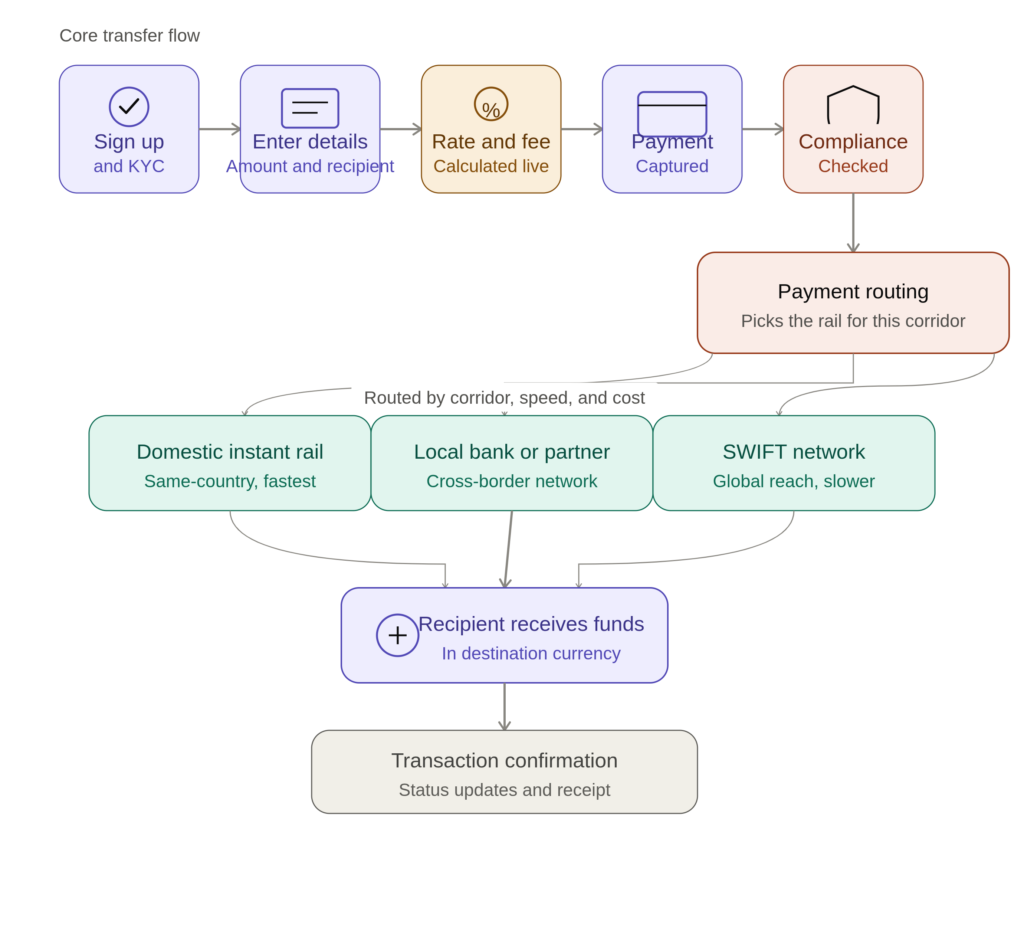
The exact flow depends on the countries, currencies, payment methods, and financial partners involved. This matters most when developing a Multi Currency Money Transfer App, as different payment corridors can have their own processing requirements, regulations, fees, and settlement timelines.
Get Your Wise Clone App Developed With Complete Source Code Ownership
How to Build an App Like Wise With White Label Software?
A Wise Clone App Development project starts with a pre-built money transfer platform, but the launch still requires careful planning. The business needs to define its markets, currencies, compliance requirements, payment infrastructure, pricing, and customer experience before the platform goes live.
With white-label money transfer software, development focuses on configuring and customizing the existing platform, connecting the required financial services, and tailoring it to the business model. Here are the Steps to follow:
Step 1: Define Your Business Model and Target Customers
Start by deciding who the platform will serve and what type of money movement you want to support. You might target individual remittance customers, freelancers, international businesses, expats, or a combination of customer groups.
This decision affects the features, currencies, payment methods, pricing structure, and compliance setup you will need. For example, a platform serving businesses may require multi-user accounts, beneficiary approvals, bulk transfers, and transaction reporting.
Step 2: Choose Your Launch Markets and Payment Corridors
Decide which countries you will support at launch and where customers will send or receive money. Each corridor can have different currencies, payment rails, settlement processes, fees, and regulatory requirements.
Start with a manageable number of high-value corridors instead of opening every market at once. Once the initial setup is stable, you can add new countries, currencies, and payout methods.
Step 3: Map Licensing and Compliance Requirements
Money transfer businesses need to understand the regulatory obligations attached to their operating model and target markets. This can include KYC, AML, sanctions screening, transaction monitoring, data protection, record-keeping, and licensing or registration requirements.
Define these requirements before configuring the platform. Your compliance model also affects which financial institutions, payment partners, and service providers you can work with.
Step 4: Customize the White Label Platform
Once the business model and operating markets are clear, customize the platform around your brand and requirements. This can include the UI, logo, colors, customer onboarding flow, supported currencies, transfer corridors, pricing rules, transaction limits, notifications, and selected features.
The goal is to make the platform fit the business rather than simply putting a new logo on an existing application.
Step 5: Connect Banking, Payment, FX, and Compliance Services
A money transfer platform depends on several external services to move and manage funds. Depending on the target markets, integrations may include banks, payment gateways, FX providers, KYC and AML providers, local payment rails, and payout partners.
At this stage, define how money enters the platform, how currency conversion is handled, where funds are settled, and how recipients receive their money. These integrations form the operational foundation of the transfer service.
Step 6: Configure Wallets, Transfers, Pricing, and Admin Controls
Now configure the core functions around the business rules. Set up multi-currency wallets, beneficiary management, transfer limits, FX rates, fees, transaction statuses, notifications, and administrative permissions.
The admin panel should give the operations team enough control to manage users, transactions, pricing, supported currencies, KYC status, disputes, and reports without depending on developers for routine changes.
Step 7: Build the Transaction and Compliance Workflows
A successful transfer involves several checkpoints. The platform needs to handle customer verification, balance checks, payment authorization, sanctions screening, transaction monitoring, FX calculation, transfer processing, settlement, and status updates.
Define what happens when a transaction is approved, rejected, delayed, reversed, refunded, or flagged for review. Clear workflows at this stage reduce operational problems once transaction volume starts increasing.
Step 8: Test Real-World Transfer Scenarios
Testing should cover more than whether the app works when everything goes right. Run successful and failed payments, incorrect recipient details, KYC failures, payment reversals, refunds, exchange-rate changes, transaction-limit breaches, duplicate transactions, and interrupted transfers.
Reconciliation should also be tested so the balances recorded in the platform match the movement of funds across connected financial systems.
Step 9: Launch With a Controlled Market Rollout
Start with the selected countries, currencies, payment methods, and customer segment instead of opening every planned feature immediately. Monitor transaction success rates, failed payments, verification issues, settlement times, customer support requests, and reconciliation results during the initial rollout.
Once the platform performs reliably, expand into additional corridors, currencies, payment methods, and customer segments.
Technical Requirements for Building an App Like Wise
A Wise-like money transfer platform needs a reliable architecture for handling financial transactions, currency conversion, partner integrations, and sensitive customer data. Transactions should maintain financial consistency, with clear controls for failed payments, reversals, and reconciliation. The platform also needs real-time transaction and transfer status, secure API communication, role-based access, audit trails, automated monitoring, regular backups, and a tested disaster recovery process.
| Layer | What It Covers | Common Technologies |
| Frontend | Onboarding, KYC, transfers, wallet balances, exchange rates, recipients, transaction tracking, authentication, payment confirmation, beneficiary changes | React Native, Flutter, React.js |
| Backend | Business logic connecting customers, wallets, transactions, currencies, payment providers, and compliance services. Also handles transaction processing, authentication, API security, error management, and concurrent load | Node.js, Python, Java, .NET |
| Database | Customer profiles, wallet balances, beneficiaries, transaction records, exchange rates, compliance data, operational data | PostgreSQL, MySQL, Redis |
| Ledger | Auditable record of every debit, credit, fee, conversion, and adjustment. Balances reconcile against external payment and banking systems | Built into the core platform |
| Payment and Banking APIs | Connect the platform to banks, payment gateways, payout providers, and local payment rails. Modular architecture allows partners to be added or replaced as corridors expand | Provider-dependent |
| Currency and FX APIs | Live exchange rates and currency conversion within the transfer flow. Records the rate applied to each transaction, including markup and conversion fee | Provider-dependent |
| KYC, AML, and Compliance APIs | Document verification, liveness checks, sanctions screening, transaction monitoring. Audit trails and configurable rules for transaction limits, verification levels, and risk-based reviews | Onfido, Jumio, Persona, Sardine, Alloy |
| Cloud Infrastructure | Runs the application, APIs, databases, background jobs, and monitoring. Covers availability, backups, disaster recovery, access controls, logging, and sensitive data handling | AWS, Microsoft Azure, Google Cloud |
| Security | TLS encryption, encryption at rest, multi-factor authentication, role-based access control, API authentication, tokenization, device verification, rate limiting, security monitoring, audit logs | Built into the platform |
| Admin and Monitoring | Visibility into transactions, users, KYC status, payment failures, exchange rates, system health, and reconciliation. Tracks API failures, latency, server performance, transaction errors, and unusual activity | Provider-dependent |
How Much Does a Wise Clone App Cost?
The cost of a Wise Clone App depends on the level of customization, supported currencies, payment corridors, financial integrations, compliance services, and additional features required for launch. With white label money transfer software, the core platform is already developed, so the budget mainly covers customization, integrations, configuration, testing, and deployment.
Wise Clone App Cost Breakdown
| Cost Component | Estimated Cost |
| White-label Wise clone platform | $6,000–$10,000 |
| UI and branding customization | Included/depends on scope |
| Core money transfer functionality | Included |
| Multi-currency functionality | Included |
| Admin dashboard | Included |
| Payment and financial integrations | Depends on providers |
| KYC/AML services | Provider-dependent |
| Licensing and regulatory costs | Market-dependent |
| Cloud and infrastructure | Usage-dependent |
| Ongoing maintenance | Depends on support requirements |
Factors that Impact Wise Clone App Cost?
The base platform price is only one part of the overall launch budget. Several factors can affect the final investment.
Number of currencies and corridors: Supporting additional currencies and payment corridors may require new banking, payout, FX, or payment integrations.
Financial integrations: Banks, payment gateways, FX providers, and local payment rails may have separate setup, integration, or transaction charges.
KYC and AML services: Identity verification, sanctions screening, and compliance providers generally charge based on usage, verification volume, or selected services.
Custom functionality: Business accounts, bulk payments, advanced reporting, custom APIs, additional payment methods, or specialized workflows can increase the implementation scope.
Regulatory requirements: Licensing, registration, legal support, compliance programs, and other regulatory obligations vary by jurisdiction and business model.
Infrastructure and operations: Cloud hosting, monitoring, security services, technical support, and ongoing maintenance contribute to the operating budget after launch.
Launch Your Wise Clone App With Our Cost-Effective White-Label Solution
How Long Does It Take to Launch a Wise Clone App?
A white-label Wise clone can typically be customized and prepared for launch within 2–4 weeks. The timeline covers activities such as branding, platform configuration, feature setup, financial integrations, testing, and deployment.
The exact timeline depends on how many currencies and payment corridors need to be configured, which third-party services need to be connected, and how much customization the business requires.
How Does a Money Transfer App Make Money?
One of the most common questions people ask before beginning to build a money transfer app like Wise: How does it actually make money? The answer usually comes down to transfer fees, FX spreads, premium financial services, and business-focused offerings. Some revenue comes directly from each transaction, while other streams come from additional services offered through the platform.
Transaction & Service Fees
Transfer fees can be charged as a flat amount or as a percentage of the transaction value, particularly for international transfers. Platforms can also charge additional fees for instant transfers or specific funding methods, such as card-funded transactions.
Foreign Exchange (FX) Spreads
FX spreads generate revenue by applying a margin to the exchange rate used for currency conversion. The margin can vary by currency pair, transfer corridor, transaction size, and market conditions.
Business & Merchant Services
Business accounts can create additional revenue through transaction fees, account plans, and specialized payment services. Depending on the platform’s scope, merchant payments, business payouts, and other payment services can also generate fees.
Premium Financial Services
A money transfer platform can expand its revenue through financial products and paid services offered to eligible customers. Depending on the business model and regulatory permissions, this could include credit products, insurance, premium accounts, or other financial services.
Interest on Customer Balances
Platforms that hold customer funds may generate interest income on eligible balances while funds remain within the applicable financial and regulatory framework. The availability and treatment of this revenue stream depend heavily on the platform’s licensing structure and local regulations.
Additional Payment Services
Bill payments, mobile recharges, card services, and other payment-related products can create additional transaction-based revenue. These services can increase the number of financial activities customers complete through the platform.
Mandatory Compliance Workflows for Your Wise Clone App
A multi-currency money transfer app needs to support the compliance workflows required for the markets it serves. Requirements vary by country, but KYC/KYB, AML/CTF checks, sanctions screening, transaction monitoring, data protection, and secure handling of payment information are common considerations.
Identity Verification and Onboarding
The onboarding flow should support KYC for individuals and, where applicable, KYB for businesses. This can include government ID verification, biometric liveness checks, customer information screening, and verification levels linked to transaction limits.
AML, CTF and Sanctions Screening
The platform should support Anti-Money Laundering (AML) and Counter-Terrorist Financing (CTF) controls before and during transactions. Sanctions and PEP screening can check customers and relevant transactions against applicable lists, including OFAC, UN, and EU sanctions lists.
Transaction Monitoring
Transaction monitoring helps identify activity that may require further review, such as unusual transaction patterns, rapid movement of funds, repeated transfers, or activity that does not match a customer’s expected profile. The platform can use rules-based monitoring and risk-based controls to flag transactions for review.
Payment Data Security
If the platform processes card payments, PCI DSS requirements may apply to the relevant payment environment. Security controls should also cover encryption, access management, authentication, secure API communication, and protection of sensitive financial information.
Data Protection
A money transfer platform needs to follow the privacy requirements applicable to its operating markets. For example, businesses serving customers in Europe need to consider GDPR, while other countries and regions have their own data protection requirements.
Country-Specific Regulations
The regulatory framework varies by market. A money transfer business operating in the United States may need to consider FinCEN requirements and state money transmitter licensing, while businesses providing regulated payment services in the UK may fall under FCA requirements. In the EU, frameworks such as PSD2 govern payment services, alongside applicable AML and data protection requirements.
How to Choose a White Label Vendor: 5-Point Checklist
A reliable white-label vendor should meet these five checks before you move ahead with Wise clone app development.
| Key Consideration | What to Look For |
| Payment Corridors & Rails | Supported countries, currencies, banking partners, payment gateways, payout providers, and local payment rails. |
| KYC, AML & Financial Integrations | Supported KYC/AML providers, FX services, banking APIs, sanctions screening, and transaction-monitoring integrations. |
| Source Code & Ownership | Confirm that the customized platform and source code are transferred to your business, giving you full control over the product. |
| Pricing & Additional Costs | Check customization, integration, KYC/AML, payment provider, infrastructure, maintenance, and support costs separately. |
| SLA & Post-Launch Support | Review response times, maintenance coverage, deployment support, technical assistance, and relevant fintech project experience. |
What Can Hyperlocal Cloud Build for Your Wise-Like Money Transfer Business?
Hyperlocal Cloud provides a customizable Wise clone app for businesses planning to enter the international money transfer market. The platform can be adapted to your brand, target markets, pricing model, payment setup, and business requirements, giving you a ready foundation to launch without developing the core product from the ground up.
The team handles the customization, configuration, third-party integrations, testing, and deployment required to prepare the platform for launch. You receive the customized solution and source code, giving your business control over future updates and product expansion. With an estimated 2-4 week implementation timeline, Hyperlocal Cloud helps turn your money transfer concept into a market-ready product.
Ready to build a money transfer app like Wise? Get in touch with Hyperlocal Cloud to discuss your requirements and start building your white-label money transfer platform.
Ready to Launch? Build Your Wise Clone App Today
Conclusion
A successful launch of an app like Wise requires careful planning around payments, currencies, compliance, security, and market requirements. A Wise Clone App built with white-label money transfer software gives businesses a practical foundation they can customize for their target customers and markets. With the right integrations, workflows, and technical setup, businesses can launch faster while retaining control over their product. The key is choosing a solution that supports long-term growth, regulatory requirements, and evolving customer needs.
FAQs (Frequently Asked Questions)

Nisha Bagga is a technical writer with more than 7 years of experience creating high-quality content for a wide range of industries. She specializes in developing clear, engaging, and well-researched technical and business content tailored to diverse audiences and industry requirements.

Need Help With
Development?