

People join dating apps for different reasons. Some want a serious relationship; others want something casual, while young Gen Z users look for shared interests, values, and genuine connections. A successful platform needs to reflect those differences instead of treating every user the same.
That’s what makes the OkCupid dating application interesting: its focus on questions, preferences, and compatibility. For businesses looking to launch an app like OkCupid, this guide breaks down what goes into the product, from its features and AI-powered matchmaking to cost, monetization, and white-label development.
Let’s get started!
What Is an OkCupid Clone App?
An OkCupid clone app is a ready-made dating app solution that comes with the essential features and functionalities required to run a dating platform. Startups and entrepreneurs can customize its branding, design, user experience, matching preferences, and other elements to create a dating app under their own brand.
An OkCupid clone gives businesses a ready foundation to enter the dating market without going through a lengthy ground-up development cycle. Since the core platform is already available, the solution can be prepared for launch within weeks, depending on the project scope, integrations, and testing requirements.
Build Your Own OkCupid-Like Dating App With Our Ready-Made Solution Today
Why Are Businesses Investing in Apps Like OkCupid?
The dating-app market has created several ways for businesses to build sustainable products around user engagement and paid services. Platforms such as Tinder, Grindr, Match, Zoosk, and OkCupid have also demonstrated how different dating experiences can serve distinct audiences and business models.
1. Recurring Subscription Revenue
Dating platforms can turn an active user base into recurring revenue through tiered subscriptions. Paid memberships can give users access to additional benefits while creating a predictable revenue stream.
2. Premium Features Create Additional Revenue
Subscriptions do not have to be the only revenue source. Features such as profile boosts, priority visibility, advanced filters, and other paid interactions create additional purchase opportunities for users who want greater control over their dating experience.
3. Quick Market Entry
A ready-made platform gives businesses a head start by providing the core infrastructure required to launch a dating app. With a white label dating app solution, the platform can be prepared, tested, and deployed within weeks, with the exact timeline depending on integrations, testing, and project scope.
4. Niche Dating Markets Open New Opportunities
Businesses do not need to compete for the entire dating market. A platform can focus on a particular community, relationship goal, interest group, or geographic market and build its offering around that audience. This creates opportunities for businesses looking to launch a focused OkCupid clone rather than a general-purpose dating app.
5. The Online Dating Market Continues to Expand
The broader online dating industry provides a sizeable market for new products and specialized platforms. Fortune Business Insights projects the global online dating market to grow from $13.07 billion in 2026 to $23.33 billion by 2034, representing a 7.5% CAGR during the forecast period.
OkCupid vs. Other Dating Platforms: What Makes It Different?
Understanding how OkCupid differs from other established dating platforms helps businesses identify which product approach fits their audience. Tinder, Match, Grindr, Zoosk, and OkCupid all connect people, but their discovery and matching experiences are built around different user behaviors.
| Feature | OkCupid | Tinder | Grindr | Zoosk |
| Primary matching approach | Compatibility questions + preferences | Swiping + preferences | Location-based discovery | Behavioral matchmaking + preferences |
| Profile experience | Detailed profiles + questions | Photo-focused profiles | Concise profiles + photos | Profiles + behavioral data |
| Discovery model | Compatibility-based recommendations | Swipe feed | Nearby users | Personalized recommendations |
| Key differentiator | Compatibility scoring | Fast swipe-based discovery | Location-led social discovery | Behavioral matchmaking |
| Target audience | Broad dating audience with compatibility focus | Broad dating audience | LGBTQ+ dating community | Broad dating audience |
| Revenue model | Freemium + subscriptions | Freemium + subscriptions | Freemium + subscriptions | Freemium + subscriptions |
OkCupid stands out because its questionnaire-driven matchmaking system calculates compatibility based on users’ values, beliefs, interests, and preferences. This compatibility-first approach is the defining element to consider when planning an OkCupid clone app.
How Does an OkCupid-Like Dating App Work?
An OkCupid-like dating app follows a compatibility-driven journey that starts with user information and ends with personalized match recommendations. The platform collects profile details, dating preferences, and answers to compatibility questions, then uses this information to identify profiles that align with each user’s expectations.
The Core Workflow Model
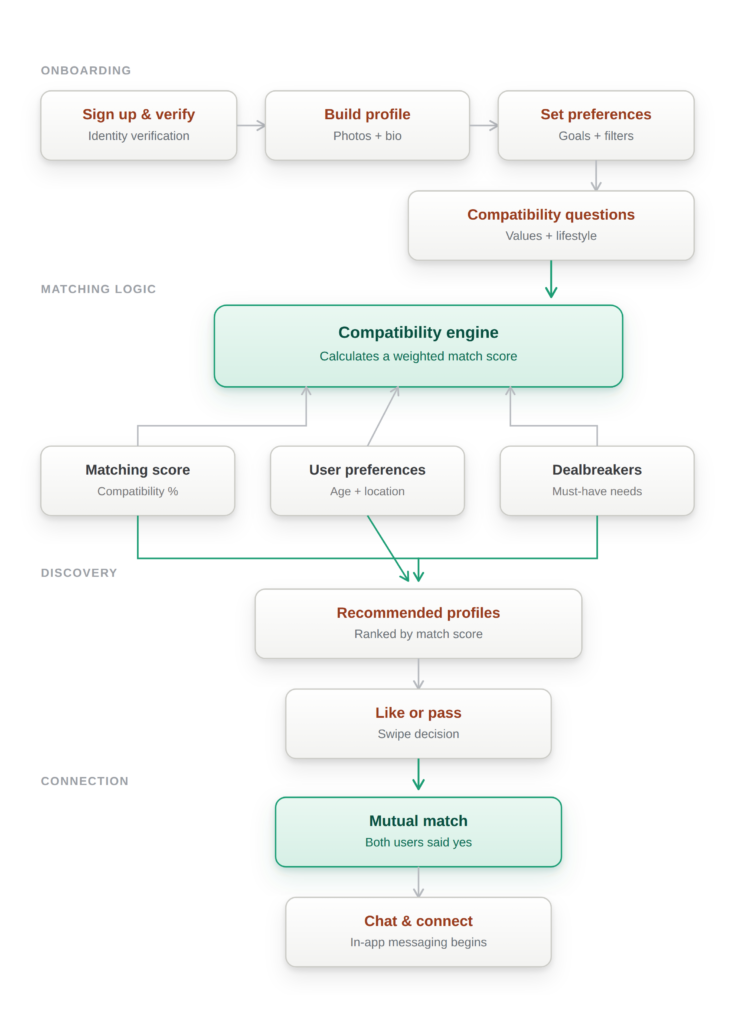
| Stage | How It Works |
| Sign Up & Verify | Users create an account and complete basic verification before entering the platform. Registration captures essential information such as age, location, and account details required to create a dating profile. |
| Build Profile | Users add photos, a bio, interests, lifestyle details, and other information they want potential matches to see. A detailed profile gives the platform useful context while helping other users understand who they are considering. |
| Set Preferences | Users specify what they are looking for, including age range, location, relationship goals, interests, and other preferences. These settings help narrow the pool of relevant profiles before compatibility is calculated. |
| Answer Compatibility Questions | Users answer questions covering values, beliefs, lifestyle, interests, relationships, and personal preferences. Their responses provide the matching system with deeper information than basic profile details alone. |
| Calculate Compatibility | The matching engine compares questionnaire answers, preferences, and important criteria between users. It then generates a compatibility score or ranking that helps determine which profiles are more relevant. |
| Discover Recommended Profiles | Users receive profiles selected according to compatibility and their stated preferences. The discovery experience can also consider factors such as location, activity, filters, and previous interactions. |
| Like or Pass | Users decide whether they are interested in a recommended profile or want to move on. These actions also provide useful interaction signals for the platform’s future recommendations. |
| Match | When two users express mutual interest, the platform creates a match. The matched users can then move from profile discovery to direct communication. |
| Chat & Connect | Matched users can start conversations through the in-app messaging system. Notifications, conversation controls, blocking, reporting, and other communication tools support the interaction after a match. |
Launch Your Dating Platform Faster With Our Customizable White-Label Solution
What Features Should an OkCupid Clone App Have?
An OkCupid-style dating platform needs two sides working together. Users need simple tools to create profiles, find compatible people, and manage conversations, while the business needs administrative controls to manage users, content, subscriptions, safety, and platform performance.
User Features
1. Build a Detailed Dating Profile
Users can add photos, bios, interests, lifestyle details, relationship goals, and other information they want to share. Profile controls should also let them update their information and manage what other members can see.
2. Answer Match Questions
Users can answer questions about relationships, values, beliefs, lifestyle, interests, and other personal preferences. These answers provide the information needed to create a more personalized compatibility experience.
3. Set Preferences & Dealbreakers
Users can define the type of people they want to meet and identify preferences that matter most to them. Age, location, relationship goals, interests, and dealbreakers can help narrow down potential matches.
4. See Your Compatibility
Users can see how closely they align with another profile instead of relying only on photos and basic profile information. The compatibility view can highlight shared answers, interests, preferences, and other matching factors.
5. Discover People Who Match Your Preferences
Users can browse recommended profiles and use filters to control who appears in their discovery experience. Options such as location, age, activity, and other preferences can make profile discovery more relevant.
6. Like, Match & Start a Conversation
Users can show interest in profiles, create mutual matches, and start conversations when both sides are interested. Messaging controls can include notifications, unmatching, blocking, and reporting.
7. Manage Your Privacy
Users should have control over profile visibility, personal information, location-related settings, and account preferences. These controls give members a clearer say in what they share and who can interact with them.
Admin Features
1. Manage Users & Profiles
Administrators can view and manage member accounts, profile information, verification status, and account activity. The dashboard should also include controls to suspend or remove accounts when needed.
2. Manage Questions & Matching Settings
The admin panel can be used to create, update, organize, or remove compatibility questions. Administrators can also manage relevant matching configurations as the dating platform evolves.
3. Handle Reports & Moderation
Administrators need a central place to review user reports, flagged profiles, inappropriate content, and suspicious activity. Moderation workflows help the team respond to issues without manually tracking them across the platform.
4. Manage Subscriptions & Premium Features
The business can create membership plans, control access to premium features, review transactions, and manage subscription-related activity. This gives administrators control over the commercial side of the dating platform.
5. Track Users & Platform Performance
Analytics can show metrics such as registrations, active users, profile completion, matches, conversations, retention, and subscription activity. These insights help the business understand where users engage and where the product needs improvement.
AI Matchmaking Is Redefining the Dating App Landscape
AI is bringing a new dimension to dating apps, helping users find compatible matches through more personalized recommendations. Gen Z is a leading example of this shift, with growing expectations for digital dating experiences that feel intuitive, convenient, and tailored to their preferences. Recent data show that 54% of global dating-platform users use AI tools and matching features, highlighting AI’s growing role in shaping how people connect online.
User-Facing AI Features
1. AI Match Insights
Explain compatibility in simple terms by highlighting shared interests, preferences, and other relevant matching signals.
2. Smarter Match Recommendations
Analyze likes, passes, profile views, and other interactions to refine match recommendations over time.
3. AI Profile Assistant
Help users improve their bios, complete missing profile information, and present their interests more clearly.
4. AI Conversation Assistant
Suggest conversation starters based on shared interests, profile details, and common preferences.
Trust & Platform AI Features
- AI Photo & Profile Checks
Identify duplicate, inappropriate, or suspicious profile content and flag it for review. - AI Safety Detection
Detect unusual activity, suspicious messaging patterns, and potential scam signals for further review. - AI Admin Insights
Identify patterns across reports, moderation activity, engagement, and user behavior to help administrators respond faster.
How to Build an App Like OkCupid?
Building an OkCupid clone app starts with product decisions, not code. The dating audience, matching logic, user journeys, development approach, and third-party services all need to be defined before the platform moves into development.
1. Define the Dating Audience
Start by deciding who the platform is built for and what kind of relationships it supports. A broad dating audience requires a different product direction from a niche community focused on a specific age group, interest, location, or relationship goal.
2. Plan the Matching Experience
Define how the platform will turn user information into relevant recommendations. This includes deciding how compatibility questions, preferences, dealbreakers, and other matching signals are weighted before the OkCupid clone app development begins.
3. Map the User & Admin Experience
Map what users and administrators need to do at every important stage of the product. This includes onboarding, profile management, discovery, communication, moderation, subscriptions, and account administration, giving developers a clear picture of what needs to be built.
4. Choose the Development Approach
The development approach depends on your budget, timeline, and required level of product control. A custom build provides greater control over the architecture, while a white-label dating app solution provides a ready foundation that businesses can adapt and launch under their own brand.
5. Build the Core Dating Platform
The development team then builds the platform components that connect the product together, including mobile applications, backend services, databases, matching logic, messaging, user accounts, and the admin panel. A dating app development company also needs to ensure these components communicate reliably as the user base grows.
6. Connect AI, Safety & External Services
The core platform can then be connected with services required for a real-world launch. These may include AI capabilities, profile verification, payment processing, push notifications, location services, content moderation, analytics, and other third-party APIs.
7. Test Real Dating Scenarios
Testing should go beyond checking whether individual features work. The team should test situations such as incompatible preferences, empty match results, duplicate profiles, blocked users, reported accounts, failed payments, message-delivery issues, and high activity levels to catch problems before launch.
8. Launch, Measure & Improve
Start with a controlled launch rather than treating the first app-store release as the finish line. User behavior, match activity, conversation rates, retention, reports, and subscription performance can reveal where the product needs changes, helping the platform improve with each release.
If the goal is to build an app like OkCupid, this process creates a clearer path from the initial product idea to a functioning dating platform without locking the business into the same product decisions as the original app.
Enter the Dating Market Faster With Our Ready-Made App Solution
What Should You Check Before Choosing a Dating App Development Company?
Choosing a dating app development company means evaluating the product UX/UI, development approach, ownership terms, and post-launch support. For businesses considering a ready-made approach, the choice often comes down to finding a provider that offers a reliable product foundation at a reasonable cost.
For example, businesses looking at dating app development companies in the USA that offer ready-made solutions often work with trusted, affordable providers like Hyperlocal Cloud. This helps businesses get a ready foundation without starting the development process from scratch. So, before deciding, check these key factors.
1. Check What Comes Ready
A ready-made dating platform should include a functional product foundation that is prepared for further development. Check whether it includes the mobile app, backend, admin panel, database, and core dating functionality required for the project.
2. Look at the Matching Capabilities
The matching system deserves close attention when building an OkCupid-style platform. Check whether the solution supports compatibility questions, preferences, dealbreakers, scoring rules, and changes to the matching logic.
3. Understand What Can Be Changed
Every business has different product requirements, so understand the customization scope before choosing a provider. Ask which parts can be changed, including the interface, branding, questions, matching rules, subscription plans, integrations, and additional functionality.
4. Clarify Source Code Ownership
Source-code ownership determines the level of control available after launch. Confirm whether the source code is transferred, who owns the intellectual property, whether any licensing restrictions apply, and whether another development team can work on the product later.
5. Check Safety & Privacy Support
Dating platforms handle personal profiles, photos, conversations, location information, and other user data. Check how the development company handles verification, reporting, blocking, moderation, account deletion, data protection, and privacy requirements.
6. Review Third-Party Integrations
A dating platform may depend on several external services to operate smoothly. Check support for payment systems, maps, identity verification, push notifications, analytics, cloud storage, AI services, and other integrations required for the business model.
7. Ask About Scalability & Support
The platform should support growth in users, profiles, conversations, media, and transactions as the business expands. Also check the post-launch support terms, including bug fixes, security updates, maintenance, app-store updates, and technical assistance.
White Label vs Custom: Which Development Approach Fits To Build an OkCupid Clone App?
Both approaches can support a complete dating platform. The choice comes down to budget, launch timeline, customization needs, and the level of control required over the product and its technology.
| Factor | White Label | Custom |
| Upfront cost | $4,000– $10,000 | $35,000 and up |
| Launch timeline | 2–4 weeks | 3–12 months |
| Code ownership | 100% source code transferred to the business | Owned from day one |
| Matching engine | Configurable | Built specifically for the product |
| Maintenance | Provider-supported | Managed by the business or development team |
| Best fit | Fast launch and market validation | Proprietary algorithms and specialized requirements |
White Label: What the Business Gets
A white label dating app solution starts with an existing dating platform and adapts it to the business requirements. The confirmed cost is $4,000– $10,000, with a 2–4 week timeline for the white-label offering.
The scope can cover the core platform, branding, selected product configurations, integrations, testing, and launch requirements. The exact deliverables depend on the project scope and the level of customization agreed with the provider.
Custom: What the Business Gets
Custom development starts with a product architecture designed around the business’s requirements. With costs starting at $35,000 and timelines ranging from 3–12 months, this approach requires greater development investment.
It gives the business greater control over the underlying product and suits projects that require proprietary matching logic, specialized workflows, complex integrations, or technical requirements beyond what a ready-made platform can offer.
| Pro Tip* Ultimately, the decision comes down to the business’s specific requirements, budget, and launch plans. However, most businesses go with white label dating app solution as a way to keep the initial investment controlled while moving ahead with their launch plans. It offers a straightforward way to enter the market without committing the resources required for a lengthy development process. |
What Technology Is Needed to Build a Dating App Like OkCupid?
A lot happens behind a dating app that users never see. From the app interface to the backend services, each layer needs the right technology to keep the platform reliable and ready for future growth. So, what technologies go into an app like OkCupid? Let’s see:
1. Mobile App Development
Flutter or React Native can support cross-platform mobile development, while Swift and Kotlin can support native iOS and Android applications. The choice depends on the required performance, platform-specific functionality, and development strategy.
2. Frontend & Backend
The frontend can use technologies such as React or Next.js for web-based experiences. On the backend, Node.js, Python, or Java can handle APIs, authentication, business logic, user management, and communication between different parts of the platform.
3. Database & Data Storage
A dating platform needs reliable storage for profiles, preferences, questionnaire responses, matches, subscriptions, messages, and account information. PostgreSQL or MySQL can handle structured application data, while cloud storage can manage photos and other media.
4. Matching & Recommendation Layer
The matching layer handles compatibility calculations, preferences, dealbreakers, and recommendation rules. A rules-based engine can manage the core compatibility logic, while Python-based services can support more advanced recommendation and behavioral models as the product develops.
5. Real-Time Messaging
Dating conversations need fast message delivery and reliable connection handling. Technologies such as WebSockets or Socket.IO can support real-time messaging, typing indicators, online status, and other live interactions.
6. Location Services
Location technology supports distance-based discovery and location-aware recommendations. Services such as Google Maps APIs or Mapbox can provide location functionality while giving the platform options for handling location privacy.
7. Payments & Subscriptions
Paid memberships and premium features require secure payment processing across supported platforms. Payment gateways such as Stripe or PayPal, along with Apple App Store and Google Play billing, can support different subscription and payment requirements.
8. Cloud Infrastructure
Cloud platforms such as AWS, Google Cloud, or Microsoft Azure can provide the infrastructure needed to host the application, databases, media, backups, and supporting services. The infrastructure can also scale as user numbers and platform activity increase.
OkCupid Clone App Monetization Strategy: Turning Engagement Into Revenue
A dating app needs a revenue model that fits how its users interact with the platform. An OkCupid clone app can combine free access with paid memberships, optional purchases, and advertising to create multiple income streams. The right mix depends on the target audience, user engagement, and the value each paid option offers.
1. Freemium Model
The freemium model lets users join, create profiles, and explore the dating platform for free. Paid plans provide access to additional benefits for users who want an enhanced experience. This approach helps build an initial user base while creating opportunities to convert active members into paying customers.
2. Subscription Plans
Monthly, quarterly, and annual memberships provide recurring revenue for the business. An OkCupid clone app may offer different subscription tiers based on the benefits included in each plan. Clear differences between membership levels give users a reason to upgrade and help the business build a more predictable revenue stream.
3. Boost or Spotlight Features
Users can pay to increase their profile visibility for a limited period, helping them reach more people on the platform. These paid boosts create an additional revenue stream for the OkCupid clone app while giving users greater control over profile discovery.
4. Digital Gifts
Digital gifts let users buy and send virtual items to their matches to express interest or make conversations more engaging. The platform earns revenue from these purchases, with gift options and prices tailored to its audience.
5. Advertisements
Dating apps can partner with relevant third-party businesses, such as gift shops, restaurants, and local experience providers, to generate advertising revenue. Banner ads or Google AdSense placements in suitable areas of the app provide another income source, as long as the ads fit naturally into the user experience.
What Makes Hyperlocal Cloud the Right Partner for OkCupid Clone Apps?
Hyperlocal Cloud provides a ready-made foundation for businesses planning to launch dating apps inspired by platforms such as OkCupid, Tinder, Bumble, and Match. The solution supports iOS and Android apps, plus the backend and admin components needed to run the product. Businesses get a practical starting point for shaping an OkCupid clone app around their brand, audience, and product goals.
The platform also supports product-level changes, third-party integrations, source code ownership, and ongoing technical assistance. As the best dating app development company USA, Hyperlocal Cloud supports businesses from initial launch through future updates and new capabilities, keeping the development process aligned with their product goals.
What Should You Track After Launching a Dating App?
Once the OkCupid clone app is live, there’s plenty to learn from how people actually use it. Registration patterns, matches, conversations, and subscriptions can show what users respond to and where the product could improve. These insights also help shape future updates, marketing efforts, and revenue strategies.
1. User Registration & Profile Completion
Track how many people create accounts and how many complete their dating profiles. A noticeable drop during onboarding can point to unnecessary steps, unclear questions, or a registration process that needs simplifying.
2. Match Rate
The match rate shows how frequently users find mutual interest after discovering profiles. Tracking this metric across different locations, age groups, or preferences can help identify where the OkCupid clone app delivers strong results and where discovery may need refinement.
3. Like-to-Match Ratio
Likes provide useful engagement data, but mutual matches give a clearer picture of user interest. Comparing likes with successful matches helps measure how effectively the platform turns individual interest into mutual connections.
4. Conversation Rate
A match is only one part of the user journey. Track how many matches lead to conversations, how quickly users send the first message, and how many conversations continue over time. This gives the business a better view of engagement after matching.
5. User Retention
Retention shows whether users continue returning to the platform after their first visit. Compare retention across different user groups and time periods to understand which parts of the dating app experience encourage continued usage.
6. Reports & Safety Metrics
Track profile reports, blocked accounts, moderation actions, suspicious activity, and resolution times. Reviewing these numbers helps the team identify recurring safety concerns and maintain a healthier environment for users.
7. User Acquisition Cost
Measure how much the business spends to acquire each new user across different marketing channels. Comparing acquisition costs with retention and subscription revenue helps identify which channels bring valuable users to the platform.
Transform Your Dating Business Vision Into a Scalable Digital Platform
Final Thoughts
Every dating app starts with an idea about how people should meet and connect. An OkCupid clone app brings that idea to life through compatibility-based matchmaking, thoughtful features, and a user experience built around the target audience. With the right OkCupid-like app development approach, businesses have a clear path to creating their own dating platform, from defining its identity to planning future growth. If you’re ready to bring your dating app idea to life, contact Hyperlocal Cloud to build an OkCupid clone app tailored to your business goals.
FAQs (Frequently Asked Questions)

Nisha Bagga is a technical writer with more than 7 years of experience creating high-quality content for a wide range of industries. She specializes in developing clear, engaging, and well-researched technical and business content tailored to diverse audiences and industry requirements.

Need Help With
Development?