

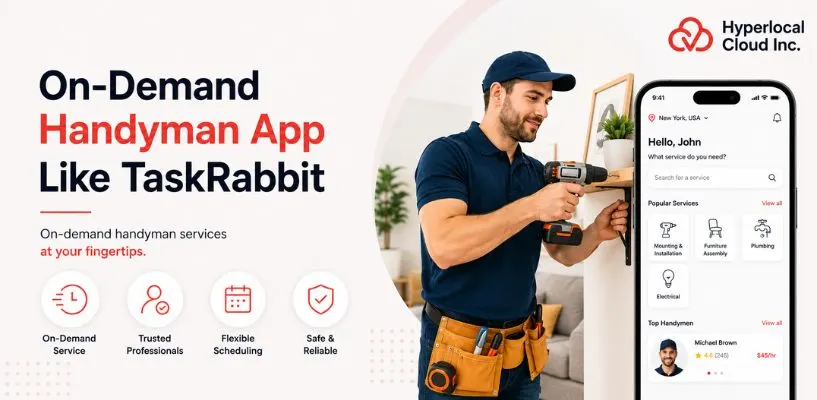
The on-demand home services industry is growing rapidly as consumers increasingly prefer booking trusted professionals through mobile apps for services like home repairs, furniture assembly, plumbing, electrical work, and cleaning. Platforms like TaskRabbit have transformed the traditional handyman industry by offering a convenient, secure, and transparent way to connect customers with skilled service providers. This growing demand presents a lucrative opportunity for entrepreneurs and businesses looking to launch their own handyman marketplace.
If you’re planning to build an app like TaskRabbit, understanding the right business model, essential features, development cost, technology stack, monetization strategies, and launch process is crucial for long-term success. In this guide, we’ll walk you through everything you need to know to develop a scalable, feature-rich on-demand handyman app that meets market demands and delivers a seamless user experience.
What You Should Know About The TaskRabbit App
The TaskRabbit app is an on-demand mobile marketplace that pairs those in need of assistance with simple daily tasks (for example, furniture assembly, cleaning, moving, handyman work, and running errands) with nearby, qualified freelancers, “Taskers,” who offer their services. Through the app, users are able to locate, book, message, pay, and review the person providing the help, which is very convenient and on-demand. It is a platform that enables taskers to earn an income with great flexibility and allows users to save time.
Build Your Handyman App Like TaskRabbit With Our Expert Development Team Today
Understanding How The Handyman App Like TaskRabbit Works
The following table shows the detailed workflow of the app, like TaskRabbit, for both customers and taskers.
| For Users | For Taskers |
| Download and Sign Up – The users download the TaskRabbit app and make their own account by giving some basic information. They look through different service categories to find the kind of help they want. | Apply and Get Verified – Taskers are registered for the service and are background checked. They determine their hourly rates, skills, and availability in their profile. |
| Post a Task – Users explain their work, decide on their own budget, and choose the date and time they would like. They write down the location where the work will be done. | Browse Available Tasks – Taskers are notified of the jobs that fit their expertise in the field. They have the opportunity to read task details and the needs of customers and apply them. |
| Review Tasker Profiles – The application presents the taskers that are free, their rating, reviews, hourly rate, and the year of experience. Users are able to compare the various profiles and pick the one that best fits them. | Submit Proposals – Taskers present customers with proposals of how they will handle the job and when they are available. They are able to change their rates depending on the complexity of the tasks. |
| Confirm Booking – After the selection of a tasker, users confirm their booking and get the task details. They can talk with the tasker directly through the messaging feature in the app. | Accept Jobs – Taskers are notified with all the required information and the job the moment a customer chooses one. They get in touch with customers to understand their requirements when necessary. |
| Task Completion – The tasker comes at the time that was previously scheduled and does the job. Users can easily pay for the task through the app after the work is done. | Complete Work – Taskers arrive on schedule, do the job, and leave the customer satisfied. They can post pictures or notes about the work that has been done. |
| Rate and Review – Users give ratings and write reviews about the tasker they worked with. This feedback is one of the ways the platform maintains high service quality. | Receive Payment – The job is completed, and the customer has approved, and payment is transferred to the account of the tasker. All transactions are done safely with a service fee charged on the platform. |
Why Should Anyone Invest in a TaskRabbit-Like App
The on-demand home services industry is experiencing rapid growth as consumers increasingly rely on mobile apps to book trusted professionals for home repairs, cleaning, moving, and maintenance services. According to industry reports, the global online on-demand home services market is expected to grow from USD 5.95 billion in 2025 to USD 10.4 billion by 2029, at a 15% CAGR, highlighting the strong demand for digital service marketplaces.
Here are the key reasons why investing in a TaskRabbit-like app is a smart business opportunity:
Growing Home Services Market
The home services sector continues to expand due to urbanization, busy lifestyles, and consumers’ preference for convenient, app-based solutions. As more users shift from traditional service providers to digital platforms, businesses have a significant opportunity to capture a growing market.
Expanding Gig Economy
The gig economy has enabled millions of skilled professionals to earn flexible income through digital marketplaces. Platforms like TaskRabbit connect independent service providers with customers, creating a scalable ecosystem that benefits both sides while reducing operational overhead.
Increasing Smartphone Adoption
With smartphones becoming the primary way consumers discover and book local services, mobile-first marketplaces are seeing higher engagement and faster adoption. Features like real-time booking, GPS tracking, secure payments, and instant communication have made on-demand service apps the preferred choice for modern consumers.
Multiple Recurring Revenue Streams
Unlike traditional service businesses, a TaskRabbit-like platform can generate recurring revenue through service commissions, booking fees, subscriptions, featured listings, surge pricing, and in-app advertising. These diversified revenue models create long-term profitability while supporting business scalability.
Rising Demand for Local Services
Consumers increasingly expect quick access to verified professionals for everyday services such as plumbing, electrical repairs, appliance installation, furniture assembly, and home cleaning. Since much of the home services industry remains fragmented and unorganized, technology-driven marketplaces have an opportunity to deliver greater convenience, transparency, and trust.
Must-Have Features Offered By The TaskRabbit Clone
A successful TaskRabbit clone app should deliver a seamless experience for customers, service providers, and administrators. While each user group has different requirements, the platform should focus on simplifying service discovery, booking management, secure transactions, and overall marketplace operations.
Task Poster (User) Panel Features
1. Easy Registration and Profile Management
Users can create an account and maintain their profiles with minimal time and effort by using email or social media accounts.
2. Service Browsing & Advanced Filters
Customers will be able to use advanced filters and search a variety of types of tasks (e.g., cleaning, moving, furniture assembly, handyman services) and use advanced filters based on location, price, tasker skills, and reviews in order to find the right professional.
3. Task Posting and Scheduling
The user is allowed to post a detailed task request, define demands, specify a location, and select the desired date and time of the service, having such options as same-day booking and recurrent booking.
4. Tasker Matching and Comparison
The app recommends qualified taskers, depending on the task, location, and availability, which lets one see the profiles of taskers, hourly rates, experience, and the reviews before deciding.
5. In-App Communication
Once the customer has selected a tasker, he or she can use the chat option or even call in-app to clear the points, establish the order, and ensure there is a seamless communication process without exposing his or her personal contacts.
6. Real-Time Tracking and Status Updates
Customers are given real-time updates and the real-time location (ETA) and job status of the tasker, which brings in more transparency and minimizes the uncertainty.
7. Secure In-App Payments
The app is secure in all its transactions, and the user can have the ability to pay using different options such as credit cards, digital wallets, or gift cards, once the task is done. The app also provides the ability to tip the tasker using the system.
8. Ratings and Reviews System
Once the task is completed and paid, the customers are able to rate and review the performance of the tasker; this will enable the generation of trust within the community and will be used in future hiring decisions.
9. Booking and Payment History
Customers can easily keep their records by having full access to their entire history of bookings, invoices, and payment information.
10. Help and Support
There is a help and support section where customers can get assistance and settle their disputes.
Tasker (Service Provider) Panel Features
1. Registration & Profile Setup
It is the process that taskers can register, have background checks done, and create a profile that displays their skills, experience, and work area.
2. Availability Management
The taskers should be able to manage their hours of work and availability with the help of an in-app calendar.
3. Task Notifications
Through this feature, the taskers get timely alerts of new and available tasks in their locality that are within their skills.
4. Accept/Reject Tasks
Taskers can take or decline the job requests depending on their schedule and availability at a particular time.
5. In-App Chat
Taskers can communicate using the in-app chat feature with customers to negotiate task requirements and logistics.
6. Job Rescheduling
Taskers will be able to reschedule a task that has been confirmed in case of an unexpected situation.
7. Earnings & Payment Tracking
A dashboard in which the taskers will be able to monitor their total earnings, payment history, and the payout they are awaiting.
8. Client Ratings
The client ratings feature allows the client to rate and comment on the tasker’s services, and this will be shown on the tasker’s profile.
Admin Panel Features
1. Dashboard
The admin gets the overview of all activities that are taking place, such as the number of users, taskers, and running tasks.
2. User & Tasker Management
Admin can use these tools to manage user information, add/ delete service providers, and handle complaints.
3. Marketplace & Pricing Management
This feature gives the admin full control over service categories, pricing structures, and commission fees.
4. Analytics & Reports
Real-time analytics to determine the performance of the apps, track the demand for the services, and make business decisions in the future.
5. Promotions & Offers
The alternative is where the administration is free to control and implement promo-codes, discounts, and advertisement campaigns.
6. Payment & Invoice Management
Admin can use the payment & invoice management feature and monitor all financial operations, such as bill preparation and payment.
7. Customer Support Tools
The feature used by the admin to handle customer and tasker support tickets and provide timely solutions.
Create a Powerful Taskrabbit-like App With Our Experienced Developers
Advanced AI-Driven Features That Improve User Experience
TaskRabbit clone uses several high-tech AI and machine learning abilities to optimize its operations, enhance consumer satisfaction, and ensure effective service provision.
1. AI-Driven Smart Task Matching
With advanced algorithms, customers are automatically matched with the best taskers according to skills, location, ratings, and task requirements.
2. AI-Powered Customer Support Chatbots
Chatbots with artificial intelligence serve as real-time 24/7 helpers that are more responsive to all types of requests, such as bookings, cancellations, and payments.
3. Predictive Demand Forecasting
These machine learning algorithms take into account the trends to ascertain at what time and what type of task is likely to experience increasing demand in order to plan resources.
4. Intelligent Pricing and Personalization
AI understands the behavior of users and market dynamics to provide dynamic pricing, customized recommendations on services to use, and discounts.
5. Advanced Analytics and Reporting
AI-based analytics monitor performance measures, user actions, and service patterns to help in making data-driven business decisions.
6. Fraud Detection
AI algorithms would track and identify suspicious behavior or possible fraud in ensuring platform security and trust.
7. Assisted Engineering (Internal Use)
AI development tools are used to assist engineering teams in various tasks like code reviews, documentation, and refactoring to speed up engineering development cycles.
Step-by-Step Development Process for a TaskRabbit Clone App
Developing a TaskRabbit-like app requires careful planning, the right technology stack, and a user-centric approach. Whether you’re looking to create a platform for on-demand home services or launch an MVP, following a structured development process helps reduce risks, optimize costs, and ensure a successful product launch.
1. Conduct Market Research
Start by identifying your target audience, competitors, and market opportunities. Analyze popular platforms like TaskRabbit, Thumbtack, and Handy to understand their strengths, weaknesses, pricing models, and feature offerings. This research helps define your unique value proposition and business strategy.
2. Gather Requirements
Clearly define your business goals, target users, service categories, monetization strategy, and technical requirements. At this stage, prioritize features for the initial launch (MVP) and create a detailed product roadmap for future updates.
3. Design an Intuitive UI/UX
Create wireframes and interactive prototypes that deliver a seamless experience for customers, service providers, and administrators. Focus on simple navigation, fast booking flows, and responsive designs that work across Android, iOS, and web platforms.
4. Build the MVP
Develop a Minimum Viable Product (MVP) with core features such as user registration, service listings, bookings, payments, notifications, and ratings. Launching an MVP allows you to validate your idea, gather user feedback, and reduce development costs before investing in advanced functionality.
5. Develop the Backend
Build a secure and scalable backend to manage user authentication, bookings, payments, messaging, notifications, and business logic. A robust backend ensures smooth performance as your user base grows.
6. Integrate Third-Party APIs
Integrate essential services such as payment gateways, maps and location tracking, push notifications, SMS/email services, and analytics tools. These integrations enhance functionality while reducing development time.
7. Perform Testing & Quality Assurance
Conduct comprehensive testing, including functional, usability, performance, security, and compatibility testing. Fix bugs, optimize performance, and ensure a consistent user experience across different devices and operating systems.
8. Deploy the Application
Deploy the backend infrastructure on a reliable cloud platform and configure databases, security protocols, backups, and monitoring tools. Proper deployment ensures your application remains secure, stable, and highly available.
9. Launch on App Stores
Publish the application on the Google Play Store and Apple App Store after meeting their submission guidelines. Prepare optimized app listings with compelling descriptions, screenshots, keywords, and promotional assets to maximize downloads.
10. Continuously Improve the Platform
The launch is only the beginning. Regularly monitor user behavior, collect customer feedback, fix issues, introduce new features, and optimize app performance. Continuous improvements help increase user retention, enhance customer satisfaction, and keep your platform competitive in the evolving on-demand services market.
How Much Does It Cost to Build an App Like TaskRabbit?
The cost of building an app like TaskRabbit depends on several factors, including the complexity of features, the number of platforms, the technology stack, the development team’s location, integrations, and the level of customization required. A basic handyman marketplace with essential features will require less investment, while an enterprise-level platform with AI capabilities, advanced analytics, and automation will require a larger budget.
On average, the cost to develop a TaskRabbit-like app can range from $10,000 to $40,000, depending on the scope and business requirements.
Tech Components Involved in the Development of a TaskRabbit-like App
The table below lists the technologies required to develop a handyman app like TaskRabbit and the purpose of using each technology. Let’s have a look:
| Technology Category | Technology/Tool | Purpose |
| Frontend (Mobile) | React Native / Flutter / Swift (iOS) / Kotlin (Android) | Build responsive and user-friendly mobile applications for customers and service providers |
| Backend | Node.js / Python (Django) / Ruby on Rails | Handle server-side logic, business operations, and data processing |
| Database | PostgreSQL / MySQL / MongoDB | Store and manage user data, task information, transactions, and app content securely |
| Cloud Hosting | AWS / Google Cloud / Microsoft Azure | Provide scalable infrastructure, storage, and hosting for the application |
| Payment Gateway | Stripe / PayPal / Braintree | Process secure online payments, handle transactions, and manage refunds |
| Push Notifications | Firebase Cloud Messaging / OneSignal | Send real-time alerts about bookings, messages, and task updates to users |
| Authentication | OAuth / JWT / Firebase Auth | Secure user login, registration, and session management |
| Real-time Messaging | Socket.io / Twilio / Firebase Realtime Database | Enable instant in-app chat communication between customers and service providers |
| Background Check API | Checkr / Sterling / Certn | Verify service provider identity and conduct background checks to ensure safety and trust. |
Ways In Which An On-Demand App Like TaskRabbit Generates Income
A successful handyman marketplace app can generate revenue through multiple channels instead of relying on a single income source. Platforms like TaskRabbit use a marketplace-based model where customers get convenient access to skilled professionals, while service providers gain new business opportunities. By combining commissions, subscriptions, premium visibility, and service fees, entrepreneurs can build a scalable and profitable on-demand service platform.
1. Commission-Based Revenue
The commission model is one of the most common revenue streams for handyman marketplace apps. The platform charges a percentage of each completed transaction from service providers or customers for facilitating the connection, managing bookings, processing payments, and maintaining the marketplace.
Example:
- Average handyman service booking: $100
- Platform commission: 20%
- Revenue earned per booking: $20
If the platform completes 5,000 bookings per month:
5,000 × $20 = $100,000 monthly revenue
2. Service Fees
A platform can charge customers a small service or convenience fee on every booking. This fee helps cover operational costs such as payment processing, customer support, platform maintenance, and service quality management.
Example:
- Customer booking amount: $80
- Service fee: $5
- Total customer payment: $85
With 10,000 monthly bookings, the platform can generate:
10,000 × $5 = $50,000 monthly revenue
3. Subscription Plans
Subscription models create predictable recurring revenue by offering premium benefits to customers or service providers. Businesses can provide features such as discounted service fees, priority bookings, enhanced visibility, or additional tools through monthly or yearly plans.
Example:
- Premium customer membership: $9.99/month
- Number of subscribers: 10,000
10,000 × $9.99 = $99,900 monthly recurring revenue
4. Featured Listings and Promotions
Service providers can pay to increase their visibility within the marketplace. Featured listings help professionals appear at the top of search results, receive more job opportunities, and attract more customers.
Example:
- Featured listing fee: $50/month
- 2,000 service providers purchase promotions
2,000 × $50 = $100,000 monthly revenue
5. Surge Pricing and Dynamic Pricing
During periods of high demand, platforms can implement dynamic pricing to increase revenue while balancing supply and demand. For example, prices may increase during weekends, holidays, emergency repairs, or peak booking hours.
Example:
- Normal service price: $100
- Peak demand increase: 20%
- Additional revenue per booking: $20
For 3,000 peak-time bookings:
3,000 × $20 = $60,000 additional revenue
6. Membership Programs
Membership programs encourage customer retention by offering exclusive benefits such as discounted bookings, free service visits, priority scheduling, and extended support.
Example:
- Annual membership: $99/year
- 20,000 members
20,000 × $99 = $1.98 million annual revenue
Develop Your TaskRabbit Clone App With Advanced Features and Technology
Conclusion
Building an on-demand handyman app like TaskRabbit presents a strong business opportunity as more customers shift toward convenient, app-based home service solutions. With growing demand for trusted professionals, a well-designed marketplace can help businesses connect users with service providers while creating a scalable digital platform.
A successful on-demand handyman app requires the right combination of essential features, including seamless booking, secure payments, service provider management, real-time communication, ratings, and administrative controls. Understanding development costs, selecting the right technology stack, and implementing a suitable revenue model are critical steps in building a platform that can compete in the market.
Choosing the right development approach—whether building a custom solution, launching an MVP, or adopting a white-label platform—can significantly impact your launch speed, investment, and long-term scalability. With the right strategy and technology partner, you can transform your handyman app idea into a profitable on-demand service marketplace.

Nisha Bagga is a technical writer with more than 7 years of experience creating high-quality content for a wide range of industries. She specializes in developing clear, engaging, and well-researched technical and business content tailored to diverse audiences and industry requirements.

Need Help With
Development?