

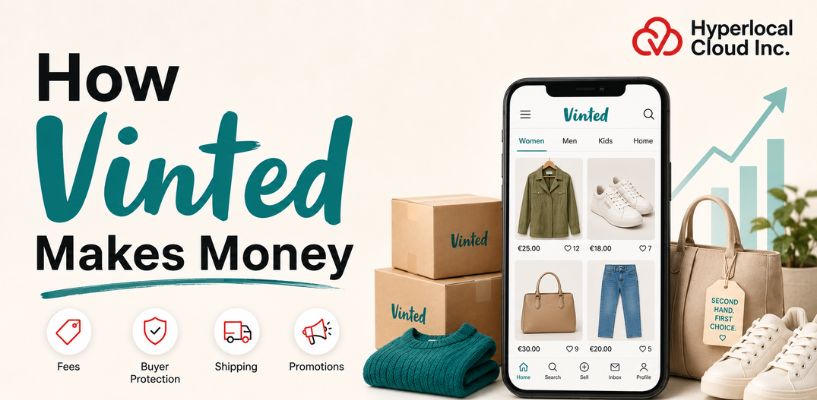
- Vinted mainly earns through buyer-paid fees, while sellers can list and sell items without a standard selling fee.
- Its revenue model centers on Buyer Protection, payments, shipping, and other marketplace services.
- In 2025, Vinted Group generated €1.1 billion in revenue, up 38% from 2024.
- Vinted's marketplace recorded €10.8 billion in GMV in 2025, showing the scale of its C2C marketplace.
- Vinted is also expanding beyond the marketplace through Vinted Go logistics and Vinted Pay payments.
- Its model shows how a marketplace can reduce seller friction while earning from services used during transactions.
- Businesses planning a similar app can use this model to understand revenue streams, user flow, marketplace fees, and platform growth.
Vinted has built its marketplace around a simple concept: people can sell products they no longer need while other users can discover and purchase those products through the same platform. The model reduces the friction involved in second-hand commerce by bringing product listings, communication, payments, buyer protection, and shipping into one marketplace experience.
Unlike traditional marketplaces that often depend heavily on seller commissions, Vinted’s approach places greater emphasis on services connected to transactions. Buyer protection, payments, shipping, promotions, and other marketplace services can create revenue opportunities while keeping the process of listing products relatively simple for sellers.
This business model makes Vinted an interesting example for entrepreneurs planning to launch a C2C, resale, or fashion marketplace. Understanding how the platform works, where revenue comes from, and what keeps buyers and sellers active can help when planning a similar marketplace.
Ongoing Market Trends Behind Vinted’s Growth
The second-hand economy has become increasingly digital as consumers look for more affordable ways to purchase products and convenient channels for selling items they no longer use. Online marketplaces make it possible for individuals to reach a much larger pool of potential buyers than traditional offline resale methods.
At the same time, resale platforms are expanding beyond individual clothing transactions. Broader product categories, cross-border commerce, integrated delivery services, digital payments, and better product discovery are creating more opportunities for marketplaces to increase transaction activity.
Several trends are particularly relevant when evaluating a Vinted-like business model:
- Growth of Second-Hand Commerce: Consumers are increasingly using online marketplaces to buy and sell pre-owned products.
- Expansion Beyond Fashion: Resale marketplaces can expand into categories such as electronics, home goods, children’s products, accessories, and collectibles.
- Cross-Border Marketplace Growth: Supporting transactions across regions can increase the potential pool of buyers and sellers.
- Integrated Logistics: Connecting shipping directly with the marketplace can reduce friction after a purchase is completed.
- Growing Role of Digital Payments: Integrated payment systems make it easier to process purchases, refunds, payouts, and transaction-related services.
These trends create an environment where a marketplace can generate revenue not only from selling products but also from the services that support each transaction.
Explore the Business Model Behind Vinted’s Remarkable Marketplace Growth
Understand the Vinted App
The Vinted app connects buyers and sellers through a marketplace where users can list products, discover items, communicate, complete transactions, and arrange delivery. The platform brings several parts of the resale journey together instead of requiring users to rely on separate services for product discovery, payment, and shipping.
For sellers, the process generally starts with creating a listing by uploading product photographs, adding relevant information, selecting a price, and making the product available to potential buyers. For buyers, the experience focuses on discovering relevant products, evaluating listings, completing purchases, and receiving orders through available delivery options.
| Aspect | Description |
| Seller Journey | Sellers upload product photos, provide descriptions, select prices, and publish listings through the marketplace. |
| Buyer Journey | Buyers search for products, review listings, complete purchases, and receive products through available delivery options. |
| Buyer Protection | Transaction protection provides buyers with additional support when an order has a problem. |
| In-App Payments | Payment functionality allows transactions to be completed through supported payment methods within the marketplace. |
| Shipping Integration | Shipping services can connect sellers and buyers while simplifying labels, delivery, and tracking. |
| Reviews and Trust | Profiles, reviews, verification, messaging, and transaction controls help create confidence between marketplace participants. |
The value of this model comes from connecting these activities into one continuous experience. When listing, discovery, payment, and delivery are easier to manage, the platform can potentially encourage more users to complete transactions repeatedly.
Working Mechanism of a Marketplace App Like Vinted
A Vinted-like marketplace follows a transaction cycle that begins when a seller publishes a product and ends after the buyer receives the order. Although the visible process is relatively simple, the platform needs several systems working together behind the scenes to manage accounts, listings, payments, orders, communication, delivery, and transaction support.
The basic workflow can be understood through the following stages.
1. Seller Lists a Product
The seller creates a product listing by uploading photographs, entering product details, selecting the appropriate category, and setting a price. A simple listing process is important because unnecessary complexity can discourage casual sellers from adding products to the marketplace.
2. Buyer Finds the Product
The buyer searches for products using categories, keywords, filters, brands, prices, sizes, or other discovery options supported by the platform. Search and recommendation functionality becomes increasingly important as the number of marketplace listings grows.
3. Buyer Places an Order
Once the buyer finds a suitable product, they can review the listing and proceed with the purchase. The marketplace then creates an order that connects the buyer, seller, product, payment, and delivery information.
4. Platform Processes Payment
The platform processes the transaction through its integrated payment infrastructure. Depending on the marketplace design, the system may need to manage payment authorization, transaction status, refunds, seller payouts, and other financial events.
5. Seller Ships the Product
After the purchase is confirmed, the seller prepares the item for delivery. Integrated shipping options can simplify this stage by providing shipping instructions, labels, tracking information, and delivery updates.
6. Buyer Receives the Product
The buyer receives the order and can complete the transaction according to the marketplace workflow. If there is an issue with the product or delivery, the platform may provide processes for reporting the problem and handling the dispute.
7. Platform Earns Revenue
Revenue can be generated through the services connected to the transaction rather than relying solely on a traditional seller commission. Buyer protection, payments, shipping, promotions, subscriptions, and other premium services can provide different monetization opportunities.
The Revenue Streams of a Vinted-Like App
A Vinted-like marketplace can use multiple revenue streams to avoid depending entirely on one type of fee. The exact combination depends on the marketplace category, target users, transaction volume, seller types, geographic markets, and services offered.
1. Buyer Protection Fees
Buyer protection fees can provide a transaction-based revenue stream while giving buyers additional support when purchasing from another marketplace participant. The fee can be associated with services such as transaction protection, issue resolution, and dispute support.
This model also allows the platform to keep the basic seller experience relatively simple. For entrepreneurs building a similar marketplace, buyer-focused service fees can therefore be considered as one possible alternative to charging sellers for every transaction.
2. Seller Commission
A marketplace similar to Vinted can introduce seller commissions depending on its target audience and business model. For example, a platform could allow casual users to sell without a standard commission while applying transaction fees to professional or high-volume sellers.
This approach can create different monetization rules for different seller groups. It can also allow the platform to encourage individual sellers to contribute product supply while monetizing larger commercial participants.
3. Listing and Product Promotion Fees
Sellers may pay for additional visibility when they want their products to reach more potential buyers. A marketplace can offer promotional features that place selected listings in more visible areas of the platform.
Examples include boosted listings, featured products, category promotion, or additional search visibility. These services can generate revenue without requiring the marketplace to charge every seller a standard transaction commission.
4. Shipping and Logistics Fees
Shipping can become an important revenue opportunity when logistics are integrated into the marketplace. Instead of leaving buyers and sellers to arrange delivery independently, the platform can connect transactions with shipping providers and build delivery services into the purchasing process.
Depending on the business structure, revenue can come from shipping-related service charges, negotiated logistics arrangements, or other fees associated with delivery. Integrated logistics can also improve the overall transaction experience by keeping order and tracking information within the marketplace.
5. Payment Processing Fees
Payments are an essential component of a marketplace because transactions need to move securely between buyers, sellers, and the platform. A Vinted-like application can integrate payment providers to support cards, wallets, refunds, payouts, and other transaction requirements.
Payment-related services can create another potential revenue stream depending on the platform’s agreements and financial architecture. More importantly, integrated payments allow the marketplace to maintain greater control over the transaction experience.
6. Subscription Plans
Professional sellers may need tools that casual sellers do not require. A marketplace can therefore offer optional subscription plans that provide additional functionality for businesses or high-volume users.
These plans could include advanced analytics, bulk listings, promotional credits, business reporting, inventory management, or priority support. Subscription revenue can also provide a recurring component alongside transaction-based monetization.
7. Advertising Revenue
Once a marketplace develops a significant user base, advertising can become another possible source of revenue. Brands, professional sellers, and other businesses may pay to promote relevant products or services to marketplace users.
Advertising options can include sponsored listings, promoted categories, display placements, or targeted marketplace campaigns. The platform can determine which advertising formats fit the user experience without making product discovery unnecessarily difficult.
8. Premium Marketplace Services
A marketplace can introduce additional paid services based on the needs of its users. These services might include advanced seller analytics, premium storefronts, verification, enhanced support, business tools, or specialized marketplace functionality.
Premium services can be introduced gradually as the platform learns which features users are willing to pay for. This gives the business another way to expand monetization without changing the basic marketplace experience.
Discover Key Revenue Streams Powering Vinted’s Marketplace Ecosystem
How to Build a Marketplace Like Vinted
Building a marketplace like Vinted requires more than developing product listings and a shopping interface. Businesses looking for a faster route to launch can also consider a white-label Vinted app, which provides a ready-made foundation that can be customized to their branding, features, and business model. The business still needs a clear marketplace structure, monetization model, trust system, payment infrastructure, logistics strategy, and plan for attracting both buyers and sellers.
1. Define Your Marketplace Niche
Start by deciding what type of products your marketplace will support. You could focus on fashion, electronics, furniture, children’s products, collectibles, luxury goods, or several related categories.
A defined niche can make it easier to understand your target audience and design relevant features. It can also help the marketplace build an initial product supply before expanding into additional categories.
2. Choose C2C, B2C, B2B or Hybrid
The marketplace structure determines how users interact with one another and what functionality the platform needs. A C2C marketplace connects individual users, while B2C platforms allow businesses to sell directly to consumers.
A hybrid marketplace can support multiple seller types and create separate workflows for individuals and businesses. The right model depends on the products, sellers, customers, and transaction structure you want to support.
3. Define Your Revenue Model
Revenue planning should happen before development because monetization affects the transaction flow and platform architecture. You may choose buyer service fees, seller commissions, promoted listings, subscriptions, advertising, payment services, logistics revenue, or a combination of these options.
The objective is not simply to add as many fees as possible. The revenue model should fit user behavior and provide enough value that users understand why they are paying for a particular service.
4. Add Marketplace Trust Infrastructure
Trust is particularly important when buyers and sellers do not know one another. A marketplace therefore needs mechanisms that help users evaluate other participants and report problems when transactions do not go as expected.
Depending on the marketplace category, useful infrastructure can include user profiles, ratings, reviews, verification, product reporting, dispute management, fraud monitoring, secure payments, and order tracking. These features can help create a more reliable transaction environment.
5. Integrate Payments
A marketplace payment system needs to support more than simply accepting a customer’s card. Depending on the business model, the platform may need to manage payment authorization, seller payouts, refunds, cancellations, transaction records, and disputes.
Payment architecture should therefore be planned around the different roles and transaction states in the marketplace. Selecting appropriate payment providers and designing the payment flow early can also reduce development changes later.
6. Integrate Logistics
Physical-product marketplaces need a reliable process for moving items between sellers and buyers. Logistics integrations can connect the marketplace with shipping providers and support labels, tracking, delivery updates, and returns.
The platform can also support multiple delivery options when serving different locations. This makes logistics an important part of the marketplace experience rather than something handled entirely outside the application.
7. Launch and Solve the Liquidity Problem
A marketplace needs both supply and demand to remain active. Attracting sellers without enough buyers can result in inactive listings, while attracting buyers without sufficient product availability can create a poor shopping experience.
For this reason, an initial marketplace launch can focus on a specific audience, location, product category, or seller segment. Once transaction activity begins to develop, the platform can gradually expand its categories and geographic coverage.
Vinted-Like Marketplace Technology Stack
The technology stack for a Vinted-like marketplace needs to support product discovery, user accounts, listings, payments, communication, order management, logistics, analytics, and administration. The final choices should depend on the expected scale, required integrations, development approach, and long-term product roadmap.
| Category | Possible Tech Stack | Uses |
| Frontend | React, Next.js | Web marketplace, seller interfaces, buyer interfaces |
| Mobile App | Flutter, React Native | Cross-platform buyer and seller applications |
| Backend | Node.js, Laravel, Django | APIs, business logic, authentication, orders |
| Database | PostgreSQL, MySQL, MongoDB | Users, listings, orders, reviews, transactions |
| Payment Gateway | Stripe, Adyen, PayPal | Payments, refunds, payouts, transaction processing |
| Logistics APIs | Carrier and shipping APIs | Labels, tracking, delivery updates, returns |
| Search & Recommendation Engine | Elasticsearch, OpenSearch | Product search, filtering, discovery, recommendations |
| Fraud Detection | Rule engines and third-party fraud tools | Account and transaction risk monitoring |
| Analytics | Mixpanel, Google Analytics, custom dashboards | User behavior and marketplace performance |
| Cloud Infrastructure | AWS, Google Cloud, Azure | Hosting, storage, scaling, monitoring, infrastructure |
A marketplace should not select technologies only because they are popular. The stack should support the application’s expected traffic, integrations, security requirements, geographic coverage, and future scalability.
What Makes Vinted’s Business Model Successful?
Vinted’s business model combines several marketplace mechanisms rather than relying on one feature. Low seller friction can encourage product supply, while buyer protection, payments, logistics, product discovery, and trust features help support the transaction experience.
For businesses planning a similar marketplace, the important lesson is that monetization and marketplace usability need to work together. Revenue opportunities are more sustainable when they are connected to services that users already need during the buying and selling process.
1. Low Seller Friction
Making it easy for users to create listings can help a marketplace build product supply. When sellers can upload products without navigating a complicated process, more casual users may be willing to participate.
A straightforward listing experience can therefore support marketplace growth while reducing the effort required to bring new inventory onto the platform. Keeping the initial selling process simple is particularly relevant for C2C marketplaces where many sellers may only list products occasionally.
2. Marketplace Liquidity
Marketplace liquidity refers to the ability of buyers and sellers to find suitable opportunities to transact. A buyer needs enough relevant products to choose from, while a seller needs enough potential buyers to justify continuing to list products.
This creates a two-sided growth challenge. A Vinted-like marketplace needs to continuously work on both product supply and buyer demand rather than treating either side as a secondary concern.
3. Trust & Safety
Trust becomes essential when transactions occur between people who may not have any previous relationship. Users need ways to evaluate sellers, understand transaction status, report problems, and receive support when necessary.
Features such as ratings, reviews, verification, reporting, secure payments, and transaction controls can contribute to a more trustworthy marketplace experience. The exact trust mechanisms should be adapted to the products and risks associated with the marketplace category.
4. Buyer Protection
Buyer protection can reduce uncertainty when purchasing products from another user. If an order has a problem, buyers need a clear process for reporting the issue and understanding what happens next.
For a marketplace operator, this system also needs to be connected with order records, payment status, seller information, and dispute workflows. A well-defined process can make transaction support easier to manage as marketplace volume increases.
5. Integrated Shipping
Shipping is an important part of any marketplace that handles physical products. If buyers and sellers have to arrange every delivery detail independently, the transaction can become more complicated after the purchase.
Integrating shipping providers can simplify labels, tracking, delivery updates, and other logistics tasks. It also gives the marketplace more visibility into the order journey from purchase through delivery.
6. Product Discovery
As a marketplace grows, finding the right product becomes increasingly important. Search, filters, categories, sorting, recommendations, and personalized discovery can help users navigate a large number of listings.
Effective product discovery can also increase the likelihood that users continue browsing rather than leaving because they cannot find relevant products. This makes search and recommendation infrastructure an important part of the marketplace experience.
7. Data & Personalization
Marketplace activity generates useful information about searches, views, saved products, purchases, listings, and user interactions. Businesses can analyze these patterns to understand what users are looking for and where the marketplace experience can be improved.
Personalization can then be used to make product discovery more relevant. Analytics can also help marketplace operators understand seller activity, category performance, transaction behavior, and other operational metrics.
8. Multiple Monetization Layers
A marketplace does not have to depend on one revenue source. Transaction services, promotions, subscriptions, payments, logistics, advertising, and premium tools can provide different monetization opportunities.
Having multiple revenue layers can also allow the platform to adapt its business model as its user base develops. However, each revenue stream should have a clear connection to the value provided to users.
Learn the Fundamentals of Building a Successful Resale Marketplace
Who Uses Vinted?
A marketplace like Vinted brings together several groups that perform different roles within the transaction ecosystem. Buyers create demand, sellers provide products, while logistics and payment providers support the infrastructure required to complete transactions.
Understanding these participants is important when planning a similar marketplace because each group requires different functionality and operational support.
1. Buyers
Buyers use the marketplace to discover products, compare listings, communicate with sellers, make purchases, and receive orders. They typically need search and filtering tools, detailed product information, secure payment options, order tracking, and transaction support.
The buyer experience should make it easy to move from product discovery to completed purchase. Trust features are also important because buyers may be purchasing from sellers they have never interacted with before.
2. Casual Sellers
Casual sellers generally list products they no longer need and use the marketplace to reach potential buyers. They may not have extensive e-commerce experience, which makes a simple listing and selling workflow particularly important.
The platform can make the process easier by simplifying product uploads, pricing, communication, payments, and shipping. Lower friction can encourage more users to participate as occasional sellers.
3. Professional Sellers
Professional sellers may use the marketplace to manage larger product volumes and reach a broader customer base. Their requirements can be different from those of casual sellers because they may need tools for inventory, bulk listings, analytics, promotions, shipping, and financial management.
A marketplace can provide additional features or subscription plans for this user group. Supporting professional sellers can also create additional monetization opportunities beyond casual C2C transactions.
4. Logistics Partners
Logistics companies support the physical movement of products between marketplace participants. Their services can include shipping, tracking, delivery updates, returns, and other transportation-related operations.
API integrations can connect these services directly to the marketplace. This allows order information and delivery status to remain connected throughout the transaction.
5. Payment Ecosystem
Payment providers support the financial infrastructure required to complete marketplace transactions. Depending on the platform architecture, they can be involved in purchases, refunds, seller payouts, transaction processing, and other financial operations.
A secure payment setup is important because users need confidence that their financial information and transactions are being handled appropriately. The payment architecture should also support the marketplace’s specific buyer and seller workflows.
Vinted Business Model vs Traditional Marketplace
A Vinted-like marketplace can reduce seller friction and generate revenue through services surrounding transactions. A more traditional marketplace may rely more heavily on seller commissions, listing fees, or paid seller services.
The difference is not simply about whether sellers pay a fee. It is about where monetization occurs within the marketplace and how the platform balances revenue generation with the need to attract product supply and buyer demand.
| Business Factor | Vinted-Like Model | Traditional Marketplace |
| Seller Fees | Can keep basic selling free or low-cost to encourage more listings | Often charges sellers a commission or listing fee |
| Buyer Fees | Can use buyer protection or service fees as a revenue source | Buyer fees may be limited or not used |
| Promotions | Optional promoted listings can help sellers increase visibility | Paid promotions are often a core seller feature |
| Subscriptions | Can offer optional plans for professional or high-volume sellers | Often used for premium seller tools and benefits |
| Logistics | Shipping can be integrated directly into the marketplace experience | Logistics may be handled separately by sellers or third parties |
| Payments | Payments can be built into the marketplace for a smoother transaction flow | Payment processing may rely more heavily on external providers |
| Trust | Reviews, verification, buyer protection, and dispute handling can support user trust | Trust tools vary depending on the marketplace and product category |
| Liquidity Strategy | Reducing seller friction can help build a large supply of listings | May rely more on acquisition, seller incentives, or established brands |
This comparison can help entrepreneurs understand why a low-friction seller model can require a different monetization strategy. The appropriate structure ultimately depends on the target users, category, transaction economics, and services the marketplace plans to provide.
How Much Does It Cost to Build an App Like Vinted?
The cost to build an app like Vinted depends on the marketplace scope, required features, platforms, and integrations. A basic MVP will generally require less development effort than a marketplace with advanced payments, logistics, analytics, and recommendation features. If you want to reduce the initial development effort, you can also explore an e-commerce app for sale and customize it around your business requirements.
The development approach can also influence the initial investment. A business can start with an MVP containing the most important marketplace functions and then introduce advanced features as user demand and transaction volume increase.
| Development Scope | Typical Features | Estimated Cost Level |
| Basic MVP | Registration, listings, search, basic messaging, orders, payments, reviews, and admin management | Lower |
| Standard Marketplace | Buyer and seller apps, advanced search, notifications, payments, shipping, reviews, reporting, and stronger administration | Medium |
| Advanced Marketplace | Recommendations, fraud detection, analytics, logistics integrations, subscriptions, promotions, and scalable architecture | Higher |
Several additional factors can influence the final development cost, including the number of platforms, UI/UX requirements, payment providers, logistics APIs, third-party services, security requirements, geographic markets, and customization.
For this reason, it is useful to separate essential MVP features from advanced functionality before development begins. This creates a clearer development roadmap and helps businesses decide which capabilities need to be available at launch and which can be added later.
How Hyperlocal Cloud Can Help Build a Vinted-Like Marketplace
Hyperlocal Cloud can help businesses develop a Vinted-like marketplace based on their target category, business model, user roles, monetization strategy, and operational requirements. Instead of treating every marketplace as identical, the development scope can be structured around the workflows that matter most to the intended audience.
The development can cover the core marketplace experience as well as the supporting systems required to manage transactions and marketplace operations.
Marketplace Development
The marketplace can include product listings, categories, search, filters, product details, user profiles, orders, messaging, reviews, and other core functionality required for buyers and sellers to interact.
Buyer & Seller Apps
Design separate experiences for buyers and sellers when their workflows require different functionality. Buyers can focus on product discovery and purchasing, while sellers can manage listings, orders, shipping, payouts, and sales activity.
Admin Dashboard
An administration dashboard can give marketplace operators centralized control over users, listings, transactions, reports, categories, orders, and other operational activities. This can become particularly important as the number of users and transactions increases.
Payment Integration
Payment integrations can support purchases, refunds, seller payouts, transaction records, and other financial workflows. The implementation can be structured around the selected marketplace model and payment provider.
Logistics Integration
Shipping and logistics integrations can connect the marketplace with delivery providers and support tracking, shipping labels, delivery updates, and related order processes. This can reduce manual work for marketplace participants.
Trust & Safety
Trust and safety functionality can include reviews, verification, reporting, dispute handling, transaction controls, and other mechanisms appropriate to the marketplace category. These features can help establish confidence between buyers and sellers.
Custom Monetization
The platform can be structured around the revenue model selected for the business. Depending on the marketplace strategy, this could include buyer service fees, seller commissions, promoted listings, subscriptions, advertising, premium services, or logistics-related revenue.
Scalable Architecture
The technical architecture can be planned to support increasing users, product listings, transactions, integrations, and geographic coverage. Building with scalability in mind can reduce the need for major architectural changes as the marketplace grows.
Launch a Marketplace That Connects Buyers, Sellers, and Recurring Revenue
Conclusion
Vinted demonstrates how a marketplace can create a business around more than simply connecting buyers with sellers. Product listings create the marketplace supply, while payments, buyer protection, shipping, trust features, product discovery, and additional services support the transaction ecosystem.
For entrepreneurs planning a Vinted-like resale marketplace, the key is to define the target audience, marketplace structure, revenue model, trust infrastructure, logistics strategy, and technology requirements before development begins. Starting with a focused MVP and expanding based on actual user behavior can also provide a practical way to develop the platform over time.
A well-planned marketplace needs to make participation simple for sellers, product discovery convenient for buyers, and transactions manageable for the business operating the platform. When these elements are designed together, a Vinted-like concept can become a structured digital marketplace rather than simply an app for listing second-hand products.

Nisha Bagga is a technical writer with more than 7 years of experience creating high-quality content for a wide range of industries. She specializes in developing clear, engaging, and well-researched technical and business content tailored to diverse audiences and industry requirements.

Need Help With
Development?