


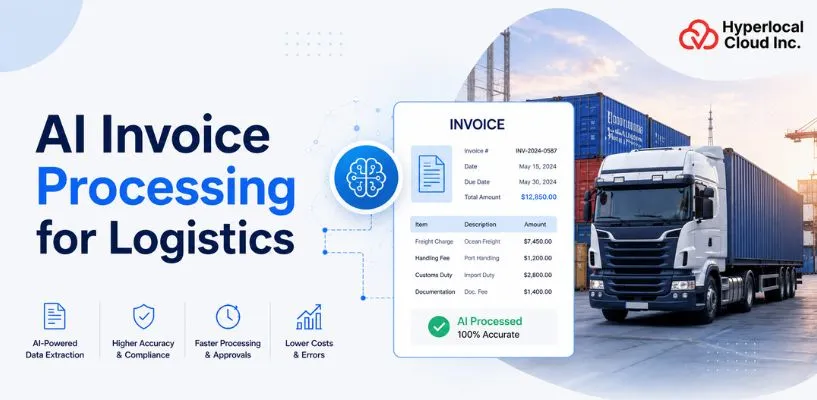
The logistics industry handles a vast number of invoices every day, including freight bills, shipping charges, customs fees, warehousing costs, and transportation invoices. Managing these documents manually is often time-consuming, error-prone, and resource-intensive. As supply chains become increasingly complex, organizations require faster and more accurate ways to process invoices while maintaining compliance and financial control.
An AI invoice processing agent for logistics leverages artificial intelligence, machine learning, and intelligent document processing technologies to automate the end-to-end invoice processing workflow. The agent can extract relevant information from invoices, validate data against purchase orders and contracts, identify discrepancies, route invoices for approvals, and integrate seamlessly with ERP and accounting systems.
Understanding Logistics Invoice Processing
Logistics invoice processing is the systematic process of receiving, verifying, approving, and paying invoices generated during logistics and supply chain operations. These invoices may originate from carriers, freight forwarders, warehouse providers, customs brokers, shipping companies, and other logistics service providers.
Schedule a Free AI Invoice Automation Assessment for Your Logistics Business
Workflow of the AI Invoice Processing Agent
Here, we present a complete working mechanism for an AI invoice-processing agent that facilitates the logistics industry. To know everything in detail, review the pointers below.
1. Invoice received
The system begins evolving when the invoice is received via the logistics system. Sellers can also send invoices via email, dealer portals, or as scanned files or PDFs. Some organizations can also receive printed invoices that can be scanned and uploaded to the machine.
2. Document classification
After receiving the invoice, the AI agent identifies the type of listing uploaded. Logistics teams manage a wide variety of documents every day, including invoices, purchase orders, shipping receipts, transport records, freight payments, and customs documents.
3. OCR extraction
Once the invoice is confirmed, the AI agent uses OCR technology to scan the file. OCR converts printed or scanned text into digital data that the smartphone can recognize. This eliminates the need for employees to enter records into accounting systems manually.
4. AI data extraction
After reading the OCR document, artificial intelligence similarly analyzes the extracted information. AI can identify exact prices for each item, separate transportation costs from taxes, apply discount rates, track line-item details, and improve its accuracy over time by mastering pre-processed invoices.
5. ERP posting
After the bill is passed, the AI transfers the checked records to the organization’s enterprise resource planning (ERP) or accounting engine. This computerized record ensures that financial transactions are accurate and regular in all sole proprietorship systems. It reduces the reproductive image and improves overall productivity.
6. Payment processing
Once the invoice is registered within the ERP system, the payment process begins. However, the payment option is user-friendly and offers multiple options for the fulfillment of payments.
7. Reporting & Analytics
The final stage specializes in reporting and commercial business insights. Reporting also supports audits and helps businesses comply with financial guidelines.
Key Features of AI-Centric Invoice Processing Agent
AI-driven invoice processing agents offer numerous features, of which the most relevant ones are listed below. Have a look:
1. Intelligent invoice classification
Invoices come mainly from specific vendors. Some may be digital files, while others are scanned copies or electronic invoices.
2. Automated coding
Research past transactions and company policies to assign the correct accounting codes with high accuracy. This reduces the guiding effort and allows for the maintenance of consistent financial records.
3. Vendor learning
This non-stop knowledge acquisition improves efficiency in developing vendor relationships.
4. Predictive approval routing
AI examines pre-approval patterns and automatically predicts the most appropriate approver for each invoice. Instead of expecting employees to decide where an invoice should go, AI routes it directly to the best person.
5. Duplicate invoice detection
Duplicate invoices allow businesses to quickly collect multiple payments for the same invoice. If a recurring invoice is detected, the finance team is immediately notified before any value is created. This can prevent pointless financial losses.
6. Anomaly detection
Sometimes invoices have unusual values that can indicate errors or surprising changes. AI continuously monitors billing records and identifies a type of transaction from typical business patterns.
7. Fraud detection
Fraud can cause significant financial risk to logistics businesses. AI catches suspicious invoices by looking for unusual vendor lease agreements, fake invoices, altered payment information, duplicate invoices, or random changes in transaction style.
8. Smart recommendations
AI does more than billing techniques, after all. It also presents useful recommendations to help finance teams make smarter decisions. These recommendations help employees work more efficiently while improving general account control.
9. Conversational invoice search
Manually searching for invoices can take a significant amount of time. AI Speedy is aware of the request and retrieves the required records, making invoice search much faster and easier.
10. Automated email responses
Many vendors regularly contact finance groups to inquire about invoice popularity or payment updates. AI can mechanically respond to these not uncommon queries by sending accurate updates primarily based on real-time billing statistics.
AI-Centric Technologies Used to Empower Invoice Processing Agents for Logistics
Artificial Intelligence is a core element in the integration of a robust invoice processing agent to automate the workload of the logistics industry. Here are all the essential AI-driven technologies that are used by experienced AI app development companies.
1. Machine Learning
Machine learning is one of the central technologies behind the AI-powered bill processing tool. It allows smart contracts to check based on past billing statistics rather than simply following routines.
2. Large Language Models (LLMs)
Large language models (LLMs) help AI recognize and interpret written facts like how humans read documents. This makes bill management easier and improves the overall user experience.
3. Natural Language Processing (NLP)
Natural language processing, commonly known as NLP, allows AI to understand and systematize the written language observed in invoices and related company files. With NLP knowledge, invoice processing is faster and more convenient.
4. Computer Vision
Many logistics companies receive invoices as scanned documents, issued copies, snapshots, or PDFs. Computer vision allows AI to recognize visual files. This improves efficiency and can reduce statistical reporting errors.
5. Generative AI
Generative AI adds every other layer of intelligence to invoice processing by supporting users in recognizing records, generating responses, and simplifying routine responsibilities. This improves negotiations while reducing the workload of employees.
Build Smarter Logistics Finance Workflows With Our AI Invoice Solutions Today
Know the Real-World Use Cases of Integrating an AI-Driven Invoice Agent
Businesses should know the real-world use cases of the AI-driven invoice agent before investing in it. Below you will get a complete list of the use cases.
1. Freight invoice automation
Bills of lading are generated each time goods are moved from one location to another. These bills typically include transportation costs, gas surcharges, taxes, customs clearance, and various service fees.
2. Third-party logistics (3PL) billing
Many companies work with third-party logistics partners, also known as 3PLs, to manage transportation, warehousing, and inventory delivery. This reduces billing disputes and allows companies to manage 3PL invoices more efficiently.
3. Cross-border shipment invoicing
International shipments involve multiple locations, currencies, tax regulations, customs duties, and transportation providers. This makes the go-limit billing process faster and more reliable.
4. Customs invoice verification
Customs invoices contain important data on imported and exported goods, product descriptions, advertised prices, taxes, duties, and shipping information.
5. Carrier payment automation
Logistics companies usually form with several carriers who set invoices when the deliveries are completed. This allows logistics companies to pay carriers on time while reducing manual processing efforts.
6. Warehouse billing reconciliation
Warehouse operators generate invoices for services such as garaging, storage, packing, loading, unloading, and order shopping. This improves billing accuracy and reduces disputes between warehousing companies and logistics companies.
7. Last-mile delivery invoice processing
Last-mile transportation is the final stage of shipping, where goods are transported from the distribution center to the customer’s location. Companies switching to large system networks may receive invoices from more than one distribution partner per day.
Challenges and Limitations of Integrating AI Invoice Agent
Businesses must have knowledge of the challenges and limitations when integrating an AI invoice agent for the logistics industry. Consider all of these challenges to avoid any kind of unwanted error.
1. Poor-quality scanned invoices
Many logistics companies still receive invoices as scanned copies or printed files. Sometimes those invoices are blurry, faded, crooked, handwritten, or annotated. To mitigate this task, companies need to encourage them to provide brilliant digital invoices whenever possible.
2. Diverse invoice formats
Some invoices are tables, while others use unique layouts, fonts, or field names. Important information, such as invoice numbers, tax information, or payment terms, will also appear in individual places on each report. Organizations should regularly issue smart contracts and allow AI to learn from new billing codecs so that processing accuracy will continue to increase over time.
3. Complex freight billing
Freight invoices are often more certain than broader retail invoices. They can also include transportation charges, petrol surcharges, storage costs, customs fees, handling prices, coverage, and any other transportation charges. AI needs to efficiently identify each charge, verify settlement costs, and check billing information with cargo records.
4. Regulatory variations
Logistics businesses often operate in specific cities, states, and international locations. Each jurisdiction may have its own tax laws, billing requirements, money reporting requirements, and compliance rules. Businesses need to update their AI infrastructure frequently to ensure it remains aligned with modern legal and financial requirements.
5. Legacy system integration
Still, many logistics companies use legacy accounting software, enterprise resource planning (ERP) systems, or financial software developed years ago.
6. AI model bias
AI systems learn from records. If school records contain errors, incomplete facts, or repetitive patterns that aren’t all commercial and entrepreneurial situations, AI is likely the best option. Regular tracking, continuous model training, and various training techniques help reduce bias and improve overall performance.
7. Data privacy concerns
Invoices contain sensitive business information, including supplier details, customs data, financial data, shipping charges, tax information, and contract prices. Maintaining sound data protection practices also allows companies to comply with financial records protection regulations.
8. User adoption and change management
Introducing AI into the billing process integration so that employees can do their day-to-day work. Some group participants may additionally feel uncertain about using new technology, or they may prefer traditional guided procedures.
Future Enhancements in the AI-Powered Invoice Processing Agent
All the most relevant future enhancements in the AI-powered invoice processing agent are mentioned in the section below. Businesses can review these trending aspects of the system in order to invest in the same.
1. Autonomous finance agents
In the future, AI systems will go beyond simple automation and become autonomous financial vendors. Instead of the easiest processing of invoices, these intelligent marketers could automatically transform entire economic workflows.
2. Multi-modal AI
Instead of the simplest text processing, multimodal AI will combine data from scanned invoice images, emails, voice messages, transportation documents, contracts, and even handwritten notes.
3. Voice-enabled invoice approval
Instead of opening multiple applications, the supervisor will surely ask the AI for pending invoices, evaluate important details through voice communication, and approve invoices using secure voice authentication.
4. Blockchain-based invoice verification
Blockchain technology has the potential to make invoice verification more secure and transparent. This approach can also simplify audit strategies by providing reliable and clear transaction statistics.
5. Predictive cash flow management
The AI models of the future will not make the best process calculations, but they will also help groups plan their cost ranges more efficiently. After reading past payment information, seasonal business models, customer payments, and supplier invoices.
6. AI negotiation with vendors
As AI technologies transform into more superior forms, future systems can assist in negotiations with vendors. AI could look at prior contracts, payment histories, market prices, and overall supplier performance to advocate for higher payment terms or price agreements.
7. Digital twin for finance operations
In the future, logistics companies may also create a virtual twin in their financial operations. These virtual models will simulate invoice processing, payment workflows, and approval cycles.
8. Self-learning invoice agents
In the future, AI-powered invoice processing vendors are predicted to continue to be increasingly independent in learning. These self-mastery systems will increase efficiency by helping them automatically read new invoice formats, supplier behaviors, approval patterns, regulatory updates, and business guidelines.
Get Your Logistics Invoice Automation Strategy Designed by AI Experts Today
Wrapping Up
AI-powered invoice processing is transforming the way logistics organizations manage financial operations by replacing manual, document-intensive workflows with intelligent automation. By streamlining invoice capture, validation, approval, and payment processes, organizations can reduce operational costs, minimize errors, accelerate payment cycles, and strengthen compliance. To do so, businesses are required to partner with a well-experienced logistics app development company.

Patt Cummins is an experienced content writer with over 10 years of experience creating clear and engaging content for technology-focused industries. He specializes in simplifying complex technical topics into easy-to-understand stories that educate readers, support brand communication, and help businesses effectively share their solutions.

Need Help With
Development?