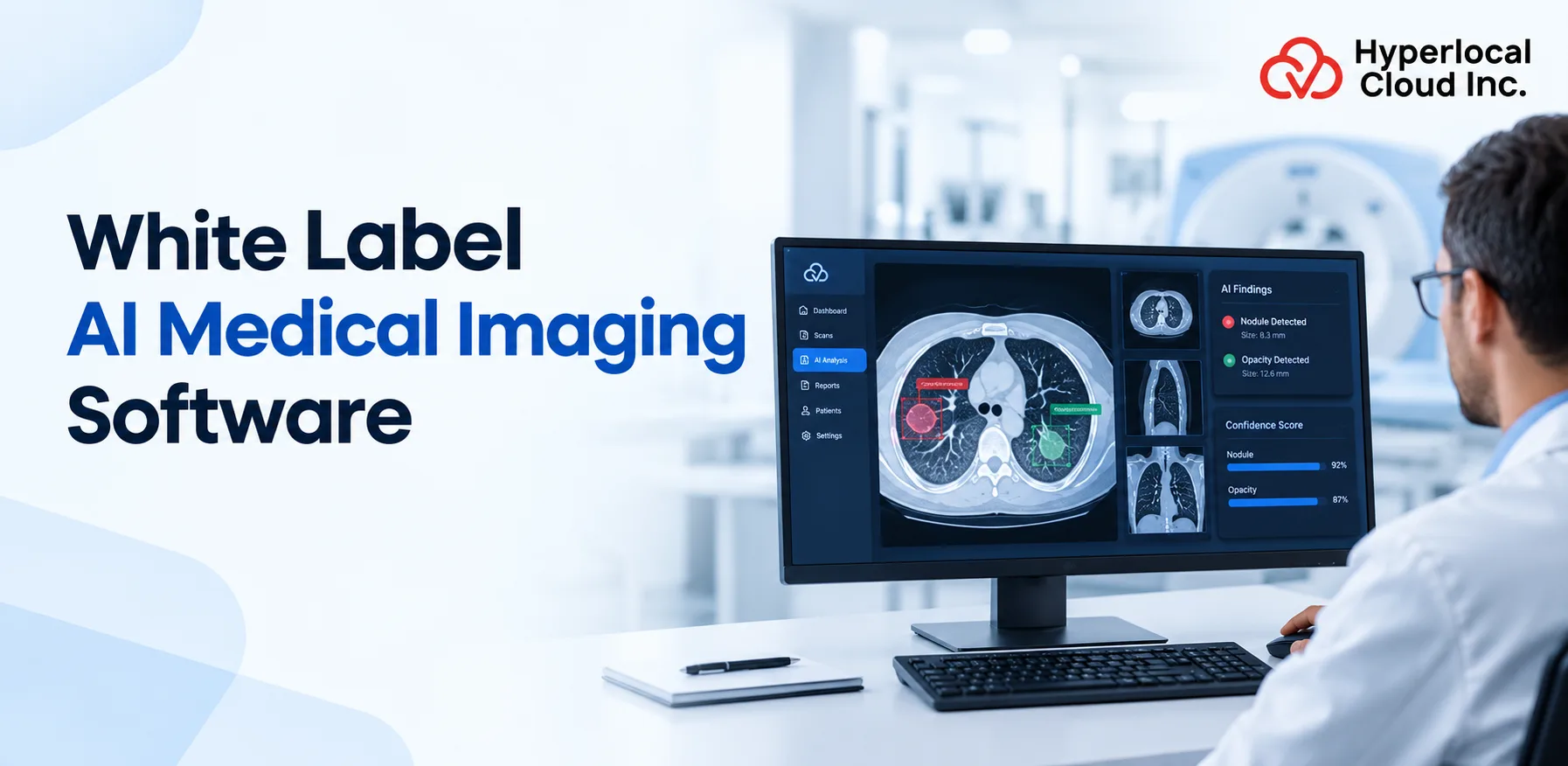
Artificial intelligence is changing how healthcare organizations manage medical images, support radiology workflows, and organize diagnostic information. From analyzing X-rays and CT scans to assisting with MRI image interpretation, AI-powered tools can help clinicians review imaging data and prioritize cases more efficiently when appropriately validated and integrated into clinical practice.
For healthcare entrepreneurs, medical software vendors, diagnostic center owners, and technology investors, this creates an opportunity to launch a branded AI medical imaging platform. Instead of building every component from scratch, businesses can explore white-label software that provides a foundation for customization, integration, and deployment.
White-label AI medical imaging software lets businesses offer imaging technology under their own brand, subject to the provider’s licensing terms and the capabilities of the underlying solution. The platform may include image viewing, AI-assisted analysis, reporting tools, user management, and integrations with existing healthcare systems.
This guide explains how white-label AI imaging platforms work, which features matter, how to approach implementation, what affects the cost, and how businesses can build a sustainable service around the technology.
AI Medical Imaging Market: Latest Industry Statistics
The business opportunity is growing as healthcare providers invest in AI-powered imaging technology. According to Grand View Research, the global AI medical imaging market is projected to grow from $1.8 billion in 2025 to $20.2 billion by 2033. This growth creates opportunities for businesses to launch specialized imaging platforms through white-label solutions.
Launch Your Branded AI Medical Imaging Platform With the Right Development Partner
What Is White Label AI Medical Imaging Software?
White-label AI medical imaging software is an existing software solution that a business can license, customize, and offer under its own brand. Depending on the product, it may combine medical image management, AI-based image analysis, reporting workflows, and administrative tools within one platform.
For example, a healthcare technology company could launch an imaging platform for diagnostic centers. The company could customize the interface, configure user roles, connect supported imaging systems, and offer access to selected AI capabilities without developing the entire infrastructure independently.
The exact scope of a white-label solution varies. Some providers offer a ready-made application with limited customization, while others support integrations with third-party AI models, cloud infrastructure, and healthcare information systems.
It is important to distinguish AI-assisted analysis from an independent diagnosis. The software may identify patterns or highlight areas for review, but clinical decisions must follow the intended use of the product, applicable regulations, and the judgment of qualified healthcare professionals. Businesses exploring healthcare software development should consider these requirements when planning a medical imaging product.
How Does a White Label AI Medical Imaging Platform Work?
An AI medical imaging platform connects image acquisition, data management, analysis, and clinical review. Its workflow depends on the imaging equipment, healthcare systems, AI models, and intended clinical application.
A typical workflow includes the following stages.
Image acquisition: Medical images are generated by supported equipment, such as X-ray, CT, MRI, or ultrasound systems. The platform receives images through configured integrations or approved upload workflows.
Secure image management: Images and related metadata are stored or routed through the appropriate imaging infrastructure. DICOM, a widely used medical imaging standard, helps systems exchange and manage imaging information.
AI-assisted analysis: A compatible AI model processes the image for a defined task, such as segmentation, measurement, or identifying patterns that require further review. The available capabilities depend on the model and the imaging modality.
Clinician review: Qualified professionals examine the original images alongside AI-generated findings. They assess whether the output is relevant, accurate, and appropriate for the patient’s clinical context.
Reporting and integration: Findings can be incorporated into supported reporting workflows or transferred to connected healthcare systems, subject to integration capabilities and clinical approval.
Monitoring and administration: Authorized administrators manage user access, review system activity, monitor technical performance, and oversee maintenance.
A well-designed platform should preserve the relationship between the original image, the AI output, and the clinician’s final interpretation. This supports traceability and helps users understand how automated analysis fits into their workflow.
Why Build Your Own AI Medical Imaging Platform?
Launching a branded platform can help healthcare technology businesses expand their services without having to create every software component independently. However, the commercial value depends on the target market, the quality of the underlying technology, and the ability to meet clinical and operational requirements.
Faster Time to Market
A white-label foundation can reduce the work required to build common application components, including user management, dashboards, and administrative workflows. Businesses can focus their development efforts on configuration, integrations, validation, and customer requirements.
The actual launch timeline still depends on the platform’s readiness, the complexity of the integrations, and any required regulatory or clinical evaluations.
Build Your Own Brand
Businesses can create a distinct identity through their own branding, domain, interface, and service packages where the licensing agreement permits it. This can help healthcare technology providers maintain a consistent experience across their products.
Lower Initial Development Effort
Using existing software may reduce the need to build standard functionality from scratch. However, licensing fees, AI model costs, cloud infrastructure, integrations, security work, and clinical validation can still represent substantial investments.
Recurring Revenue Opportunities
A platform can support subscription-based or usage-based commercial models. Depending on the customer segment, businesses may charge for access, supported AI analysis, facility-level licensing, or enterprise deployments.
Scalable Service Delivery
Cloud infrastructure and multi-facility administration can support expansion across multiple clinics or diagnostic centers. Scalability must be planned around image volumes, processing requirements, data residency, access controls, and service availability.
Customization for Specific Healthcare Needs
A business can focus on a defined market, such as radiology groups, diagnostic centers, or imaging service providers. A focused product strategy can make it easier to prioritize the workflows, integrations, and AI capabilities that matter most to those customers.
Build a Scalable Medical Imaging Solution Tailored to Your Business Goals
Essential Features of White Label AI Medical Imaging Software
The right feature set depends on the intended use of the platform. A solution designed for radiology departments will have different requirements from one intended for research, image segmentation, or remote image review.
1. AI-Powered Medical Image Analysis
The platform should support AI models that match the intended imaging task. Depending on the available technology, these may assist with image classification, measurements, segmentation, or highlighting regions for clinician review.
Evaluate model documentation, supported modalities, validation evidence, limitations, and deployment requirements before selecting an AI capability. General-purpose AI functionality should not be treated as a substitute for clinically validated tools.
2. DICOM Image Viewer and Management
A medical imaging viewer allows authorized users to open, navigate, and review supported images. Useful capabilities may include zooming, panning, window-level adjustments, image series navigation, measurements, and comparison of previous studies.
DICOM compatibility should be evaluated alongside the viewer’s support for the relevant imaging modalities and associated metadata.
3. AI-Assisted Finding Detection
Some imaging models are designed to flag specific patterns or findings for further review. These functions may help organize a reading workflow, depending on the clinical use case and the model’s validated performance.
The platform should communicate AI-generated findings clearly and allow clinicians to review the underlying images rather than treating model outputs as definitive diagnoses.
4. Radiology Reporting Tools
Reporting functionality can help organize observations, measurements, and interpretations into structured or narrative reports. Depending on the workflow, the software may support templates, report review, approval, and export to connected systems.
Clinical sign-off and the handling of corrections should be clearly defined.
5. PACS and RIS Integration
Picture Archiving and Communication Systems (PACS) store and distribute medical images, while Radiology Information Systems (RIS) help manage imaging-related workflows.
Integration with these systems can reduce duplicate data entry and support smoother image retrieval. The implementation must account for supported interfaces, identity matching, worklist management, and the handling of failed transfers.
6. EHR Integration
Electronic Health Record (EHR) integration can connect imaging workflows with relevant patient and clinical information. Depending on the system, this may include patient identifiers, orders, reports, and other authorized records.
Interoperability requirements should be defined early to reduce integration challenges and prevent mismatched patient information. Businesses looking for related solutions can explore EHR software development to understand how electronic health records fit into a connected healthcare technology environment.
7. Secure Cloud Storage and Data Access
Cloud deployment can provide centralized access and flexible infrastructure, but medical imaging data requires careful security and governance.
Important capabilities include encryption, secure transfer, backup and recovery, controlled access, audit logs, and configurable retention policies. Data residency and hosting arrangements should match applicable legal and contractual requirements.
8. Role-Based Access Control
Radiologists, technicians, administrators, and referring clinicians may need different permissions. Role-based access controls help restrict functions and records according to each user’s responsibilities.
Multi-factor authentication and centralized identity management may also be appropriate, depending on the platform and deployment environment.
9. Custom Branding and Multi-Tenant Management
White-label functionality may include logos, colors, branded login screens, domain configuration, and customer-specific settings. For a business serving multiple healthcare organizations, tenant separation is particularly important.
Each customer’s data, users, configuration, and permissions should remain appropriately isolated.
10. Analytics and System Monitoring
Administrative dashboards can track operational indicators such as image processing times, system availability, failed jobs, storage consumption, and user activity.
Clinical performance monitoring is a separate requirement. Where permitted and supported, model performance should be evaluated using appropriate data and procedures rather than inferred from general platform usage metrics.
Types of AI Medical Imaging Solutions You Can Launch
Businesses should select their product category based on a defined customer need instead of trying to support every imaging workflow from the beginning.
AI Radiology Platform
A radiology platform can bring image viewing, worklists, reporting, and selected AI-assisted functions into a coordinated workflow. Potential customers include radiology practices, hospitals, and imaging service providers.
AI-Assisted Diagnostic Imaging Software
These solutions focus on specific imaging tasks, such as highlighting potential findings or supporting image measurements. The chosen model must be suitable for the intended clinical use and meet applicable regulatory requirements.
Medical Image Segmentation Platform
Segmentation software identifies and separates structures within medical images. It can be useful in research, image quantification, treatment planning, and other specialized workflows, depending on the intended use and validation.
Oncology Imaging Platform
Oncology-focused platforms may support tumor measurement, lesion tracking, image comparison, or segmentation. Their usefulness depends on the supported modalities, clinical workflow, and validation for the specific application.
Cloud-Based Medical Imaging Platform
A cloud-based platform enables authorized users to access imaging services remotely. Businesses must consider secure access, image transfer, latency, storage costs, uptime, and applicable data residency requirements.
Teleradiology Platform
A teleradiology solution supports remote access to imaging studies and collaboration among authorized professionals. Potential features include secure image sharing, worklist management, reporting, and communication tools.
These categories can overlap. The most appropriate starting point is usually the use case with a clear customer need, a feasible integration path, and well-defined clinical and regulatory requirements.
Who Can Benefit From a White Label AI Imaging Platform?
Healthcare technology startups can use an existing software foundation to explore a defined market without independently developing every platform component.
Diagnostic imaging centers may evaluate AI-enabled workflows that complement their existing imaging infrastructure, provided the selected technology is suitable for their clinical use.
Hospitals and healthcare networks may consider specialized imaging tools that integrate with established clinical systems and governance processes.
Radiology service providers can explore remote image access, workflow coordination, and compatible AI-assisted tools.
Medical software vendors may expand an existing product portfolio by licensing additional imaging capabilities.
Healthcare SaaS companies can build a recurring-revenue service around platform access, integrations, support, or appropriately licensed AI functionality.
Each organization should assess whether a white-label arrangement fits its operational model, clinical responsibilities, and regulatory obligations before committing to a deployment.
White Label vs. Custom AI Medical Imaging Software Development
Choosing between a white-label solution and custom development depends on your budget, product requirements, timeline, and need for technical control.
| Comparison Factor | White-Label Software | Custom Development |
| Initial development effort | Typically lower | Typically higher |
| Time to market | Often faster | Usually longer |
| Branding | Available within licensing terms | Tailored to your requirements |
| Feature flexibility | Depends on the existing platform | Greater design flexibility |
| AI model selection | Depends on supported options | Can be planned around specific requirements |
| Integrations | Limited to supported interfaces and customization | Can be designed for required systems |
| Maintenance | Depends on the vendor agreement | Managed internally or with a development partner |
| Technical control | Depends on licensing and access | Greater control over the architecture |
White-label software can suit businesses that want to enter the market using an existing foundation. Custom development may be more appropriate when the business requires specialized workflows, unique integrations, or control over the software architecture.
A hybrid approach is also possible. A company can license an existing platform while developing custom modules or integrations for its target customers. This can balance launch speed with product differentiation, provided the underlying license permits such modifications.
How to Build an AI Medical Imaging Platform
Launching an AI imaging platform requires more than applying a logo to existing software. The process should cover business planning, technical integration, security, clinical validation, and deployment.
Step 1: Define Your Business Model and Target Market
Start by identifying who will use the platform and which problem it will address. Your target customers might include independent radiology practices, diagnostic centers, hospital networks, or healthcare software vendors.
Interview potential customers to understand their existing imaging systems, operational challenges, procurement requirements, and budget expectations. Use this information to establish the initial product scope.
Step 2: Select the Imaging Modalities and Use Cases
Decide whether the initial platform will support X-rays, CT scans, MRI, ultrasound, or another imaging category.
Next, define the intended tasks, such as image visualization, segmentation, measurement, or AI-assisted review. Each use case may have different data, integration, validation, and regulatory requirements.
A focused initial release is generally easier to evaluate than a platform that attempts to support numerous modalities and clinical applications simultaneously.
Step 3: Choose a White-Label Platform and AI Models
Evaluate prospective providers based on their architecture, licensing terms, supported imaging standards, AI model documentation, security controls, and customization options.
Confirm whether the license permits commercial redistribution, branding, third-party integrations, and deployment for multiple customers. Establish who is responsible for model updates, infrastructure, technical support, and regulatory documentation.
Businesses should also review medical software development considerations when defining the platform’s technical requirements, integration needs, and implementation scope.
Step 4: Customize the Branding and User Experience
Configure the platform’s name, logo, colors, navigation, dashboards, and user-facing workflows where supported.
The interface should accommodate the needs of radiologists, technicians, administrators, and other authorized users. Medical imaging interfaces should prioritize clarity and usability rather than decorative design.
Step 5: Integrate Existing Healthcare Systems
Connect the platform with relevant PACS, RIS, EHR, imaging equipment, and identity management systems.
Integration planning should address patient matching, image routing, report transfer, authentication, error handling, and auditability. Test these workflows with representative scenarios before introducing the system into clinical operations.
Step 6: Implement Security and Regulatory Controls
Determine which privacy laws, medical device regulations, contractual requirements, and organizational policies apply to the intended product and deployment locations.
Implement appropriate access controls, encryption, audit logging, backup procedures, incident response processes, and data retention rules. Confirm responsibilities for data processing and security between the platform provider and the business operating the service.
Step 7: Validate the Platform and Clinical Workflows
Conduct technical testing, integration testing, usability evaluation, and security assessments. For clinical AI applications, evaluate the model using evidence and validation procedures appropriate to its intended use.
Assess relevant performance measures, including sensitivity, specificity, false-positive and false-negative behavior, and performance across relevant patient populations when applicable. Confirm that the software’s limitations are documented and that clinical users understand how to review its outputs.
Step 8: Deploy, Monitor, and Maintain
Begin with a controlled deployment where appropriate. Train users, document operating procedures, and establish a process for handling incidents and feedback.
After launch, monitor technical reliability, integration failures, security events, and relevant model performance indicators. Updates to the software or AI models should be managed through appropriate testing and change-control procedures.
Bring Your AI Medical Imaging Platform Vision to Life With Confidence
Technology Stack for AI Medical Imaging Software
The technology stack depends on the imaging workload, model requirements, deployment strategy, and existing healthcare infrastructure. The following are examples of technologies that may be considered.
| Technology Layer | Possible Technologies or Standards | Purpose |
| Frontend | React, Angular | Web-based dashboards and application interfaces |
| Backend | Python, FastAPI, Node.js, Java | Application logic and service APIs |
| AI and machine learning | PyTorch, TensorFlow | Model development or deployment, where supported |
| Medical imaging | DICOM, compatible imaging libraries | Image exchange, processing, and visualization |
| Database | PostgreSQL and suitable metadata stores | Application records and structured information |
| Cloud infrastructure | AWS, Microsoft Azure, Google Cloud | Hosting, storage, and scalable computing |
| Interoperability | DICOMweb, HL7, FHIR where appropriate | Exchange of supported imaging and clinical information |
| Security | Identity management, encryption, audit logging | Protecting access and tracking activity |
Not every white-label platform will allow customers to select or modify its underlying technology stack. Some components may be managed entirely by the vendor.
For that reason, businesses should evaluate the architecture they are licensing rather than assuming they can replace individual technologies. Performance testing is also important because large image files and AI inference workloads can create different infrastructure demands from conventional web applications.
Data Security and Regulatory Compliance Requirements
Medical imaging platforms process sensitive healthcare information, so security and compliance should be considered from the beginning of the project.
HIPAA and Healthcare Data Protection
For covered entities and business associates subject to HIPAA in the United States, applicable requirements include safeguards for protected health information. Businesses should assess access controls, audit mechanisms, data transmission, vendor arrangements, and incident response obligations.
GDPR and International Data Privacy
Where the GDPR applies, organizations must evaluate lawful processing, transparency, data minimization, individual rights, security, and other relevant obligations. Cross-border transfers and data residency may also require additional planning.
FDA and Medical Device Requirements
AI software intended for medical purposes may fall within medical device regulation, depending on its functionality, intended use, and jurisdiction. In the United States, some AI-enabled imaging applications may require FDA authorization or clearance before marketing.
Using white-label software does not automatically transfer or eliminate regulatory responsibilities. The business model, product modifications, claims, and distribution arrangements can affect which obligations apply.
Data Governance and Model Monitoring
Organizations should define who owns or controls the data, who can access it, how long it is retained, and how it may be used. Medical images should not be used for additional model training without an appropriate legal basis, permissions, and governance arrangements.
Where an AI model is used clinically, its performance should be monitored under an appropriate plan. Material changes to the model or its intended use may require additional validation or regulatory assessment.
How Much Does White Label AI Medical Imaging Software Cost?
The cost of launching a white-label AI medical imaging platform starts from $8,000 USD and can increase depending on the licensing model, selected AI capabilities, integrations, infrastructure, and compliance requirements. The final investment varies based on the level of customization and the complexity of the intended solution.
The main cost components include:
- White-label licensing: Providers may charge an upfront licensing fee, recurring subscriptions, usage-based fees, or enterprise licensing costs.
- AI model licensing: Commercial AI models may involve separate licensing fees, per-study charges, inference costs, or restrictions on commercial use.
- Customization and branding: Interface changes, customer-specific workflows, dashboards, and custom modules can increase the initial investment.
- Healthcare integrations: Connecting PACS, RIS, EHR, and other systems may require specialized development, testing, and coordination with third-party vendors.
- Cloud infrastructure: Image storage, processing, backups, networking, and high-performance computing contribute to ongoing operating costs.
- Security and compliance: Risk assessments, security testing, documentation, privacy controls, and regulatory work may require additional internal or external resources.
- Maintenance and support: Ongoing expenses can include monitoring, software updates, troubleshooting, infrastructure management, and AI model maintenance.
Business Models for Monetizing an AI Medical Imaging Platform
The right revenue model depends on the customer segment, the service being provided, and the commercial terms attached to the licensed technology.
Subscription-Based SaaS
Charge customers a monthly or annual fee for platform access. Pricing may vary according to the number of users, facilities, supported modules, or service tier.
Per-Facility or Enterprise Licensing
Offer contracts to imaging centers, hospitals, or healthcare networks. These arrangements may include defined user limits, deployment options, support commitments, and integration services.
Usage-Based Pricing
Charge according to an agreed measure, such as the number of studies processed or AI analyses performed. Ensure that the pricing structure accounts for underlying model and infrastructure costs.
API and Integration Services
Where licensing permits, offer access to supported platform capabilities through APIs or charge for integration with existing healthcare software. This model requires clear technical documentation and appropriate access controls.
Premium Support and Managed Services
Offer additional services such as implementation assistance, technical support, workflow configuration, and system monitoring. Clearly distinguish these services from clinical interpretation or other regulated activities.
Regardless of the model, avoid making revenue projections without evidence of customer demand, realistic acquisition costs, infrastructure expenses, and licensing constraints.
Challenges to Consider Before Launching an AI Imaging Platform
White-label technology can simplify some aspects of implementation, but it does not eliminate the operational challenges of healthcare software.
AI performance and generalizability: A model that performs well in one setting may not perform similarly across different scanners, patient populations, or clinical environments. Validation should reflect the intended use.
Integration complexity: Healthcare organizations may rely on different systems, interfaces, and workflows. Integration requirements should be confirmed before the project scope and budget are finalized.
Privacy and cybersecurity: Imaging data needs appropriate protection throughout acquisition, processing, storage, and transfer. Weak access controls or poorly configured integrations can expose sensitive information.
Regulatory uncertainty: The obligations associated with medical AI depend on the intended use, claims, functionality, and jurisdiction. Early regulatory assessment can help prevent costly changes later.
Vendor dependency: A white-label provider may control model updates, hosting, product features, and technical support. Contracts should clarify data access, service availability, maintenance, and migration rights.
Clinical adoption: Healthcare professionals need to understand what the system can and cannot do. Clear interfaces, suitable training, transparent AI outputs, and defined responsibility for clinical decisions are important for adoption.
Ongoing operating costs: Large imaging files and computationally intensive AI workloads can increase storage and processing expenses as usage grows. Monitor these costs as part of the business model.
Take the Next Step Toward Launching Your Own Medical Imaging Platform
How to Choose the Right White Label AI Medical Imaging Software Provider
Choosing a provider requires evaluating the technology and the business arrangement together.
Evaluate AI Capabilities: Check supported imaging modalities, AI models, intended clinical uses, validation evidence, and model limitations.
Check Healthcare Integrations: Ensure compatibility with PACS, RIS, EHR, DICOM, and other required healthcare systems.
Review Customization Options: Confirm support for your branding, user interface, workflows, and customer-specific configurations.
Assess Data Security: Review encryption, access controls, audit logs, backup policies, and incident response procedures.
Verify Regulatory Requirements: Understand applicable HIPAA, GDPR, FDA, and other regulatory obligations based on your target market and intended use.
Compare Pricing Models: Evaluate licensing fees, AI processing charges, infrastructure costs, customization expenses, and ongoing maintenance.
Examine Scalability: Confirm that the platform can handle increasing image volumes, additional facilities, and growing user demand.
Understand Licensing Terms: Check commercial usage rights, rebranding permissions, data ownership, third-party model restrictions, and exit provisions.
Review Technical Support: Assess vendor availability, maintenance commitments, software updates, and service-level agreements.
Request a Demo: Test the platform’s usability, integration workflows, performance, and administrative features before making a decision.
Why Choose Hyperlocal Cloud for AI Medical Imaging Platform Development?
Building an AI-enabled healthcare product requires careful planning across software architecture, user experience, integrations, security, and long-term maintenance. The development approach should reflect the intended clinical use and the specific requirements of the organizations that will use the platform.
Hyperlocal Cloud provides mHealth app development services for businesses exploring digital healthcare applications. For an AI medical imaging project, prospective clients should discuss their specific requirements to establish which capabilities can be developed, which components require third-party licensing, and what clinical or regulatory expertise is needed.
Before moving forward, define the platform’s intended use, target customers, supported imaging modalities, required integrations, deployment environment, and budget. These details help establish a realistic project scope and identify dependencies that may affect implementation.
FAQs (Frequently Asked Questions)

Nisha Bagga is a technical writer with more than 7 years of experience creating high-quality content for a wide range of industries. She specializes in developing clear, engaging, and well-researched technical and business content tailored to diverse audiences and industry requirements.

Need Help With
Development?