

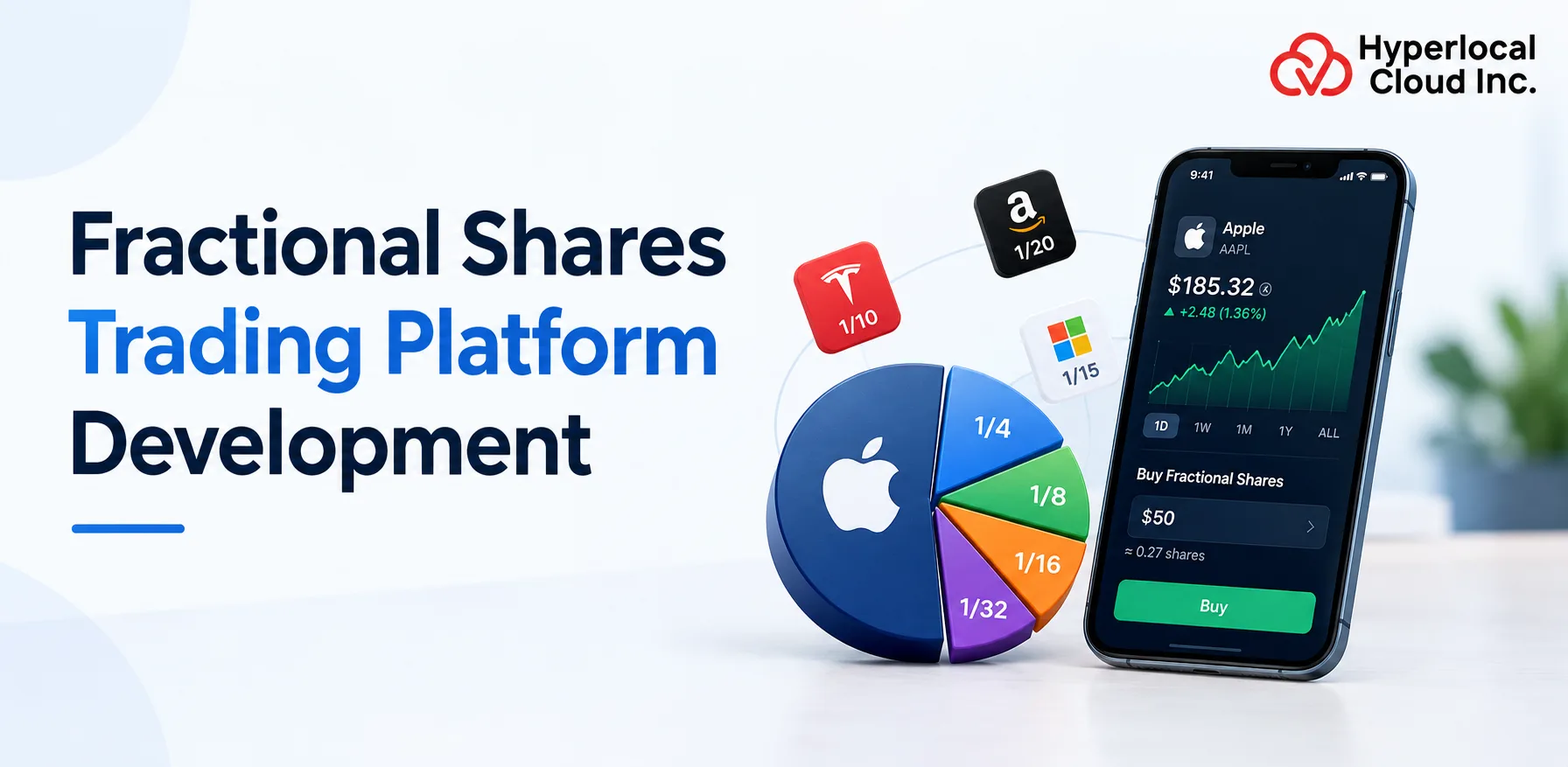
Fractional trading transformed retail investing by removing capital barriers. Empowered individuals to buy slices of high-priced stocks or ETFs for as little as $1 rather than paying the full price for a single share. Fidelity Investments, Robinhood, Interactive Brokers, and Charles Schwab lead the retail market as top fractional trading platforms.
Building a fractional trading platform for retail investors requires a unique approach, since exchanges like NYSE and Nasdaq execute transactions only in whole shares. Two common paths to build a fractional-shares trading platform are a B2B infrastructure API and an Internal ledger engine.
Primary Engineering Challenge
Since many market and clearing processes handle whole shares, platforms use internal methods to process fractional-share orders. The U.S. Securities and Exchange Commission (SEC) explains that brokerage firms’ fractional-share handling methods can affect order execution prices.
As per the U.S. Securities and Exchange Commission (SEC), Investor.gov: “The process your brokerage firm uses to handle buying and selling of fractional shares may impact the price you pay or receive for a fractional share order.”
Allocation Mode
- Purchases the whole share on the open market.
- Credits the user’s requested fraction to their account ledger.
- Holds the remaining fraction in its internal inventory account.
Batching
- Combines fractional share requests from multiple users.
- Matches quantities (e.g., 0.4 + 0.6 = 1) shares.
- Place one whole-share order on the exchange.
Launch a Feature-Rich Stock Trading App With Our White-Label Solution
Infrastructure Deployment Paths
Building a broker-dealer from scratch requires significant investment and rigorous regulatory review. Most modern fintechs utilize white-label stock trading solutions or API-first infrastructure providers that handle the execution ledger and compliance natively.
| Infrastructure Provider | Core Capabilities | Ideal For |
| Alpaca API |
|
Rapid global fintech deployment and algorithmic platforms |
| Tradier API |
|
Platforms prioritizing heavy charting, education, or options workflows |
| WealthKernel API |
|
Retail apps targeting European and UK jurisdictions |
Building Proprietary Core Engine – Option B
If you want to operate as the main clearing broker-dealer, your backend must meet strict regulatory and technical requirements.
The Ledger System
- Utilizes an immutable, double-entry ledger to record every transaction.
- Tracks all fractional share movements accurately.
- Calculates dividends based on each user’s exact ownership ratio.
- Example: Owning 0.005 Apple shares earns 0.005x the per-share dividend.
The Pre-Trade Risk Engine
- Continuously calculate available buying power as the share price changes.
- Block orders that exceed the client’s available cash balance.
Real-Time Synchronization
- Use WebSockets to deliver instant stock price and status updates.
- Integrate providers like Polygon.io or Alpha Vantage for real-time market data.
- Feed live price updates directly into the matching system.
Regulatory & Compliance Architecture
A fractional asset platform cannot scale safely without strict alignment across financial compliance guidelines:
KYC/AML Infrastructure
- Integrate Plaid, Persona, or Jumio during signup.
- Automate identity verification through background checks.
Capital Requirements
- Hold leftover fractional shares in an internal inventory account.
- Maintain sufficient capital reserves to cover overnight market price fluctuations.
Licensing
- Register as a broker-dealer with the SEC in the US.
- Obtain FINRA and SIPC membership.
- Secure equivalent regulatory approvals, such as FCA authorization in the UK.
Your target location dictates your legal overhead, licensing timelines, and required compliance integrations.
United States (SEC & FINRA)
- High regulatory burden.
- Requires registering as a broker-dealer (based on activities & serving jurisdictions)
- SEC, FINRA & SIPC.
- Compliance with FINRA Rule 5310 for brokerages offering internal fractional execution.
- 6–12 months for custom licensing.
- 1-3 months if using a B2B provider (like Alpaca or DriveWealth).
United Kingdom & Europe (FCA & MiFID II)
- Strict regulatory requirements.
- Governed by FCA (UK) or ESMA (EU).
- Strict MiFID II transparency rules.
- Technically structured true fractional shares.
- Contract/Co-ownership wrapper.
- Single EU license to offer financial services across member states.
- Consider licensed hubs like Ireland, Lithuania, or Germany.
Emerging Markets (LATAM, India, SE Asia)
- Medium to high regulatory burden.
- Local capital market regulators prohibit fractional trading of domestic blue-chip stocks.
- Platforms offering cross-border trading succeed.
- Allow users to buy fractional shares of US equities via partnerships with US clearing brokers.
Tech & Ledger Demands
Market data sources, execution logic, and internal ledger payout processing depend on the asset type you offer.
US Equities & ETFs
- Extremely high liquidity.
- Easy to match retail orders to wholesale market makers.
- Requires reliable SIP via WebSockets.
- Complex ledgers.
- Accurate tracking and distribution of micro-dividends to eight decimal places.
Crypto & Digital Assets
- High liquidity.
- Highly fragmented across global private exchanges.
- REST and WebSocket API connections routed to major crypto liquidity hubs.
- Less complex ledgers.
- Fractional-by-design cryptocurrencies.
Alternative Assets
- Low liquidity.
- Requires a specialized secondary P2P marketplace.
- Users can trade their slices with one another.
- Custom or manual appraisal pricing models.
- No automated live tickers for these items.
- Handled through tokenization.
- Private ledger or blockchain network.
Partner With Our Experts to Develop a Secure Fractional Trading Platform
Monetization Models for $1 Minimum Trading
Traditional per-trade flat commissions will discourage fractional investors, as they trade in very small amounts. Some of the alternate revenue streams are discussed below:
Premium Subscription Tiers
Charging fixed monthly fees for:
- Extended hours trading.
- Instant funding access.
- Automated recurring portfolios.
- High-yield cash sweep accounts.
Net Interest Margin
- Earning interest on the uninvested cash.
- Cash is swept into partner banks.
- Yield is split between your platform and the clearing house.
Payment for Order Flow
Market makers pay a fraction of a cent per share for execution volume. (Note: This is highly lucrative in the US but legally banned or heavily restricted in the UK and EU).
Related: 8 Ways FinTechs Monetize Stock Trading Platforms
Estimated Development Cost By Platform Type
The estimated development cost to launch a retail fractional trading platform ranges from $50,000 to $20,00,000. The total cost depends on whether you build in-house infrastructure or use existing solutions.
| Platform Architecture Type | Estimated Cost (USD) | Time to Market | Core Expenses & Cost Drivers |
| API-Driven Fintech App | $50,000 -$150,000 |
2 – 4 months |
|
| Custom Brokerage Platform | $250,000 – $600,000 | 8 -14 months |
|
| Enterprise/Neobank Suite | $1,000,000 – $2,000,000 | 18 – 24 months |
|
Note: Actual costs vary by jurisdiction, brokerage partnerships, security requirements, and operational needs. Consult with experts for an accurate cost estimate.
Must-Have Features of a Fractional Stock Trading Platform
A feature-rich fractional trading platform must make investing easier while staying profitable and compliant with all regulatory requirements. If you’re planning to launch your MVP, then cash/share toggle UI, instant funding, and automated KYC verification are non-negotiables.
Cash/Share Toggle
Lets users invest a dollar amount or buy a fraction of a share.
Real-Time Price Estimator
Dynamically updates the fractional share count as the user types an amount.
Instant Funding
Credits a user’s account immediately, up to a safe limit, while the bank transfer clears over 3 days.
Pie-Chart Interface
Displays the user’s fractional holdings visually, focusing on percentage allocation over raw share counts.
Micro-Dividend Tracker
Displays dividends calculated to the nearest cent, even for tiny holdings in high-dividend stocks.
Consolidated Tax Export
Automated tax document generation (like 1099-Bs) that cleanly compiles hundreds of micro-transactions.
Recurring Baskets
Allows users to build a custom basket of stocks and auto-invest $10 into it every week.
Spare Change Round-Ups
Links to a debit card, rounds up purchases, and invests the fractions in stocks.
Dividend Reinvestment
Automatically reinvests fractional dividends in the same stock.
Stock Gift Cards
Lets users send a text or digital card worth a certain amount of stock to family or friends.
Gamified Learning
Rewards users with a tiny fraction of a stock for completing brief in-app financial literacy quizzes.
Public Profiles
Enable users to share a visual view of their portfolio mix to a social feed.
Slippage Guardrail
Automatically cancels a retail cash order if the market price moves beyond a set threshold before execution.
Dormant Account Cleanup
Automatically sweeps and clears dormant accounts with cash balances under $1 to reduce platform maintenance fees.
Circuit Breaker Switch
An admin dashboard feature that instantly pauses all retail trading if the third-party execution API goes down.
Omnibus Reconciliation Screen
A dashboard that compares user records with the clearing firm’s stock records in real time.
Fractional Dust Liquidator
Automatically sweeps and clears dormant accounts with cash balances under $1 to reduce platform maintenance fees.
Build a Scalable Investment App With Advanced Fractional Trading Features Today
Conclusion
Fractional trading is the future of retail investing because it lets anyone buy a piece of the stock market for just $1. Building a fractional share trading platform isn’t one-size-fits-all; success depends on your choices. For startups, pre-built financial APIs are a smart choice; with Hyperlocal Cloud’s white-label stock trading platform solution, you can launch for as little as $7,000. Strict regulatory compliance is non-negotiable when building a fractional trading platform, as features that are highly profitable in the US are illegal in the UK and Europe.
FAQs (Frequently Asked Questions)

Nisha Bagga is a technical writer with more than 7 years of experience creating high-quality content for a wide range of industries. She specializes in developing clear, engaging, and well-researched technical and business content tailored to diverse audiences and industry requirements.

Need Help With
Development?