


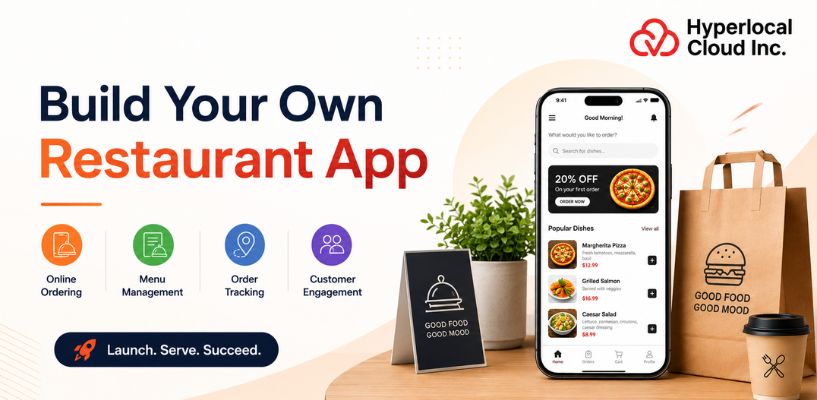
Are you looking to grow your restaurant business and connect with customers in the digital age? Developing a mobile restaurant app is one of the most effective ways to boost sales, improve customer experience, and stay ahead of the competition. Whether you run a small café or a multi-location restaurant, a well-designed app can help you streamline operations and increase loyalty.
Recently, technology has taken the front seat and become an essential part of our daily lives. Due to this, there has been a considerable rise in smart devices that have acted as a dynamic tool in the app development process. Businesses have leveraged the power of advanced tools and technologies and have taken an online route to showcase and popularize their brand value.
In this blog, you will get a cooked recipe for success, and it will help you gain massive profits.
Why Restaurant Apps Are Growing So Fast (Latest Stats)
The global shift toward mobile ordering is accelerating:
- The global online food delivery market is projected to exceed $280–320 billion in 2026, with continued strong growth expected through 2030+
- More than 1.8 billion people worldwide have now used food delivery apps at least once
- Around 60%–62% of restaurant orders now come through mobile apps in many markets
- Asia leads global adoption, accounting for over 55% of food delivery app downloads
- Leading apps like Uber Eats alone recorded 60M+ downloads in a single year, showing sustained consumer demand
These numbers highlight a clear trend: customers now prefer ordering food through apps rather than traditional phone calls or walk-ins.
Talk to Our Experts and Start Building Your Restaurant App
Must-Have Features In a Restaurant App
Here, we have curated the features you can integrate into your restaurant app.
1. Customer App Features
A customer-facing app should be simple, fast, and easy to use:
Menu Browsing
Offers a highly intuitive interface that helps customers seamlessly browse the menu by applying search and filter options.
User Registration
Enables customers to create their own profiles on the platform by entering their contact and payment-related details.
Multiple Payment methods
Allows users to make payments through various payment methods such as digital wallets, credit/debit cards, and cash.
Ratings & Reviews
Allows customers to rate their dining experience by reviewing the food item, thereby helping users make informed decisions.
2. Driver App Features
The delivery system plays a critical role in user experience:
Order Assignment
Our restaurant app assigns delivery orders to drivers depending on their availability, along with optimized route navigation services.
Real-Time Updates
Offers drivers with real-time updates when it comes to order acceptance, pickup, delivery, and any changes in order status.
Earnings Dashboard
Exhibits all key performance metrics and an overall summary of completed deliveries such as earnings, bonuses, tips etc.
Accept/ Reject Orders
Gives authority to the drivers to take action on the requests in real time by either accepting or rejecting the orders.
3. Restaurant App Features
This panel helps manage daily restaurant operations:
Menu Management
Allows app owners to add and delete the food items on the restaurant’s menu along with categorizing items for seamless navigation.
Customer Management
Flawlessly manages the entire customer database with order history and contact details that customize the dining experience.
Analytics and Reporting
Helps generate reports on key performance metrics, including sales, profits, tracking retention rates, active users, etc.
Driver Management
Properly monitors the real-time location of drivers as to where they have reached in terms of picking and delivering orders.
Advanced Technology Stack For Modern Restaurant App Development
We craft a solution integrated with modern technologies to draw users’ attention. These are;
Frontend Development
Programming Languages: JavaScript, Dart
Framework: React Native, Flutter
Backend Development
Framework: Node. js, Django
Database: MongoDB, PostgreSQL
Geolocation Services
API: Mapbox Google Maps API
Cloud Services
Hosting: Amazon Web Services, Microsoft Azure, Google Cloud Functions
Serverless Computing: AWS Lambda, Google Cloud Functions
Payment Integration
Payment Gateway: Braintree, Stripe
Start Your Restaurant App Development Journey with Us Today
Step-by-Step Restaurant App Development Process
Here’s the process that encompasses conceptualization, ideation, market research, development, and deployment.
1. Research & Planning
Performing market research, understand the market, and analyze the trends. Based on that, an effective roadmap is created that includes the blueprint of all the necessary features and functionalities.
2. UI/UX Design
Focus on building simple and convenient user experiences. They take care of all the visual components of the app, such as icons, buttons, etc., while creating aesthetically pleasing interfaces.
3. App Development
Then comes developing high-quality digital products for your organization. Aim for each function Frontend and backend development of all modules and integrations to work properly and deliver effective results.
4. Testing & Quality Assurance
Once the development team builds the app, the testing team checks for bugs and errors and removes them by performing several testing techniques.
5. Launch
The developed app is finally launched on the dedicated servers and play stores for public consumption.
6. Support And Maintenance
The clients are offered timely post-maintenance services in case of any technical glitches or issues.
Business Benefits of a Restaurant App
1. Higher Revenue Growth
Through data analytics and reporting features, restaurant apps can gain valuable insights from their owners by evaluating trends, user preferences, and ordering habits. This helps businesses improve their customer service and devise better marketing strategies.
2. Enhanced Customer Experience
The restaurant app development process best suits all businesses striving to provide a phenomenal customer experience. The process of selecting food, ordering dishes, making quick payments, tracking orders, etc., is helpful in offering a superior customer experience.
3. Improved Payment Processing
The most critical step for business owners is when the users make online orders. But our food delivery apps are integrated with secure payment methods that process transactions from anywhere.
4. Lower Operational Costs
With automated processes, a restaurant app can steer towards ultimate cost savings because every menu is digitized with no printing costs, saving time and money.
5. Customer Loyalty
With in-app rewards and top-notch loyalty programs, it excites end-users and compels them to make repeat purchases. It also aids restaurants in building a loyal customer base and boosting customer retention rates.
How Much Does It Cost to Build a Restaurant App?
The cost of building a restaurant app depends on several factors, including the app’s complexity, platform (iOS, Android, or both), design requirements, and the features you want to include.
- Basic App: For a simple app with menu browsing, ordering, and payment integration, development can start from $6,000.
- Advanced App: Apps with real-time order tracking, loyalty programs, analytics dashboards, and multi-platform support can range from $20,000.
Other factors that influence cost include:
- UI/UX design complexity – custom animations and polished interfaces increase costs.
- Backend & database requirements – real-time order processing, cloud hosting, and scalability add to the budget.
- Third-party integrations – payment gateways, mapping APIs, and delivery tracking services.
- Maintenance & updates – ongoing support is usually calculated as a monthly or annual fee.
Instead of focusing only on the price, it’s better to define your requirements and goals first, which helps get a more accurate estimate and ensures the app delivers real value to your business.
Launch Your Restaurant App and Grow Your Business Faster

Patt Cummins is an experienced content writer with over 10 years of experience creating clear and engaging content for technology-focused industries. He specializes in simplifying complex technical topics into easy-to-understand stories that educate readers, support brand communication, and help businesses effectively share their solutions.

Need Help With
Development?