

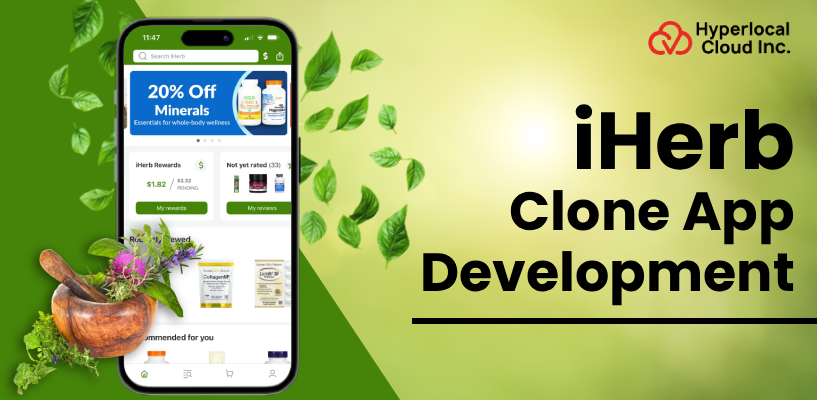
The habit of people to purchase vitamins and supplements has been transformed to their mobile phones. iHerb achieved a net sales of $2.9 billion in fiscal 2025, 19% year-over-year, and the company completed more than 44 million orders and 15 million active customers across 75 countries worldwide. In the meantime, the U.S. dietary supplements market alone is projected to increase its size from $85.4 billion in 2026 to approximately $190 billion by 2035. Such money does not lie down.
Customers now demand delivery of their daily vitamins over subscriptions, recommendations, and delivery within the same day, as they do with their groceries. When you have a health and wellness brand or a startup that considers this area, having a dedicated delivery app is no longer a nice-to-have anymore. It’s where the customers already are. This blog divides up to the exact steps of constructing one, what features are important, and how the market currently looks.
What is the iHerb App?
iHerb is an online health and wellness app that began in 1996 in Irvine, California. It currently serves 180 countries, has 36 languages, and has nine climate-controlled fulfillment centers located in the U.S., Asia, and the Middle East. The app retails all sorts of vitamins and supplements, sports nutrition, beauty products, and groceries. Repeat buyers make up about 80% of orders, and that is an indicator that the retention model is successful. It is basically what a supplements-delivering app ought to resemble.
Build Your Iherb-like App and Tap the Booming Supplements Market
How Does a Vitamins & Supplements Delivery App Like iHerb Work?
A supplements delivery application is not a complex one for the user. The entire process is reduced to browsing, purchasing, and having it delivered. The following is the way it works in each step:
1. Product Discovery & Search
Users browse by product category, health issue, or brand. The application relies on AI-based suggestions to tailor the outcomes; therefore, every customer will have what is most suitable to their wellness objectives.
2. Authentic Customer Reviews
Reviews can be left only by customers who have purchased a product. This makes feedback truthful and makes new buyers more confident of what they are putting in their bodies without having to guess.
3. Cart, Coupons & Checkout
Communication with customers happens through promotional codes, reward points, and discounts that are specific to the apps, and then they pay. The initial customers who use the app are normally given a 20% discount on their first purchase, which is an effective way to copy.
4. Climate-Controlled Shipping
Fulfillment centers are temperature-controlled, and ship goods directly to maintain product potency and freshness. Depending on the urgency, the customers can choose between a normal and a rush delivery.
5. Subscription & Auto-Refill
In 2025, Subscriptions on iHerb increased by 370. Users save a repeating delivery schedule of their most frequent products and automatically get the best price they can each time.
6. Real-Time Order Tracking
Live tracking alerts are sent directly to the phone of the user. Between ordering and receiving, buyers can view the precise location of their order without digging through emails and support chats.
What Features Do You Need to Build a Supplements Delivery App Like iHerb?
Developing an app that delivers supplements will entail ensuring that it works as desired by all individuals who will have to interact with the app. This is what you should have in each panel of your application.
Customer App Features
1. Smart Product Search & Filters
The filters, such as brand, health goal, price, and dietary preference, will enable the users to find what they need within seconds. Include autocomplete and search history to prevent returning customers from starting all over again.
2. Personalized Product Recommendations
The application must know what every user purchases and recommend a product that is related to their purchases. This is the way to add average order value without urging it.
3. Detailed Product Pages
All the listings should include ingredient details, dosage, certification, and quality images. Consumers who are purchasing supplements are more focused on the contents of the bottle, rather than the appearance of the label.
4. Verified Customer Reviews & Ratings
Allow only those buyers who have bought an item to leave a review. This single feature will create more trust than any marketing campaign that you will ever have.
5. Subscription & Auto-Refill
Allow users to make recurring deliveries at a schedule of their choice, be it weekly, monthly, or every 90 days. Give a discount on subscription orders in order to secure long-term retention.
6. Multiple Payment Options
Store cards, buy-now-pay-later, support credit cards, debit cards, and digital wallets. The fewer payment friction points you have, the fewer carts will be left at the checkout.
7. Real-Time Order Tracking
Demonstrate to users the physical location of their order in the warehouse up to their doorstep. Each stage will have its own push notifications so that buyers will not have to open the app every time.
8. Wishlist & Save for Later
Not all people make purchases on the first occasion. Allow users to save items that they would like to get and provide a slight alert to them about the same when they are on sale.
9. In-App Loyalty & Rewards Program
Reward customers with points each time they make a purchase, referral, or even a review. Allow them to redeem such points as discounts on future orders so that they will be coming back.
10. Reorder with One Tap
Give users a history of their previous orders and enable them to reorder them with one tap. When it comes to supplements, individuals like to purchase the same products repeatedly, and therefore, make it as painless as possible.
Delivery Driver App Features
1. Order Assignment & Acceptance
The drivers are made aware of the new deliveries, and they can either accept or reject them, based on their availability. The system should automatically send the orders to the nearest driver in a bid to minimize the time taken to make the delivery.
2. GPS Navigation & Route Optimization
Embedded maps should give the most optimal route to all drop-offs to the drivers. Smart routing is energy efficient, reduces time wastage, and enables the drivers to make more deliveries within a shift.
3. Delivery Status Updates
Each stage of a delivery is noted by the drivers as they progress, such as picked up, out for delivery, and delivered. These notifications are real-time with the customer app, and hence no one is left guessing.
4. Digital Proof of Delivery
Allow the drivers to take a picture or take a digital signature at the door. This protects both the business and the driver in the event that a customer complains that they never received their order.
5. Earnings Dashboard
Drivers should have a clear picture of how much they have made in terms of earnings per day, week, and month. Display finished deliveries and tips, bonuses, and awaiting payouts.
6. In-App Chat with Support
Occasionally, things can go awry on the road. The app ought to assist drivers to get assistance or the customer without revealing personal phone numbers.
7. Delivery Schedule Management
Allowing drivers to determine their own availability periods and choose the shifts that are convenient to them. Flexibility in schedules will maintain your pool of drivers and decrease no-shows.
8. Order Details & Special Instructions
The drivers can view the entire delivery address, package contents, and any customer notes prior to leaving. When one mentions leave at the side door, the information ought to have been hard to miss.
9. Temperature-Sensitive Handling Alerts
Under extreme temperatures, either extreme heat or extreme cold, supplements may lose their potency. Flag orders that should be handled cautiously so that drivers are aware not to leave them sitting in a hot vehicle for hours.
10. Performance Ratings & Feedback
Allow customers to rate their experience with delivery, and allow drivers to see their scores in the long run. The high performers are assigned priority duties, and this encourages improved service throughout.
Admin Panel Features
1. Centralized Order Management
Admins should be able to access all orders in the system through one dashboard to filter and manipulate them. All pending, delivered, and refunded are to be visible and searchable in a single place.
2. Product & Inventory Management
Create, edit, and delete products in bulk. Monitor inventory in warehouses and install low-stock alarms, so you won’t run out of inventory and sell a product that is unavailable.
3. User & Driver Management
On the same screen, see all customers and delivery drivers. Admins should be able to verify, block, or flag accounts without necessarily changing to different tools.
4. Promotions & Discount Engine
Create coupons, flash sales, packages, and referral rewards on the back. Instead of needing to call your team of devs every time, a flexible promo engine will enable you to try different offers.
5. Analytics & Sales Reporting
Track revenue, top-selling products, cost of acquisition, and retention rates in real-time. Good data will inform you what is working and where you are bleeding money.
6. Subscription Management
See all active subscriptions, renewals, cancellations, and failed payments. Offer admins the choice to pause, update, or renew a user subscription in case of receiving tickets.
7. Content & Banner Management
Change home page banners, featured products, and category highlighting without the need to touch any code. The marketing team ought to have the capability to run campaigns without relying on the dev team.
8. Review & Feedback Moderation
Check incoming reviews (spoofing, fake reviews, or abusive content). To ensure the credibility of product pages, admins should approve, flag, or delete reviews.
9. Multi-Warehouse & Fulfillment Tracking
Assuming you are shipping across multiple locations, then the orders should automatically be sent to the closest warehouse using the admin panel. Monitor the progress of individual facilities and identify early bottlenecks.
10. Role-Based Access Control
Not all the members of your team require access to all. Assign roles and permissions to categorize your warehouse staff, marketing team, and finance team to only see what they need to know about their job.
Launch Faster, Scale Smarter, and Win the Supplements Delivery Space
AI-Powered Features That Make a Supplements Delivery App Smarter
AI is no buzzword. It is what makes the difference between a simple ecommerce app and one that comprehends what each customer requires prior to them searching.
| AI-Driven Features | Description |
| Personalized Supplement Recommendations | The application uses purchase history, browsing behavior, and each user’s health targets to propose appropriate products. Each shopper is shown a feed tailored to them instead of presenting the same list of bestsellers to each shopper. |
| Smart Search with Natural Language Processing | People can enter such queries as something to help with joint pain or vegan protein that is not made of soy, and get the correct answer. NLP can learn the intent behind unintended searches, and thus, the customers do not have to be aware of specific products. |
| AI-Based Health Goal Matching | A short quiz regarding the health goals of a new user is input into a recommendation engine when the user signs in. The app will then select a starter package or a day-to-day routine depending on what they really require, not what is trending. |
| Dynamic Pricing & Discount Optimization | AI monitors the demand trends, rival pricing, and inventory to change the prices on the fly. It also determines how much of a discount is going to cause a buy, but not to the point where you are cutting your margins. |
| Predictive Reorder Reminders | The app forecasts when a customer is running out based on the frequency of purchases and the usual time period of a supplement cycle. It provides a well-timed notification or auto-refill alert when the bottle is nearly full. |
| AI-Powered Review Summarization | Users do not need to scroll down and read hundreds of reviews; instead, a brief AI-generated summary of what was liked and disliked by buyers is available to them. This is time-saving and provides the shopper with a quick preview as to whether a product is worth trying. |
| Chatbot for Instant Customer Support | An AI chatbot processes frequent questions related to orders and shipping, returns, and product details 24/7. It solves the simple problems immediately and delegates the complicated problems to a human operator without requiring the user to rephrase. |
Step-by-step Process to Build a Vitamins & Supplements Delivery App Like iHerb
This app was not created by simply jumping into code. It is all about making the correct choices at the beginning of your life to avoid spending months restoring all that ought to have been decided at the beginning.
Step 1: Market Research & Competitor Analysis
Research the successes and the areas of weakness of iHerb, Vitacost, GNC, and The Vitamin Shop. Interview actual users of the supplement, get to know their areas of pain, and identify the gap that your application can fulfill and is being overlooked by others.
Step 2: Define Your Business Model & Feature Scope
Choose between a marketplace, a single-brand store, or a subscription-first platform. Get your MVPs’ feature list locked early to make sure your team is not chasing all the shiny objects and blowing the budget before you roll to launch.
Step 3: UI/UX Design & Prototyping
Trace the entire user flow of signing up, checking out, and reordering, and create clickable wireframes. Test these prototypes on real users prior to writing a single line of code, since, on paper, it is free to fix a design; whereas, in production, it is very expensive.
Step 4: iHerb Clone Development
The iHerb clone app development can happen in two ways, i.e., a custom-based way, and the purchase of a white-label solution. Custom-based strategy entails that the app has to be created anew, and it needs a longer duration and investment. Conversely, a white-label solution is the type of solution that you can buy and repackage as your own and introduce in less than a week or two. Such solutions are relatively affordable.
Step 5: Testing & Quality Assurance
Functional test, performance test, security testing, and payment gateway testing your app on all devices and OS versions your users may use. A single hiccup when it comes to payment or a broken checkout page on the opening day may kill trust even before you have even taken off.
Step 6: Launch, Monitor & Iterate
Begin with a small-scale launch to a smaller user base, get feedback, correct what fails, and then scale out. The actual work starts at post-launch, since the behavior of the users will inform you of things you could not have known before the actual launch.
How Does a Vitamins & Supplements Delivery App Like iHerb Make Money?
The supplements delivery app is not based on a single income stream. By piling up various sources of revenue, the most intelligent players make sure that the business is not affected in terms of profitability when one channel runs dry.
1. Product Sales & Markup
This is the simplest of them. You can purchase supplements at wholesale rates and sell at a premium via your application. Even better margins can be made if you introduce private-label products, as iHerb did in its own line of California Gold Nutrition.
2. Subscription & Auto-Refill Fees
Recurring deliveries are users who ensure a steady stream of revenue, and you can plan on it. A little discount on subscription orders would be worth it since you would be trading a couple of percentage points for a surety of repeat business and reduced customer acquisition cost.
3. Commission from Third-Party Brands
In case you are operating a marketplace business model, impose a percentage of each sale on the brands that use your platform. The higher the traffic that your app generates, the more brands are ready to spend to obtain shelf space and place in your product listings.
4. Sponsored Listings & Featured Placements
Allow brands to advertise to put their products on your home page, category page, or search results. This is similar to paid advertisements within your app, and it does not harm the user experience, provided that the advertised goods are somewhat relevant.
5. Affiliate & Referral Programs
Make their current customers have a reason to refer new ones by providing them with store credits or money back for each successful referral. Your users are your most cost-effective marketing tool, and the cost per acquisition is much lower than on paid ads.
Transform Your Wellness Brand Into a Subscription-driven Mobile App Today
How Much Does It Cost to Build an App Like iHerb
Building a vitamins and supplements delivery app similar to iHerb is dependent on features, platform, and intricacy. Basic Mobile App is $7,000 – $15,000, and a fully-featured Mobile App with AI recommendations, subscription management and real-time tracking will cost you $20,000 – $40,000. While a custom-built solution will cost more, a white-label clone will be quicker and more cost-effective.
Hosting, maintenance and updates of servers are ongoing costs. Subscription billing, secure payments, automated reminders to reorder, etc., are features that enhance upfront investment, which leads to a boost in retention and revenue. Features of proper planning and prioritizing enable control of costs and provide a smooth user experience.
In Conclusion!
The supplements business is expanding rapidly, and apps such as iHerb have already shown that clients like to shop for their vitamins online by subscription, personalized selections, and delivery. And, in case you are serious about getting into this space, this is the time. Waiting until it becomes crowded is not the best thing to do.
We develop tailored vitamins and supplements delivery applications at Hyperlocal Cloud, which can be scaled at the initial stage. We are also able to provide clone app solutions at affordable rates so that you can launch at a faster rate without any compromise on the quality. No matter what you require, a complete custom construction or a pre-built solution, our staff takes care of the design process from deployment. Get in touch with us, and we will transform your app idea into a product.
FAQs (Frequently Asked Questions)

Patt Cummins is an experienced content writer with over 10 years of experience creating clear and engaging content for technology-focused industries. He specializes in simplifying complex technical topics into easy-to-understand stories that educate readers, support brand communication, and help businesses effectively share their solutions.

Need Help With
Development?