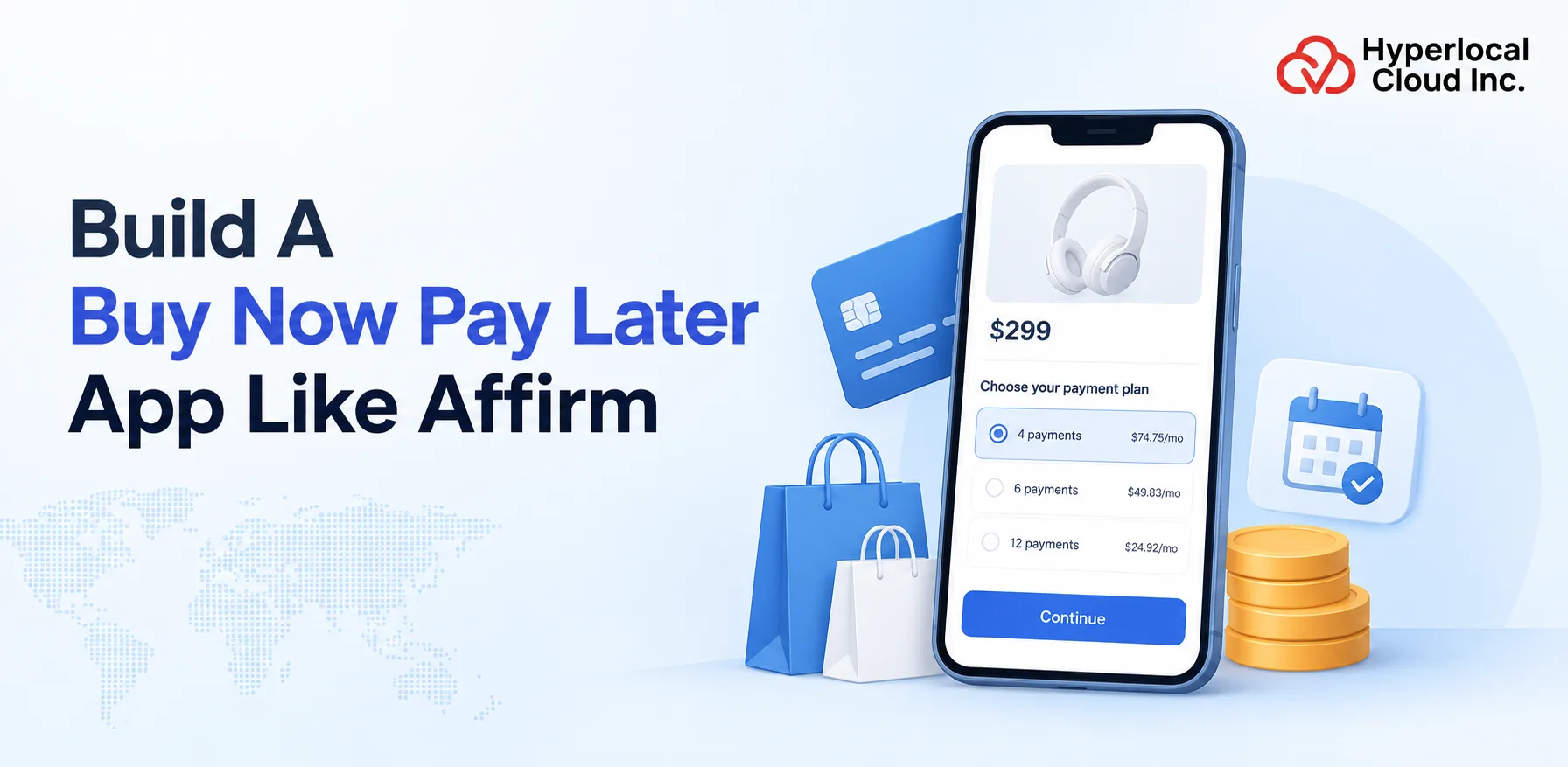
- A BNPL app allows eligible consumers to divide qualifying purchases into scheduled payments under clearly disclosed terms.
- A complete platform may include customer applications, merchant integrations, an administrative dashboard, payment processing, and transaction monitoring.
- AI-assisted risk assessment and fraud detection can support lending decisions when implemented with appropriate controls and human oversight.
- Development costs depend on customization, payment integrations, security requirements, and the complexity of the financing model.
- Hyperlocal Cloud lists its white label solution with a starting development cost of $6,000, subject to customization requirements.
- White-label software can provide a starting point for businesses that want to launch a branded BNPL solution without building every component from scratch.
- Lending partnerships, consumer protection, data privacy, and applicable financial regulations should be addressed before launch.
The way consumers pay for products and services has changed significantly with the growth of digital payments and flexible financing options. Buy Now, Pay Later (BNPL) platforms allow eligible customers to purchase products immediately and repay the amount through scheduled installments. For merchants, these solutions can offer another checkout option, while fintech companies can build new services around digital lending and payment management.
Affirm is one of the recognizable names in the BNPL industry. Its business model provides an example for entrepreneurs interested in developing a similar financial technology platform with their own branding, merchant partnerships, payment options, and customer experience.
However, building a successful BNPL platform requires more than replicating an app interface. Businesses must plan their lending or financing model, payment integrations, credit assessment workflows, security architecture, compliance responsibilities, and customer support processes.
This guide explains how to build an app like Affirm in 2026, covering essential features, technology choices, development steps, monetization opportunities, regulatory considerations, and estimated costs.
What Is a Buy Now, Pay Later App Like Affirm?
A Buy Now, Pay Later application is a digital payment or financing platform that allows eligible customers to pay for purchases over an agreed period rather than paying the entire amount immediately.
Depending on the product, customers may receive short-term installment plans, longer-term financing, or other payment arrangements. Some plans charge no interest when their conditions are met, while others may include interest or additional charges.
The platform coordinates the customer experience, payment schedule, merchant checkout, repayment collection, and relevant financial services. The exact responsibilities depend on whether the business operates as a lender, partners with a licensed financial institution, or provides technology to other financial service providers.
For entrepreneurs exploring this business opportunity, an Affirm-like platform can serve online stores, retail businesses, electronics merchants, fashion retailers, and other eligible merchants.
Understanding the Affirm Business Model
Affirm operates in the consumer financing market by offering payment options at checkout and through its consumer-facing services. Its financing arrangements can vary by purchase, merchant, customer eligibility, and the terms presented to the customer.
An entrepreneur developing a similar platform should first decide how financing will be provided. The business might partner with a lending institution, work with an established financing provider, or pursue an appropriately structured lending operation.
The decision affects the company’s revenue model, capital requirements, licensing obligations, credit decision process, and operational responsibilities.
A successful platform should prioritize transparent pricing, clear repayment schedules, reliable payment processing, and responsible credit decisions instead of focusing exclusively on increasing transaction volume.
How BNPL Apps Benefit Consumers and Merchants
Consumers can benefit from payment flexibility when installment plans fit their budgets and financial circumstances. Clear repayment schedules can help customers understand their upcoming obligations and manage payments.
Merchants can offer an additional checkout method to eligible shoppers. Depending on their customers and implementation, this option may help reduce checkout friction, support purchasing decisions, and improve the shopping experience.
Fintech entrepreneurs can build services around merchant onboarding, transaction processing, financing integrations, repayment management, and customer account administration.
However, BNPL availability does not guarantee higher sales or better conversion rates. Businesses should evaluate these outcomes using actual merchant data and customer behavior.
Transform Your Fintech Business Idea Into a Scalable BNPL Platform
How Does an Affirm-Like BNPL App Work?
A BNPL platform connects customers, merchants, payment systems, and the relevant financing provider through a coordinated workflow.
Customer Registration and Identity Verification
Customers create an account using the information required by the platform. Depending on the product, the registration process may collect contact information, identity details, and payment preferences.
Identity verification can help prevent impersonation, account misuse, and certain types of financial fraud. Verification requirements should match the product’s risk profile and applicable legal obligations.
Eligibility Assessment and Credit Evaluation
When a customer selects a financing option, the platform gathers the information required to evaluate eligibility.
A decision engine or integrated financing provider may assess application details, available credit information, purchase value, repayment capacity, and applicable underwriting criteria.
The platform then communicates the available financing options and their terms. Approval should never be presented as guaranteed.
Merchant Checkout and Payment Approval
The customer selects BNPL at checkout and reviews the repayment schedule, applicable charges, and other required disclosures.
After the financing decision, the system communicates the approval or other decision to the merchant checkout. If approved, the order proceeds according to the merchant’s and financing provider’s arrangements.
Installment Scheduling and Repayment
The platform creates a repayment schedule and displays upcoming due dates, payment amounts, and relevant account information.
Customers may receive reminders before payments are due. Supported payment methods can include cards or bank transfers, depending on the payment provider and product design.
Failed payments should trigger a clearly defined process for notifications, retries where permitted, customer support, and account updates.
Merchant Settlement and Transaction Reconciliation
The financing arrangement determines when and how the merchant receives payment. The platform should record transactions, applicable fees, settlements, refunds, and adjustments.
Reconciliation tools help identify differences between payment processor records, financing records, and merchant reports.
A reliable reconciliation process is essential for maintaining accurate financial records and resolving discrepancies.
Essential Features of a BNPL App Like Affirm
A robust BNPL platform requires features for customers, merchants, administrators, and the underlying financial operations. The exact scope depends on the business model and the services supplied by third-party partners.
Customer App Features
User registration and authentication: Provide secure account creation, login, identity verification workflows, and account recovery.
Personalized financing options: Display financing plans available to each customer based on the relevant eligibility decision and product rules.
Payment schedule management: Show installment amounts, due dates, outstanding balances, and payment history.
Payment reminders: Send timely notifications about upcoming installments, successful payments, and payment problems.
Transaction history: Maintain an accessible record of purchases, repayments, refunds, and other account activity.
Payment method management: Allow customers to manage supported cards or bank accounts using secure payment-provider integrations.
Customer support: Provide assistance for payment questions, disputes, returns, refunds, and account issues.
Account and privacy settings: Let users review account details, manage appropriate communication preferences, and access relevant privacy information.
Merchant Dashboard Features
BNPL checkout integration: Allow participating merchants to present supported financing options during checkout.
Merchant onboarding: Collect required business information and manage onboarding and verification workflows.
Transaction management: Display purchase records, financing status, refunds, and relevant transaction identifiers.
Settlement tracking: Help merchants monitor expected and completed settlements under their agreements.
Sales analytics: Provide reports on transaction activity, financing usage, and other relevant business indicators.
Refund and cancellation management: Coordinate order cancellations, returns, adjustments, and associated financing updates.
Merchant account management: Provide access to integration settings, staff permissions, and business reporting.
Admin Panel Features
Customer and merchant management: Manage accounts, permissions, onboarding statuses, and support requests.
Transaction monitoring: Identify unusual patterns and flag transactions for further review.
Financing and repayment management: Monitor payment schedules, outstanding obligations, repayment events, and exceptions.
Risk management tools: Review alerts, manage risk rules, and support authorized credit decision workflows.
Reporting and reconciliation: Track transaction activity, settlements, repayment performance, and operational exceptions.
Compliance records: Maintain appropriate audit trails, disclosures, consent records, and reporting information.
System monitoring: Track application performance, integration failures, access events, and service availability.
For businesses evaluating a ready-made starting point, Hyperlocal Cloud’s Affirm Clone App development solution describes features such as transaction monitoring, payment integrations, reporting, analytics, and account management.
Advanced Technologies to Integrate Into Your BNPL Platform
Technology selection should support reliable payment processing, efficient operations, secure data handling, and responsible financing decisions.
AI-Powered Fraud Detection
Machine learning can help identify unusual transaction patterns, suspicious account behavior, and potentially fraudulent applications.
A risk engine may examine device signals, transaction characteristics, historical patterns, and other lawfully available information. Suspicious cases can be flagged for additional verification or review.
AI should support a broader fraud prevention strategy rather than act as the only control. Rules-based checks, secure authentication, monitoring, and investigation procedures remain important.
Automated Credit Risk Assessment
Credit decision systems can help authorized lenders evaluate applications consistently. Depending on the financing model, these systems may incorporate verified application information, credit data, repayment history, and other permitted inputs.
Automated decisions require careful validation, documentation, and ongoing monitoring. Businesses should assess model accuracy, potential discrimination, data quality, and applicable fair lending obligations.
Real-Time Payment Processing
Payment integrations allow the application to communicate with supported payment processors, banking services, and financing partners.
The platform should manage authorization responses, payment confirmations, failed transactions, refunds, and duplicate-event prevention. Reliable webhook processing and reconciliation are particularly important when multiple providers are involved.
Predictive Analytics and Personalization
Analytics can help businesses understand payment preferences, merchant activity, customer support needs, and operational bottlenecks.
Personalization may improve how customers discover eligible financing options, but it should not obscure important terms or encourage unsuitable borrowing.
Automated Repayment Notifications
Notification systems can send reminders about upcoming payments, successful transactions, failed payments, and account changes.
Businesses should make notifications accurate, timely, and consistent with customer communication preferences and applicable requirements.
Book a BNPL App Development Consultation With Fintech Technology Experts
Step-by-Step Process to Develop a BNPL App
Building an Affirm-like platform involves business planning, software development, third-party integration, testing, and operational preparation.
Step 1: Conduct Market Research and Competitor Analysis
Start by studying the US BNPL market, target customers, merchant requirements, and competing services.
Identify the categories you want to serve, such as fashion, electronics, home products, or general e-commerce. Interview potential merchants and investigate what they need from a financing partner.
Research should also cover customer expectations, transaction economics, payment preferences, and the risks associated with short-term consumer credit.
Use these findings to define your product’s value proposition and initial market.
Step 2: Define Your BNPL Business Model
Determine how your business will provide financing and generate revenue.
You might operate a technology platform for an established lender, establish a financing partnership, or pursue a lending model subject to the relevant requirements.
Define who makes credit decisions, who funds purchases, who bears credit losses, who handles customer complaints, and who is responsible for servicing and repayment collection.
These decisions influence the software architecture, contracts, operating budget, and regulatory analysis.
Step 3: Select a Technology Partner
Choose a development partner with relevant fintech experience, payment integration capabilities, security practices, and experience building reliable applications.
Assess the team’s ability to implement customer interfaces, merchant tools, backend services, transaction workflows, and administrative reporting.
Before signing a contract, clarify source-code ownership, customization rights, deployment arrangements, third-party licensing, maintenance, and post-launch support.
Businesses comparing technology providers can explore Hyperlocal Cloud’s broader product and solution catalog to review available application categories.
Step 4: Design the UI/UX
Create wireframes and interactive prototypes for the customer app, merchant dashboard, and administrative interface.
The customer experience should make payment amounts, due dates, eligibility outcomes, and applicable charges easy to understand.
Merchant screens should prioritize transactions, settlement information, and exception handling. Administrative interfaces should make operational status and risk alerts easy to review.
Test prototypes with representative users before committing to full development.
Step 5: Develop the Customer App and Merchant Portal
Build the frontends and backend services required for registration, account management, checkout, payment schedules, merchant transactions, and reporting.
A modular architecture can separate user interfaces, business logic, transaction processing, and external integrations.
Develop the core workflows first, then expand the platform based on business priorities and validated requirements.
Step 6: Integrate Payment, Banking, and Credit Services
Select providers based on supported transaction types, geographic coverage, integration requirements, service reliability, and commercial terms.
Depending on the operating model, integrations may include payment processing, identity verification, credit data, bank connectivity, fraud monitoring, and financing services.
Use sandbox environments to test approval responses, payment failures, refunds, duplicate events, and reconciliation scenarios.
Remember that integrating a payment gateway alone does not establish the legal authority to originate or provide consumer credit.
Step 7: Implement Security and Compliance Controls
Apply encryption, secure authentication, least-privilege access, secrets management, audit logging, and appropriate data retention policies.
Conduct threat modeling, vulnerability assessments, and security testing before launch.
Determine the applicable obligations based on the platform’s role, lending structure, partner relationships, customer locations, and payment flows.
Step 8: Test, Launch, and Maintain the Platform
Perform functional, integration, performance, accessibility, and security testing.
Test end-to-end scenarios such as application approval, repayment, failed payments, refunds, disputes, and merchant settlement.
Launch initially with a controlled group of merchants if practical. Monitor transaction failures, customer complaints, repayment outcomes, and service availability.
After launch, maintain the application through security patches, performance improvements, provider updates, and carefully managed feature releases.
Technology Stack Required to Build an Affirm-Like App
The technology stack should be selected according to the team’s expertise, performance requirements, security needs, and integration environment.
Frontend Technologies
React.js or Next.js can support web applications and merchant dashboards. Flutter or React Native can be considered for cross-platform mobile development, while native iOS and Android development may suit products with specialized platform requirements.
Backend Technologies
Node.js with Express, Python, Java, or comparable backend technologies can support account management, transaction orchestration, repayment workflows, and integrations.
The choice should prioritize maintainability, security, testing, and the availability of suitable libraries and engineering expertise.
Database and Data Management
PostgreSQL is a strong candidate for structured transactional records and relationships. Other databases may support particular workloads, but financial records require deliberate consistency, integrity, backup, and recovery strategies.
Sensitive information should be protected through appropriate encryption, access restrictions, and retention controls.
Cloud Infrastructure
Cloud providers such as AWS or Microsoft Azure can supply computing, managed databases, monitoring, storage, and deployment services.
Infrastructure should include backups, disaster recovery planning, access monitoring, and capacity management.
Payment and Financial Integrations
Integrations depend on the business model and may include payment processors, banking providers, identity verification services, credit data providers, and financing partners.
Use provider-approved interfaces and follow applicable security standards. For payment card environments, determine the relevant PCI DSS responsibilities with the payment processor and compliance specialists.
Security and Monitoring
Implement secure authentication, encryption in transit and at rest, role-based access controls, audit trails, vulnerability management, and operational alerts.
A well-designed system should also support incident response and recovery if an integration or infrastructure component becomes unavailable.
BNPL App Security and Regulatory Compliance
Compliance should be considered during product planning rather than added after development.
The legal requirements for a BNPL platform depend on its structure, the type of financing offered, the entities involved, and the jurisdictions in which it operates.
Data Encryption and Secure Authentication
Protect customer information through secure communication, appropriate encryption, access controls, and multi-factor authentication where suitable.
Limit employee access to sensitive information and maintain logs of important administrative actions.
KYC, AML, and Identity Verification
Determine which identity verification, customer due diligence, and anti-money-laundering obligations apply to the business and its financial partners.
Use appropriately configured verification services and establish procedures for suspicious activity, identity mismatches, and account takeover risks.
Credit Reporting and Responsible Lending
Credit assessment processes should use permitted data and follow applicable rules for consumer reporting, adverse action, fair lending, and customer disclosures.
Explain financing terms clearly and design repayment experiences that support informed decisions.
Consumer Data Privacy and Payment Security
Establish clear data collection, consent, retention, and deletion practices. Collect only information necessary for legitimate business purposes and protect it throughout its lifecycle.
Payment processing and storage responsibilities should be agreed upon with relevant providers.
US BNPL Regulations and Licensing Considerations
For US-focused businesses, regulatory analysis should consider federal and state requirements that may apply to lending, consumer disclosures, credit reporting, electronic payments, privacy, servicing, and debt collection.
The regulatory environment can change. For example, the Consumer Financial Protection Bureau announced in May 2025 that it had withdrawn its 2024 BNPL interpretive rule. Businesses should not rely on outdated summaries of that rule as a complete statement of current obligations.
Review the CFPB’s official BNPL compliance resources and consult qualified US financial regulatory counsel before launch.
Create Your Own Branded Installment Payment App for Digital Commerce
How Much Does It Cost to Develop an App Like Affirm?
The cost of building an Affirm-like platform depends on the required features, degree of customization, number of applications, third-party integrations, security requirements, and operating model.
Hyperlocal Cloud lists its white label BNPL app solution with a starting price of $6,000, with the final cost depending on customization. This should be treated as a vendor-listed starting point, not a guaranteed price for every production-ready BNPL business.
White-Label Solution Cost
A white label BNPL app solution can provide an existing software platform that businesses customize with their branding and selected functionality.
This approach may reduce the amount of development required compared with building every component from scratch. However, the actual scope of the supplied software, source-code access, integration work, licensing fees, and maintenance arrangements must be confirmed.
A starting software price does not necessarily include lending capital, regulatory approvals, legal advice, payment provider fees, credit data, or all production deployment expenses.
Custom BNPL App Development Cost
Custom development is appropriate for businesses requiring specialized workflows, proprietary risk models, extensive financial integrations, or a unique customer experience.
Costs depend on the number of platforms, engineering team, design scope, security architecture, integrations, testing requirements, and ongoing support commitments.
A custom project should begin with a detailed requirements document and a phased estimate rather than a single unsupported industry-wide price.
Factors That Affect Development Costs
Feature complexity: More complex underwriting workflows, reconciliation, and reporting require additional design and engineering.
Platform coverage: Separate web, iOS, and Android experiences can increase implementation and testing requirements.
Third-party integrations: Each payment, banking, identity, or credit provider can introduce development and ongoing service costs.
Security requirements: Security assessments, monitoring, access controls, and incident response preparation require planning and resources.
Compliance requirements: Legal analysis, documentation, audits, and operational controls may contribute significantly to the overall budget.
Customization level: Reusing an existing software solution can reduce some work, while extensive modifications may require substantial engineering.
Additional Costs After Launch
Plan for cloud infrastructure, payment processing, third-party service subscriptions, maintenance, customer support, security monitoring, and regulatory operations.
Depending on the business model, lending capital, funding arrangements, credit losses, and collections operations may be substantial additional expenses.
Before choosing a provider, request a written quotation that distinguishes software development from external service charges and ongoing operational expenses.
Best Revenue Models for a BNPL Platform
The right revenue model depends on whether the business provides financing, operates the software, or connects merchants with a financing partner.
Merchant Transaction Fees
A platform or financing provider may receive fees associated with transactions under merchant agreements.
Pricing should account for transaction volume, refunds, chargebacks, settlement requirements, and the responsibilities assigned to each party.
Interest Revenue on Eligible Installment Plans
Some financing products charge interest according to their terms. Where permitted, interest revenue may contribute to the lender’s income.
The business must account for funding costs, credit losses, servicing expenses, disclosures, and applicable lending requirements.
Merchant Subscription Plans
A technology provider may charge merchants recurring fees for access to software, reporting, integrations, or premium platform capabilities.
This model can create recurring revenue that is less dependent on individual transaction values.
Platform and Integration Fees
Businesses may charge for merchant onboarding, customized integrations, implementation services, or additional software modules where their agreements allow it.
Fees should be clearly disclosed and aligned with the value of the services delivered.
Value-Added Financial Services
Additional services might include analytics, merchant reporting, reconciliation tools, or integrations with business systems.
Any additional financial product should be evaluated separately for feasibility, customer suitability, and applicable legal requirements.
Penalty charges should not be treated as a default growth strategy. Fee structures must be lawful, clearly disclosed, and consistent with the relevant product and customer agreements.
White-Label vs. Custom BNPL App Development
Both approaches can support the launch of an Affirm-like platform, but they address different business requirements.
Benefits of White-Label BNPL Software
White-label software provides a starting foundation with existing components that may be configured and branded for a business.
It can reduce duplicated development work and help teams focus on business validation, partnerships, and launch planning.
The key is to verify which features are included, how integrations work, and whether the product supports the intended operating model.
Advantages of Custom BNPL Development
Custom development gives businesses greater control over architecture, interfaces, integrations, and specialized workflows.
It can be useful for established financial companies or startups with distinctive requirements. However, it typically requires more planning, engineering effort, testing, and maintenance.
Which Approach Is Best for Your Business?
A startup validating a focused product may prefer a white-label solution if it satisfies the required security, compliance, and integration needs.
An organization with complex workflows or proprietary technology requirements may prefer custom development or a hybrid approach.
Before deciding, evaluate total cost of ownership, customization flexibility, provider dependencies, software ownership, and future scalability.
Explore Hyperlocal Cloud’s white label app solution to discuss whether its available software and customization options align with your requirements.
Challenges in Building an Affirm-Like BNPL Platform
Managing Credit Risk and Defaults
A platform that offers financing must address the possibility that customers will not repay their obligations.
Risk assessment, appropriate eligibility criteria, portfolio monitoring, and transparent repayment terms can support responsible operations. Risk models should be evaluated regularly and updated when performance changes.
Preventing Payment Fraud
Fraud may involve stolen payment credentials, synthetic identities, account takeovers, or suspicious transaction activity.
Layered security controls, transaction monitoring, identity verification, and appropriate investigation workflows help manage these risks.
Building Trust With Consumers and Merchants
Customers need to understand their repayment obligations, while merchants need reliable checkout, accurate settlement information, and responsive support.
Transparent pricing, clear disclosures, dependable systems, and timely dispute handling are important for building long-term relationships.
Handling Refunds, Disputes, and Missed Payments
Returns and cancellations can affect outstanding balances, merchant settlements, and customer repayment schedules.
The platform should define how refunds are communicated, how payment obligations are adjusted, and how disputed transactions are reviewed. These workflows should align with applicable laws and partner agreements.
Scaling the Platform Securely
Growing transaction volumes can increase infrastructure demands, monitoring requirements, and operational complexity.
Use performance testing, capacity planning, automated alerts, secure deployment practices, and disaster recovery procedures to prepare for growth.
Build a Feature-Rich Affirm Clone App for Your Fintech Startup
How to Choose the Right BNPL App Development Company
Selecting a development partner is an important decision because the platform must combine user-friendly software with dependable financial workflows.
Evaluate potential providers using the following criteria:
- Fintech experience: Look for experience with payment systems, financial workflows, and sensitive customer data.
- Integration capabilities: Confirm experience with relevant payment processors, banking services, identity verification, and other required APIs.
- Security practices: Ask about secure development, testing, access controls, vulnerability management, and incident response.
- Transparent pricing: Request an itemized estimate covering development, customization, integrations, and maintenance.
- Customization options: Determine whether the solution supports your business model, branding, workflows, and future requirements.
- Scalability: Assess architecture, monitoring, deployment processes, and expected infrastructure needs.
- Post-launch support: Confirm service levels, maintenance responsibilities, update policies, and issue resolution procedures.
- Clear ownership terms: Review intellectual property rights, source-code access, third-party licensing, and contract termination provisions.
Ask for a product demonstration and a written scope of work before making a final decision.
Why Choose Hyperlocal Cloud for Affirm Clone App Development?
Hyperlocal Cloud offers a white-label BNPL app solution for businesses interested in developing a branded BNPL platform.
Its published product page describes functionality including payment gateway integration, transaction monitoring, reporting, analytics, payment processing, and customer self-service features.
For a business considering this option, the next step is to assess the actual implementation scope against its business model and operational requirements.
Before committing, discuss the following with the development team:
- Customer app, merchant dashboard, and administrative functionality.
- Available payment and financial service integrations.
- Customization requirements and branding.
- Security testing and data protection responsibilities.
- Deployment, maintenance, and support arrangements.
- Project deliverables, costs, and estimated timelines.
Hyperlocal Cloud lists a starting development price of $6,000 for its white label BNPL app solution, depending on customization.
FAQs (Frequently Asked Questions)

Patt Cummins is an experienced content writer with over 10 years of experience creating clear and engaging content for technology-focused industries. He specializes in simplifying complex technical topics into easy-to-understand stories that educate readers, support brand communication, and help businesses effectively share their solutions.

Need Help With
Development?