


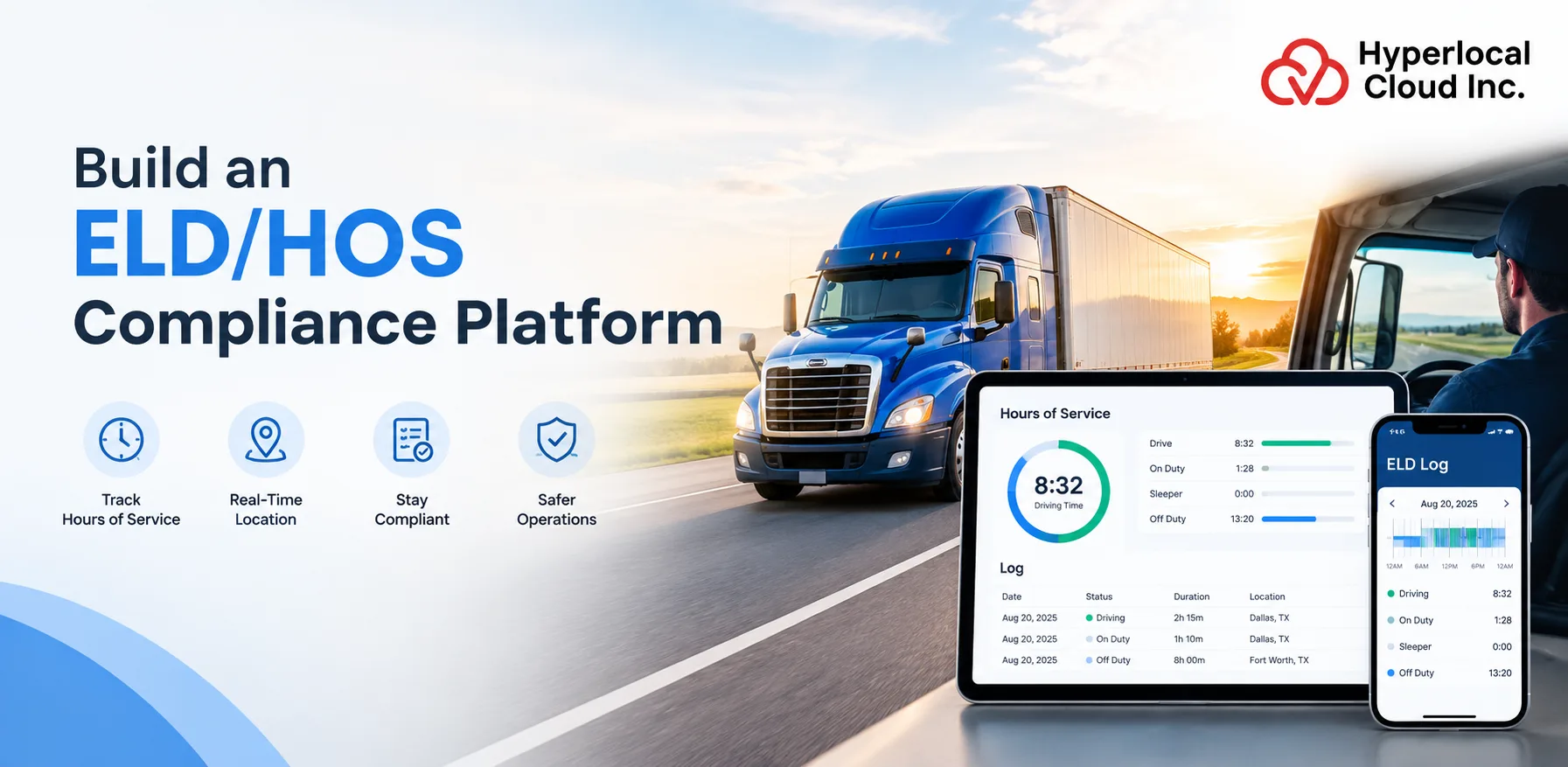
The transportation and trucking industry is increasingly dependent on digital solutions to manage drivers, vehicles, hours of service, compliance records, and fleet operations. An ELD/HOS compliance platform brings these functions together by connecting electronic logging devices, driver applications, fleet dashboards, GPS, telematics, and compliance workflows in one centralized system.
For trucking companies, logistics providers, fleet operators, and technology businesses, developing a dedicated ELD/HOS platform can create a more efficient way to manage driver activity and fleet data. A well-designed platform can automate electronic logs, monitor HOS-related information, generate alerts, provide fleet visibility, and simplify access to compliance records.
Businesses can develop such platforms from scratch or choose a white-label solution that can be customized with their branding and business workflows.
This guide explains the features, technology, development process, compliance considerations, integrations, cost factors, and business models involved in building an ELD/HOS compliance platform for fleet management.
What Is an ELD/HOS Compliance Platform?
An ELD/HOS compliance platform is a fleet management software solution designed to collect, process, monitor, and manage information related to electronic logging devices and drivers’ hours of service.
An ELD, or Electronic Logging Device, connects with a commercial motor vehicle to capture relevant vehicle and driving information. HOS, or Hours of Service, refers to regulations governing how long commercial drivers can drive and work before taking required rest periods.
An ELD/HOS platform typically consists of:
- Driver mobile application
- Fleet management dashboard
- ELD integration
- HOS compliance engine
- GPS tracking
- Telematics integration
- Alerts and notifications
- Compliance reporting
- Administrative panel
- Cloud infrastructure
What Is an ELD?
An Electronic Logging Device (ELD) is a device used to electronically record relevant information about a commercial driver’s activity and vehicle operation.
Instead of depending entirely on paper-based records, an ELD-enabled system can automatically capture certain vehicle-related information and synchronize it with software applications.
Depending on the device and integration, information may include:
- Vehicle identification
- Engine information
- Vehicle movement
- Mileage
- Engine hours
- Driving status
- Location information
- Diagnostic information
An ELD/HOS software platform uses this information to provide fleet managers and drivers with a centralized interface for managing records and operational workflows.
What Is HOS?
Hours of Service (HOS) refers to rules governing the amount of time commercial drivers can drive and work, along with required rest periods.
An HOS software component can help organizations monitor applicable driving and duty-status information.
Typical HOS functionality can include:
- Driving-time tracking
- On-duty status
- Off-duty status
- Sleeper-berth status
- Rest-break tracking
- Cycle monitoring
- Remaining-hours calculations
- Compliance alerts
- Driver log management
The platform should apply the appropriate rules based on the fleet’s operating requirements rather than treating every fleet or jurisdiction identically.
Request a Free Consultation for Your ELD/HOS Project
Why Build an ELD/HOS Compliance Platform?
Developing an ELD/HOS platform can provide a centralized technology layer for managing driver, vehicle, and compliance information.
Automate Driver Log Management
Electronic workflows can reduce dependence on manual recordkeeping and help drivers manage their logs through a mobile application.
The driver can view duty status, review records, make permitted annotations, certify logs, and access relevant documents from one application.
Improve HOS Monitoring
Fleet managers can monitor driver status through a centralized dashboard and receive notifications when attention may be required.
This can help fleet operators identify potential compliance issues earlier and improve operational visibility.
Centralize Fleet Information
Instead of managing driver, vehicle, and compliance information across disconnected systems, businesses can bring relevant information into a unified platform.
A centralized system can provide:
- Driver information
- Vehicle information
- Location information
- HOS information
- Compliance records
- Alerts
- Reports
Improve Fleet Visibility
Integrating GPS, ELD, and telematics data can give fleet managers a more comprehensive view of vehicles and drivers.
Managers can potentially monitor:
- Current vehicle location
- Driver status
- Trip history
- Vehicle activity
- Route information
- Compliance status
Simplify Reporting
A centralized reporting system can allow managers to retrieve driver logs, compliance records, vehicle information, and other operational data more efficiently.
Create a Fleet Technology Product
Technology companies can also build an ELD/HOS platform as a commercial SaaS product and offer it to trucking companies, logistics providers, and fleet operators through subscription or licensing models.
Key Features of an ELD/HOS Compliance Platform
The features you include will depend on the target fleet, regulatory requirements, integrations, and business model. However, a comprehensive platform can include the following modules.
1. Driver Mobile Application
The driver application is one of the most important components of an ELD/HOS platform.
It can provide drivers with access to their daily fleet and compliance workflows.
Driver App Features
- Driver registration and login
- Driver profile
- Vehicle assignment
- Duty-status management
- Electronic driver logs
- Driving-time tracking
- On-duty/off-duty status
- Sleeper-berth status
- Break tracking
- Log certification
- Permitted log annotations
- Document management
- DVIR workflows
- Notifications
- Compliance warnings
- Support access
A well-designed driver application should have a simple interface because drivers need to access important information while minimizing unnecessary interaction with the device during vehicle operation.
2. Fleet Manager Dashboard
The fleet dashboard provides managers with centralized visibility into drivers, vehicles, compliance information, and operational activity.
Important Dashboard Features
- Fleet overview
- Driver management
- Vehicle management
- Driver status
- Vehicle status
- Real-time location
- HOS information
- Compliance alerts
- Violation monitoring
- Driver history
- Vehicle history
- Reports
- Document management
- User management
Managers can use dashboard filters to locate individual drivers, vehicles, locations, or compliance records.
3. HOS Compliance Engine
The HOS engine is responsible for processing driver activity and applying the applicable business and regulatory rules.
It can support functionality such as:
- Duty-status calculations
- Driving-hour calculations
- Cycle monitoring
- Rest-break monitoring
- Remaining-hours calculations
- Compliance warnings
- Violation detection
- Driver status updates
Because regulatory requirements can change, the compliance engine should be designed to support maintainable rules and updates.
4. ELD Device Integration
An ELD platform generally needs an integration layer that communicates with supported ELD hardware or ELD service providers.
Depending on the integration, the platform may receive:
- Engine data
- Vehicle movement
- Mileage
- Engine hours
- Diagnostic information
- Location data
- Driving status
The integration architecture should account for device connectivity, data synchronization, error handling, and compatibility requirements.
5. GPS and Vehicle Tracking
GPS integration can help fleet operators understand where their vehicles are and how they are moving.
A GPS-enabled platform can provide:
- Real-time location
- Route tracking
- Trip history
- Geofencing
- Location history
- Vehicle movement
- Driver location
- Map-based fleet visualization
Fleet managers can use this information alongside ELD and HOS data to gain broader operational visibility.
6. Compliance Alerts and Notifications
Alerts help managers and drivers pay attention to events that may require action.
Examples include:
- HOS-related warnings
- Break reminders
- Driver log reminders
- Device connection issues
- Vehicle diagnostic alerts
- Compliance events
- Data synchronization issues
Notifications can be delivered through the mobile application, dashboard, email, SMS, or push notifications depending on the platform architecture.
7. Reporting and Analytics
Reporting functionality allows fleet managers to analyze historical and current information.
Possible reports include:
- Driver log reports
- HOS reports
- Compliance reports
- Violation reports
- Vehicle reports
- Driver activity
- Fleet utilization
- Trip history
- Location history
- Device reports
Advanced analytics can also help businesses identify operational patterns across their fleet.
8. Admin Panel
The administrator panel provides centralized control over the platform.
It can include:
- User management
- Driver management
- Fleet management
- Vehicle management
- Role management
- Subscription management
- API configuration
- Device configuration
- Compliance settings
- Reporting
- Audit logs
- Platform settings
Role-based access allows businesses to give different permissions to administrators, fleet managers, dispatchers, drivers, and other users.
How Does an ELD/HOS Platform Work?
An ELD/HOS platform generally works by collecting information from vehicles and drivers, processing it through the backend, and presenting relevant information through mobile and web applications.
Step 1: Vehicle Connects With ELD
The ELD device communicates with the vehicle and collects relevant information.
Step 2: Vehicle Data Is Transmitted
The collected information is transferred to the connected software platform using the supported communication architecture.
Step 3: Driver Uses the Mobile Application
The driver can access electronic logs, duty status, vehicle information, inspections, and other supported functions.
Step 4: Backend Processes the Data
The cloud backend receives and stores information from supported devices and applications.
Step 5: Compliance Engine Processes Information
The platform analyzes applicable driver activity and calculates relevant HOS information.
Step 6: Fleet Manager Receives Updates
Fleet managers can access information through their web dashboard.
Step 7: Alerts Are Generated
When configured conditions occur, the platform can send appropriate notifications.
Step 8: Reports Are Generated
Managers can retrieve relevant records and operational reports from the platform.
Create a Custom Fleet Compliance Platform for Your Business
FMCSA Compliance Requirements for ELD/HOS Software
For platforms intended for the U.S. commercial trucking market, FMCSA requirements should be considered from the beginning of the product architecture and development process.
An ELD solution may need to support requirements involving electronic records, driver logs, data transfer, malfunction handling, supporting documents, and other applicable requirements.
ELD Technical Requirements
The software and device integration should be designed around the applicable technical requirements rather than simply adding an ELD label to an existing fleet management product.
Driver Records
The platform should provide appropriate mechanisms for creating, storing, reviewing, and managing required driver records.
Data Transfer
The solution should support applicable mechanisms for transferring required information during inspections or other regulatory workflows.
Driver Log Certification
Drivers should have appropriate workflows for reviewing and certifying their records.
Supporting Documents
Where applicable, the system can provide functionality for associating and managing supporting documents.
Malfunction Management
The platform should account for applicable ELD malfunction and diagnostic workflows.
Record Retention
The system should be designed to securely retain and retrieve records for the periods required by applicable regulations.
Important: FMCSA compliance is a regulatory matter, and software functionality alone does not automatically make a product certified or compliant. Businesses should validate their implementation against current requirements and applicable certification processes.
Technology Stack for ELD/HOS Platform Development
The technology stack should be selected according to the platform’s scalability, integrations, security, and performance requirements.
Frontend Development
Potential technologies include:
- React.js
- Angular
- Vue.js
These can be used to build fleet management dashboards and administrative interfaces.
Mobile App Development
Possible technologies include:
- Flutter
- React Native
- Swift
- Kotlin
A cross-platform framework can support development for multiple mobile operating systems, while native technologies can be selected when platform-specific capabilities are required.
Backend Development
Possible backend technologies include:
- Node.js
- Python
- Java
- .NET
The backend handles APIs, business logic, authentication, data processing, integrations, and communication between applications.
Database
Depending on the data architecture, developers may use:
- PostgreSQL
- MySQL
- MongoDB
Cloud Infrastructure
Potential infrastructure providers include:
- AWS
- Microsoft Azure
- Google Cloud
Cloud infrastructure can provide scalable computing, storage, monitoring, databases, and security services.
APIs and Integrations
The platform can integrate with:
- ELD APIs
- Telematics APIs
- GPS services
- Mapping APIs
- TMS systems
- Dispatch systems
- Maintenance platforms
- Payment systems
- Notification services
ELD/HOS Platform Development Process
Building an ELD/HOS platform requires more than developing a driver application and dashboard. The project should cover product requirements, integrations, compliance considerations, security, testing, and ongoing maintenance.
1. Business Requirement Analysis
The first step is to understand:
- Target market
- Fleet size
- User types
- Vehicle types
- Required features
- Supported devices
- Required integrations
- Geographic markets
- Compliance requirements
- Business model
This information helps determine the platform architecture and development scope.
2. UI/UX Design
The development team creates interfaces for:
- Driver application
- Fleet dashboard
- Admin panel
- Reports
- Alerts
- Vehicle management
The driver application should prioritize simplicity and usability.
3. Platform Architecture
Developers define:
- Backend architecture
- Database architecture
- API architecture
- Cloud infrastructure
- Security architecture
- Integration architecture
4. Driver App Development
The team develops the driver-facing application and implements required workflows such as logs, duty status, inspections, notifications, and documentation.
5. Fleet Dashboard Development
The web dashboard is developed for managers and administrators to manage drivers, vehicles, compliance information, alerts, and reports.
6. ELD and Telematics Integration
The platform is connected to supported ELD hardware, telematics services, and other required APIs.
7. HOS and Compliance Logic
The appropriate compliance rules and calculations are implemented based on the product’s intended operating environment.
8. Testing
Testing can include:
- Functional testing
- API testing
- Device testing
- Integration testing
- Security testing
- Performance testing
- Mobile testing
- Dashboard testing
- Compliance-focused testing
9. Deployment
After testing, the platform can be deployed to the selected cloud infrastructure and application distribution channels.
10. Maintenance and Updates
After launch, businesses may require:
- Bug fixes
- Security updates
- API updates
- Device compatibility updates
- Compliance-related updates
- Performance optimization
- New features
Start Building Your ELD/HOS Platform With Hyperlocal Cloud
How Much Does It Cost to Build an ELD/HOS Platform?
The ELD/HOS software development cost depends heavily on the scope of the platform.
A simple MVP with basic driver logs and fleet management will have different requirements from an enterprise platform supporting multiple ELD devices, advanced telematics, sophisticated reporting, and complex integrations.
The primary cost factors include:
- Number of platforms
- Driver app complexity
- Fleet dashboard
- Admin panel
- ELD integrations
- Telematics integrations
- GPS tracking
- HOS engine
- Reporting
- Third-party APIs
- Security requirements
- Cloud infrastructure
- UI/UX complexity
- Testing
- Post-launch support
Basic ELD/HOS MVP
An MVP may include:
- Driver application
- Basic electronic logs
- Fleet dashboard
- Basic GPS
- Driver management
- Basic alerts
- Basic reporting
This approach is suitable for validating the product concept before expanding into more advanced functionality.
Advanced Custom ELD/HOS Platform
An advanced platform may include:
- Multiple ELD integrations
- Advanced HOS functionality
- Real-time fleet tracking
- Telematics
- Advanced analytics
- Comprehensive reporting
- Multiple user roles
- TMS integrations
- Maintenance integrations
- Enterprise security
The additional integrations and workflows significantly increase development complexity.
White-Label ELD/HOS Platform
A white-label ELD/HOS solution can provide an existing software foundation that businesses customize with their own:
- Brand
- Logo
- Colors
- User interface
- Features
- Business workflows
- Pricing model
This approach can reduce the amount of software that needs to be developed from scratch and can help businesses move toward market launch more quickly.
Want to know the cost for your specific requirements? Contact our team for an ELD/HOS platform development estimate.
Custom vs White-Label ELD/HOS Platform
Businesses generally have two major development approaches: custom development and white-label development.
Custom ELD/HOS Platform
A custom platform is developed specifically around the organization’s requirements.
It can be suitable for businesses that need:
- Unique workflows
- Custom integrations
- Specialized fleet operations
- Proprietary functionality
- Full control over the product roadmap
- Highly customized user experiences
White-Label ELD/HOS Platform
A white-label solution provides a pre-developed software foundation that can be customized and branded.
It can be suitable for businesses looking for:
- Faster deployment
- Existing core functionality
- Brand customization
- Configurable features
- Lower initial development effort
The appropriate approach depends on the company’s budget, timeline, product requirements, customization needs, and long-term strategy.
ELD/HOS Platform Integrations
Integrations can significantly expand the capabilities of an ELD/HOS platform.
ELD Hardware
ELD integration allows the software platform to receive relevant vehicle and driving information.
GPS and Mapping
GPS and mapping integrations support:
- Vehicle tracking
- Route visualization
- Location history
- Geofencing
- Trip monitoring
Telematics
Telematics integrations can connect additional vehicle and operational data with the fleet platform.
Transportation Management Systems
TMS integration can connect ELD information with transportation planning and operational workflows.
Dispatch Software
Integration with dispatch systems can synchronize relevant driver, vehicle, and trip information.
Maintenance Software
Maintenance integrations can connect vehicle information with maintenance and service workflows.
Payroll Systems
Where appropriate, integrations can connect relevant driver-work information with payroll workflows.
Security Considerations for an ELD/HOS Platform
An ELD/HOS platform handles important driver, vehicle, operational, and business information. Security should therefore be considered throughout development.
Data Encryption
Sensitive data should be protected during transmission and storage using appropriate encryption mechanisms.
Authentication
Secure authentication helps prevent unauthorized access.
Role-Based Access
Different users should receive only the permissions necessary for their responsibilities.
API Security
APIs should use appropriate authentication, authorization, validation, rate limiting, and monitoring controls.
Audit Logs
Audit trails can help organizations track important administrative actions and system events.
Data Backup
Regular backups can help reduce the impact of data loss or infrastructure failures.
Cloud Security
Cloud infrastructure should be configured with appropriate access controls, monitoring, network security, and data protection measures.
Build a Powerful Fleet Management Platform With ELD
Business Models for an ELD/HOS Platform
If you are developing an ELD/HOS platform as a commercial software product, several monetization approaches are possible.
Subscription Model
Charge customers a monthly or annual subscription for platform access.
Per-Vehicle Pricing
Charge based on the number of vehicles managed through the platform.
Per-Driver Pricing
Charge according to the number of active drivers.
Enterprise Plans
Offer customized packages to larger fleets with specific requirements.
Add-On Services
Additional revenue can come from:
- Premium analytics
- Additional integrations
- Advanced reports
- Dedicated support
- Custom development
- Enterprise features
Who Can Use an ELD/HOS Platform?
Trucking Companies
Trucking companies can use the platform to manage drivers, vehicles, logs, and fleet information.
Logistics Companies
Logistics providers can connect driver and vehicle information with their broader operational workflows.
Freight Carriers
Freight carriers can use centralized dashboards to manage fleet and driver activity.
Fleet Management Companies
Fleet management providers can offer ELD/HOS functionality as part of a broader technology platform.
Transportation Startups
Startups can build specialized fleet technology products around ELD/HOS functionality.
Telematics Providers
Telematics companies can integrate ELD/HOS functionality into their existing product ecosystems.
Benefits of Developing a Custom ELD/HOS Platform
A well-designed platform can provide several operational benefits.
Centralized Fleet Operations
Manage relevant driver and vehicle information from a unified system.
Automated Driver Logging
Reduce manual processes through electronic driver workflows.
Real-Time Visibility
Monitor applicable driver and vehicle information through dashboards.
Automated Alerts
Notify users when configured events require attention.
Simplified Reporting
Access and organize fleet and compliance information more efficiently.
Scalable Architecture
Build the system to support growing numbers of drivers and vehicles.
Integration Capabilities
Connect ELDs, telematics, GPS, TMS, dispatch, and other business systems.
Branded Experience
Custom and white-label solutions allow businesses to provide their own branded fleet technology.
Challenges in ELD/HOS Platform Development
Developing an ELD/HOS solution also involves several technical and operational challenges.
Regulatory Complexity
Applicable requirements need to be reviewed and incorporated into the product design.
Hardware Compatibility
Different ELD devices and providers may require different integration approaches.
Real-Time Data Processing
Large fleets can generate significant amounts of vehicle and driver data that must be processed reliably.
Data Accuracy
Incorrect or delayed data can affect operational and compliance workflows, making data validation and synchronization important.
Security
Driver and fleet information should be protected against unauthorized access and data loss.
Scalability
The architecture should be capable of supporting growth from a small fleet to significantly larger deployments.
Ongoing Maintenance
ELD integrations, APIs, cloud services, security requirements, and applicable regulations may change over time, requiring ongoing updates.
Develop a Scalable ELD/HOS Platform With Our Experts
How to Choose an ELD/HOS Software Development Company
Selecting the right development partner can have a major impact on the project’s technical implementation and long-term maintenance.
Look for a company with experience in:
Fleet Management Software
The development team should understand vehicle, driver, fleet, and operational workflows.
ELD Integration
Ask about experience integrating ELD hardware or ELD service APIs.
Telematics
Experience with vehicle data and telematics can simplify complex integrations.
Mobile Development
The company should be able to develop reliable driver-facing mobile applications.
Backend Development
The backend should be capable of processing real-time fleet and vehicle data.
Cloud Infrastructure
The development partner should understand scalable cloud architecture.
Security
Ask about authentication, authorization, encryption, monitoring, and data protection.
Testing
The company should have a structured QA process covering devices, APIs, applications, and integrations.
Post-Launch Support
ELD/HOS software often requires ongoing maintenance and updates, making post-launch support important.
Why Choose Hyperlocal Cloud for ELD/HOS Platform Development?
Building an ELD/HOS platform requires expertise across mobile applications, web dashboards, APIs, cloud infrastructure, real-time data, integrations, and fleet-management workflows.
Hyperlocal Cloud can help businesses plan and develop an ELD/HOS-focused fleet management platform around their specific business requirements.
Our development approach can include:
- Custom ELD/HOS software development
- Driver mobile application
- Fleet management dashboard
- Admin panel
- ELD integrations
- GPS tracking
- Telematics integrations
- HOS monitoring
- Compliance reporting
- API integrations
- Cloud deployment
- Custom software development
- Post-launch support
Whether you are a trucking company looking to digitize fleet operations or a technology business planning to launch a fleet-management SaaS product, the platform can be designed around your target users, fleet size, integrations, and business model.
FAQs (Frequently Asked Questions)

Patt Cummins is an experienced content writer with over 10 years of experience creating clear and engaging content for technology-focused industries. He specializes in simplifying complex technical topics into easy-to-understand stories that educate readers, support brand communication, and help businesses effectively share their solutions.

Need Help With
Development?