


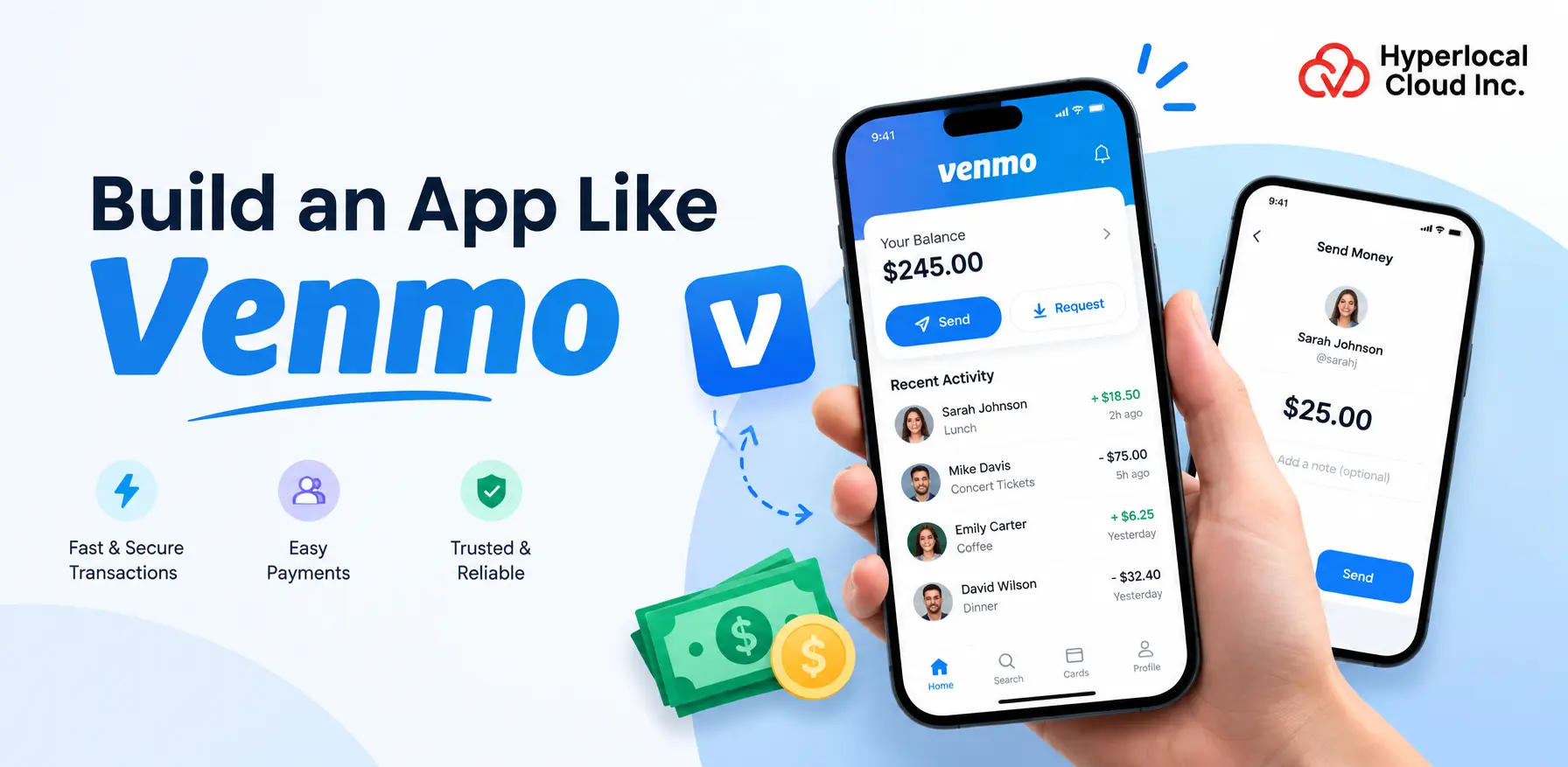
Building an app like Venmo in 2026 means entering one of fintech’s fastest-growing segments. P2P payment demand keeps climbing, with apps like Venmo, Cash App, and Zelle already moving billions each year.
Understanding how to build an app like Venmo starts here, with this guide covering P2P payment app development from concept to launch: features, compliance, architecture, and real payment app development costs. Whether validating an idea or scoping a Venmo clone app development project, here is the complete roadmap.
Let’s get started!
What Is a P2P Payment App, and How Does It Actually Work
A P2P payment app enables direct money transfers between individuals through a mobile app, without cash or a bank branch visit. It connects to a funding source, typically a bank account, debit card, or an internal balance held within the platform. Behind this sits a digital ledger, where each transfer is recorded as a debit against the sender’s balance and a credit to the recipient’s. That entry then settles through external banking rails, card networks, or instant payment systems, depending on which transfer speed the user selects.
Two settlement paths typically exist. A standard transfer clears through the ACH network, which generally takes one to three business days. An instant transfer moves funds within minutes instead, routing through a debit card network, usually for a small fee.
Every transfer depends on two safeguards working in tandem. Identity verification, typically a KYC check against a government-issued ID, confirms who is sending and receiving money before linking any funding source. Data protection relies on encryption in transit and at rest, along with tokenization that keeps raw card and bank account numbers out of the app’s own database. These are not minor technical details. They are the reason building a compliant P2P payment app costs more and takes longer than building a typical consumer app, a distinction the compliance, architecture, and cost sections address directly.
Build an App Like Venmo With Secure, Scalable Payment Features
Why Businesses Are Building Apps Like Venmo Right Now
Businesses are building apps like Venmo because P2P payments now drive real, measurable revenue while keeping users engaged inside a single app. In 2025, a PayPal report found that Venmo earned about $340 million more from transactions than the previous year. This is linked to increased payment volume and a growing share of users who use instant transactions to their bank accounts and debit cards.
Smartphones made this possible, and younger users made it a habit, one now built around handling money from a phone instead of a bank branch.
In the early years, P2P payments were largely driven by fintech companies building dedicated platforms for digital money transfers. That landscape has changed. Nowadays, marketplaces, gig platforms, and retailers are integrating P2P payments into their own applications, thus creating an opportunity for users to transfer, receive, and manage funds using a single platform. Moreover, this integration can attract users and give them access to additional financial services.
Key Features Every App Like Venmo Needs
Every app like Venmo runs on the same six building blocks. Skip one, and the product breaks down. Overbuild one, and you spend budget you needed elsewhere. The following six features must be included in the MVP:
- Account Creation and Identity Verification (KYC): Users sign up, verify their identity, and clear compliance checks before money touches their account.
- Bank and Card Linking: Users connect a funding source, often through a provider like Plaid or Stripe, before sending or receiving a payment.
- Send, Request, and Split Payments: This core loop lets users send money, request funds, or split a shared expense among a group.
- Wallet Balance and Cash-Out Options: Users hold funds in an internal balance, then cash out to a linked bank account anytime.
- Transaction History and Notifications: Every payment, request, and cash-out creates a clear record and sends an instant alert.
- QR Code and Contact-Based Payments: Users pay or get paid by scanning a code or picking a saved contact, which cuts friction fast.
- Chatbot Assistant: A chatbot answers common questions, guides users through payment issues, and connects them with support when needed.
This list sets the baseline for every app in this category, with P2P payment options forming the core of the user experience.
| Feature | Priority | Complexity |
| Account creation and KYC | Must-have | High |
| Bank and card linking | Must-have | Medium |
| Send, request, and split payments | Must-have | High |
| Wallet balance and cash-out | Must-have | Medium |
| Transaction history and notifications | Should-have | Low |
| QR code and contact-based payments | Nice-to-have | Low |
Four of these six features are essential: account creation and KYC verify who is sending money, bank and card linking supplies the funding source, and the send, request, and split loop with wallet and cash-out lets users actually move and access funds. If any one of them is missing, the basic transfer loop breaks down completely. The remaining two features improve usability rather than core function, so both can move into a later release without any risk to launch.
Complexity here does not measure how hard a feature is to build. It measures how much a feature changes the app’s design, its compliance needs, and its final cost. High-complexity features drive the highest costs in the budget. The cost section later in this guide builds directly on this table.
How to Build an App Like Venmo: Step by Step
Building an app like Venmo involves several moving parts, from payment workflows and compliance to banking integrations, security, and the user experience. The development path also depends on whether you choose a white-label solution, a ready-made application, or a fully custom build. Here are the key steps to take your payment app from an initial concept to a market-ready product
1. Define Your Payment App Model
Start by defining what your payment app needs to offer and who it will serve. These decisions will shape the features, integrations, compliance requirements, and infrastructure needed throughout development.
Consider factors such as:
- Target users: Decide whether the app will serve consumers, businesses, freelancers, marketplaces, or a combination of user groups.
- Primary use cases: Determine whether users will send money, request payments, split bills, pay merchants, or move funds between accounts.
- Funding sources: Identify whether users will connect bank accounts, debit cards, credit cards, or use an in-app balance.
- Target market: Establish the countries or regions where the app will operate because payment regulations and available payment rails vary by market.
- Revenue model: Decide whether revenue will come from instant transfer fees, merchant payments, subscriptions, interchange, or other financial services.
- MVP scope: Separate essential payment functionality from features that can be introduced after the core product has been validated.
A well-defined product model gives the development team a clear scope to work with. It also helps prevent unnecessary features from increasing the initial development workload and payment app development cost.
2. Research Compliance and Regulatory Requirements
A P2P payment app handles sensitive financial information, so regulatory planning needs to happen before development gets too far. The exact requirements depend on your business model, payment flows, and target jurisdiction.
| Compliance Area | What to Determine |
| KYC | How users will verify their identity before accessing regulated payment features |
| AML | How the platform will identify and manage potentially suspicious financial activity |
| Money transmission | Whether your business requires licensing or must operate through a licensed financial partner |
| PCI DSS | How payment card information will be handled and protected |
| Data privacy | Which privacy regulations apply to user and financial data |
| Transaction monitoring | How unusual transaction patterns and potential fraud will be detected |
| Record keeping | What transaction and identity records must be retained and for how long |
The development team should map these requirements to the product architecture instead of treating compliance as a final-stage checklist. Depending on the jurisdiction, you may also need licensed banking or payment partners to handle regulated activities.
3. Choose the Right Development Approach
There are several ways to approach P2P payment app development, and each one offers a different balance of speed, flexibility, cost, and control. Your choice will depend on the product scope, available budget, launch timeline, and technical requirements.
White-Label Payment App Development
A white-label payment app uses an existing payment platform as its foundation, which is then branded and configured for your business. A white-label money transfer solution can further reduce the work required to launch. It can reduce development time and initial investment while still allowing changes to the interface, workflows, and selected features. Businesses looking to launch payment apps like Venmo can work with a white-label payment app development company to configure the platform around their brand, payment model, and operational requirements.
Ready-Made Payment App Development
A ready-made payment app provides a pre-developed application with established P2P payment functionality. The business can configure the application around its branding, target audience, workflows, and required features. Venmo clone app development can also follow this route when a ready-made solution already includes the payment workflows required for the planned product.
Custom Payment App Development
Custom development starts with the business requirements and builds the application around them. The development team can build the user experience, payment workflows, backend architecture, integrations, security controls, and administrative features to match the product specifications. This route requires greater development effort, but it provides extensive control over the final product.
| Pro tip: Choosing the development approach early gives the team a clearer scope and makes it easier to estimate the payment app development cost. It also establishes which components should be configured, integrated, or developed from the ground up. |
Choose the Right Payment App Development Company for Your Product
4. Plan the Technology and Product Architecture
Once the development approach is clear, plan the technical foundation that will support the application. This includes the mobile technology, backend, database, cloud infrastructure, APIs, payment integrations, security systems, and external financial services.
A typical technology setup may include:
| Technology Layer | Common Options |
| Mobile app | Swift, Kotlin, Flutter, React Native |
| Backend | Node.js, Python, Java, .NET |
| Database | PostgreSQL, MySQL, MongoDB |
| Cloud | AWS, Google Cloud, Microsoft Azure |
| APIs | REST, GraphQL |
| Payment infrastructure | Payment processors, banking APIs, card networks |
| Identity verification | KYC and identity verification providers |
| Security | Encryption, tokenization, authentication, access controls |
| Monitoring | Application monitoring, logging, alerts, transaction monitoring |
The architecture should also account for the transaction ledger, payment states, webhooks, retries, reconciliation, and audit records required in a digital wallet app. These systems keep financial information consistent as transactions move between the app and external payment providers.
At this point, you should also figure out how different services will interact and where sensitive financial data will be stored. A modular design could facilitate the replacement of the existing payment provider or additional integration with other banks.
5. Design the App Interface and User Experience
The design process should translate complex financial workflows into interfaces that users can understand quickly. Start with wireframes for the primary journeys, then move toward the visual design and interactive prototype.
Key areas can include:
- Registration and login
- Identity verification
- Home or wallet dashboard
- Bank and card linking
- Send and request money
- Payment confirmation
- Transaction history
- Transfer status
- Notifications
- Security settings
- Help and support
The design also needs to account for situations where something goes wrong. A payment can remain pending, fail, require additional verification, or be reversed. Clear status messages and actionable instructions help users understand what happened without creating unnecessary confusion.
Before development begins, validate the main flows through prototypes and usability testing. Fixing a confusing payment flow at the design stage is considerably easier than changing it after the backend and mobile application are already built around it.
6. Develop the MVP
With the architecture and designs approved, development can begin with the MVP. The first release should support the core workflows users need to create accounts, complete verification, connect funding sources, send or receive money, and track transactions.
The development process typically involves both frontend and backend work running in parallel. Mobile developers build the application interface, while backend developers implement APIs, authentication, transaction processing, ledger logic, integrations, and administrative functionality.
An iterative development approach can help the team release functionality in smaller cycles. The team can review and test each cycle before adding the next set of functionality. This gives the business opportunities to identify technical or product issues early and adjust priorities as development progresses.
7. Test the Payment App
Testing needs to cover financial workflows, application behavior, integrations, security, and failure scenarios. A payment app can appear to work correctly on the surface while still producing problems in transaction processing or account balances, so QA should test the underlying logic as well.
| Testing Area | What to Check |
| Functional testing | Registration, verification, transfers, requests, withdrawals, and account settings |
| Payment testing | Successful, failed, pending, reversed, and duplicate transactions |
| Security testing | Authentication, authorization, encryption, session management |
| API testing | Provider responses, timeouts, failed requests, and webhooks |
| Fraud testing | Suspicious transactions, unusual activity, and account takeover scenarios |
| Performance testing | Concurrent users, transaction loads, and response times |
| Device testing | Different mobile devices, operating systems, and screen sizes |
| Reconciliation testing | Internal ledger records against external payment records |
The team should also simulate real-world failures. Network interruptions, provider downtime, delayed webhooks, duplicate requests, and partially completed transactions can all affect the final transaction state. Testing these scenarios helps establish predictable recovery behavior before the application reaches production.
8. Deploy and Monitor the Product
After the MVP passes testing, deploy the application to the intended market through a controlled release. A staged launch can help the team monitor transaction behavior and infrastructure performance before expanding the user base.
Monitor metrics such as:
- Payment success and failure rates
- Transaction volume and value
- KYC completion rates
- Fraud alerts
- User activation and retention
- API and infrastructure errors
- Support requests
- Reconciliation exceptions
- Application crashes and performance issues
Monitoring should cover both technical performance and financial activity. A spike in failed payments, for example, could indicate an integration problem, while an unusual transaction pattern may require investigation by the risk or compliance team.
9. Collect Feedback and Improve the Product
Once users start interacting with the application, their behavior and feedback become valuable inputs for the next development cycle. App Store reviews, support tickets, onboarding drop-offs, transaction failures, and feature usage can reveal areas that require attention.
Use this information to prioritize improvements across:
- User onboarding
- Payment workflows
- Application performance
- Security controls
- Customer support
- Existing features
- New payment methods
- Administrative tools
The product can then move through repeated cycles of development, testing, release, and refinement. This approach allows the payment platform to evolve according to actual user needs and operational data instead of relying entirely on assumptions made during the initial planning stage.
Compliance and Legal Groundwork for a Payment App
Does building an app like Venmo require a money transmitter license? In most cases, yes, though the exact requirement depends entirely on where the app operates and how money moves through it. This single question shapes more of the build than any other decision made early on.
Money Transmitter Licensing
Licensing rules vary by country, and often by state or province within a single country. Some businesses secure their own license directly. Others partner with an already-licensed provider and operate under that license instead, a route that can cut months off the timeline. Either path needs confirmation before development starts, since the answer changes what the app’s legal structure needs to look like from day one.
KYC and AML Requirements
Know Your Customer rules require verifying a user’s identity before they can send or receive money, typically through a government ID check matched against a live selfie. Anti-Money Laundering rules go further. They require the app to monitor transaction patterns, flag suspicious activity, and report certain transactions to regulators. Both requirements apply from the first transaction, not after the app reaches scale.
PCI-DSS for Card Data
Any app that stores, processes, or transmits card data must meet PCI-DSS standards. Most teams sidestep the heaviest compliance burden by routing card data through a certified payment processor instead of storing it directly, which keeps raw card numbers out of the app’s own database entirely.
Data Privacy for Financial Information
Financial data counts as sensitive personal information under most privacy laws, including GDPR in the EU and comparable regulations elsewhere. These laws govern how data gets stored, how long it stays on file, and what rights users have to access or delete it. A payment app operating across multiple regions needs to satisfy every applicable regulation at once, not just the strictest one.
Launch Your P2p Payment App With Compliance and Security Included
How This Stage Controls Your Timeline and Budget
Compliance can significantly affect both payment app development cost and launch time. Licensing, legal reviews, audit preparation, KYC and AML processes, and ongoing monitoring all add work before the product can go live. Map these requirements early because changes to the business model or payment flow can affect the architecture, development scope, and launch timeline.
| Region | Primary Regulator | Key Requirement | Typical Timeline |
| United States | FinCEN plus state regulators | State-by-state money transmitter licenses | 6 to 18 months |
| European Union | National regulators under PSD2 | Payment institution or e-money license | 6 to 12 months |
| United Kingdom | Financial Conduct Authority | Authorized payment institution status | 6 to 12 months |
Mapping these requirements before writing a single line of code protects both the timeline and the budget.
How Much Does It Cost to Build an App Like Venmo?
The payment app development cost depends on the development approach, product scope, level of customization, integrations, and technical requirements. A white-label solution offers the most cost-effective route for businesses that want to launch with an existing payment foundation. Ready-made solutions offer more configuration flexibility, while custom Venmo clone app development gives businesses greater control over the product, architecture, and payment workflows.
| Development Approach | Estimated Cost | Best For |
| White-label payment app | $5,000 to $15,000 | Businesses looking for a cost-effective and faster launch |
| Custom payment app development | $40,000 to $250,000+ | Businesses that need full control over the product and underlying systems |
Factors That Affect Payment App Development Cost
The scope sets the starting point. A few other decisions can move the estimate quite a bit, including the factors that influence e-wallet development costs.
Product scope: Every additional screen, workflow, user role, or admin function adds development hours. Keeping the first release focused helps control the initial budget.
Level of customization: A ready-made product needs configuration around your business requirements. A custom build gives the team more freedom, but it also means creating more components from the ground up.
Number of integrations: One external provider may require limited integration work. Several banks, payment processors, KYC services, or financial APIs create a wider development scope.
Development team location: Team rates vary across markets. Experience and technical specialization matter as well, so two companies can quote very different amounts for the same project.
Project timeline: Launching sooner can require a larger team. More developers, designers, and testers working at the same time can increase the overall development bill.
Third-party service fees: Some services add recurring charges after development ends. Payment processing, KYC verification, cloud hosting, messaging, and other APIs can fall into this category.
Changes during development: Requirements rarely stay frozen on every project. Adding new workflows or changing approved designs can increase both development hours and delivery time.
Post-launch support: The budget continues after launch. Maintenance, infrastructure, monitoring, provider charges, and product updates all create ongoing expenses.
For businesses planning P2P payment apps like Venmo, a detailed scope makes the estimate more useful. Ask a specialized payment app development company like Hyperlocal Cloud to separate design, development, integrations, testing, deployment, and ongoing support in the proposal. Then you can see where the money goes and which parts of the project you can adjust before development begins.
Common Challenges in P2P Payment App Development and How to Solve Them
A payment app may look simple to the person using it. Behind each transfer, though, several systems need to respond at the right time. A failed payment, suspicious transaction, provider outage, or incorrect balance can quickly turn into a serious user issue. Good P2P payment app development accounts for these situations before they reach production.
Payment Failures and Transaction Errors
The challenge: Payment could be declined for any reason – a rejected card, interrupted network connection, provider timeout, delayed response. The problem worsens because the application doesn’t know whether the money went through. Users need status information; the system needs the correct balance.
How to solve it: Assign every transaction a clear state, such as pending, completed, failed, or reversed. Idempotency keys prevent duplicate payment requests, while webhooks capture status changes from external providers. Reconciliation checks both sides against each other and flags mismatches. Hyperlocal Cloud builds these safeguards into the payment workflow from the backend layer.
Fraud and Unauthorized Transactions
The challenge: There are several forms of fraud that could be committed, including account takeover, credential theft, or unauthorized transfers. A payment system must be able to identify any fraud attempts without having to make every single transaction pass through the security filter.
How to solve it: Integrate the transaction monitoring system with device monitoring, multifactor authentication, transfer limits, and risk management rules. The system will enhance the verification process in case of suspicious transactions but allow normal transactions to proceed with ease.
Third-Party Integration Failures
The challenge: Your payment app may rely on several external services. Banks, payment processors, KYC providers, and financial APIs can experience downtime or return unexpected responses. When one connection fails, the payment journey should not fall apart with it.
How to solve it: Keep each integration separate and give providers their own error-handling logic. Retries can handle temporary failures. Timeout controls prevent stalled requests, while webhook validation helps the system process provider updates safely. This structure also makes it easier for Hyperlocal Cloud to work with different payment and financial service providers.
Keeping the Transaction Ledger Accurate
The challenge: Users expect the balance on their screen to reflect their actual funds. Even a small mismatch can cause problems when the internal ledger says one thing and the bank or payment provider reports another.
How to solve it: Record every movement through a double-entry ledger, with matching debit and credit entries. Reconciliation processes can compare those records against external payment data and flag differences for review. Keep audit logs too. They provide a traceable history when a transaction needs investigation.
Scaling Transaction Volume
The challenge: Early transaction volumes rarely tell the whole story. As more users join, the backend must handle additional payment requests, database activity, notifications, and background jobs without slowing down the core payment flow.
How to solve it: Design the infrastructure around expected growth from the beginning. Queue-based processing can handle background work, while database optimization and caching reduce unnecessary load. Monitoring also gives the team visibility into performance as transaction volumes rise. This planning helps keep future payment app development costs under control when the product needs more capacity.
Balancing Security With User Experience
The challenge: Strong security can create friction when every payment triggers multiple verification steps. Users want to know their money is protected, but they also expect routine transfers to move without unnecessary interruptions.
How to solve it: Apply security checks based on transaction risk. A familiar device and routine payment can follow a simpler path, while an unusual transfer can trigger additional authentication. Hyperlocal Cloud can build these rules around the payment journeys and risk levels defined for the product.
How Hyperlocal Cloud Helps Build an App Like Venmo
Launching a payment product requires decisions around business goals, regulatory needs, technical architecture, and the development approach. Hyperlocal Cloud works as a payment app development company, bringing these areas together throughout the project. The team defines the product scope, selects suitable third-party services, plans the architecture, and builds the platform around the intended market and operating model.
When it comes to a payment app like Venmo, the development strategy may also vary depending on the level of customization and the deadline. With white-label, ready-made, and custom development options, Hyperlocal Cloud lets companies choose the right fit. The company also provides integration, testing, deployment, and further product enhancements.
Start Your Venmo Clone App Development Journey With Experts
Final Thoughts
The opportunity behind how to build an app like Venmo lies in creating a payment experience that fits a specific market and business model. This process can be implemented in different ways, starting with modifying the existing solution to building a new one from scratch. All you need to do, with the right product vision, the right partners, and the right development team, is transform your idea into a payment product tailored specifically for your customers. If you need help planning your payment product, feel free to contact the experts at Hyperlocal Cloud for guidance on your development requirements.
FAQs (Frequently Asked Questions)

Patt Cummins is an experienced content writer with over 10 years of experience creating clear and engaging content for technology-focused industries. He specializes in simplifying complex technical topics into easy-to-understand stories that educate readers, support brand communication, and help businesses effectively share their solutions.

Need Help With
Development?