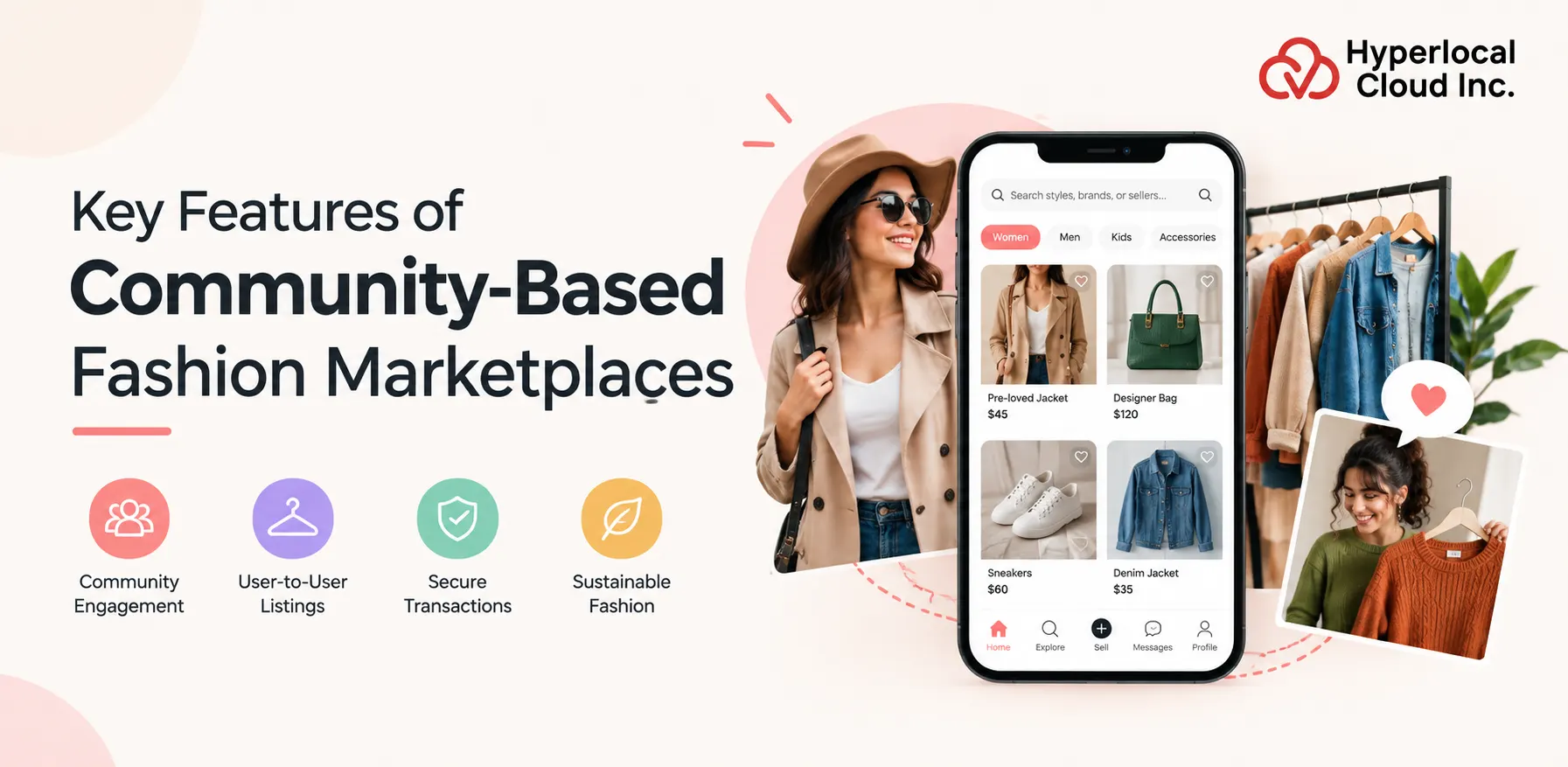
Second-hand and vintage fashion has moved beyond traditional thrift stores and occasional peer-to-peer selling. Digital marketplaces now allow people to discover pre-owned clothing, connect with sellers, share styling ideas, and build communities around particular fashion interests. This creates opportunities for businesses to develop platforms where commerce and community engagement work together.
A community-based fashion marketplace needs more than product listings and checkout. Buyers expect personalized discovery, trustworthy sellers, secure payments, detailed product information, and ways to interact with other users. Sellers also need tools to showcase their collections, communicate with buyers, manage orders, and build a recognizable presence on the platform.
This guide explores the key features, technology requirements, monetization options, development approaches, and challenges involved in building a community-based marketplace for second-hand and vintage fashion.
What Is a Community-Based Fashion Marketplace?
A community-based fashion marketplace is an online platform where users can buy and sell fashion products while also interacting with other members of the community. Unlike a conventional online fashion store, the inventory can come from individual users, independent sellers, boutiques, brands, or professional resellers.
The community element adds another layer to the marketplace. Users can follow sellers, share outfits, discuss fashion trends, save products, leave reviews, and participate in niche fashion groups. This creates an environment where product discovery is influenced not only by search and recommendations but also by people and communities.
The model can support different niches, including everyday second-hand clothing, designer resale, vintage fashion, sustainable clothing, streetwear, and a luxury fashion community marketplace.
Build a Scalable Fashion Marketplace Tailored To Your Business Needs
Why Community Matters in Second-Hand and Vintage Fashion
Trust plays a major role in second-hand fashion. Buyers are often purchasing products from individual sellers rather than established retailers, so they need enough information to judge the condition, authenticity, seller reliability, and value of an item.
A community can help strengthen that trust. Seller profiles, reviews, transaction history, discussions, and user-generated content give buyers more context before making a purchase. At the same time, sellers can develop relationships with repeat customers instead of treating every transaction as an isolated sale.
Community features can also improve product discovery. Someone looking for a vintage jacket may discover it through a seller they follow, an outfit post, a community discussion, or a personalized recommendation rather than a conventional product search.
Key Features of a Community-Based Fashion Marketplace
User Profiles and Seller Identity
User profiles give buyers and sellers a recognizable identity within the marketplace. Buyers can create profiles based on their fashion interests, while sellers can use their profiles to showcase their inventory and establish credibility.
A useful profile system can include seller ratings, reviews, transaction history, verification status, followers, and product collections. Professional sellers may also benefit from storefront-style profiles where their inventory can be organized by brand, category, collection, or style.
Strong seller profiles are particularly useful for vintage and luxury marketplaces because buyers often want to understand who they are purchasing from before completing a transaction.
Detailed Product Listings
Product listings need to provide enough information for buyers to make informed decisions. Second-hand products can vary considerably in condition, sizing, and appearance, making detailed listings particularly important.
Listings can include multiple photographs, videos, product descriptions, brand names, sizes, measurements, colors, materials, condition, pricing, and availability. Sellers dealing with vintage products can also provide information about the item’s approximate era or distinctive characteristics.
Clear descriptions can reduce misunderstandings between buyers and sellers and make it easier for users to compare similar products.
Advanced Search and Fashion Filters
Large fashion marketplaces can quickly become difficult to navigate without effective search and filtering. Buyers should be able to narrow down thousands of listings according to their preferences.
Common filters can include brand, category, size, price, color, condition, material, location, and listing date. Platforms focused on vintage or luxury fashion can add more specialized filters for designer brands, fashion eras, collections, or authentication status.
Search can also be combined with personalized recommendations so users can discover products that match their interests without repeatedly entering the same search criteria.
Personalized Fashion Discovery
Personalization can make a marketplace more relevant as the user spends more time on the platform. The system can analyze activities such as searches, viewed products, saved listings, purchases, follows, and interactions to generate relevant recommendations.
For example, a user who frequently views vintage denim may receive recommendations for similar products, sellers specializing in denim, or community posts featuring related styles.
Personalized feeds can also help sellers reach buyers who are more likely to be interested in their products, creating value for both sides of the marketplace.
Social Feed and Fashion Communities
A social feed can turn a resale platform into a more engaging fashion destination. Users can share outfits, styling ideas, collections, product discoveries, and fashion-related discussions.
Features such as likes, comments, saves, and follows can encourage users to return to the platform even when they are not actively shopping.
Businesses can also create niche communities around vintage fashion, designer clothing, sustainable fashion, streetwear, or specific brands. These communities can become an additional source of product discovery and user engagement.
Seller Storefronts
Seller storefronts provide more visibility to users who regularly sell fashion products. Instead of presenting sellers as anonymous accounts, the marketplace can give them dedicated spaces to display their inventory and establish their identity.
A storefront can contain seller information, product collections, ratings, reviews, followers, and recently added items. Professional sellers can use these pages to organize products into collections and develop a recognizable presence.
This feature can also create opportunities for premium seller subscriptions or paid storefront upgrades.
Buyer-Seller Messaging
Messaging allows buyers and sellers to communicate before and after a purchase. Buyers may want to ask about measurements, product condition, material, authenticity, shipping, or other details.
An integrated messaging system keeps these conversations within the marketplace instead of requiring users to move to external communication channels.
The platform can also support notifications for new messages, offer responses, order updates, and other important interactions.
Offers and Negotiation
Negotiation is common in peer-to-peer resale. A marketplace can make this process easier by allowing buyers to submit offers directly from a product page.
Sellers can accept an offer, decline it, or respond with a counteroffer. Platforms can also support bundle discounts when buyers purchase multiple items from the same seller.
A structured negotiation system gives both parties a clear record of the conversation and transaction terms while making the buying process more flexible.
Secure Checkout and Payments
A reliable payment system is essential for marketplace transactions. Buyers need a straightforward checkout process, while sellers need predictable payment and transaction management.
The platform can support credit and debit cards, digital wallets, bank-based payment options, and region-specific gateways depending on the target market.
Payment functionality should also account for refunds, cancellations, transaction records, platform commissions, and seller payouts. Security measures should be incorporated throughout the payment flow to protect users and financial information.
Shipping and Order Tracking
Shipping becomes more complex when products are sold by individual sellers in different locations. The marketplace should provide clear shipping workflows for both sides.
Depending on the business model, features can include shipping options, delivery estimates, shipping labels, tracking information, pickup options, and automated order notifications.
Buyers should be able to view order status from their account, while sellers need tools to update fulfillment information and manage their outgoing orders.
Ratings, Reviews, and Trust Signals
Reviews help users understand the reliability of sellers and the quality of marketplace transactions. Buyers can provide feedback after receiving their orders, while platforms can use verified transaction indicators to distinguish genuine reviews from unverified comments.
Seller ratings can consider factors such as communication, product accuracy, shipping, and overall transaction experience.
The marketplace should also provide reporting options for misleading listings, inappropriate content, suspicious behavior, or poor transactions.
Authentication and Counterfeit Protection
Authentication becomes especially important when a marketplace includes designer and luxury products. Buyers need confidence that expensive products are genuine and accurately represented.
A platform can introduce seller verification, product authentication workflows, supporting documentation, and dedicated review processes for selected categories.
Counterfeit reporting can also allow users to flag suspicious listings. Depending on the platform’s business model, authentication can be performed by internal teams, specialist partners, or a combination of automated and manual processes.
Wishlist and Saved Searches
Wishlist functionality allows buyers to save products they may want to purchase later. Saved searches can go a step further by allowing users to receive notifications when matching products are added.
For example, a buyer could save a search for a particular designer, size, or vintage clothing category and receive alerts when relevant listings appear.
Price-drop notifications and similar-item recommendations can further support product discovery without requiring users to repeatedly search the marketplace.
Community Moderation
Community features require moderation to maintain a safe and useful environment. Users should have straightforward ways to report suspicious listings, inappropriate content, fraudulent behavior, or abusive interactions.
Administrators can use moderation workflows to review reported content, suspend accounts, remove listings, and manage violations of marketplace guidelines.
Automated systems can assist with spam and suspicious activity detection, while human review can handle more complex cases.
Create a Vintage Fashion Marketplace Designed for Buyers, Sellers, and Communities
Features Needed for a Fashion Marketplace
A fashion marketplace has different requirements from a consumer resale platform because the participants may include brands, manufacturers, wholesalers, retailers, distributors, and professional buyers.
Business accounts can include company profiles, catalogs, wholesale pricing, minimum order quantities, bulk ordering, quotation requests, and supplier information. Buyers may also need tools for comparing suppliers and negotiating larger orders.
Order management becomes more important in a B2B environment because transactions can involve larger quantities, invoices, purchase orders, recurring orders, and different payment terms.
Community features can still play an important role. Businesses can follow suppliers, participate in industry-specific discussions, discover new brands, and build relationships with other marketplace participants.
How a Resale Marketplace Can Learn From Apps Like Vinted
Established resale platforms have demonstrated the importance of combining simple listings with discovery, communication, payments, shipping, and seller reputation. These functions create a complete journey from product discovery to completed transaction.
Businesses planning a resale app like Vinted can study these marketplace mechanics while developing a product designed around their own target audience.
For example, a platform focused on luxury fashion may place greater emphasis on authentication and seller verification. A vintage marketplace may prioritize fashion-era filters and community discussions, while a professional resale platform may require stronger inventory and seller management tools.
The goal should be to create a marketplace with a clear reason for users to choose it rather than simply reproducing another platform’s features.
Admin Features for Managing the Fashion Marketplace
The administration panel acts as the operational center of the marketplace. Administrators need visibility into users, listings, transactions, payments, community activity, and platform performance.
Important admin capabilities can include:
- User and seller management with verification and account controls.
- Product and category management for organizing marketplace inventory.
- Listing moderation for reviewing reported or suspicious products.
- Order and payment management for monitoring transactions and refunds.
- Commission configuration for controlling marketplace revenue.
- Seller verification and authentication workflows.
- Dispute management for resolving buyer-seller issues.
- Community moderation for managing user-generated content.
- Analytics and reporting for tracking marketplace activity.
The exact administration features should be based on the platform’s business model and operational requirements rather than adding every possible control from the beginning.
Monetization Models for Community-Based Fashion Marketplaces
A second-hand fashion marketplace can generate revenue in several ways. The right model depends on the target audience, transaction volume, seller type, and services offered by the platform.
Transaction commissions are one of the most common options. The marketplace charges a percentage or fixed fee when a transaction is completed. This model aligns platform revenue with marketplace activity.
Professional sellers can also be offered subscription plans with additional storefront capabilities, analytics, listing allowances, or promotional tools. Featured listings can provide another revenue stream by allowing sellers to increase the visibility of selected products.
For luxury marketplaces, authentication services can potentially become a separate paid service. Advertising, premium discovery features, and partnerships with fashion brands can provide additional monetization opportunities as the marketplace grows.
Technology Stack for a Fashion Marketplace
The technology stack should support marketplace transactions while also handling search, social interaction, payments, notifications, and scalable data management.
| Technology Area | Possible Technologies |
| Mobile App | Flutter, React Native, Swift, Kotlin |
| Frontend | React.js, Next.js |
| Backend | Node.js, Laravel, Python |
| Database | PostgreSQL, MySQL, MongoDB |
| Cloud | AWS, Google Cloud, Azure |
| Payments | Stripe, PayPal, Regional Payment Gateways |
| Search | Elasticsearch, Algolia |
| Notifications | Firebase Cloud Messaging |
| Analytics | Google Analytics, Mixpanel |
The final technology choices should depend on the required platforms, expected traffic, development approach, integrations, and long-term scalability requirements.
How Much Does It Cost to Build a Community-Based Fashion Marketplace?
The cost to build a community-based fashion marketplace starts at $8,000 for an MVP or ready-made marketplace solution with essential features. This can include user registration, seller profiles, product listings, search, messaging, payments, order management, and basic admin controls.
The overall cost increases as you add more advanced functionality. Features such as social feeds, personalized recommendations, product authentication, separate buyer and seller apps, advanced search, shipping integrations, and detailed seller tools can require additional development work.
The final budget also depends on the number of platforms, UI/UX complexity, third-party integrations, technology stack, customization requirements, and whether you choose custom development or a ready-made solution.
Bring Your Fashion Marketplace Concept to Life With Flexible Development Options
Custom vs Ready-Made Fashion Marketplace Development
Custom Fashion Marketplace Development
Custom development provides greater control over the marketplace’s functionality, design, workflows, and technical architecture. It can be suitable when the business has a unique community model or requires specialized features that are not available in existing solutions.
For example, a luxury marketplace may need custom authentication workflows, while a B2B fashion platform may require specialized quotation and bulk-ordering functionality.
The tradeoff is that custom development generally requires more planning, development time, testing, and initial investment.
Ready-Made Fashion Marketplace Solution
A ready-made solution provides pre-built marketplace functionality that can be customized according to the business requirements. This approach can reduce the initial development workload and allow a business to launch its marketplace sooner.
Branding, user interfaces, marketplace workflows, payment gateways, and additional features can be adapted to the target audience. It can be useful for businesses that want to validate a marketplace concept before making a larger investment in custom development.
The right approach depends on the required level of customization, launch objectives, available resources, and long-term product strategy.
How to Build a Community-Based Fashion Marketplace
Building the marketplace starts with defining the audience and the type of fashion community the platform will serve. A general resale platform will have different requirements from a vintage-only marketplace or a B2B fashion network.
The next step is to research buyers and sellers and map their complete journeys. This includes product discovery, listing creation, communication, negotiation, payment, shipping, reviews, and post-purchase support.
The MVP should then focus on the functions necessary to complete these journeys. Advanced social features, personalization, authentication, and analytics can be introduced progressively based on user needs and marketplace data.
A typical development process includes:
- Define the target fashion community and business model.
- Research buyer and seller requirements.
- Map marketplace workflows and revenue streams.
- Prioritize the MVP feature set.
- Select custom or ready-made development.
- Design the buyer, seller, and community experience.
- Develop the marketplace and required integrations.
- Test payments, listings, messaging, shipping, and moderation.
- Launch the platform and onboard initial users.
- Improve the product using user feedback and marketplace data.
Challenges in Building a Second-Hand and Vintage Fashion Marketplace
Trust is one of the biggest challenges for a peer-to-peer fashion marketplace. Buyers need confidence that products are accurately described and that sellers will fulfill orders properly. Reviews, verification, authentication, secure payments, and dispute management can help address these concerns.
Counterfeit products are another challenge, particularly for luxury fashion. Marketplaces need clear policies and appropriate verification processes to reduce the risk of fraudulent listings.
Shipping can also become complicated because sellers may operate from different locations and have different fulfillment capabilities. A clear shipping workflow and order tracking system can make the process easier for both sides.
Community moderation is equally important. As the number of users grows, the platform needs systems for handling spam, fraudulent accounts, inappropriate content, and disputes.
Finally, marketplace liquidity is an important operational challenge. A platform needs enough relevant products to attract buyers and enough active buyers to make selling worthwhile. Focusing on a specific niche initially can help create a more concentrated community.
How an App Development Company Can Help Build the Marketplace
Developing a community-based fashion marketplace involves more than creating product listings and checkout screens. The platform needs carefully connected buyer, seller, community, payment, shipping, and administrative workflows.
An experienced app development company can help businesses plan these workflows, design the user experience, select an appropriate technology stack, develop the marketplace, integrate third-party services, and prepare the platform for launch.
The development partner can also support post-launch improvements based on user behavior and marketplace performance. This can include adding recommendation systems, advanced seller tools, authentication workflows, social features, or new payment and shipping integrations.
The development approach should ultimately reflect the business model and target audience rather than simply copying features from established marketplaces.
Future Trends in Community-Based Fashion Marketplaces
Fashion marketplaces are increasingly combining commerce with personalization and social discovery. Recommendation technology can help users find relevant products based on their browsing behavior, saved items, purchases, and interests.
Visual search is another potential development area. Users may be able to upload an image and discover visually similar second-hand or vintage products available on the marketplace.
AI-assisted listing creation can also reduce the effort required from sellers by helping generate product descriptions, categorize items, or identify relevant attributes from uploaded images.
Social commerce, live selling, virtual styling, and personalized fashion feeds can further connect community activity with product discovery. At the same time, authentication and trust technologies will remain important as resale expands into higher-value fashion categories.
Turn Your Fashion Marketplace Idea Into a User-Friendly Digital Platform
Conclusion
A successful community-based fashion marketplace needs to bring together commerce, discovery, trust, and social interaction. Product listings and payments provide the foundation, while profiles, reviews, messaging, communities, recommendations, and seller storefronts can make the platform more engaging.
The feature priorities will depend on the marketplace’s target audience. A vintage platform may focus on discovery and community discussions, while a luxury marketplace may prioritize authentication and seller verification. A fashion marketplace will require business accounts, wholesale workflows, bulk ordering, and supplier management.
Whether the platform is developed as a custom product or customized from a ready-made solution, the focus should remain on creating a reliable buying and selling experience while giving users a reason to participate in the community.

Nisha Bagga is a technical writer with more than 7 years of experience creating high-quality content for a wide range of industries. She specializes in developing clear, engaging, and well-researched technical and business content tailored to diverse audiences and industry requirements.

Need Help With
Development?