
10 AI Workflows Every B2B Company Should Automate This Year
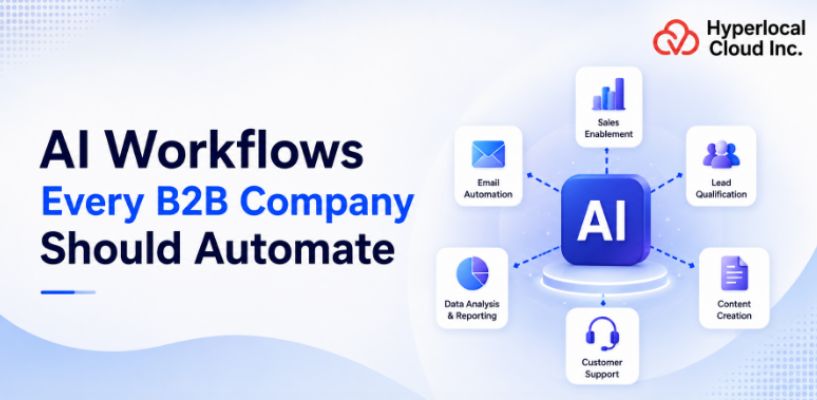
Key Takeaways:-
|
Businesses today are eagerly looking for a reliable solution to overcome the situation of constantly delivering top-notch services in a quick time with a better customer experience. At the same time, the team of experts also needs to spend a lot of time on repetitive tasks that are manually very complex to complete. Thus, this is the point where AI-centric workflows are introduced in the market in order to increase businesses’ productivity.
These workflows can automate tasks like analyzing information and making better decisions. Unlike traditional methods of manually managing tasks, businesses can utilize workflows that can easily do all the essential tasks automatically.
In the B2B market, the solution has become in demand across industries. From fintech to sales and marketing, the tool has evolved successfully. With the help of these AI workflows, businesses can reduce manual errors, improve performance, and streamline daily operations.
A Brief Concept of an AI Workflow
An AI workflow is powered by AI that is specifically designed to help businesses automate their tasks without human involvement. These workflows can analyze data, recognize patterns, and automatically adapt to changing situations. The main function of this process is to reduce the overall manual work in order to increase productivity and accuracy. That’s the reason businesses are shifting towards AI workflow automation solutions.
Automate Your Business Today and Unlock Faster Smarter AI Powered Growth
Why B2B Companies Should Prioritize AI Workflows
There are so many benefits that businesses will get from prioritizing an AI workflow. To know each one, you must review the information we have mentioned below.
1. Reduced operational costs
The foremost benefit of prioritizing an AI workflow is that it reduces the overall operational cost. This is because so many businesses or startups are working on the same repetitive tasks that require time and resources, which can be done manually with the help of employees. However, with AI workflows, the process becomes easy to manage for businesses.
2. Improved employee productivity
AI workflows help shed a lot of this burden by automating repetitive tasks. Tasks that include scheduling meetings, scheduling announcements, qualifying leads, creating reviews, and completing buyer inquiries can be done with minimal human involvement. This allows employees to be recognized for productivity that requires creativity, the necessary supervision, and understanding.
3. Faster decision-making
In the modern world, businesses generate huge amounts of data every day. However, information gathering is most effective if organizations can use it to make informed decisions. AI workflows can examine records from two sources in real time and identify patterns, trends, and opportunities. Instead of waiting for manual reports or lengthy evaluation techniques, businesses will get more valuable insight much faster.
4. Better customer experiences
Professional customers appreciate quick, customized communication and seamless support throughout the journey. AI workflows help businesses meet those expectations through automation in order to enhance overall user experience.
5. Increased revenue opportunities
Instead of just providing efficient support, AI workflows help businesses to build new revenue opportunities. By analyzing user preferences and market trends that are easily identified by AI-driven technologies without any human intervention. This approach will help businesses in order to analyze high-value capabilities and offer customers appropriate services to build a strong user base.
6. Scalability without proportional hiring
As companies evolve, their operational requirements increase. Traditionally, business growth regularly requires more employees to be hired to manage larger workloads. AI workflows allow companies to handle large volumes of work without making the workforce bigger. Automated systems can easily manage multiple user queries, handle additional information, and assist multiple customers without requiring significant additional resources.
10 AI Workflows Every B2B Company Should Automate in 2026
A complete list of the top 10 AI-centric workflows every B2B company should automate in 2026 is mentioned below. If you are looking to initiate your business journey with an improvement in performance, then you must know about these workflows that will be useful to automate your tasks.
AI-Powered Lead Qualification and Scoring
In businesses, not every single lead has the potential to become a client. However, sales teams usually spend a lot of their time approaching customers who are not ready to proceed. In this scenario, AI-powered lead qualification tools help to automatically evaluate the incoming leads based on actual needs and past data. The tool typically analyzes information such as business size, engagement history, website activity, and buying intent in order to provide efficient results.
Automated Prospect Research and Sales Outreach
For sales teams, researching prospects can be challenging. AI can automate this task by generating and collecting reliable information from multiple sources in order to create prospect profiles. The tool typically works by analyzing company information, tracking business updates, and monitoring potential opportunities.
AI Content Creation and Distribution
Content plays an important role in attracting and nurturing potential customers. However, continued production and distribution of content material may require vast resources. AI can help advertising and marketing teams generate content ideas, draft articles, create social media posts, write email campaigns, and optimize content for search engines like Google. This allows advertising teams to constantly move with the flow of content while improving efficiency and reach.
Intelligent Customer Support Automation
Customer support teams typically deal with massive volumes of repetitive queries. AI-powered support systems can automate responses to unusual queries and provide customers with immediate assistance. AI chatbots and digital assistants can guide customers through troubleshooting steps, answer regularly asked questions, and access records before humans escalate issues. This reduces response times, improves user happiness, and allows support teams to focus on issues that require more complex human knowledge
AI-Powered Meeting Intelligence
Meetings can create valuable records, but manually taking photos and organizing them can be challenging. AI-powered meeting intelligence equipment can automatically record conversations, create transcripts, generate summaries, capture action items, and highlight key discussion points. This ensures team members have accurate records and can quickly assess key opportunities and next steps. As a result, groups spend less time taking notes and extra time communicating important information.
Automated Proposal and RFP Response Generation
Preparing proposals and responding to requests for proposals (RFPs) on a regular basis takes a tremendous amount of effort and coordination. AI can streamline this technique with the help of pulling records from existing files, knowledge bases, and previous bids. The tool can generate response suggestions, recommend applicable content, and ensure file consistency. This reduces the workload of intake and ideation teams and makes it easier for companies to respond to prospects quickly.
AI-Driven Customer Onboarding
A clean onboarding experience is essential to customer success. AI workflows can automate many factors of onboarding, including account setup, training tips, progress tracking, and protecting communication. By providing personalized control and timely assistance, AI enables customers to add value quickly and reduces the likelihood of initial dissatisfaction. This creates a stronger foundation for long-term consumer relationships.
Revenue Forecasting and Pipeline Management
Accurate forecasting is important for growth when planning a commercial enterprise. AI can study historical sales records, market characteristics, customer behavior, and management interests to generate reliable sales forecasts. The system can identify potential threats, highlight stalled opportunities, and advocate for steps to improve the management process. These insights help sales managers make more informed decisions and allocate resources more effectively.
Accounts Payable and Financial Operations Automation
Finance teams typically spend a significant amount of time processing invoices, approving invoices, and managing information. AI workflows can automate invoice processing, data extraction, payment approval, payment classification, and financial reporting. This improves accuracy, reduces processing time, and reduces the risk of errors. Finance groups can then be more aware of strategic design planning and economic analysis compared to routine administrative tasks.
Employee Knowledge Management and Internal AI Assistants
As the business evolves, employees typically struggle to discover the information they want quickly. Real expertise can be stored in any file, email, database, or internal systems. AI-powered understanding and control structures can centralize records and provide employees with on-the-spot solutions to common queries. Internal AI assistants can help teams discover files, access company policies, retrieve task facts, and assist with day-to-day work activities.
Transform Your B2B Operations Now With Powerful AI Automation Strategies
How to Prioritize AI Workflows for Your Business?
A complete overview of the steps that help businesses to understand how they can prioritize AI workflows for their business is discussed below. Let’s have a look:
1. Evaluate Current Processes
The first step is to take a closer look at your current business processes. Each branch within the organization performs dozens of tasks a day. Some responsibilities are highly strategic and require human input, just as others begin by identifying strategies that are repetitive, follow the same pattern over and over again, and consume considerable time, require executive effort, or often cause bottlenecks. These are pleasant ways for standard automation.
2. Assess Automation Readiness
Once capacity workflows are identified, the next step is to determine whether or not they should be ready for automation. Not every approach is equally suitable for implementing AI. Some workflows have clean steps, daily records, and fully described results. Others can be surprisingly unpredictable and require a great deal of human judgment.
3. Focus on High-ROI Opportunities
The simplest and most common way to prioritize an AI workflow automation is that it focuses on the ROI, which means businesses are required to choose workflows that can easily grow their overall revenue, provide quality performance, are cost-effective, and user-friendly.
4. Quick Wins
Quick wins are AI projects that can be implemented very quickly and start delivering results within a quick time frame. These projects typically involve repeats that have already achieved clean regulations and established records. They often require minimal research to present a workflow and can be followed through by employees with limited interruptions.
5. Medium-Term Projects
Once initial automation efforts are a hit, companies can move on to medium-term projects. These projects typically involve multiple departments, large data sets, and more complex integrations. Although they need more planning and coordination, they still have the ability to provide a large business fee. Medium-term projects usually require collaboration between some groups, making powerful planning and stakeholder coordination critical to achieving them.
6. Strategic Initiatives
Strategic AI initiatives are long-term missions that have the potential to change the way the business enterprise operates. These workflows typically include better analytics, predictive capabilities, and enterprise-wide automation. They usually require large funding, strong management support, and careful business management.
Common Challenges When Implementing AI Workflows
Implementation of AI workflows in B2B companies is not that easy. This is because several challenges exist that make the process more complex. That’s why businesses are required to address and consider these challenges to overcome last-minute hassles.
1. Data Quality Issues
AI models rely heavily on records. Better output produced by AI is immediately linked to the higher quality of the records it receives. AI workflows can also be incredibly impactful if business statistics are incomplete, outdated, inconsistent, or corrupt. Poor information can affect the accuracy of predictive forecasts, buyer insights, automated decision-making, and the general system’s overall performance. Maintaining strong statistical management practices is critical to long-term success.
2. Change Management
The technical use is not the simplest in terms of change management. Employees may also be concerned about how AI will affect their roles, duties, and day-to-day work. Successful AI implementations often rely as much on humans as on technology.
3. Security and Compliance
Many AI workflows process sensitive details and company information, user records, financial records, and internal business and company documents. Thus, protection and control should be key considerations at some stage of implementation. Failure to address security and compliance requirements can lead to breaches and reputational risk.
4. Integration Complexity
Most companies already use a couple of software systems to manage specific business capabilities. These can include customer data monitoring systems, advertising platforms, economic software applications, communication tools, and data analytics solutions. For AI workflows to work properly, they need to hook into many of those systems. A nice and deliberate integration technique ensures that AI workflows work well and provide maximum value across the organization.
Make Smarter Decisions Faster With AI Powered Workflow Automation Systems
Know the Best Practices for Successful AI Automation
The following is a list that lets you know about the best practices for successful AI automation that provides immense growth to your businesses and streamlines all your business operations. Just have a look:
1. Start with One High-Impact Workflow
One of the most not uncommon mistakes professionals make now is trying to automate too many processes. While it can be tempting to launch more than one AI feature at the same time, this method can quickly prove difficult to handle. Teams may struggle with demanding implementation issues, assistance barriers, and difficulty adopting workers. Starting with a cross-functional workflow allows organizations to test from the implementation stage, identify skills challenges, and build confidence in the age of AI.
2. Define Clear KPIs
Before implementing any AI workflow, groups should establish clear key performance indicators (KPIs). Without measurable goals, it becomes difficult to determine whether or not an AI initiative delivers value. KPIs should be linked to the results that the organization wants to achieve all at once. Depending on the workflow, these metrics may include:
- Time saved on manual tasks
- Reduction in operational costs
- Increase in lead conversion rates
- Faster response times
- Customer satisfaction improvements
- Revenue growth
- Employee productivity gains
3. Maintain Human Oversight
While AI can automate many commercial and entrepreneurial activities, human involvement is still critical. AI systems can fact-check, spot patterns, and make suggestions, but they’re not the best right now. Sometimes there may be situations where things like creativity, moral consideration, and context matter. Thus, maintaining human oversight is helpful in order to make sure that the AI-generated outputs are accurate and suited to your business goals.
4. Continuously Optimize Models and Processes
Integration of AI-driven technologies is not a one-time thing; it needs to be continuously optimized for the models and processes. This is because business needs, user expectations, and the market can be changed anytime. As a result, the AI-automated workflows must be monitored and evaluated by businesses. However, the overall process can include updating data sources, improving workflows, retraining AI models, and updating automation guidelines.
5. Build a Cross-Functional AI Team
AI projects often impact more than one department throughout the organization. For this reason, successful implementation requires cooperation between certain groups. Cross-functional collaboration also increases communication, reduces administrative challenges, and encourages use across the organization. A cross-functional AI team brings together individuals with expertise in areas such as:
- Business operations
- Information technology
- Data management
- Sales and marketing
- Customer service
- Finance
- Compliance and security
Understand the Future Trends in B2B AI Automation
There are several trends that make B2B AI automation stand out in the market. Want to know about all these emerging future trends? Just go through the information that we have mentioned below.
1. Autonomous AI Agents
A full-scale development of AI automation is autonomous AI agents. Unlike traditional AI tools that receive instructions and perform specific tasks, self-sufficient agents can work autonomously toward declared goals. They can gather information, investigate situations, make decisions, and assume full responsibility with limited human intervention.
2. Multi-Agent Workflow Systems
The subsequent development of AI automation has seen two AI agents run together as an integrated system. In a multi-agent environment, single AI agents specialize in specific functions and collaborate to complete larger commercial enterprise tasks. Together, these agents can manage workflows that would traditionally require more than one employee and department.
3. Hyper-Personalized Customer Journeys
Personalization has become an essential element in customer engagement, but future AI systems will take it to a whole new dimension. AI should be able to research shopper behavior, choices, interactions, and style purchases in real time. This approach will help businesses to deliver a customized experience to their user based on their preferences.
4. Predictive Business Operations
Currently, many companies are using AI to explore ancient data. In fact, AI will play a much bigger role in predicting outcomes and recommending routes before problems arise. This will enable organizations to identify threats, forecast demand, capture customer needs, and optimize resource allocation with greater accuracy. This shift from reactive selection and design to proactive design can help groups work better and respond quickly to changing situations.
5. AI-Native Organizations
Unlike traditional groups that add AI to existing methods, AI app development companies build their business around AI from the start. In these companies, AI supports selection, workflow management, customer engagement, information sharing, and operational planning across the commercial enterprise.
Begin Your AI Transformation Journey and Optimize Every Business Workflow Today
Conclusion
AI workflow automation quickly becomes the core part of a modern B2B company to seamlessly fulfill its operations. These workflows work across industries and quickly become the most scalable and flexible solution. From lead qualification to customer services, businesses can automate each task with the help of AI-driven workflow automation. That’s why businesses initiate the utilization of these workflows in order to transform the process of completing tasks with minimal human intervention.

Patt Cummins is an experienced content writer with over 10 years of experience creating clear and engaging content for technology-focused industries. He specializes in simplifying complex technical topics into easy-to-understand stories that educate readers, support brand communication, and help businesses effectively share their solutions.

Need Help With
Development?