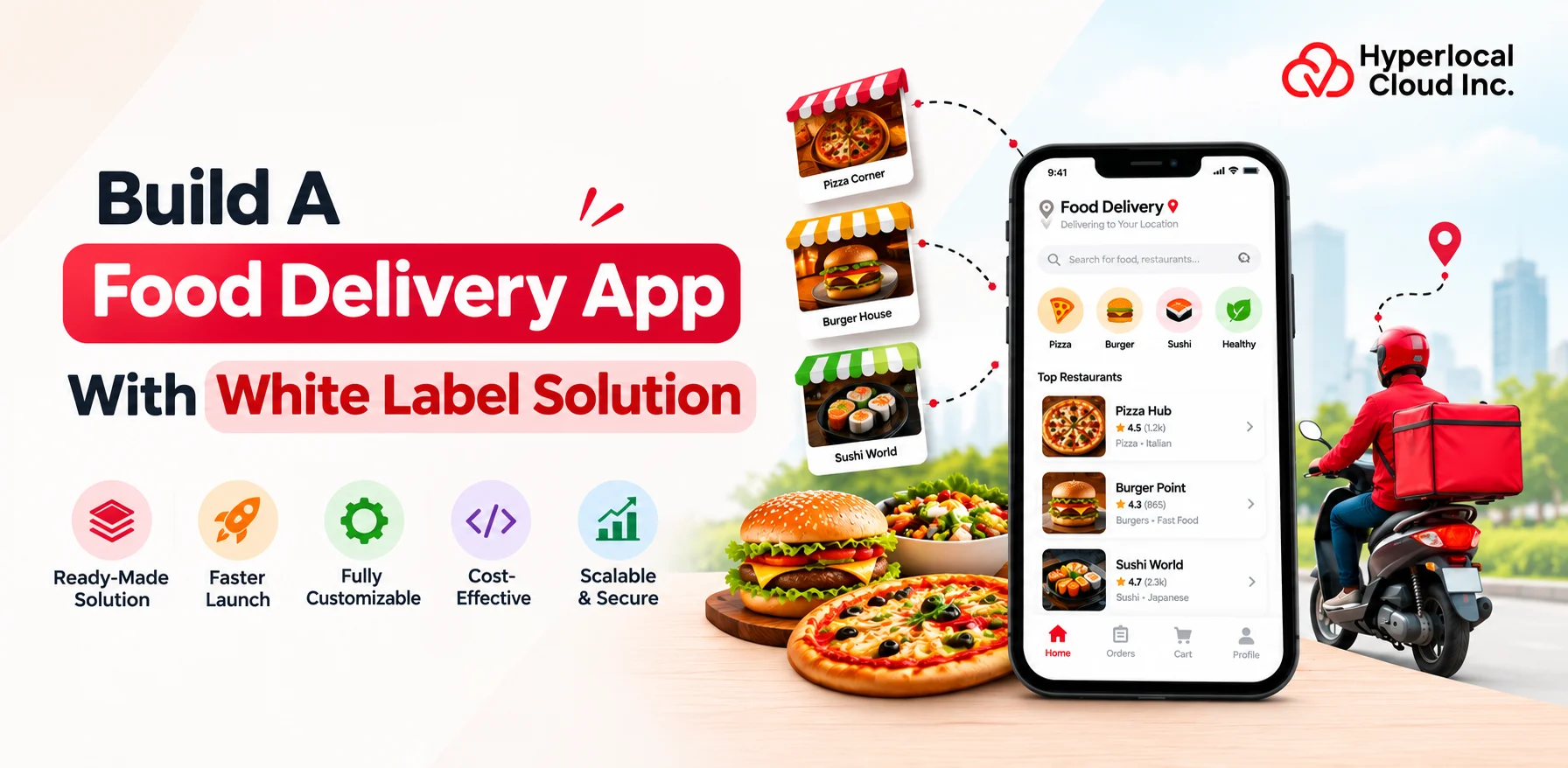
- Launch your own branded food delivery app without building from scratch.
- Get customer, restaurant, delivery partner, and admin applications.
- Customize features, branding, and third-party integrations.
- Generate revenue through commissions, delivery fees, and subscriptions.
- Scale your business across multiple restaurants and locations.
- Hyperlocal Cloud offers a white label food delivery app starting at $5,000.
The online food delivery industry continues to create opportunities for entrepreneurs, restaurant owners, cloud kitchen operators, and businesses looking to establish their digital presence. Customers increasingly prefer ordering meals through mobile applications because of convenience, flexible payment options, and doorstep delivery. For businesses, this creates an opportunity to build a scalable food delivery platform without developing an entire application from scratch.
A white label food delivery app provides a ready-made technology solution that businesses can customize with their own brand name, logo, colors, and business requirements. It helps entrepreneurs enter the food delivery market with essential features, including restaurant management, order processing, delivery tracking, payment integration, and administrative controls.
Hyperlocal Cloud offers a white label food delivery app solution designed to help businesses launch and manage their own branded food ordering platforms. Whether you want to build a multi-restaurant marketplace, launch a cloud kitchen delivery service, or digitize an existing restaurant business, a customizable solution can simplify your launch process.
What Is a White Label Food Delivery App?
A white label food delivery app is a pre-developed software solution that businesses can purchase, customize, and launch under their own brand identity. Instead of investing time and resources in developing an application from the beginning, businesses can use an existing platform and configure it according to their operational needs.
The solution typically includes separate applications or interfaces for customers, restaurants, delivery partners, and administrators. Each component serves a specific purpose, helping businesses manage the complete food ordering and delivery process through a centralized platform.
For example, an entrepreneur planning to launch a food delivery marketplace can use a white label solution to connect multiple restaurants with customers. The business owner can manage restaurant registrations, commissions, orders, delivery operations, promotional campaigns, and payments through an admin dashboard.
White Label vs. Custom Food Delivery App Development
Both development approaches can help businesses establish a food delivery app, but they differ in implementation, customization, and initial investment.
White Label Food Delivery App ($5,000)
A white label solution uses an existing software solution that can be branded and configured for a particular business. It is suitable for startups and businesses looking to launch without building every component from scratch.
Custom Food Delivery App Development
Custom development involves designing and developing an application according to specific business requirements. It provides greater flexibility over architecture, workflows, integrations, and specialized features but generally requires more development resources.
The right approach depends on your budget, launch timeline, operational complexity, and long-term product requirements.
Launch Your Own Food Delivery App Today!
Why Should Businesses Invest in a White Label Food Delivery App?
Launching a food delivery business requires more than connecting restaurants with customers. Businesses need reliable software to manage orders, coordinate deliveries, process payments, and maintain customer relationships.
A white label food delivery app can simplify these responsibilities by providing an established technology foundation.
Faster Market Entry
Developing an application from scratch involves planning, designing, programming, testing, and deployment. A ready-made solution reduces the amount of initial development work and helps businesses move toward launch more quickly.
Entrepreneurs can concentrate on onboarding restaurants, building customer awareness, establishing delivery operations, and expanding their service areas.
Lower Initial Development Costs
Custom application development can require significant investment in developers, designers, infrastructure, and ongoing testing.
A white label solution can reduce the initial development effort by providing pre-built functionality. Businesses can allocate more resources to marketing, restaurant partnerships, customer acquisition, and operational growth.
Complete Brand Ownership
Businesses can establish their own digital identity by customizing the application’s logo, colors, name, visual elements, and other branding components.
This helps create a recognizable food delivery brand rather than relying entirely on an established third-party marketplace.
Flexible Customization
Different food delivery businesses have different operational requirements. A restaurant chain may need centralized menu management, while a multi-vendor marketplace may require restaurant commissions and vendor dashboards.
A customizable white label food ordering system can be configured to support these requirements through suitable features, integrations, and workflows.
Scalable Business Operations
As a food delivery business expands, its technology must support additional customers, restaurants, delivery partners, and locations.
A scalable solution can help businesses extend their operations into new neighborhoods or cities while maintaining centralized management.
Reduced Development Complexity
A pre-developed application provides an existing foundation for essential workflows such as ordering, payment processing, restaurant management, and delivery coordination.
This reduces the need to manage every development activity internally and allows business owners to focus on their core operations.
Types of Food Delivery Businesses You Can Launch
A white label food delivery app can support different business models depending on the target audience, restaurant partnerships, delivery operations, and revenue strategy.
Multi-Restaurant Food Delivery Marketplace
A multi-restaurant marketplace connects customers with several restaurants through a single application. Customers can browse different restaurants, compare menus, select meals, and place orders.
The platform owner can generate revenue through restaurant commissions, delivery charges, promotional placements, and subscription plans.
Single Restaurant Food Delivery App
Restaurants can launch their own branded food ordering application to receive orders directly from customers.
This model helps restaurant owners manage menus, accept online payments, offer discounts, and build direct customer relationships without depending exclusively on third-party marketplaces.
Cloud Kitchen Delivery Platform
Cloud kitchens operate without traditional dine-in facilities and primarily focus on preparing food for delivery and takeaway.
A dedicated food delivery platform can help cloud kitchen businesses manage multiple virtual brands, menus, incoming orders, and delivery operations from a centralized system.
Food Delivery Aggregator
A food delivery aggregator connects multiple restaurants with customers and coordinates the ordering experience through one digital marketplace.
The business can manage restaurant onboarding, menu listings, order allocation, payment collection, and delivery coordination through its platform.
Restaurant Chain Ordering App
Restaurant chains operating across multiple locations can use a branded food ordering application to manage online orders across different branches.
The platform can support location-based restaurant discovery, branch-specific menus, order management, and centralized reporting.
Specialty Food Delivery Platform
Businesses can also develop niche food delivery services focused on specific customer requirements.
Examples include
-
Healthy meal delivery platforms.
-
Organic food ordering applications.
-
Grocery and fresh food delivery.
-
Bakery and dessert delivery.
-
Vegan and vegetarian food marketplaces.
-
Meal subscription and tiffin delivery services.
These specialized platforms can target specific customer segments and create differentiated food delivery experiences.
Essential Components of Our White Label Food Delivery App
A successful food delivery platform requires multiple interconnected applications and dashboards. Each component serves a different user group while maintaining a smooth ordering and delivery experience.
Hyperlocal Cloud’s white label food delivery app solution is designed around four essential components.
Customer Application
The customer application provides an interface for discovering restaurants, browsing food menus, placing orders, and tracking deliveries.
Important customer-side functionalities include:
-
User registration and secure login.
-
Restaurant discovery based on location.
-
Food categories and menu browsing.
-
Search and filter options.
-
Shopping cart and checkout.
-
Multiple payment options.
-
Order scheduling.
-
Live order tracking.
-
Discounts and promotional offers.
-
Ratings and reviews.
-
Order history and repeat ordering.
-
Customer support and notifications.
A simple and intuitive customer interface can help improve the ordering experience and encourage repeat purchases.
Restaurant Partner Application
The restaurant application enables food vendors to manage their participation in the marketplace and process customer orders.
Key functionalities include:
-
Restaurant registration and profile management.
-
Menu creation and editing.
-
Food pricing and availability management.
-
Order acceptance and rejection.
-
Food preparation status updates.
-
Restaurant operating hours.
-
Sales and order history.
-
Promotional offer management.
-
Customer feedback monitoring.
-
Earnings and commission reports.
These features help restaurant partners manage their daily activities without depending on manual communication with platform administrators.
Delivery Partner Application
The delivery partner application supports delivery personnel throughout the order fulfillment process.
Its essential functionalities include:
-
Delivery partner registration.
-
Profile and document management.
-
Availability status.
-
New delivery request notifications.
-
Order acceptance and rejection.
-
Restaurant pickup details.
-
GPS-based navigation.
-
Customer delivery information.
-
Delivery status updates.
-
Earnings and delivery history.
-
Delivery notifications.
The application helps delivery partners manage assigned orders and coordinate pickups and drop-offs efficiently.
Admin Dashboard
The admin dashboard acts as the central control panel for managing the complete food delivery business.
Platform administrators can access different operational and business management tools, including:
-
Customer account management.
-
Restaurant registration and verification.
-
Delivery partner management.
-
Order monitoring and management.
-
Commission configuration.
-
Payment and transaction management.
-
Coupon and discount management.
-
Service area configuration.
-
Promotional banner management.
-
Customer complaints and support.
-
Revenue and performance reports.
-
Platform settings and permissions.
A centralized dashboard gives business owners better visibility into daily operations and helps them make informed business decisions.
Ready to Enter the Online Food Delivery Market?
Must-Have Features of a White Label Food Delivery App
Features play an important role in determining the usability, performance, and competitiveness of a food delivery application. Businesses should prioritize functionalities that improve customer convenience, simplify restaurant operations, and support efficient delivery management.
Here are the essential features to consider when launching your food delivery platform.
AI-Based Restaurant Recommendations
AI-powered recommendation systems can analyze customer preferences, previous orders, browsing activity, and food interests to suggest relevant restaurants and dishes.
For example, customers who frequently order vegetarian meals can receive recommendations for similar restaurants and menu items.
Personalized suggestions can improve food discovery and encourage additional purchases.
Real-Time Order Tracking
Real-time tracking allows customers to monitor their orders after checkout. They can view order confirmation, food preparation, pickup, and delivery progress.
GPS integration can help customers identify the delivery partner’s approximate location and estimated arrival time.
This feature also improves communication between customers, restaurants, and delivery personnel.
Multiple Payment Gateway Integration
Customers expect convenient and secure payment experiences. Integrating multiple payment methods can make the checkout process easier.
Depending on the target market, the platform can support:
-
Credit and debit cards.
-
Digital wallets.
-
Online banking.
-
UPI payments.
-
Cash on delivery.
-
Other supported regional payment methods.
Payment gateway selection should consider transaction fees, supported currencies, security requirements, and geographical availability.
Smart Search and Filters
Smart search helps customers quickly discover restaurants, cuisines, and food items.
Filters can allow users to narrow their choices based on:
-
Food categories.
-
Cuisine types.
-
Price ranges.
-
Customer ratings.
-
Delivery time.
-
Dietary preferences.
-
Restaurant availability.
These options make restaurant discovery easier, particularly when the platform contains a large number of listings.
Order Scheduling
Order scheduling allows customers to select a preferred delivery time instead of ordering only for immediate fulfillment.
This feature is useful for office lunches, family gatherings, planned dinners, and recurring meal requirements.
Restaurants can use scheduled orders to plan food preparation and manage upcoming demand.
Discounts and Coupon Management
Promotional features help businesses attract new customers and encourage existing users to place repeat orders.
Administrators can configure promotional campaigns such as:
-
First-order discounts.
-
Percentage-based offers.
-
Fixed-value coupons.
-
Restaurant-specific promotions.
-
Free delivery campaigns.
-
Seasonal discounts.
-
Referral rewards.
Businesses should establish suitable offer conditions to maintain profitability while attracting customers.
Push Notifications
Push notifications keep customers, restaurants, and delivery partners informed about important activities.
Examples include order confirmations, preparation updates, delivery assignments, promotional offers, payment notifications, and order completion alerts.
Relevant notifications improve communication and reduce the need for manual follow-ups.
Ratings and Reviews
Ratings and reviews allow customers to share feedback about restaurants, food quality, and delivery experiences.
Restaurants can use this information to identify service improvements, while administrators can monitor customer satisfaction and handle complaints.
Analytics and Reporting
Analytics provide insights into business performance and operational activities.
Administrators can monitor metrics such as:
-
Total orders.
-
Completed and cancelled orders.
-
Revenue and commission.
-
Average order value.
-
Customer acquisition.
-
Restaurant performance.
-
Delivery completion rates.
-
Promotional campaign performance.
These insights help businesses understand their performance and identify opportunities for improvement.
Delivery Route Optimization
Route optimization helps delivery partners identify suitable routes between restaurants and customers.
Depending on the integration and supported functionality, the system can consider distance, traffic conditions, and multiple delivery locations when planning routes.
This can help reduce unnecessary travel and improve delivery efficiency.
How Does a Food Delivery App Work?
A food delivery application coordinates several activities from the moment a customer selects a meal until the order reaches their doorstep.
Understanding this workflow helps business owners identify the operational requirements of their platform.
Customer Places an Order
Customers open the application, select their preferred restaurant, explore the available menu, and add food items to their cart.
After reviewing the order, they enter delivery information, select a payment method, and confirm the purchase.
Restaurant Receives and Accepts the Order
Once the order is submitted, the restaurant receives a notification through its partner application.
Restaurant staff review the order, confirm availability, and accept it for preparation. The order status is updated so customers can monitor progress.
Food Preparation and Packaging
The restaurant prepares the selected food items and updates the preparation status through its application.
After preparation, the order is packaged and marked as ready for pickup.
Delivery Partner Assignment
The platform assigns an available delivery partner based on its configured allocation rules and operational requirements.
The delivery partner receives the pickup information and can accept the delivery request where supported.
Real-Time Delivery Tracking
After collecting the food, the delivery partner proceeds toward the customer’s location.
Customers can follow the delivery progress through the tracking interface, depending on the platform’s GPS and mapping integrations.
Order Completion and Payment Settlement
The delivery partner hands over the order and marks it as delivered.
The platform records the order completion and associated payment information. Restaurant payouts, commissions, and delivery partner earnings can then be managed according to the configured settlement process.
Revenue Models for a Food Delivery Business
Selecting an appropriate revenue model is essential for building a sustainable food delivery business. Entrepreneurs can use one or multiple monetization strategies depending on their marketplace structure and target customers.
Commission-Based Revenue
The platform owner charges restaurants a percentage of each successfully completed order.
For example, if a restaurant receives an order worth $50 and the agreed commission is 15%, the platform earns $7.50 before applicable fees and other expenses.
Commission rates can vary according to restaurant agreements and business policies.
Delivery Charges
Businesses can charge customers a delivery fee based on distance, location, order size, or delivery requirements.
Some platforms also offer free delivery above a minimum order value to encourage larger purchases.
Restaurant Subscription Fees
Restaurant partners can pay a recurring subscription fee to access the food delivery marketplace.
Different subscription plans can offer different benefits, such as menu management, promotional tools, reporting, and enhanced visibility.
Featured Restaurant Listings
Restaurants can pay additional fees to receive premium placement within search results, category pages, or promotional sections.
Sponsored listings can create another revenue stream while giving restaurant partners opportunities to increase their visibility.
In-App Advertising
Food delivery businesses can generate advertising revenue by offering promotional placements to restaurants, food brands, and relevant businesses.
Advertising formats may include sponsored banners, promoted restaurants, and featured food products.
Customer Membership Plans
Businesses can introduce paid membership programs that provide customers with benefits such as reduced delivery charges, exclusive discounts, and special promotions.
Recurring memberships can support customer retention and create predictable revenue opportunities.
White Label Food Delivery App Customization and Integrations
Every food delivery business has different operational requirements. A successful platform should allow businesses to configure its appearance, functionality, and third-party integrations according to their needs.
Custom Branding and UI/UX
Branding helps businesses establish a recognizable identity in the competitive food delivery market.
A customizable application can incorporate:
-
Business logo and brand name.
-
Brand colors and typography.
-
Custom splash screens.
-
Personalized application icons.
-
Customized menus and categories.
-
Business-specific banners.
-
Customized customer journeys.
The user interface should also be optimized for different screen sizes and devices.
Payment Gateway Integration
Payment gateway integration enables customers to complete transactions through supported payment methods.
Businesses can select payment providers based on their operating region, transaction requirements, supported currencies, and settlement preferences.
Maps and GPS Integration
Maps and GPS services support restaurant discovery, address selection, delivery tracking, and navigation.
Businesses can integrate suitable mapping services to improve location accuracy and delivery coordination.
CRM and Marketing Integrations
CRM integrations help businesses organize customer information, manage communication, and run marketing campaigns.
Email marketing, customer segmentation, promotional notifications, and loyalty programs can support customer engagement.
Third-Party Delivery Integrations
Businesses that do not maintain their own delivery fleet may integrate external delivery service providers where supported.
These integrations can help coordinate delivery requests, obtain status updates, and manage fulfillment without operating an entirely in-house delivery network.
Get a Feature-Rich Food Delivery App for Your Business
How Much Does a White Label Food Delivery App Cost?
The cost of launching a food delivery application depends on the solution’s functionality, customization requirements, integrations, and business model.
A ready-made platform generally requires less initial development effort than building a completely customized application from scratch.
Hyperlocal Cloud’s white label food ordering app solution is listed with a starting price of $5,000. The final investment should be confirmed based on the selected package and any additional requirements.
Factors Affecting Development Costs
Several factors can influence the overall investment.
Application Components: A solution with customer, restaurant, delivery partner, and admin applications may have different implementation requirements from a single-restaurant application.
Customization Requirements: Changes to the interface, workflows, features, and business logic can affect the final cost.
Third-Party Integrations: Payment gateways, maps, CRM systems, and external delivery services may involve additional integration and subscription expenses.
Platform Compatibility: Android, iOS, and web application requirements can influence the implementation scope.
Advanced Features: AI recommendations, loyalty programs, advanced analytics, and automated delivery allocation may increase customization requirements.
Maintenance and Support: Businesses should also consider hosting, updates, technical support, and ongoing maintenance in their operating budget.
White Label Solution vs. Custom Development Cost
White label solution can be a practical choice for businesses that want to launch using an existing software solution.
Custom development may require a larger initial investment because the application architecture, design, and functionalities need to be developed according to individual specifications.
The best option depends on your available budget, required flexibility, launch objectives, and expected business growth.
Additional Customization and Maintenance Costs
Apart from the initial software investment, businesses should account for recurring and optional expenses.
These may include:
-
Server hosting and infrastructure.
-
Payment gateway transaction charges.
-
Maps and location service usage.
-
SMS and notification services.
-
App store developer accounts.
-
Additional feature development.
-
Security updates and maintenance.
-
Marketing and customer acquisition.
Planning for these expenses helps businesses estimate their total cost of ownership more accurately.
How to Choose the Right Food Delivery App Development Company
Selecting the right technology partner is an important decision when launching a food delivery business. The food delivery app development company should understand your business model and provide a solution that supports your current requirements and future expansion plans.
Consider the following factors before making a decision.
Industry Experience
Look for a development company with experience in food delivery applications, restaurant management systems, and on-demand platforms.
Review its portfolio to understand the types of solutions it has delivered and whether its experience matches your business requirements.
Customization Capabilities
Your technology partner should offer customization options for branding, application workflows, features, and integrations.
Discuss your business requirements before selecting a solution to ensure the platform can support your intended operations.
Technology and Scalability
Choose a solution designed to support increasing customers, restaurant partners, orders, and geographical coverage.
Ask about its technology stack, infrastructure, performance capabilities, and scalability approach.
Security and Compliance
Food delivery applications handle customer information, delivery addresses, and payment-related data.
Check whether the solution supports secure authentication, appropriate data protection measures, payment security, and applicable regional compliance requirements.
Technical Support and Maintenance
Post-launch support is important for maintaining application performance and resolving technical issues.
Understand the company’s support process, maintenance arrangements, software updates, and customization assistance before finalizing the partnership.
Why Choose Hyperlocal Cloud for Your White Label Food Delivery App?
Launching a food delivery business requires a technology solution that supports customer ordering, restaurant operations, delivery management, and business administration.
Hyperlocal Cloud provides a white label food delivery app solution that helps entrepreneurs and established businesses establish their own branded food ordering platforms.
Here are some reasons to consider Hyperlocal Cloud for your food delivery business.
Ready-to-Launch Food Delivery Solution
Get started with an existing food delivery software solution instead of developing every application component from scratch.
This approach can help reduce initial development complexity and accelerate the process of preparing your business for launch.
Business-Specific Customization
Customize the application according to your business identity and operational requirements.
You can discuss branding, design preferences, required functionalities, and integrations to align the platform with your business model.
Experienced Development Team
Work with a technology team to understand your requirements and configure the solution according to your project scope.
The team can help you identify the application components and functionality needed for your food delivery business.
Scalable Architecture
Build your food delivery business with a platform designed to accommodate growing operational requirements.
As your business expands, you can evaluate additional features, integrations, and infrastructure requirements to support new markets and customers.
Deployment and Ongoing Support
Launching an application is only one part of establishing a successful food delivery business.
Technical assistance, maintenance, updates, and customization support can help businesses manage their platform after deployment. Confirm the specific support services included in your selected package.
FAQs (Frequently Asked Questions)

Patt Cummins is an experienced content writer with over 10 years of experience creating clear and engaging content for technology-focused industries. He specializes in simplifying complex technical topics into easy-to-understand stories that educate readers, support brand communication, and help businesses effectively share their solutions.

Need Help With
Development?