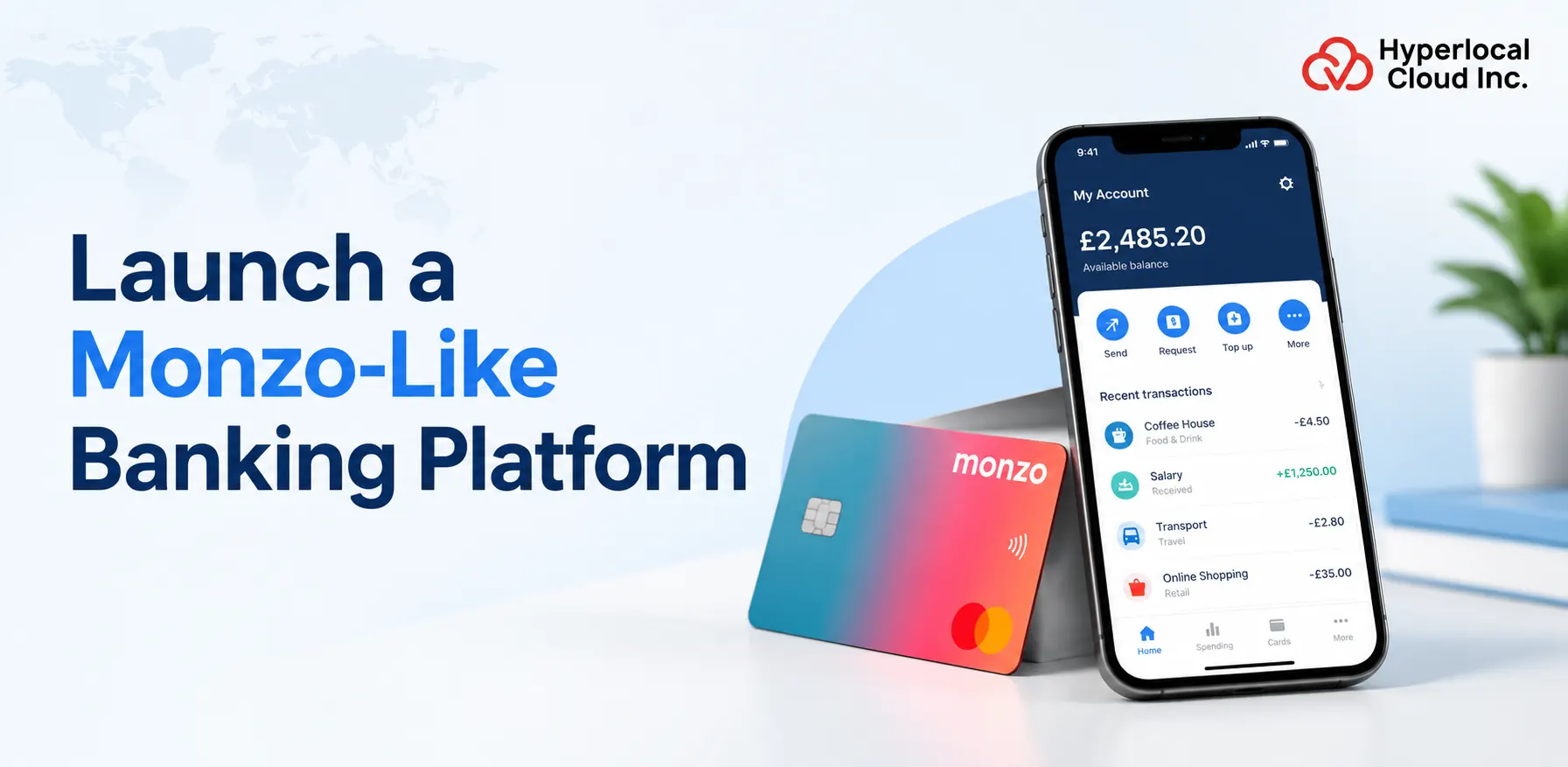
- Launch a Monzo-like digital banking platform with a white-label solution.
- Integrate essential features like money transfers, budgeting, payments, and transaction alerts.
- Prioritize security, KYC, AML, and regulatory compliance.
- Deliver a seamless, user-friendly mobile banking experience.
- Integrate banking APIs and payment gateways for efficient operations.
- Choose a scalable fintech solution to support future business growth.
The growing demand for mobile-first financial services has created opportunities for fintech startups, financial institutions, and entrepreneurs to launch digital banking platforms. Customers increasingly expect convenient access to account information, money transfers, transaction notifications, budgeting tools, and personalized financial insights through their smartphones.
Monzo has become a recognizable example of a mobile-first banking experience, combining everyday money management with a user-friendly digital interface. Businesses looking to develop a similar experience can explore a Monzo clone app development solution to create a branded digital banking platform tailored to their target audience.
Hyperlocal Cloud offers a Monzo-inspired, white-label app solution that businesses can customize according to their branding, feature requirements, and business objectives. With the right technology, integrations, banking partnerships, and regulatory arrangements, businesses can build a scalable platform designed to simplify digital financial services.
What Is a Monzo Clone App?
A Monzo clone app is a digital banking application inspired by the functionality and user experience of Monzo. It can provide features such as digital account management, transaction tracking, payment processing, spending analytics, notifications, and financial management tools.
Unlike the original Monzo application, a clone solution is intended to help businesses develop their own branded product. The interface, supported features, integrations, and workflows can be adapted to suit a particular customer segment or financial services model.
For example, a fintech startup could use a white-label banking app as the foundation for a personal finance platform, while an established financial services provider could customize it to complement its existing services.
A typical Monzo-like banking platform includes three main components:
- Customer application: Provides account access, transactions, payment features, notifications, and financial management tools.
- Administrative dashboard: Helps authorized staff manage users, monitor transactions, review reports, and configure supported platform functions.
- Backend infrastructure: Connects the application to payment providers, banking partners, identity verification services, and other financial APIs.
The exact functionality depends on the selected solution and its integrations. A software clone does not automatically provide a bank charter, deposit-taking authority, or access to Monzo’s proprietary systems.
Build Your Own Digital Banking App
Why Invest in Digital Banking App Development?
Digital banking app development can help businesses deliver convenient financial experiences while creating new opportunities to serve customers through mobile platforms.
Growing Demand for Mobile-First Financial Services
Customers increasingly expect to manage their finances digitally, including reviewing transactions, receiving payment alerts, and tracking spending. A well-designed mobile banking application can bring these activities together in one accessible interface.
Businesses can use this approach to serve customers who prefer digital interactions over traditional, branch-based processes.
Opportunities for Fintech Startups and Financial Institutions
A digital banking platform can support different business models, including fintech applications, financial management services, payment platforms, and banking services delivered through authorized partners.
Startups can focus on specific customer segments, such as freelancers, small businesses, younger consumers, or customers who want more effective budgeting tools. Existing financial institutions can explore new digital experiences and additional customer touchpoints.
Benefits of a White-Label Banking Solution
Developing every component from scratch can require significant planning, engineering, testing, and integration work. A white-label neobank platform provides a reusable software foundation that businesses can adapt to their requirements.
Depending on the package, businesses may benefit from:
- Custom branding and interface configuration
- Prebuilt application modules
- Reusable administrative functionality
- Integration options for third-party services
- Support for platform customization
- A foundation for future feature development
The actual development effort and launch timeline depend on the starting product, required integrations, compliance arrangements, and degree of customization.
Essential Features of a Monzo Clone App
Features determine how customers interact with a digital banking platform. A successful application should prioritize usability, reliability, security, and clear financial information.
User Registration and Identity Verification
The registration process should allow customers to create accounts and complete the required onboarding steps. Depending on the business model and jurisdiction, this may include identity verification, document submission, address verification, and customer due diligence.
Integration with a suitable identity verification provider can help automate parts of the onboarding workflow. Verification requirements should be configured according to the applicable legal and compliance obligations.
Digital Account and Balance Management
Customers should be able to view account information, check available balances, review account activity, and access relevant account details through a centralized dashboard.
The application should display financial information clearly and distinguish available balances from pending transactions where applicable. Account creation, balance updates, and account servicing must be supported by the relevant banking infrastructure.
Money Transfers and Payment Processing
Payment functionality can allow customers to initiate supported transfers and review payment statuses. Depending on the integration, payment methods may include domestic transfers, eligible peer-to-peer payments, and other authorized payment services.
A reliable payment workflow should include appropriate authentication, transaction validation, status tracking, error handling, and confirmation notifications.
Payment availability depends on the connected provider, account type, supported payment rails, and applicable restrictions.
Transaction History and Instant Notifications
Transaction history enables customers to review completed and pending activity, search records, and understand where their money is going.
Push notifications or other alerts can notify customers about eligible transactions, incoming payments, payment failures, account activity, and important account updates. Notification preferences should be configurable where appropriate.
Budgeting Tools and Spending Analytics
Budgeting features help customers understand spending patterns and manage their finances more effectively.
Useful capabilities include:
- Automatic transaction categorization
- Monthly spending summaries
- Budget creation and tracking
- Spending-category breakdowns
- Savings progress indicators
- Financial activity reports
Clear visualizations can help users identify spending trends and make more informed decisions without navigating complicated financial reports.
Savings Goals and Financial Insights
Savings tools can help users establish financial goals, track progress, and build consistent saving habits. Customers might create separate goals for travel, emergency expenses, purchases, or other personal objectives.
Depending on the product model, the platform can also provide personalized insights based on transaction categories and user-selected goals. Any automated financial recommendations should be appropriately disclosed and designed around relevant privacy and consumer protection requirements.
Card Management and Payment Controls
If supported by the banking or card-issuing partner, the application can provide card-related functionality, including:
- Viewing card details securely
- Freezing and unfreezing eligible cards
- Managing supported payment controls
- Reviewing card transactions
- Requesting replacement cards
- Receiving card activity alerts
Actual card issuance and card management capabilities require appropriate issuer and processing integrations.
Multi-Currency Support
Multi-currency functionality can be useful for customers who travel, shop internationally, or conduct eligible cross-border transactions.
Depending on the service model, the platform may display balances in multiple currencies, retrieve exchange rates, or support eligible international payments. Exchange rates, fees, settlement rules, and currency availability should be communicated transparently.
Admin Dashboard and Reporting
The administrative dashboard gives authorized operators access to platform management tools.
Common capabilities include customer account administration, transaction monitoring, operational reporting, support workflows, role-based access controls, and configurable system settings.
Sensitive financial operations should be protected through appropriate permissions, audit trails, approval processes, and monitoring controls. Administrative access should be limited to personnel who require it.
Advanced Features to Make Your Neobank App Stand Out
A digital banking application can differentiate itself by offering features that improve convenience, personalization, and financial awareness.
AI-Powered Financial Insights
AI-powered analytics can help users understand their spending behavior, identify recurring expenses, and receive relevant financial summaries. For example, an application could highlight changes in monthly spending or identify subscriptions that users may want to review.
These capabilities should use appropriate data permissions, explain insights clearly, and avoid presenting unqualified automated outputs as professional financial advice.
Automated Savings Tools
Automated savings functionality can help customers work toward their financial goals through configurable saving rules. Depending on the banking infrastructure, users might schedule transfers, set savings targets, or allocate eligible funds according to predefined preferences.
Before implementing automated transfers, businesses should provide clear consent, transaction controls, and appropriate safeguards against unintended transfers.
Fraud Detection and Suspicious-Activity Alerts
Security features are essential for financial applications. Transaction monitoring systems can identify potentially suspicious activity using configurable rules and, where appropriate, machine learning models.
Useful capabilities include unusual-transaction alerts, risk-based authentication, device monitoring, and workflows for reporting unauthorized activity. Detection systems should be evaluated regularly to balance fraud prevention with the risk of incorrectly flagging legitimate transactions.
Open Banking Integrations
Open banking integrations can allow eligible applications to connect with external financial accounts through authorized providers and customer consent.
Depending on the provider and jurisdiction, these integrations may support account information retrieval, transaction categorization, financial overviews, or supported payment initiation. Access permissions, consent management, and data security should be considered from the beginning of development.
Personalized Financial Recommendations
A neobank application can offer personalized budgeting suggestions, spending summaries, and savings reminders based on relevant customer activity and preferences.
Businesses should provide transparent explanations for recommendations, protect sensitive information, and ensure that any regulated financial advice or product recommendations meet applicable requirements.
Start Your Neobank App Development Journey
How to Build a Banking App Like Monzo
Building a banking application requires more than developing a mobile interface. Businesses must coordinate product planning, financial integrations, security, regulatory requirements, and ongoing operations.
Step 1: Define Your Target Market and Business Model
Start by identifying the customers your platform will serve. Your target audience might include individuals, freelancers, small businesses, international customers, or users seeking better budgeting tools.
Define your core value proposition and decide which services the application will provide. Consider whether you intend to operate through a licensed banking partner, work with an authorized financial institution, or develop software for an existing regulated organization.
Your business model will influence the required features, integrations, operational structure, and launch strategy.
Step 2: Select Banking Partners and Required Licenses
Identify the banking, payment, card-issuing, and financial infrastructure partners required for your proposed services.
Regulatory obligations vary depending on the jurisdiction and the activities offered. For example, launching a US financial application may involve banking partners, payment providers, money transmission considerations, consumer protection obligations, and applicable identity verification and anti-money-laundering requirements.
Determine these requirements before finalizing your development scope. A software provider can help build the technology, but buying a white-label solution does not itself grant the right to provide regulated financial services.
Step 3: Plan the App Architecture and User Experience
Design the customer journey from registration and verification to account management, payments, notifications, and support.
Create wireframes and prototypes for the main screens before implementing the full application. Prioritize clear navigation, accessible interface elements, understandable transaction statuses, and straightforward error messages.
The technical architecture should account for secure authentication, API integrations, transaction processing, data storage, monitoring, and future scalability.
Step 4: Integrate Payment and Financial APIs
Choose appropriate providers for the services your application needs. Depending on the business model, these could include account infrastructure, payment processing, card issuing, identity verification, fraud monitoring, and open banking services.
Each integration should be tested for authentication, response handling, transaction failures, duplicate requests, timeouts, reconciliation, and service interruptions.
Financial transactions require particular care. Idempotency controls, reliable transaction records, and reconciliation processes help reduce errors and discrepancies.
Step 5: Implement Security and Compliance Controls
Security should be built into the application architecture rather than added only before launch.
Important controls may include:
- Encryption of sensitive data in transit and at rest
- Multi-factor authentication and secure session management
- Role-based access controls
- Secure API authentication and authorization
- Audit logging and security monitoring
- Fraud detection and suspicious-activity workflows
- Data retention and privacy controls
- Vulnerability testing and incident response procedures
The implementation should reflect the platform’s actual risks, applicable regulations, and requirements imposed by financial partners.
Step 6: Test, Deploy, and Maintain the Application
Before launch, test the mobile application, administrative dashboard, backend services, and financial integrations.
Testing should cover functional behavior, performance, accessibility, security, payment failures, account verification, and transaction reconciliation. Where appropriate, use sandbox environments provided by financial partners before moving to production.
After deployment, monitor application performance, integration health, transaction processing, customer support issues, and security events. Regular maintenance and updates help keep the platform reliable as customer needs and provider requirements evolve.
Technology Stack for Neobank App Development
The right technology stack depends on performance requirements, integrations, team expertise, security needs, and long-term maintenance plans.
Frontend Development
Cross-platform frameworks such as Flutter or React Native can support iOS and Android development using a shared codebase. Native Swift and Kotlin development may be appropriate when platform-specific capabilities or requirements justify separate implementations.
The interface should prioritize accessibility, responsive performance, secure authentication flows, and consistent financial information.
Backend Development
The backend manages application logic, account-related workflows, API integrations, notifications, and administrative functions.
Technologies such as Node.js, Java, Python, or .NET may be suitable depending on the team’s expertise and system requirements. Financial transaction processing should use carefully designed validation, authorization, logging, and reconciliation mechanisms.
Database and Data Management
A relational database such as PostgreSQL or a comparable managed database can support structured application records and operational data.
The architecture should protect sensitive information through access controls, encryption, backup policies, and appropriate data retention practices. Financial recordkeeping may require specialized ledger functionality, reconciliation, and controls designed to preserve transaction integrity.
Cloud Infrastructure
Cloud platforms such as AWS, Microsoft Azure, or Google Cloud can provide computing, networking, storage, monitoring, and security services.
The final infrastructure should reflect availability requirements, disaster recovery needs, deployment processes, and applicable data residency obligations.
APIs and Third-Party Integrations
A neobank platform may require APIs for banking services, payment processing, identity verification, card issuing, notifications, and external account connectivity.
Before choosing a provider, assess its supported countries, licensing arrangements, documentation, pricing, security controls, service availability, and integration requirements.
Security and Monitoring Tools
Security tooling may include centralized logging, vulnerability scanning, secrets management, access monitoring, and automated alerting. The specific tools should be selected according to the application’s architecture and operational needs.
A suitable technology stack supports the business requirements, but security and reliability ultimately depend on implementation quality, operational processes, and ongoing testing.
Banking App Security and Regulatory Considerations
Financial applications handle sensitive personal and transaction information, making security and regulatory planning essential.
Data Protection and Encryption
Use appropriate encryption to protect information during transmission and storage. Restrict access to sensitive records, maintain secure credentials, and avoid collecting information that is not necessary for the service.
Privacy notices should explain how customer data is collected, processed, shared, and retained.
Authentication and Access Management
Strong authentication helps protect customer accounts from unauthorized access. Depending on risk and functionality, controls may include multi-factor authentication, secure session handling, device checks, and additional verification for sensitive actions.
Administrative accounts should use stronger access controls and permissions based on job responsibilities.
Identity Verification and Financial Crime Controls
Depending on the business model, onboarding may require customer identification, verification, sanctions screening, transaction monitoring, or other financial crime controls.
The precise obligations depend on the jurisdiction, regulated entity, banking partnerships, and services provided. Businesses should obtain appropriate legal and compliance guidance before launch.
Payment Security and Transaction Monitoring
Payment flows should incorporate authorization checks, transaction validation, appropriate limits, error handling, monitoring, and reconciliation.
If payment cards are supported, relevant card-industry security requirements may also apply. Systems should be reviewed against the standards and obligations relevant to their actual payment architecture.
Regulatory Requirements in the United States
Businesses planning to launch in the US should assess applicable federal and state requirements based on their activities. These may include banking partnership requirements, state money transmission laws, consumer financial protection obligations, privacy requirements, and applicable anti-money-laundering rules.
Requirements differ according to the legal entity, services offered, and operational model. Working with qualified legal and compliance professionals can help establish an appropriate launch plan.
Monzo Clone App Development Cost
The cost of developing a Monzo-like digital banking application depends on the selected software foundation, feature scope, integrations, security requirements, and degree of customization.
A white-label solution and a fully custom platform generally involve different levels of development effort.
White-Label vs. Custom Banking App Development
White-label Solution ($ 6,000): A prebuilt software foundation can reduce the amount of development required for supported features. Businesses can adapt branding, configure available modules, and add integrations or custom functionality according to the solution’s capabilities.
Custom development (15,000 to 80,000): A platform built around specific business requirements can offer greater architectural and functional flexibility. However, it may require additional design, engineering, testing, integration, and maintenance work.
The best choice depends on the business’s launch objectives, technical requirements, available resources, and long-term product strategy.
Factors That Affect Development Cost
Several factors influence the total investment:
- Number and complexity of application features
- iOS, Android, and web administration requirements
- Banking, payment, and card-issuing integrations
- Identity verification and fraud prevention
- Security testing and regulatory requirements
- UI/UX customization
- Backend architecture and scalability
- Third-party licensing and service fees
- Ongoing maintenance and technical support
Ongoing Operational Expenses
The total cost of ownership extends beyond initial software development. Businesses should budget for infrastructure, third-party APIs, financial service providers, compliance operations, security reviews, customer support, and ongoing maintenance.
For an accurate estimate, define the required features, intended launch market, banking partner arrangements, and expected transaction volumes before requesting a development proposal.
Discuss Your Fintech App Requirements
How Does a Monzo-Like Banking App Make Money?
A digital banking platform can generate revenue through different models, depending on its services, partnerships, and applicable regulations.
Subscription Plans
Businesses can offer optional paid plans with additional account management tools, enhanced reporting, or premium features. Subscription benefits should be clearly explained to customers.
Permitted Service Fees
Depending on the business model and applicable rules, a platform may charge fees for selected services. Any charges should be transparent, properly disclosed, and consistent with relevant consumer protection requirements.
Card-Related Revenue
Where the business has appropriate card-issuing arrangements, revenue may be generated through eligible card-related commercial agreements. The actual revenue model depends on the issuer, payment network, partner contracts, and applicable regulations.
Financial Services Partnerships
A platform may work with authorized financial service providers to offer eligible products or services. Referral, distribution, or revenue-sharing arrangements depend on the relevant contracts and any licensing or disclosure requirements.
Business and Premium Financial Tools
Some platforms can offer advanced reporting, financial management features, or business-oriented account tools through paid plans or service agreements.
The appropriate revenue model should align with customer needs, unit economics, partner arrangements, and the legal requirements governing the services provided.
Why Choose Hyperlocal Cloud for Monzo Clone Development?
Hyperlocal Cloud helps businesses explore white-label software solutions for building branded digital products. A Monzo-inspired banking application can provide a starting point for organizations looking to establish a mobile-first financial services experience.
White-Label Software Solution
A ready-made solution can provide a platform for supported application workflows, helping businesses focus on product positioning, customer experience, and the additional capabilities needed for their use case.
Branding and Customization
Businesses can define their product identity through branding, interface design, supported features, and user workflows. The level of customization depends on the selected package and technical requirements.
Feature-Based Development
The platform can be assessed against requirements such as account management, transaction history, notifications, budgeting, and administrative controls. Additional capabilities may require integrations or custom development.
Integration Planning
Financial applications often depend on external providers for banking infrastructure, payment processing, identity verification, and card services. Integration requirements should be assessed early to ensure the selected solution is suitable for the intended market.
Scalability and Ongoing Support
A digital banking product should be designed with future growth, maintenance, security updates, and changing integration requirements in mind. Businesses should clarify the available technical support, upgrade process, and responsibilities for operating the complete service.
Ready to explore a Monzo clone app for your business? Contact Hyperlocal Cloud to discuss your product requirements, desired features, customization options, and integration needs.
FAQs (Frequently Asked Questions)

Patt Cummins is an experienced content writer with over 10 years of experience creating clear and engaging content for technology-focused industries. He specializes in simplifying complex technical topics into easy-to-understand stories that educate readers, support brand communication, and help businesses effectively share their solutions.

Need Help With
Development?