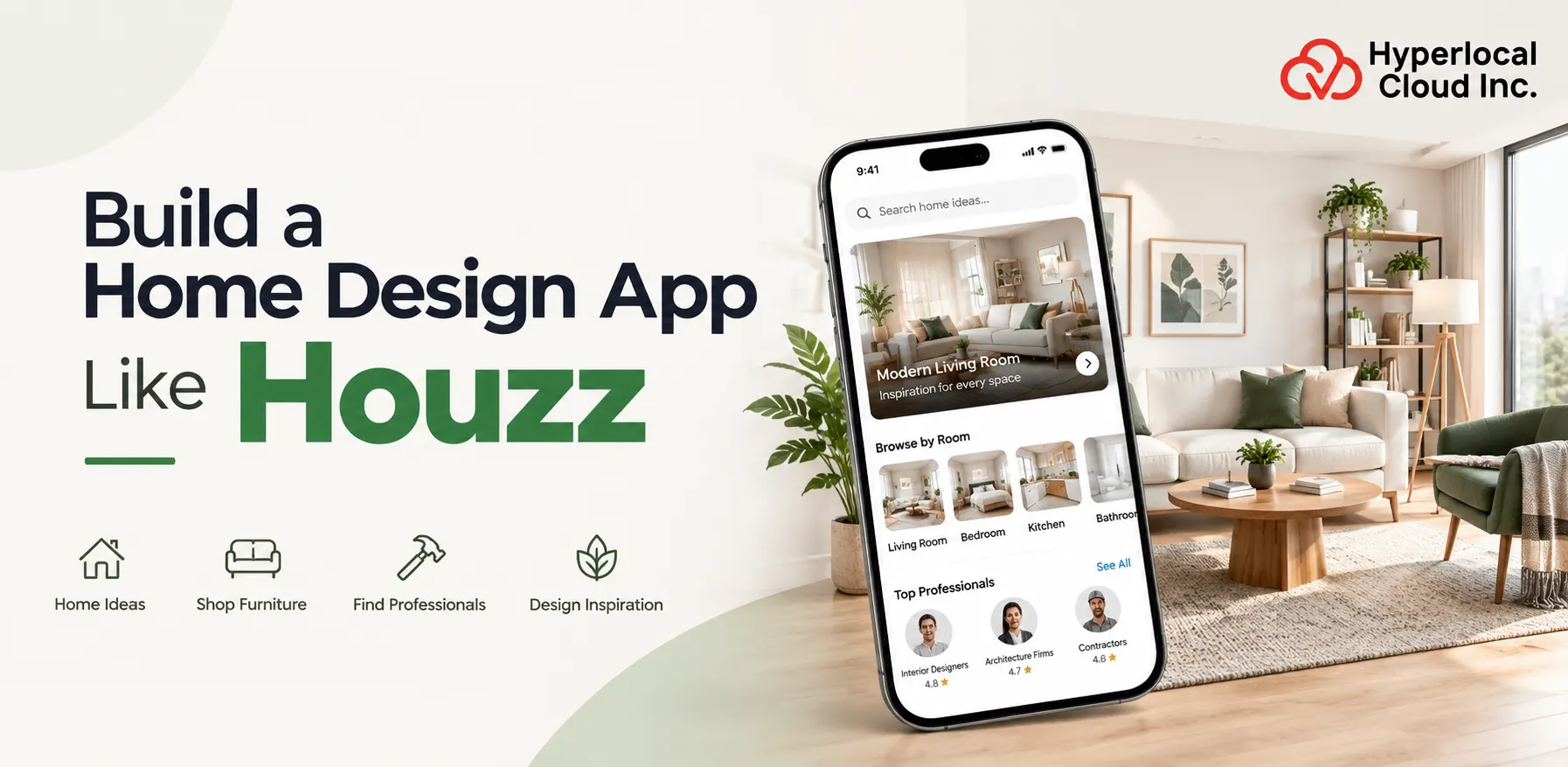
- A Houzz clone app connects homeowners with interior designers, architects, contractors, and furniture sellers.
- Essential features include design galleries, professional directories, saved collections, advanced search, messaging, and reviews.
- AR visualization, 3D room planning, and AI-powered recommendations can enhance the user experience.
- Revenue opportunities include subscriptions, sponsored listings, advertising, lead generation, and product commissions.
- A scalable, customizable platform helps businesses adapt to changing customer needs and expand their home improvement marketplace.
- Hyperlocal Cloud can help businesses build a Houzz-like solution aligned with their brand, features, and business goals.
Launch your own home design and improvement marketplace with a Houzz clone app developed by Hyperlocal Cloud. Create a digital platform where homeowners can discover interior design inspiration, connect with architects and contractors, explore furniture collections, and manage home renovation projects from one place.
Our Houzz clone solution helps entrepreneurs, startups, and established businesses build a customizable platform for the home improvement industry. Incorporate features such as professional directories, design galleries, project portfolios, product listings, consultation booking, and advanced visualization tools to deliver a seamless user experience.
Whether you want to build an interior design marketplace, a home renovation platform, or a furniture discovery application, Hyperlocal Cloud can help you develop a solution aligned with your business requirements.
What Is a Houzz Clone App?
A Houzz clone app is a home design and improvement platform inspired by the core functionality of Houzz. It connects homeowners with interior designers, architects, contractors, furniture retailers, and other home improvement professionals through a centralized digital marketplace.
Users can browse home design photographs, save their favorite ideas, explore professional portfolios, compare services, and contact experts for renovation or interior design projects. Businesses can use the platform to showcase their services, attract potential customers, and manage inquiries.
A Houzz-like platform can also integrate eCommerce capabilities, allowing users to discover and purchase furniture, lighting, decorative accessories, and other home improvement products.
How a Houzz-Like Platform Works
The platform operates through interconnected user experiences:
- Homeowners create accounts and explore design inspiration based on their preferences.
- Professionals publish portfolios, showcase completed projects, and receive customer inquiries.
- Furniture sellers list products, manage catalogs, and process orders where eCommerce functionality is enabled.
- Administrators manage users, listings, content, transactions, and platform performance.
These functions create a connected ecosystem where users can move from discovering design ideas to finding professionals and purchasing relevant products.
Who Can Benefit From a Home Design Marketplace?
A Houzz clone can support several business models and professional communities, including:
- Interior design companies looking to attract online customers.
- Architects and contractors seeking a platform to showcase their projects.
- Furniture retailers wanting to reach homeowners researching design ideas.
- Home renovation businesses looking to generate qualified leads.
- Real estate and property management companies offering complementary home improvement services.
- Entrepreneurs building niche home decor or interior design marketplaces.
Design Inspiration App vs. Full Home Improvement Marketplace
A design inspiration application primarily focuses on visual discovery, photo collections, and saved ideas. A full home improvement marketplace extends these capabilities with professional directories, quote requests, consultation bookings, product catalogs, payments, and project-related communication.
With a customizable Houzz clone, you can select the functionality that fits your target audience and business goals instead of implementing every feature from the beginning.
Create an Online Furniture and Home Decor Marketplace
Why Build an App Like Houzz?
Homeowners increasingly use digital platforms to research renovation ideas, compare products, and discover professionals before starting a project. A well-designed home improvement marketplace can bring these activities together in one convenient location.
Connect Homeowners With Design Professionals
Homeowners often need help finding suitable interior designers, architects, contractors, and renovation specialists. A dedicated platform allows them to explore portfolios, review professional profiles, evaluate customer feedback, and submit inquiries.
For service providers, the marketplace creates an additional channel for building visibility and generating business opportunities.
Create a Digital Marketplace for Furniture and Home Decor
A home design platform can combine inspiration with product discovery. Users who save a living room design, for example, can explore similar furniture, lighting, rugs, and decorative accessories.
This connection between content and commerce creates opportunities for furniture retailers and marketplace operators to convert browsing activity into product purchases.
Improve the Home Renovation Experience
Managing a renovation project often involves communicating with multiple professionals, comparing service options, and keeping track of design preferences. A centralized application can simplify discovery, consultations, and project-related communication.
Depending on the selected functionality, users can submit requirements, request quotes, schedule appointments, and maintain records of their preferred designs.
Build a Scalable Home Improvement Business
A Houzz clone can start with a specific niche, such as interior designers in one city, and expand into additional services, locations, or product categories over time.
A modular architecture makes it easier to introduce new capabilities as the business grows, including advanced search, AI-powered recommendations, additional payment methods, and augmented reality experiences.
Essential Features of a Houzz Clone App
Features determine how effectively your platform serves homeowners, professionals, and administrators. Hyperlocal Cloud can customize the following functionality according to your marketplace model.
User Registration and Personalized Profiles
Provide secure registration and convenient login options so users can create accounts and access relevant platform features.
Homeowners can save design ideas, manage favorite professionals, and track inquiries. Professionals can create business profiles containing their service categories, locations, experience, and contact information.
Profile verification, account recovery, and role-based permissions can help improve account security and platform trust.
Home Design Inspiration and Photo Galleries
Visual discovery is a central component of a Houzz-like experience. Allow professionals and approved contributors to publish high-quality photographs of kitchens, bathrooms, bedrooms, living rooms, gardens, and completed renovation projects.
Organize content by room type, interior design style, color palette, property type, and other relevant categories.
Detailed project descriptions and descriptive image metadata can make galleries easier to navigate while helping search engines understand the content.
Ideabooks and Design Collections
Enable users to save photographs, products, and design concepts into personalized collections.
For example, a homeowner planning a kitchen renovation could create a collection for cabinet designs, lighting ideas, countertop materials, and storage solutions.
Users can organize collections by project, add notes, and share selected ideas with family members or design professionals where supported.
Interior Designer and Contractor Directory
Create searchable professional profiles for interior designers, architects, contractors, landscapers, and renovation specialists.
Each profile can include:
- Business name and professional introduction.
- Service categories and supported locations.
- Project galleries and portfolio descriptions.
- Experience, qualifications, and relevant credentials.
- Customer reviews and ratings.
- Contact options and consultation availability.
Verification workflows can help administrators review professional credentials and reduce misleading listings.
Advanced Search and Filters
Help users find relevant professionals, products, and inspiration without browsing through unrelated listings.
Search and filtering options can include location, service category, design style, project type, product category, availability, and customer ratings.
Location-aware discovery is especially valuable for renovation services because homeowners often need professionals who can work in a particular area.
Reviews, Ratings, and Project Portfolios
Customer feedback helps users evaluate service providers before making contact. Allow eligible customers to submit ratings and reviews based on genuine interactions.
Professionals can showcase completed projects, explain their role in each project, and demonstrate their design expertise.
Moderation tools, reporting options, and review verification can help maintain the quality and credibility of marketplace content.
In-App Messaging and Consultation Booking
Facilitate communication between homeowners and professionals through inquiry forms, messaging, appointment scheduling, and notifications.
Users can describe their requirements, share project references, and request consultations. Professionals can respond to inquiries, confirm appointments, and communicate relevant updates.
Calendar integration and automated reminders can further simplify consultation management.
Furniture and Home Decor Marketplace
An integrated marketplace allows sellers to showcase furniture, lighting, kitchen accessories, wall decor, textiles, and other home improvement products.
Product pages can include images, descriptions, specifications, variants, availability, and delivery information.
Depending on the business model, the platform can support shopping carts, checkout, order management, payment integration, and seller dashboards.
AR Furniture Visualization and 3D Room Planning
Augmented reality and 3D planning tools can help users understand how furniture and design elements might fit into their spaces.
AR functionality can allow users to preview compatible digital furniture models within a supported real-world camera view. A room planner can help them experiment with layouts, dimensions, colors, and selected objects.
These features require suitable device support, compatible 3D assets, and appropriate technical implementation. They can be introduced as advanced capabilities based on the platform’s intended audience.
Payments, Notifications, and Customer Support
Secure payment integration can support product purchases, consultation bookings, subscriptions, and other eligible transactions.
Notifications can inform users about new messages, appointment confirmations, order updates, and responses to inquiries.
Customer support features, dispute-handling workflows, and clear transaction records can help administrators manage marketplace operations more efficiently.
Houzz Clone App Features for Different User Roles
A successful marketplace should provide appropriate functionality for every participant.
Features for Homeowners
Homeowners need an intuitive interface for discovering ideas and finding reliable service providers. Their dashboard can include saved collections, browsing history, favorite professionals, consultation requests, messages, and order information.
Personalized recommendations can help users discover relevant design styles, products, and professionals based on their interests.
Features for Interior Designers and Architects
Professional accounts should support portfolio management, service descriptions, business profiles, inquiry management, and appointment scheduling.
Professionals may also benefit from lead tracking, profile performance insights, customer communication, and subscription management where applicable.
Features for Contractors and Home Improvement Professionals
Contractors can publish their service offerings, display completed projects, specify their service areas, and receive project inquiries.
Additional features may include quote management, availability calendars, customer reviews, and lead notifications.
Features for Furniture Sellers and Suppliers
Seller dashboards can provide product catalog management, inventory updates, order tracking, and sales reporting.
Depending on the marketplace structure, sellers may also manage product variations, delivery details, promotions, and customer inquiries.
Admin Dashboard and Platform Management
Administrators require centralized controls to manage users, professionals, product listings, design content, reviews, and marketplace activity.
Key capabilities can include:
- User and professional account management.
- Listing approval and content moderation.
- Product category and catalog management.
- Subscription and commission configuration.
- Transaction and order monitoring.
- Customer support and dispute management.
- Analytics, reporting, and platform settings.
These controls help maintain marketplace quality while supporting operational growth.
Build Your Own Houzz Clone App Today
Advanced Technologies for Houzz-Like App Development
Advanced technology can improve the discovery experience, increase user engagement, and help differentiate your platform from basic listing applications.
Artificial Intelligence for Personalized Design Recommendations
AI-powered recommendations can help users discover design concepts, furniture, and professionals relevant to their interests.
Depending on the implementation, recommendation systems can analyze user preferences, saved collections, browsing behavior, and selected design categories.
AI-assisted search may also help users find inspiration using descriptive queries, while image-based discovery can identify visually similar products or design concepts when suitable models and data are available.
Augmented Reality for Virtual Furniture Placement
AR enables supported mobile devices to display digital furniture models within a camera view of a physical room.
Users can experiment with furniture placement and assess the appearance of selected items before purchasing. Accurate visualization depends on suitable 3D assets, device capabilities, tracking quality, and product dimensions.
3D Visualization and Room Planning
A 3D room planner can help users create room layouts, arrange furniture, explore color combinations, and visualize interior concepts.
Advanced implementations may support dimensions, object libraries, lighting options, and saved project designs. The scope can range from a simple room layout editor to a more sophisticated visualization environment.
Cloud Infrastructure and Secure APIs
Cloud infrastructure can support image storage, product catalogs, user accounts, messaging, and marketplace transactions.
APIs enable communication between the mobile application, web platform, backend services, payment providers, mapping tools, and other integrations.
Security measures should include appropriate access controls, encrypted data transmission, secure authentication, monitoring, and regular testing.
How to Develop an App Like Houzz
Building a home design marketplace requires a structured process that connects business goals with user needs and technical requirements.
Step 1: Define Your Business Model and Target Audience
Begin by identifying the customers your platform will serve. Decide whether the application will focus on interior design professionals, renovation services, furniture shopping, design inspiration, or a combination of these categories.
Define your geographic scope, target audience, core value proposition, and primary revenue streams before finalizing the feature list.
Step 2: Conduct Market and Competitor Research
Study existing home design platforms to understand their user journeys, discovery features, professional directories, product catalogs, and monetization approaches.
Identify underserved customer needs and opportunities to differentiate your platform. These could include specialized design categories, local professional discovery, streamlined consultations, or better product visualization.
Step 3: Plan Features and User Journeys
Map the key activities users need to complete, from registration and design discovery to contacting professionals or purchasing products.
Prioritize essential features for the initial release and reserve advanced capabilities for later phases if they are not necessary to validate the business model.
Prepare functional requirements, user flows, role permissions, and integration specifications before development begins.
Step 4: Design the UI/UX
Create wireframes and interactive prototypes for the homeowner experience, professional dashboard, seller interface, and admin panel.
Focus on visual clarity, intuitive navigation, high-quality imagery, readable product information, and simple inquiry flows.
Test the proposed design with representative users to identify usability issues before implementation.
Step 5: Develop the Frontend and Backend
Build the user-facing application and backend services according to the approved requirements.
The frontend handles interfaces, search experiences, galleries, profiles, and user interactions. The backend manages business logic, accounts, listings, permissions, inquiries, transactions, and data processing.
Choose a technology stack based on the intended platforms, performance requirements, integration needs, and long-term maintenance plans.
Step 6: Integrate APIs and Third-Party Services
Integrate relevant services for payments, maps, notifications, authentication, analytics, and other required capabilities.
If the platform includes AR, 3D visualization, or AI recommendations, assess the necessary frameworks, data requirements, device compatibility, and infrastructure before implementation.
Every integration should be selected according to actual product requirements rather than added solely for novelty.
Step 7: Test Security, Performance, and Usability
Conduct functional, integration, usability, security, and performance testing before launch.
Verify that search results are relevant, galleries load efficiently, professional inquiries work correctly, and transaction workflows behave as expected.
Test across supported devices and screen sizes, and ensure that administrators can manage listings, accounts, and reports effectively.
Step 8: Launch and Improve the Platform
Deploy the application after completing quality checks and preparing customer support, monitoring, and operational workflows.
Collect user feedback and analyze metrics such as registrations, search activity, inquiry submissions, consultation bookings, and completed purchases.
Use these insights to improve conversion paths, refine recommendations, and prioritize future features.
How Does a Houzz Clone Make Money?
A Houzz-like platform can generate revenue through several complementary business models. The right combination depends on whether the business primarily connects homeowners with professionals, sells products, or offers a broader home improvement marketplace.
Professional Subscription Plans
Offer paid subscription packages to interior designers, architects, contractors, and other professionals who want enhanced visibility or additional business tools.
Depending on the plan, benefits may include expanded portfolios, lead management, profile analytics, and promotional capabilities.
Featured Listings and Sponsored Placements
Allow eligible professionals or sellers to pay for clearly identified promotional placements in relevant search results, category pages, or discovery sections.
Promotional content should remain distinguishable from organic listings to preserve transparency and user trust.
Product Sales Commissions
If the platform supports multiple sellers, it can earn a commission on eligible transactions completed through the marketplace.
Commission rules may vary by product category, seller agreement, fulfillment model, and transaction type.
Advertising Revenue
Relevant brands can promote furniture, home decor, renovation products, and related services through sponsored content or advertising placements.
Advertising should complement the user experience rather than interrupt design discovery.
Lead Generation and Consultation Fees
The platform can charge professionals for qualified leads or offer paid consultation booking functionality.
Lead generation models should clearly define what qualifies as a lead, how inquiries are distributed, and how duplicate or invalid submissions are handled.
Benefits of Launching a Houzz Clone App
A dedicated home design marketplace creates opportunities to bring homeowners, professionals, and product sellers into a single digital ecosystem.
Centralized Home Design and Renovation Services
Users can discover design inspiration, explore products, compare professionals, and initiate renovation inquiries without switching between multiple unrelated platforms.
This connected experience can simplify the research and decision-making process.
Better Professional Discovery and Lead Generation
Professional profiles, location-based search, project galleries, and customer feedback help homeowners identify suitable service providers.
For businesses, the platform creates a structured channel for showcasing expertise and receiving relevant inquiries.
Multiple Revenue Opportunities
Subscriptions, advertising, featured listings, consultation services, and product commissions can support different revenue streams.
Businesses can introduce monetization gradually as marketplace activity and customer demand develop.
Flexible Customization and Business Scalability
A customizable solution allows you to tailor the platform to specific user groups, markets, and operational needs.
You can begin with essential marketplace functionality and introduce additional categories, seller tools, integrations, and visualization features as requirements evolve.
Discuss Your Houzz Clone Project With Our Experts
Challenges in Building a Home Design Marketplace
Understanding potential challenges early helps businesses make better product and operational decisions.
Attracting Homeowners and Qualified Professionals
A marketplace needs both customers and service providers to create meaningful value. Launching in a focused geographic area or design niche can help build an initial community before expanding.
A clear onboarding process, quality portfolios, and targeted customer acquisition strategies can support early growth.
Maintaining High-Quality Design Portfolios
Design discovery depends on useful, accurate, and visually appealing content.
Establish submission guidelines, image quality standards, content moderation procedures, and clear rules for intellectual property and image usage.
Building Trust Through Reviews and Verification
Home improvement projects can involve significant customer commitments. Professional verification, transparent business profiles, authentic reviews, and accessible support processes help users make informed decisions.
Verification should be based on appropriate evidence and clearly communicated criteria.
Managing Product Catalogs and Service Bookings
As the marketplace grows, businesses may need to manage product variations, inventory, seller information, service availability, cancellations, and customer inquiries.
Well-defined workflows, automated notifications, and administrative reporting can help control operational complexity.
Houzz Clone App Development Cost
The cost of developing a Houzz clone app depends on your business model, feature requirements, platform selection, integrations, and customization needs. Whether you want to build a home design marketplace from scratch or launch using a white-label solution, selecting the right development approach is essential.
Custom Houzz Clone App Development Cost ($20,000 to $80,000)
Custom Houzz clone app development involves building a platform around your specific business requirements. This approach is suitable for businesses that need tailored workflows, unique features, specialized integrations, or advanced functionality.
The development scope may include:
- Custom UI/UX design and branding
- Home design inspiration galleries and ideabooks
- Interior designer and contractor directories
- Advanced search and location-based discovery
- Messaging and consultation booking
- Furniture and home decor marketplace
- Payment gateway integrations
- AI-powered recommendations and AR/3D visualization, where required
- Custom admin dashboard and reporting
The overall cost depends on the complexity of these features, the number of supported platforms, and the development effort involved.
White-Label Houzz Clone App Cost
White-label Houzz clone solution: Starting at $6,000
A white-label solution is suitable for businesses that want to launch a home design marketplace using an existing software foundation. It can reduce the need to develop every core component from scratch.
Depending on the selected package, the solution may support:
- Brand customization and platform configuration
- Home design galleries and professional listings
- User registration and profile management
- Search and discovery functionality
- Product listings and marketplace workflows
- Administrative management tools
The exact features, supported platforms, customization limits, and included services should be confirmed with the provider before purchase.
Custom Development vs. White-Label Solution
Custom development is suitable for businesses requiring greater control over product architecture, specialized functionality, and unique workflows.
White-label development is suitable for businesses seeking a faster route to market using an existing solution that can be adapted to their brand and requirements.
Before selecting an option, evaluate the required features, ownership and licensing terms, scalability, integration needs, maintenance arrangements, and future customization options.
Why Choose Hyperlocal Cloud for Houzz Clone Development?
Hyperlocal Cloud can help businesses turn their home design marketplace concept into a customized digital product. The solution can be planned around your preferred business model, target users, functional requirements, and growth strategy.
Customizable Features and Branding
Adapt the platform’s branding, user interfaces, service categories, product catalog, and business workflows to match your requirements.
Choose the capabilities that matter most to your customers rather than relying on a one-size-fits-all marketplace experience.
Scalable Marketplace Architecture
Plan the application architecture to support user accounts, design galleries, professional listings, product catalogs, and integrations.
The final architecture should reflect your expected usage, data requirements, performance targets, and expansion plans.
User-Centric Design and Development
Create separate, purpose-built experiences for homeowners, professionals, sellers, and administrators.
Prioritize simple navigation, effective search, engaging visual discovery, and convenient communication throughout the customer journey.
Ongoing Technical Support
A home design marketplace requires maintenance as user needs, integrations, devices, and business processes evolve.
Plan for updates, bug fixes, performance monitoring, security improvements, and feature enhancements to keep the platform aligned with changing requirements.
FAQs (Frequently Asked Questions)

Nisha Bagga is a technical writer with more than 7 years of experience creating high-quality content for a wide range of industries. She specializes in developing clear, engaging, and well-researched technical and business content tailored to diverse audiences and industry requirements.

Need Help With
Development?