


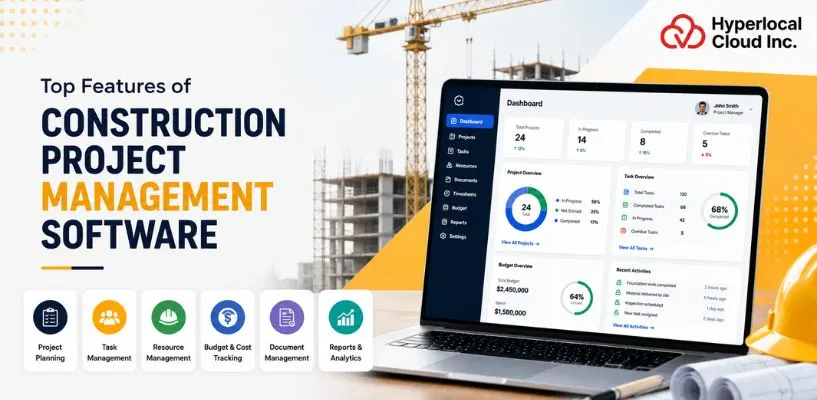
The construction industry has dealt with so many changes over the past years. In simple terms, traditional construction project management relied on paper documents, phone calls, spreadsheets, and manual planning, which became tough to handle for large projects. That’s where the demand for construction project management software grew quickly to improve productivity and reduce manual risks.
The digital automation of construction work will become more convenient for businesses, saving time and reducing paperwork. However, among construction work management, cloud-based solutions gain popularity because they allow project teams to access project data from any location.
Additionally, businesses looking to invest in cutting-edge construction management software can build their own with the help of an experienced provider to automate their workload. This helps them reduce mistakes and successfully deliver construction projects within planned timelines and budgets.
What is Construction Project Management Software?
Construction project management software is a digital solution designed to help construction companies plan, organize, monitor, and manage every stage of a construction project from beginning to end. It brings together various project management activities into a single platform, making it easier for everyone involved to access important information and work together efficiently.
Start Managing Construction Projects Smarter With Advanced ERP Software
Why Construction Companies Need Project Management Software
As the construction industry continues to adopt digital technologies, task management software has become a vital tool for improving productivity, keeping projects on track, and delivering results on time and within budget.
1. Managing Complex Construction Workflows
Many building projects involve specific tasks that must be completed in a precise order. Each undertaking includes planning, design, purchasing, equipment scheduling, inspection, accurate estimation, and final delivery. Because many of these responsibilities are interdependent, even a small delay in one area can affect the entire agenda.
2. Improving Collaboration
Successful construction initiatives rely on strong collaboration between all stakeholders. Project managers, contractors, subcontractors, architects, engineers, suppliers, and clients all need to communicate frequently at some stage in the organization. Misunderstandings can occur when communication is hesitant or delayed, leading to errors, duplicate work, or missed deadlines.
3. Reducing Delays and Cost Overruns
Project delays and cost overruns are some of the most common demanding situations encountered in construction operations. These issues can arise due to poor planning, material shortages, equipment problems, worker shortages, weather conditions, or sudden project changes. Even minor delays can increase worker costs, extend the project timeline, and affect project profitability.
4. Increasing Project Visibility
Construction projects generate huge amounts of data every day. Teams continuously update schedules, complete tasks, order materials, review work, approve documents, and report issues. Without proper visibility, it is difficult for project managers to understand current work and make informed decisions.
5. Ensuring Compliance and Documentation
Construction projects must follow various legal, safety, environmental, and business guidelines. Companies often need to maintain accurate data on permits, contracts, inspections, safety checks, certifications, construction drawings, invoices, and various critical files. Managing that data manually increases the risk of missing records, deadlines, or compliance issues.
Top Features of Construction Project Management Software
The following are some of the most important features that make construction project management software valuable for construction businesses.
1. Project Planning and Scheduling
Creating a project plan is one of the most important aspects of any construction project. Every project requires a detailed schedule that shows when each project will start, how long it will take, and who will be responsible for its completion.
Build construction management software allows construction managers to create detailed project schedules and manage responsibilities in the appropriate order. They can assign work to specific groups, set deadlines, and highlight the progress of all work.
2. Budgeting and Cost Management
Managing the project cost range is critical to maintaining production within budget. The construction project management software helps organizations create corporate budgets, estimate costs, track expenses, and compare planned costs to actual costs.
Project managers can track labor values, costs, equipment charges, subcontractor invoices, and various task-related costs from a single tool.
3. Document Management
Managing these records manually, including construction designs, contracts, permits, drawings, inspection reports, invoices, maintenance records, and project specifications, can be cumbersome and time-consuming.
The construction management software stores all project files in a secure repository where authorized users can upload documents, access documents, make updates, and share files without hassle.
4. Field Resource Management
Construction projects require careful management of workers, subcontractors, equipment, and materials across multiple work sites. Without efficient and usable resource management, teams may idle resources or even increase operating fees.
Construction project management software helps managers post tasks, check employee availability, schedule equipment usage, and allocate resources according to project needs.
5. Real-Time Collaboration
Construction projects involve many different teams working together at some point in the life cycle. Effective communication is critical to ensuring that everyone knows their responsibilities and is kept informed of work updates.
The construction management software provides a centralized platform where company managers, contractors, engineers, architects, suppliers, and customers can talk and share information in real time.
6. Field Service & Mobile Accessibility
Construction projects often involve multiple processes, making it important for relevant groups to access task information, even when on the job site. Many construction management software solutions include mobile applications that allow employees, managers, and project managers to access task information on mobile devices.
Instead, field teams can update task progress, add site photos, submit reports, review documents, and talk to employees on the job site without returning to the office. This improves performance and keeps job data up to date.
7. Time Tracking
Monitoring employee operating hours is essential to avoiding worker shortages and monitoring your company’s productivity. Construction company management software allows employees to report their working hours directly on the device. Managers can evaluate attendance statistics, check overtime, and calculate worker charges more accurately. Accurate time tracking also simplifies payroll processing and provides better visibility into the workforce.
8. Equipment Management
Construction teams rely on different types of machinery and equipment to complete projects. Proper management of smart devices ensures they are available when needed and frequently maintained.
The construction project management software tracks equipment utilization, maintenance schedules, restoration history, and availability. This reduces equipment downtime, extends the life of valuable assets, and keeps projects on schedule.
9. Procurement Management
Construction companies require nonstop purchasing of materials and equipment, as well as quotes from suppliers. Managing purchases manually can lead to delays, incorrect orders, or inventory shortages.
Construction management software empowers companies to manage purchase requisitions, supplier invoices, purchase orders, deliveries, and stock records. This improves procurement efficiency and ensures that materials are in place when needed for project completion.
10. Risk Management
Every construction task contains risks that include safety hazards, expected budget increases, schedule delays, system failures, or regulatory issues. Construction project management software enables project managers to identify capacity risks, address ongoing problems, and minimize their impact on turnaround planning.
By monitoring all project risks through development technology, companies can respond faster and reduce the chances of key business disruptions.
11. Reporting and Analytics
Construction companies need accurate data to make informed business decisions. Construction project management software generates detailed reports on business development, budget, schedule, resource utilization, efficiency, and financial position.
Many systems also provide dashboards that display important business data in a clean, intuitive layout. These reports help project managers compare performance, identify trends, and make improvements where critical.
12. Client Portal
Customers often want general updates on the progress of their production work. The construction task management software could additionally include a client portal that allows customers to view project information without periodic manual updates.
Clients can assess task progress, access files, view project milestones, and communicate with project teams through the portal. This improves transparency and strengthens the relationship between construction groups and their customers.
13. Workflow Automation
Many construction projects have repetitive administrative tasks that include submitting information, requesting approvals, assigning responsibilities, updating project information, and generating reports. Construction project management software automates many of these routine processes, reducing manual work and improving operational efficiency. Automation also reduces human error and allows task managers to focus more on strategic project management.
14. Integration Capabilities
Construction companies typically use a couple of software systems for accounting, payroll, purchasing, custodial inspection, and record keeping. Construction task management software can integrate with these existing packages so data flows easily across systems. This reduces repetitive information input, improves information accuracy, and creates a more efficient workflow for the company.
15. Security and Compliance
Construction activities contain sensitive business records that must be protected from unauthorized access. The construction project management software has protection features that include person access control, encrypted data storage, static access technology, and general machine backup.
Many solutions also help comply with business guidelines by maintaining accurate consultant information, audit trails, and document history. This helps organizations protect critical records while meeting legal and regulatory requirements.
Get a Customized Construction Project Management Platform For Your Business Needs
Benefits of Using Construction Project Management Software
Construction project management software offers many benefits to construction companies of all sizes. By enhancing task scheduling, communication, financial control, and resource coordination, the software allows companies to complete tasks more efficiently while reducing operational challenges.
1. Faster Project Completion
One of the biggest benefits of construction project management software is its ability to help events run smoothly. Because project leaders can quickly detect delays and resolve issues as they arise, initiatives are much more likely to be completed on the planned timeline.
2. Reduced Operational Costs
Construction companies are constantly looking for ways to control prices without affecting project quality. Improved financial visibility allows managers to identify waste, avoid duplicate tasks, and prevent costly delays.
3. Improved Communication
Effective communication is essential for successful work. This reduces communication gaps, strengthens coordination, and ensures that each organization is working with up-to-date project data.
4. Better Resource Utilization
Construction companies manage valuable assets such as people, subcontractors, equipment, materials, and engines. Better support planning reduces idle time, prevents scheduling conflicts, and improves shared task productivity.
5. Higher Customer Satisfaction
Customers expect production companies to complete projects on time, within a certain cost limit, and in line with agreed major requirements. When customers receive regular communication and enjoy easy task completion, they may be much more likely to be satisfied with the offers provided.
6. Increased Profitability
All the improvements delivered through the creation of construction project management software contribute to the overall performance of a powerful enterprise. As efforts become more efficient and operating costs decrease, groups can strengthen their competitive performance in the construction business as well as improve their profit margins.
Core ERP Modules Come Under Construction Project Management Software
An ERP software program consists of various modules that work together to manage several business operations. Companies can choose the modules that their enterprise needs at a high-quality level and ensure that all critical information is stored in a centralized system.
1. Finance & Accounting
The finance and accounting software allows finance teams to manage all cash flows from one place. This module allows companies to create budgets, record payments, create invoices, process payments, and compile financial reports.
2. HR & Payroll
Construction companies often manage a large workforce that includes permanent employees, contract workers, subcontractors, and a field workforce. Tracking employee numbers, attendance, salaries, leave records, and payroll can be time-consuming without HR & Payroll software.
3. Procurement
Construction projects require a continuous supply of materials, equipment, and services. Delays in purchasing or incorrect orders can affect task schedules and increase costs. This organized approach helps ensure materials arrive on time while strengthening supplier control and reducing procurement delays.
4. Inventory Management
Construction companies want accurate records of construction materials, equipment, spare parts, and consumables stored in warehouses or company websites. The inventory management module allows organizations to check inventory areas, sign incoming and outgoing items, and manage inventory at any location.
5. Asset Management
The asset management software allows organizations to report asset records, monitor asset usage, schedule maintenance, and calculate asset depreciation. Proper asset management allows equipment to last longer, reduce maintenance costs, and increase long-term return on investment.
6. CRM
CRM helps construction groups manage relationships with current and potential customers. Building strong customer relationships is critical to keeping new initiatives going and maintaining long-term company success.
7. Project Management
The project management module is one of the most important components of a construction ERP software application. It helps companies plan, prepare, release, and manage production work from start to finish.
8. Equipment Management
The equipment management software monitors equipment availability, running times, maintenance schedules, repair records, fuel consumption, and machinery. This helps companies maximize equipment utilization while minimizing downtime and maintenance costs.
9. Vendor Management
Construction companies work with many suppliers, subcontractors, and service providers during each job. It is important to maintain strong relationships with these companies to ensure timely delivery and excellent service.
10. Compliance Management
The compliance management software helps companies handle installations, licenses, monitoring, certifications, security records, and regulatory documents. It also tracks major compliance closure dates and stores accurate audit data.
Planning a Construction ERP? Talk to Our Experts Today
Industries That Benefit From the Project Management Software for Construction
Construction ERP software is designed to help different types of construction businesses. The following industries can benefit significantly from ERP software applications in construction.
1. Residential Construction
Residential construction companies build homes, dwellings, housing groups, and residential complexes. These tasks require careful planning, cost range control, coordination of contractors, and quality inspection.
2. Commercial Construction
Commercial construction projects include office buildings, retail facilities, hotels, hospitals, educational institutions, and retail space. These efforts typically involve large budgets, long timelines, and the involvement of more than one contractor.
3. Infrastructure Projects
Infrastructure initiatives include roads, highways, bridges, railways, airports, ports, water supply systems, and public utility networks. These efforts are usually large and involve several construction companies, contractors, and engineering teams.
4. Civil Engineering
Civil engineering groups are responsible for the design, planning, and construction of many public and private infrastructure projects. These tasks require careful technical planning, engineering documentation, mindful control, and project oversight.
5. Industrial Construction
Industrial construction includes building factories, construction projects, warehouses, equipment, and large industrial complexes. These efforts usually require specialized equipment, rigorous safety technology, and precise task coordination.
6. Government Projects
Government procurement efforts typically involve strict policies, specific documents, public commitments, and multiple approval processes. These works may include colleges, hospitals, transportation systems, government buildings, and public infrastructure.
How to Choose the Right Construction Project Management Software?
The following factors should be considered when choosing a construction project management software program.
1. Business Size
The size of your construction operation is one of the first factors you should consider when deciding on a task management software program. Small construction companies often have different needs than large companies, which have several tasks at the same time.
2. Budget
Budget is another important consideration when deciding on construction project management software. Every organization has unique funding sources, so it’s important to choose software that delivers the desired value without exceeding the available budget.
3. Required Features
Every construction system has precise task management needs. Before choosing a software program, companies should consider the features that may be most essential to their day-to-day functioning. It’s also helpful to choose software that offers additional features to support future business growth.
4. Scalability
Construction companies typically grow over time by taking on large jobs, hiring more employees, moving to new jobs, or relocating to new locations. Choosing scalable software protects long-term investments and reduces the need for redundant software applications as the firm’s needs evolve.
5. Ease of Use
Even the most advanced software may not produce top results if employees have difficulty using it. Construction project management software should have a simple and organized interface that allows users to quickly access data and perform daily tasks without unnecessary complexity.
6. Integration Options
Construction companies typically use separate software for accounting, payroll, inventory management, CRM, and document management. Construction management software shall be seamlessly integrated with existing systems to automatically send information to specific departments.
7. Vendor Support
Reliable vendor support is essential to the successful implementation and long-term use of construction task management software. Furthermore, even beautifully designed software applications may occasionally require technical support, software updates, user training, or troubleshooting.
Future Trends that Transform the Construction Project Management Software
Technology is transforming the construction industry, and construction project management software has been developed to aid those changes. Modern software systems have become smarter, more interconnected, and fact-driven, allowing construction companies to improve work planning, reduce risk, and improve operational performance.
1. Artificial Intelligence
Artificial intelligence currently plays an important role in construction applications. AI can examine large amounts of company information much faster than manual methods and provide valuable insights that help project managers make better decisions.
2. Predictive Analytics
Predictive analytics uses historical construction data combined with current project records to estimate future outcomes. This allows project managers to take preventive action early, helping to reduce project risk and enhance the overall performance of the joint enterprise.
3. IoT Integration
The internet connects physical devices with a network, allowing you to collect and share your own data. In the construction industry, IoT devices can monitor overall equipment performance, worker protection, environmental conditions, material usage, and energy consumption.
4. Drone Integration
Drones are increasingly common on construction sites as they can quickly capture aerial photos, videos, and topographies. Construction task management software can integrate drone information to show construction progress, track construction sites and level terrain, and compare actual site conditions with project plans.
5. BIM Integration
Building Information Modeling (BIM) is transforming how construction initiatives are designed, planned, and managed. BIM creates specific virtual models that contain important data about building structures, materials, systems, and work specifications.
6. Cloud-Native Platforms
Cloud-native construction project management software continues to gain recognition as it allows customers to access task information from virtually anywhere with an internet connection. Cloud-based systems offer automatic software updates, secure data storage, less complex collaboration, and widespread online collaboration without the need for complex infrastructure.
7. Digital Twins
The digital twin generation combines design records with real-time operational data to create a virtual representation of the physical design task. As construction progresses, digital twins continuously reflect the current state of operations, allowing managers to assess overall performance, identify bottlenecks, and monitor incidents before making necessary decisions.
Partner With Experienced Developers to Create Your Ideal Construction Management Platform
Conclusion
Investing in project management software for construction enables businesses to streamline project planning, improve team collaboration, monitor budgets, and ensure timely project delivery. For businesses seeking a tailored solution, white label construction project management software offers the flexibility to build a branded platform with features that align with unique business requirements. Likewise, partnering with experts in construction ERP software development helps integrate project management, finance, procurement, and workforce management into a single, scalable ecosystem.

Patt Cummins is an experienced content writer with over 10 years of experience creating clear and engaging content for technology-focused industries. He specializes in simplifying complex technical topics into easy-to-understand stories that educate readers, support brand communication, and help businesses effectively share their solutions.

Need Help With
Development?