- Research your target audience before starting development.
- Prioritize real-time voice communication and user experience.
- Include secure registration, messaging, and audio rooms.
- Integrate virtual gifting and wallet functionality for monetization.
- Use AI to improve matching and moderation.
- Choose scalable backend and cloud infrastructure.
- Consider white label development for faster market entry.
- Prioritize privacy, security, and community safety.
- Start with an MVP and expand features as your platform grows.
The growing popularity of social networking platforms has created new opportunities for businesses to develop applications that bring people together through real-time communication. Voice-based social networking apps are becoming an interesting alternative to traditional text-based platforms, allowing users to connect, interact, share experiences, and build digital communities through audio conversations.
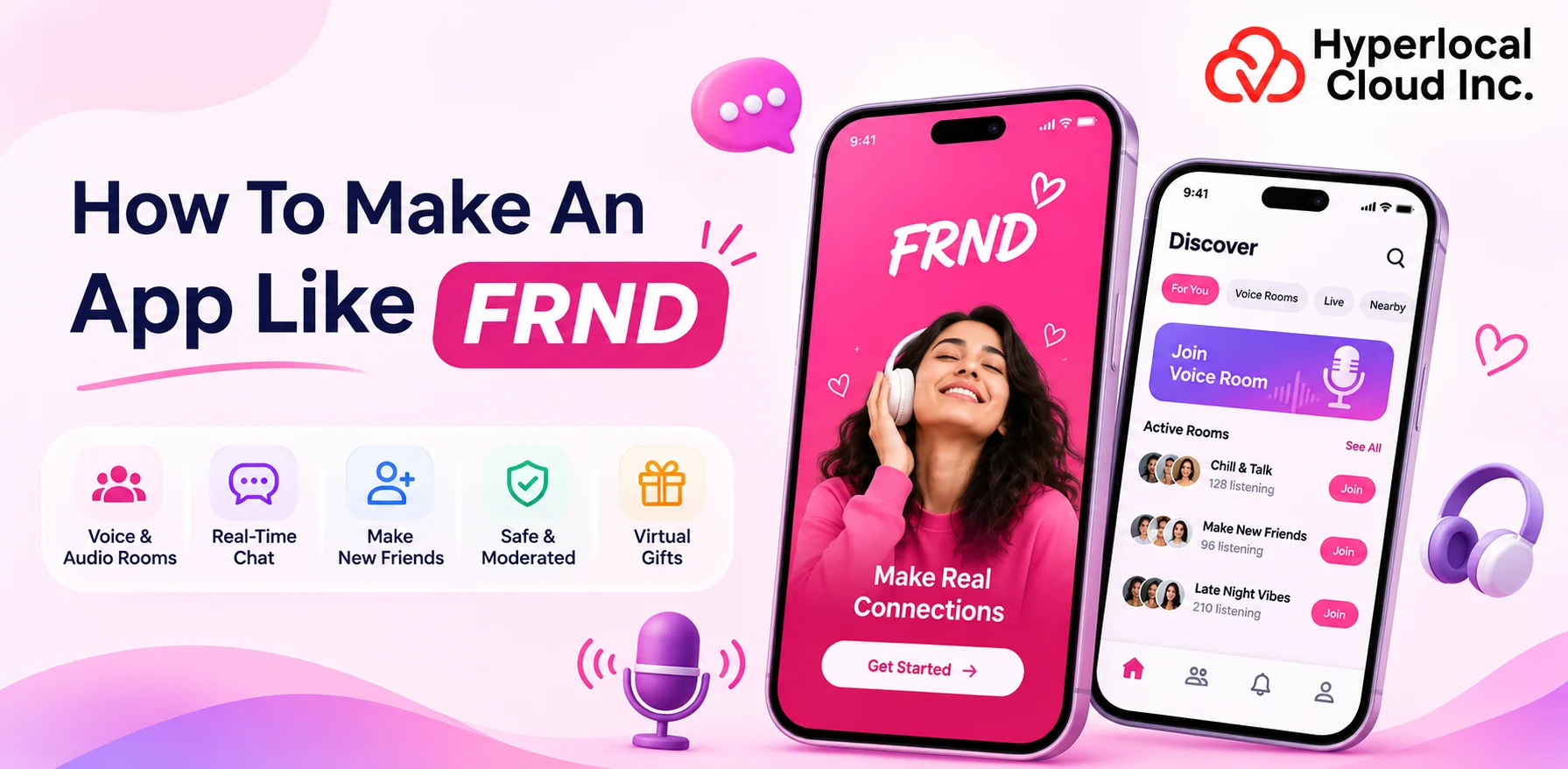
FRND is an example of this emerging category. It offers a social environment where users can discover people, participate in conversations, and enjoy interactive experiences.
If you are planning to enter this market, developing an app like FRND can be a promising business opportunity. However, building a successful platform requires more than integrating voice-calling functionality. You need a scalable backend, engaging social features, secure communication, intelligent matching, and effective monetization strategies.
In this guide, we will explain how to make an app like FRND, including its essential features, development process, technology stack, architecture, monetization opportunities, and estimated development costs.
What Is the FRND App and How Does It Work?
FRND is a voice-led social discovery platform designed to help people connect and interact through digital conversations. Instead of focusing exclusively on text-based communication, the platform emphasizes voice interactions and social entertainment.
Users can discover new people, participate in conversations, and enjoy interactive social experiences. Such applications create opportunities for individuals to communicate, develop friendships, and become part of online communities.
How Does the FRND App Work?
A typical FRND-like application operates through the following process:
1. User Registration: Users create accounts using their mobile numbers or supported authentication methods.
2. Profile Creation: Users add profile information, interests, preferences, and profile pictures to personalize their experience.
3. User Discovery: The platform recommends potential connections based on preferences, interests, language, and activity.
4. Voice Conversations: Users connect through one-to-one audio calls or participate in group voice interactions.
5. Social Engagement: Users interact with other members through messaging, audio rooms, reactions, and virtual gifts.
6. Rewards and Monetization: The application can offer virtual currencies, premium subscriptions, and paid interactive experiences.
7. Notifications: Users receive alerts about messages, invitations, new activities, and relevant social interactions.
The exact functionality varies by platform and version, so a new application should use FRND as a reference rather than copying its proprietary features or interface.
Build Your Own Social Audio App and Connect Millions of Users
Why Invest in Developing an App Like FRND?
Voice-based social networking offers businesses an opportunity to build communities around real-time human interaction. With users looking for more engaging ways to communicate online, entrepreneurs can explore this market with a well-planned product strategy.
Here are some important reasons to invest in FRND-like app development.
Growing Demand for Voice-Based Social Platforms
Voice communication creates a more personal experience than conventional text messaging. Users can express emotions, share stories, and build connections through conversations.
Businesses can capitalize on this demand by introducing applications that make voice interactions accessible and convenient.
Increasing Popularity of Digital Communities
People increasingly participate in online communities centered around entertainment, hobbies, languages, and shared interests.
A voice-based social networking platform can bring these communities together through dedicated audio rooms, group discussions, and interactive events.
Opportunities for Regional-Language Engagement
Language-based communities can help platforms attract users who prefer communicating in their native languages.
Businesses can introduce multilingual interfaces, regional audio rooms, and language-based user recommendations to reach different audiences.
Multiple Monetization Opportunities
Unlike applications that depend entirely on advertising, social audio platforms can introduce different revenue streams, including virtual gifts, premium memberships, subscriptions, and paid experiences.
Potential to Reach a Global Audience
A scalable social networking application can support users from different countries through multilingual communication, location-based discovery, and international payment integrations.
Essential Features of an App Like FRND
Features are among the most important factors influencing the success of a social networking application. A well-developed FRND-like platform should provide a smooth user experience, reliable communication, and engaging social interactions.
Here are the essential features to consider.
1. User Registration and Login
Registration allows users to create accounts and access the application securely. Provide multiple login options to simplify onboarding.
Key functionalities:
-
Mobile number and OTP verification.
-
Email-based registration.
-
Social media login integration.
-
Secure authentication.
-
Password recovery.
-
Account verification.
2. User Profile Management
Profile management allows users to create personalized identities and share information with other community members.
Key functionalities:
-
Profile picture uploads.
-
Username and personal introduction.
-
Age and language preferences.
-
Interest selection.
-
Profile editing.
-
Account visibility settings.
3. Voice Chat Rooms
Voice chat rooms allow multiple users to participate in real-time audio conversations. Users can join discussions based on their interests, preferences, and available communities.
Key functionalities:
-
Public and private audio rooms.
-
Multiple speaker permissions.
-
Listener participation.
-
Room invitations.
-
Mute and unmute controls.
-
Room moderators.
-
Live participant counts.
4. One-to-One Voice Calling
One-to-one voice calling enables users to have private conversations with other members.
Key functionalities:
-
Real-time audio calls.
-
Incoming and outgoing call notifications.
-
Accept and reject options.
-
Call duration tracking.
-
Mute functionality.
-
Call history.
-
Block and report options.
5. Group Audio Conversations
Group audio conversations allow multiple participants to communicate simultaneously. This feature is useful for social discussions, entertainment, and interest-based communities.
Key functionalities:
-
Multi-user audio sessions.
-
Speaker and listener roles.
-
Group invitations.
-
Live reactions.
-
Participant management.
-
Conversation controls.
6. Random User Matching
Random matching helps users discover new people based on selected preferences and availability.
Key functionalities:
-
Random user discovery.
-
Interest-based matching.
-
Language preferences.
-
Gender preferences where legally appropriate.
-
Online availability indicators.
-
Matching recommendations.
7. Real-Time Messaging
Messaging allows users to communicate outside voice conversations and maintain social connections.
Key functionalities:
-
Individual messaging.
-
Text messages.
-
Emoji and stickers.
-
Image sharing.
-
Message notifications.
-
Read receipts.
-
Chat history.
8. Audio Gifts and Virtual Rewards
Virtual gifting creates interactive experiences while providing monetization opportunities.
Key functionalities:
-
Digital gifts and animations.
-
Virtual coin purchases.
-
Gift-sending functionality.
-
Gift-receiving notifications.
-
Creator reward tracking.
-
Transaction history.
9. In-App Wallet
An integrated wallet allows users to manage virtual currencies and make purchases within the application.
Key functionalities:
-
Wallet balance.
-
Coin purchases.
-
Transaction history.
-
Gift payments.
-
Refund management.
-
Secure payment processing.
10. Coins and Reward System
A coin-based reward system encourages users to participate in conversations and engage with the platform.
Key functionalities:
-
Virtual coin packages.
-
Promotional rewards.
-
Daily login rewards.
-
Referral bonuses.
-
Reward redemption rules.
-
Coin balance management.
11. User Discovery
User discovery helps members find people with similar interests, languages, and preferences.
Key functionalities:
-
Search filters.
-
Interest-based recommendations.
-
Language selection.
-
Profile suggestions.
-
Recently active users.
-
Suggested communities.
12. Follow and Friend Requests
Social connection features allow users to build their networks and maintain relationships.
Key functionalities:
-
Follow and unfollow users.
-
Send and receive friend requests.
-
Accept and reject requests.
-
Followers and following lists.
-
Connection notifications.
13. Push Notifications
Push notifications keep users informed about important activities and encourage continued engagement.
Key functionalities:
-
New message alerts.
-
Incoming call notifications.
-
Audio room invitations.
-
Gift notifications.
-
Friend requests.
-
Promotional updates.
14. Audio Moderation
Moderation tools help administrators maintain a safe and respectful communication environment.
Key functionalities:
-
Report inappropriate conversations.
-
Mute disruptive participants.
-
Remove users from audio rooms.
-
Temporary account restrictions.
-
Moderator controls.
-
Abuse detection mechanisms.
15. Reporting and Blocking
Reporting and blocking features give users control over their interactions and help prevent harassment.
Key functionalities:
-
Report suspicious profiles.
-
Block unwanted users.
-
Report inappropriate messages.
-
Report abusive behavior.
-
Review submitted complaints.
-
Manage blocked accounts.
16. Admin Dashboard
An admin dashboard provides centralized control over users, transactions, content, and application activities.
Key functionalities:
-
User management.
-
Audio room management.
-
Payment monitoring.
-
Coin and gift management.
-
Reports and complaints.
-
Content moderation.
-
Revenue analytics.
-
Platform configuration.
Advanced Features to Make Your FRND-Like App Stand Out
After developing the essential functionality, businesses can introduce advanced features to improve personalization, engagement, and platform performance.
1. AI-Based User Recommendations
AI-based recommendation systems analyze user interests, interaction history, and preferences to suggest relevant profiles and communities.
2. AI-Powered Content Moderation
AI moderation can identify suspicious behavior, inappropriate language, and potentially harmful interactions. Automated systems should be combined with human moderation for better decision-making.
3. Real-Time Language Translation
Real-time translation can help users communicate with people who speak different languages.
4. Personalized Voice Room Suggestions
The application can recommend audio rooms according to user interests, previous participation, and preferred topics.
5. Smart Matching Algorithms
Intelligent matching can consider shared interests, language preferences, availability, and user-selected filters to improve connection relevance.
6. Live Audio Events
Businesses can introduce live discussions, interactive sessions, community events, and entertainment programs to increase engagement.
7. Gamification and Leaderboards
Gamification encourages participation through achievements, activity points, rankings, badges, and rewards.
8. Advanced Analytics
Analytics tools help administrators understand user behavior, retention, engagement, revenue, and application performance.
9. Subscription-Based Premium Access
Premium subscriptions can provide additional functionality, personalized experiences, exclusive rooms, and other paid benefits.
Turn Your Social Networking Idea Into a Successful Business
How to Make an App Like FRND: Step-by-Step Development Process
Developing a social audio application requires a structured approach that covers business planning, design, engineering, integration, testing, and deployment. Following a systematic development process helps businesses reduce technical risks and build a platform that can support future growth.
Here are the major steps involved in developing an app like FRND.
Step 1: Conduct Market Research and Competitor Analysis
Start by researching the social networking and voice-chat application market. Understand what users expect from voice-based platforms and identify opportunities to differentiate your application.
Analyze existing platforms, their user experiences, engagement features, monetization models, and technical capabilities.
Key activities:
-
Research competing social audio platforms.
-
Identify customer pain points.
-
Analyze popular communication features.
-
Study competitor monetization strategies.
-
Identify market gaps and opportunities.
Step 2: Identify Your Target Audience
Defining your target audience helps you develop features that match users’ communication preferences and expectations.
You can target different user segments depending on your business objectives.
Potential audiences:
-
Young adults interested in social discovery.
-
People looking to make new friends.
-
Regional-language communities.
-
Entertainment enthusiasts.
-
Online discussion groups.
-
Content creators and social influencers.
Step 3: Define App Requirements and Business Model
Once you understand your target audience, prepare a detailed project requirement document. This document should explain the application functionality, user roles, development priorities, and revenue model.
Key activities:
-
Define essential and advanced features.
-
Identify user and administrator roles.
-
Prepare application workflows.
-
Select monetization strategies.
-
Determine platform compatibility.
-
Establish project milestones.
Start with a minimum viable product (MVP) containing registration, profiles, voice calls, audio rooms, messaging, and basic administration. Advanced functionality can be introduced in subsequent releases.
Step 4: Select the Right Technology Stack
Technology selection determines how efficiently your application performs and scales as its user base grows.
Choose technologies according to your requirements for real-time communication, backend processing, database management, security, and cloud infrastructure.
Key activities:
-
Select frontend frameworks.
-
Choose backend technologies.
-
Identify suitable databases.
-
Evaluate audio communication SDKs.
-
Select cloud infrastructure.
-
Plan third-party integrations.
Step 5: Create UI/UX Designs
An intuitive interface is essential for social networking applications because users frequently interact with profiles, audio rooms, calls, and messages.
Design the application with simple navigation and a consistent visual experience.
Key activities:
-
Prepare wireframes.
-
Design user journeys.
-
Create interactive prototypes.
-
Develop an application design system.
-
Design audio room interfaces.
-
Optimize onboarding experiences.
Step 6: Develop the Frontend and Backend
Frontend development focuses on the application’s user-facing elements, while backend development handles data processing, authentication, communication, and business logic.
Both components must work together to deliver a seamless experience.
Key activities:
-
Develop Android and iOS applications.
-
Build authentication functionality.
-
Integrate user profile management.
-
Develop messaging functionality.
-
Create backend APIs.
-
Configure database connections.
-
Implement administrator controls.
Step 7: Integrate Real-Time Audio and Chat Features
Real-time communication is the foundation of a FRND-like platform. Your application should support reliable voice conversations with minimal latency and stable connections.
Key activities:
-
Integrate WebRTC or an audio communication SDK.
-
Configure voice calling.
-
Develop group audio rooms.
-
Implement speaker and listener permissions.
-
Integrate real-time messaging.
-
Configure call notifications.
-
Optimize audio quality.
Step 8: Implement Payment and Wallet Systems
If your application includes virtual gifts, subscriptions, and coin purchases, integrate a secure payment system.
Key activities:
-
Integrate payment gateways.
-
Develop virtual wallet functionality.
-
Configure coin packages.
-
Implement gift transactions.
-
Create payment history.
-
Manage refunds and disputes.
-
Add transaction verification.
Step 9: Test App Performance and Security
Before launching the application, conduct comprehensive testing to ensure that all features work correctly.
Key activities:
-
Functional testing.
-
UI/UX testing.
-
Audio quality testing.
-
Load and stress testing.
-
Payment testing.
-
Security testing.
-
Device compatibility testing.
-
Bug identification and resolution.
Step 10: Launch and Maintain the Application
Once testing is complete, publish the application on the relevant app marketplaces and prepare the backend infrastructure for production.
Development does not end with launch. Continuous monitoring and maintenance are necessary to improve performance and introduce new functionality.
Key activities:
-
Deploy backend services.
-
Publish Android and iOS applications.
-
Monitor application performance.
-
Track user engagement.
-
Fix technical issues.
-
Release feature updates.
-
Optimize cloud infrastructure.
Technology Stack Required to Develop an App Like FRND
Selecting the right technology stack is important for building a scalable, secure, and high-performing social audio application.
A FRND-like platform requires technologies that support real-time communication, user management, database operations, payment processing, and cloud-based infrastructure.
Here is a recommended technology stack.
Frontend Development Technologies
Frontend technologies are responsible for building the application’s user interface and delivering a consistent experience across devices.
-
Flutter: Suitable for developing cross-platform applications using a shared codebase.
-
React Native: Useful for building Android and iOS applications with JavaScript and React.
-
Kotlin: Suitable for native Android application development.
-
Swift: Used for native iOS application development.
Backend Development Technologies
Backend technologies manage application logic, user authentication, APIs, transactions, and communication between different components.
-
Node.js: Suitable for real-time applications and API development.
-
Python: Useful for AI integrations, recommendation systems, and backend services.
-
Java: Supports enterprise-level application development and scalable backend systems.
-
Go: Useful for high-performance backend services.
Database Technologies
A reliable database helps manage user information, chat records, transactions, profiles, and application activities.
-
PostgreSQL: Suitable for structured user and transaction data.
-
MongoDB: Useful for flexible application data.
-
Redis: Supports caching, presence management, and real-time session data.
-
Firebase: Offers managed database and application development services.
Real-Time Communication Technologies
Real-time communication technology is one of the most important components of a social audio application.
-
WebRTC: Enables real-time audio and video communication.
-
Agora: Provides real-time communication SDKs.
-
Twilio: Offers programmable communication services.
-
LiveKit: Supports real-time audio and video infrastructure.
Cloud Infrastructure
Cloud infrastructure provides the computing resources required to operate and scale the application.
-
Amazon Web Services (AWS): Provides cloud computing, storage, networking, and monitoring services.
-
Google Cloud Platform: Supports scalable infrastructure and data processing.
-
Microsoft Azure: Offers cloud hosting, security, and application management services.
Payment Integration Technologies
Payment gateways help users purchase virtual coins, subscriptions, and premium services.
-
Razorpay: Supports payment processing for eligible Indian businesses.
-
Stripe: Provides payment infrastructure in supported markets.
-
PayPal: Supports international payment services in eligible countries.
Payment integrations must follow applicable app-store billing policies and local regulations.
AI and Machine Learning Technologies
AI and machine learning can improve user discovery, personalization, and moderation.
-
Python: Supports AI model development.
-
TensorFlow: Used for machine learning applications.
-
PyTorch: Supports advanced machine learning development.
-
Natural Language Processing: Helps analyze text and detect potentially inappropriate language.
Launch Your Own Audio Chat Platform With a Scalable Solution
How Does the FRND-Like App Architecture Work?
A well-planned application architecture ensures that different components communicate efficiently and support increasing user demand.
A FRND-like application can follow a modular architecture consisting of frontend applications, backend services, real-time communication infrastructure, databases, and external integrations.
1. Mobile Application Layer
This is the user-facing layer where users register, manage profiles, discover people, join audio rooms, and interact with other members.
2. API Gateway Layer
The API gateway connects mobile applications with backend services. It manages incoming requests, authentication checks, routing, and request validation.
3. Backend Services Layer
The backend handles the core business functionality of the platform.
It can include:
-
User management services.
-
Authentication services.
-
Matching and recommendation services.
-
Chat and messaging services.
-
Audio room management.
-
Wallet and payment services.
-
Notification services.
-
Moderation services.
4. Real-Time Communication Layer
This layer manages voice communication between participants through WebRTC or a specialized real-time communication provider.
It handles audio sessions, participant connections, media routing, and call management.
5. Database and Storage Layer
The database layer stores user profiles, application records, transactions, chat information, and other relevant data.
Cloud storage can be used for profile images, media files, and other uploaded content.
6. Payment Processing Layer
This layer connects the application with payment providers to process purchases, subscriptions, refunds, and virtual currency transactions.
7. AI Moderation and Analytics Layer
AI-based services can analyze platform activity, support content moderation, and generate personalized recommendations.
Analytics tools help businesses monitor user engagement, retention, transactions, and platform performance.
Monetization Strategies for an App Like FRND
A strong monetization strategy helps businesses generate revenue while maintaining an engaging user experience.
Instead of relying on one revenue source, you can introduce multiple monetization models based on your platform’s audience and functionality.
1. In-App Purchases
Users can purchase virtual coins, premium stickers, digital gifts, and other interactive items through the application.
The platform generates revenue from these purchases.
2. Virtual Gifts and Coins
Virtual gifting allows users to send digital gifts to other participants during voice conversations or social interactions.
Businesses can sell coin packages and establish transparent creator reward and redemption policies.
3. Premium Memberships
Offer paid memberships with additional features and exclusive benefits.
Premium membership options may include advanced discovery filters, exclusive communities, profile customization, and an enhanced experience.
4. Subscription Plans
Introduce monthly, quarterly, or annual subscription packages.
Different subscription tiers can provide varying levels of access depending on the business model.
5. Paid Audio Rooms
Businesses can allow hosts to organize exclusive audio sessions and charge users for joining selected events.
This model can be useful for expert discussions, entertainment sessions, and private communities.
6. Creator Monetization
Creators can earn rewards through eligible platform activities, virtual gifts, and paid community events.
The platform can generate revenue through a clearly disclosed commission structure.
7. Brand Partnerships and Promotions
Collaborate with relevant brands to introduce sponsored audio events, promotional campaigns, and community activities.
This creates another revenue opportunity while offering brands access to relevant audiences.
8. Commission-Based Revenue
The platform can charge a defined commission on eligible transactions, such as paid sessions, virtual gifts, and creator earnings.
Ensure that commission structures, payout policies, and applicable taxes are clearly communicated.
How Much Does It Cost to Develop an App Like FRND?
The cost of developing an app like FRND depends on application complexity, features, technology selection, development team, third-party integrations, and customization requirements.
A basic social audio application requires less investment than an advanced platform featuring AI-powered recommendations, real-time group communication, virtual gifting, and complex monetization systems.
Estimated FRND-Like App Development Cost
| App Development Type | Estimated Cost |
|---|---|
| Basic App | $10,000–$20,000 |
| Mid-Level App | $20,000–$45,000 |
| Advanced App | $45,000–$90,000+ |
These are indicative planning estimates, not vendor quotations. Actual costs depend on scope, location, integrations, and development approach.
Cost Breakdown by Development Component
1. UI/UX Design
The design process includes wireframes, prototypes, navigation, screen layouts, and user experience optimization.
2. Frontend Development
Frontend development involves creating Android and iOS applications with registration, profiles, messaging, audio rooms, and other user-facing functionality.
3. Backend Development
Backend development includes APIs, database management, authentication, user matching, notifications, and administrative functionality.
4. Real-Time Audio Integration
Voice communication requires audio SDK integration, server infrastructure, media routing, and performance optimization.
5. Payment and Wallet Integration
Payment functionality involves gateway integration, virtual currency management, transaction processing, and payment security.
6. Testing and Quality Assurance
Testing ensures that the application performs reliably across different devices, operating systems, network conditions, and user loads.
Factors Affecting FRND-Like App Development Costs
-
Number of features and application complexity.
-
Android and iOS platform requirements.
-
Custom UI/UX design requirements.
-
Real-time audio infrastructure.
-
AI and machine learning integrations.
-
Third-party API subscriptions.
-
Cloud hosting and storage.
-
Security and compliance requirements.
-
Development team experience.
-
Ongoing maintenance and updates.
Businesses should also budget separately for recurring expenses such as cloud hosting, audio communication usage, payment processing, moderation, and customer support.
Transform Your Business Idea Into a Voice Chat Application
White Label FRND-Like App vs. Custom App Development
Businesses planning to launch a social audio application generally have two development approaches: white label development and custom app development.
Both approaches offer different advantages depending on investment, customization requirements, launch timelines, and long-term business goals.
What Is a White Label FRND-Like App?
A white label FRND-like app is a pre-built social audio application that businesses can customize with their own branding, design elements, and selected functionality.
It allows entrepreneurs to enter the market without developing every application component from scratch.
Key advantages:
-
Faster market launch.
-
Lower initial development investment.
-
Pre-built core functionality.
-
Branding and design customization.
-
Reduced development complexity.
-
Quicker MVP deployment.
Best suited for: Startups, entrepreneurs, and businesses looking to validate their social audio business idea with a relatively quick launch.
What Is Custom FRND-Like App Development?
Custom app development involves building an application from the ground up according to specific business requirements.
It offers greater control over application functionality, architecture, integrations, user experience, and future scalability.
Key advantages:
-
Complete customization flexibility.
-
Unique application functionality.
-
Custom user experience.
-
Greater architectural control.
-
Advanced AI integrations.
-
Business-specific monetization.
-
Flexible third-party integrations.
Best suited for: Established businesses, funded startups, and entrepreneurs planning to build a differentiated social networking platform.
Which Development Approach Should You Choose?
Choose a white label solution if your priority is launching quickly, controlling initial investment, and testing market demand.
Choose custom development if you need specialized features, complete control over the architecture, and a differentiated product experience.
Before selecting a white label solution, evaluate source-code ownership, customization rights, infrastructure control, scalability, security, and ongoing support.
Challenges in Developing a Voice-Based Social Networking App
Building a social audio platform involves several technical and operational challenges. Businesses need to address these challenges during development to deliver a reliable and engaging user experience.
1. Managing Real-Time Audio Communication
Audio communication requires low latency, stable connectivity, and consistent sound quality.
Solution: Use reliable communication infrastructure, optimized media routing, adaptive network handling, and appropriate audio codecs.
2. Maintaining Low-Latency Voice Calls
High latency can interrupt conversations and create an uncomfortable communication experience.
Solution: Use geographically distributed infrastructure, optimized audio processing, and efficient real-time communication protocols.
3. Preventing Fake Profiles
Fake accounts and fraudulent users can reduce platform trust and negatively affect the user experience.
Solution: Implement OTP verification, account monitoring, suspicious activity detection, and additional verification where appropriate.
4. Handling Inappropriate User Behavior
Social networking platforms can experience harassment, spam, impersonation, and inappropriate conversations.
Solution: Introduce reporting, blocking, moderation controls, automated detection, and trained human moderation teams.
5. Managing High User Traffic
As the application grows, increasing users and simultaneous audio sessions can put pressure on backend infrastructure.
Solution: Use scalable cloud infrastructure, load balancing, caching, monitoring, and distributed services.
6. Ensuring Uninterrupted Audio Streaming
Poor network connectivity can affect voice quality and disconnect users from conversations.
Solution: Implement network quality monitoring, adaptive bitrate controls where supported, reconnection mechanisms, and efficient media delivery.
7. Building User Trust and Engagement
Users are more likely to remain active when they feel safe and enjoy meaningful interactions.
Solution: Provide transparent community guidelines, privacy controls, effective moderation, and relevant user recommendations.
Security and Privacy Considerations for a FRND-Like App
Security and privacy are essential for any application that handles personal information and private conversations.
A FRND-like platform should implement security measures throughout its development and operational lifecycle.
1. Secure User Authentication
Implement secure login methods, OTP verification, session management, and protection against unauthorized account access.
2. End-to-End Encryption Where Appropriate
Use appropriate encryption for private communications. Where end-to-end encryption is offered, design it carefully alongside reporting, moderation, and safety requirements.
3. Voice and Identity Verification
Introduce suitable verification mechanisms to reduce impersonation, fake accounts, and fraudulent activities.
4. Data Encryption
Protect sensitive information through encryption during transmission and storage.
5. AI-Powered Content Moderation
Use automated moderation to identify suspicious patterns and potentially harmful content, with human review for sensitive cases.
6. Reporting and Blocking Mechanisms
Give users simple ways to report inappropriate behavior and block unwanted interactions.
7. Privacy and Data Protection Compliance
Follow applicable data protection and consumer protection regulations in the countries where the application operates.
For example, businesses targeting Indian users should evaluate applicable requirements under India’s Digital Personal Data Protection framework.
How to Choose the Right App Development Company?
Selecting the right development partner can significantly influence the quality, performance, and scalability of your FRND-like application.
Before hiring an app development company, evaluate its technical expertise, portfolio, development methodology, and post-launch support.
Consider these important factors:
1. Experience in Social Networking App Development
Choose a company with experience developing social networking, communication, or community-based applications.
2. Expertise in Real-Time Communication
Ensure the development team understands WebRTC, audio SDK integrations, real-time messaging, and communication infrastructure.
3. Technical Expertise
Evaluate the company’s experience with frontend frameworks, backend technologies, cloud infrastructure, database management, and security.
4. Customization Capabilities
Your development partner should be able to customize application functionality according to your business model and target audience.
5. Portfolio and Previous Projects
Review previous applications to understand the company’s development quality, design capabilities, and technical experience.
6. Development and Maintenance Support
Choose a partner that offers testing, deployment, technical support, application updates, and maintenance services.
7. Transparent Pricing
Discuss the project scope, development milestones, payment terms, infrastructure expenses, and additional integration costs before signing an agreement.
Develop a Scalable Social Networking App With Advanced Technology
Future Trends in Voice-Based Social Networking Apps
The social networking industry continues to evolve with improvements in artificial intelligence, real-time communication, and personalized digital experiences.
Businesses planning to develop a FRND-like application should consider the following emerging trends.
1. AI-Powered Social Matching
AI-powered matching systems can recommend people based on shared interests, communication preferences, and previous interactions.
2. AI Voice Companions
AI voice companions can provide interactive conversations, entertainment, and personalized assistance within social platforms.
3. Multilingual Voice Communication
Language translation technologies can help users communicate across different language communities.
4. Interactive Audio Communities
Interest-based communities, live discussions, and audio events can create more engaging social experiences.
5. Virtual Social Experiences
Applications can introduce interactive digital environments, themed communities, and virtual events to encourage participation.
6. AI-Driven Safety and Moderation
AI-based systems can help identify suspicious behavior, detect harmful interactions, and support moderation teams.
7. Creator-Centric Monetization
More platforms may introduce creator subscriptions, virtual gifts, exclusive audio sessions, and community-based earning opportunities.
Conclusion
Developing an app like FRND offers entrepreneurs and businesses an opportunity to enter the growing social networking and voice communication market.
However, building a successful platform requires more than basic audio-calling functionality. Businesses need to combine real-time communication, intelligent user matching, engaging social features, secure payment systems, and effective moderation.
Starting with an MVP can help validate your business idea before investing in advanced functionality. You can then introduce AI-powered recommendations, virtual gifting, premium subscriptions, and interactive audio communities as your platform grows.
Whether you choose white label development for faster market entry or custom development for greater flexibility, selecting the right technology and development partner is essential for long-term success.
FAQs (Frequently Asked Questions)

Nisha Bagga is a technical writer with more than 7 years of experience creating high-quality content for a wide range of industries. She specializes in developing clear, engaging, and well-researched technical and business content tailored to diverse audiences and industry requirements.

Need Help With
Development?