


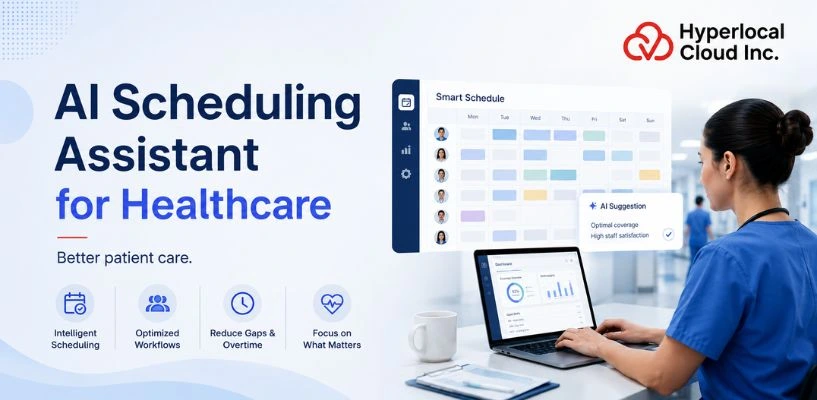
- AI scheduling assistants in healthcare work to automate medical appointment booking, rescheduling, cancellations, and reminders to patients.
- The software solution reduces the admin workload by allowing staff to focus on efficient patient care.
- The software typically eliminates the risk of appointment scheduling conflicts by improving appointment management.
- With the AI scheduling assistants, healthcare providers can offer patients the option of 24/7 appointment bookings through digital methods.
- The modern world AI scheduling assistants often use advanced technologies like ML, NLP, and predictive analysis for the enhancement of scheduling methods.
- The rapid evolution of digital healthcare services and telemedicine is the core reason behind the progressive demand for AI-powered scheduling solutions.
- By utilizing advanced scheduling solutions, healthcare providers can provide a seamless experience to their patients.
- AI scheduling systems are integrated with EHRs, patient communication platforms, and practice management software.
- The development process to build the software solution needs more focus, security, and implementation of regulatory compliance.
- Due to the vast transformation in digital healthcare, the AI-centric scheduling has become an essential part of fulfilling healthcare operations.
Key Takeaways:-
The healthcare industry undergoes massive growth, where they are required to manage thousands of appointments on a daily basis. Due to this, several hospitals, clinics, and healthcare centers often face challenges related to appointment scheduling and resource allocation. Unlike traditional methods, where scheduling relied on manual processes, AI-powered scheduling assistants manage everything effortlessly and are less time-consuming.
Artificial intelligence is a positive shift in the world of healthcare that helps medical professionals to schedule appointments with ease. These systems are designed to automate appointment scheduling by delivering a user-friendly experience.
According to some reports, it has been seen that the development of AI-powered scheduling assistants is expected to grow, which clearly means that businesses will move to get their own solution. Businesses that invest in these solutions will get proficient results and an opportunity to stand out in the competitive market.
What is an AI Scheduling Assistant?
An AI scheduling assistant is a software solution that is designed to simplify the process of appointment scheduling by using artificial intelligence. Instead of relying on the medical staff for manual scheduling, healthcare providers can utilize the AI scheduling assistant to automate tasks seamlessly. Also, these software solutions are trained to learn from historical data and adapt to ongoing or upcoming circumstances. Thus, the overall approach helps medical professionals to make smarter decisions to provide their users with a more personalized experience.
A typical healthcare AI scheduling assistant can perform several important functions:
- Appointment Booking
- Appointment Rescheduling
- Automated Appointment Reminders
- Cancellation Management
- Provider Schedule Optimization
- Patient Communication
- No-Show Prediction
- Multi-Channel Accessibility
Build Smarter Healthcare Scheduling With AI and Start Your Solution Today
How Does an AI Scheduling Assistant Work for the Healthcare Industry?
An AI-powered scheduling assistant will work seamlessly to help organizations satisfy their patients with smooth appointment scheduling. Here’s how the platform works.
1. Understanding Patient Requests
The first step in the scheduling process is to obtain the patient’s request. Patients can interact with the AI scheduling assistant through unconventional channels, along with healthcare websites, mobile applications, chatbots, messaging platforms, or voice assistants.
2. Checking Doctor and Resource Availability
Once the affected person’s request is detected, the AI scheduling assistant checks the availability of doctors, specialists, consulting rooms, clinical equipment, or telehealth assets. This technique removes the need for mentor coordination and can reduce scheduling conflicts.
3. Recommending Suitable Appointment Slots
After reviewing availability, the AI assistant provides appropriate appointment options to the patient. This allows patients to choose a convenient schedule and supportive healthcare providers to maintain a balanced schedule.
4. Booking and Confirming Appointments
By selecting an appointment that is convenient for the patient, the AI scheduling assistant completes the booking process on a regular basis. The device instantly updates the schedule and sends a confirmation message via email, SMS, or mobile notification.
5. Sending Automated Reminders
Timely reminders are a primary function of healthcare organizations. AI scheduling assistants help reduce this problem by sending computerized reminders before scheduled visits. The system can send reminders a few days before the appointment and again towards the appointment time.
6. Managing Rescheduling and Cancellations
Patients often need to reschedule their appointments due to their changing circumstances. AI scheduling assistants can handle worker requests without the need for intervention. This creates a more flexible scheduling environment and improves resource efficiency.
7. Learning and Improving Over Time
One of the most valuable aspects of AI technology is its ability to trace back to historical information. Over time, this learning feature allows the system to make smarter scheduling decisions and improve general efficiency.
Know the Core Features of an AI Scheduling Assistant
A list of the core functionalities of the software is precisely discussed below. Just know how effortlessly the platform automates healthcare-related tasks.
1. Intelligent Appointment Scheduling
The primary feature of the AI scheduling assistant is appointment management. This helps eliminate manual fastening duties and reduces the chances of human error.
2. Natural Language Processing (NLP)
Natural language processing allows patients to communicate with the AI assistant using plain language. Patients don’t want to follow complex systems or navigate complicated menus. Instead, they can certainly be kind or proceed with their requests.
3. Automated Appointment Reminders
Automated reminders play an important role in improving appointment reminders. Patients thrive on knowing about upcoming appointments, reducing the likelihood of missing a visit.
4. Smart Rescheduling and Cancellation Support
Health care plans are typically turned around due to the affected individual’s request and provider availability. An AI scheduling assistant simplifies those changes by allowing patients to reschedule or cancel appointments without contacting the administrative staff.
5. Multi-Channel Patient Interaction
Patients simply choose replacement methods based on their nonpublic preferences. This flexibility makes scheduling more available and convenient for victims.
6. Patient Profile Management
The system may include patient profiles that include time history, outlook, contact records, and call options.
7. Real-Time Availability Tracking
Real-time schedule tracking ensures that patients are consistently provided with accurate appointment data. This prevents double bookings and scheduling conflicts.
8. No-Show Prediction and Prevention
Advanced AI systems can examine older appointment information to find patients who missed appointments. The feature can then send additional reminders or follow-up messages to encourage attendance.
List of the Advanced Integration in the AI Scheduling Assistant
A modern world scheduling platform comes with a lot of integrations, of which the most relevant ones are mentioned below. Just have a look:
1. Integration with Electronic Health Records (EHR)
Electronic health records contain critical information about an affected person, including scientific records, treatment data, prescriptions, and past appointments. This integration can increase appointment accuracy and ensure greater continuity of care.
2. Telehealth Platform Integration
The evolving popularity of digital health services has increased the need for telehealth platform integration. This creates continued enhanced experience for every patient and healthcare organization.
3. Payment and Billing System Integration
Healthcare providers typically require patients to settle bills before or after appointments. This improves comfort and simplifies administrative operations.
4. Communication Platform Integration
AI scheduling assistants can be combined with communication platforms that assist email, SMS, push notifications, and voice calls. This integration ensures that patients receive timely appointment updates, reminders, confirmations, and observation communications.
5. Calendar and Workforce Management Integration
Health centers shall coordinate the schedules of doctors, nurses, specialists, and support teams for workers. By integrating worker monitoring systems and digital calendars, AI scheduling assistants can optimize employee availability and reduce scheduling conflicts.
6. Analytics and Reporting Integration
Healthcare organizations want to gain access to aggregate performance insights to improve scheduling operations. These insights help healthcare leaders make informed choices and continuously improve the overall performance plan.
7. Integration with AI and Predictive Analytics Tools
Advanced AI scheduling assistants can connect to predictive analytics platforms to forecast impacted individual demand and scheduling characteristics. The system can anticipate busy intervals, sense staffing needs, and advocate for agenda adjustments before problems arise.
Launch a Custom AI Scheduling Assistant for Modern Healthcare Solution
How to Build an AI Scheduling Assistant for Healthcare?
Here, businesses will get complete insight that lets them know about the complete steps that are required to follow for the development of an AI-centric scheduling assistant.
1. Planning and Requirement Analysis
Fulfilling any healthcare AI response starts with proper planning. Before starting off involved in improvement, it is much more important to know the goals of the healthcare provider and perceive the anticipated challenges to tackle as a scheduling assistant. Defining clear goals makes it easier to navigate the entire development process.
2. Understand User Needs
The AI scheduling assistant serves customers such as patients, doctors, nurses, administrative workers, and healthcare managers. Development teams should get feedback from those customers to understand their demanding scheduling situations and expectations. This ensures that only the final response actually meets healthcare needs.
3. Architecture Design
After gathering the necessary components, the next step is to build the device architecture. The architect acts as the muse of the AI scheduling assistant and determines how certain components will work together. A well-designed interface ensures scalability and long-term reliability.
4. Core Development Phase
Once the architecture is complete, development teams can start building the AI scheduling assistant. This process includes developing the functions of the center to provide the experience of scheduling. However, the expertise of front-end and back-end developers is a must-have requirement in this step, because they finalize the right integration of programming languages in the solution. Also, businesses are required to select between a custom-based solution or a white label solution to fulfill the development process.
5. Third-Party Integrations
A healthcare appointment scheduling assistant will be tons more efficient when it connects to existing healthcare systems. Integration ensures that information can easily move across platforms of a kind. Integration ensures that hiring data remains synchronized across the employer.
6. Testing and Compliance Validation
A healthcare application must operate conveniently, securely, and reliably. Before deployment, the AI scheduling assistant should be extensively tested. Enables verification of scheduling assistant compliance with healthcare policies on patient records, security, and data management.
7. Deployment and Maintenance
After testing is complete, the AI scheduling assistant can be implemented for international use in the real world. This allows teams to detect and address any remaining issues. Continuous improvements ensure that the scheduling assistant maintains growth rates for years to come.
Tech Stacks Used to Build an AI Scheduling Assistant
Go through the list of tech stacks that are used by AI app development companies for the fulfillment of the development process of an AI scheduling assistant.
| Categories | Tech Stacks |
| Frontend Technologies | React, Angular, Vue.js |
| Backend Technologies | Node.js, Python, Java, .NET |
| Databases | PostgreSQL, MySQL, MongoDB |
| Cloud Infrastructure | AWS, Azure, Google Cloud |
| AI and Machine Learning Tools | OpenAI APIs, NLP frameworks, Speech recognition services, Conversational AI platforms |
Real-World Use Cases of AI Scheduling Assistants in Healthcare
Businesses should know about the practical use cases in order to understand how reliable and easy to use the platform is. So here is a complete list of the particular niches of healthcare that can be facilitated by the software solution.
1. Hospitals
Hospitals manage many patients, health professionals, wards, and resources every day. AI scheduling assistants can be robotically aware of affected patients and optimizing time allocation.
2. Clinics
Clinics often operate with small teams and limited administrative resources. AI scheduling assistants help hospitals automatically book, remind, cancel, and keep appointments. This reduces manual workload and improves scheduling accuracy.
3. Telemedicine Providers
Virtual healthcare offerings continue to grow in recognition. AI scheduling assistants can coordinate telehealth solutions and ensure patients have records of essential appointments. The tool can automatically create consultation links and send appointment instructions.
4. Specialty Healthcare Practices
Specialty healthcare facilities typically have unique scheduling needs. AI scheduling assistants help properly coordinate consultations, follow-up visits, tests, and procedures. This improves the scheduling process and patient outcomes.
5. Healthcare Networks
Large healthcare organizations often operate multiple hospitals, clinics, and specialty clinics. AI scheduling assistants can provide integrated scheduling experience at any location. This can reduce wait times and improve access to care.
Turn Challenges Into Opportunities With an AI Assistant Today
Discover the Common Challenges and Ways to Overcome Them
During the development process, businesses will often face some challenges that are quite important for them to be considered so that they can overcome them in a timely manner. Here is a list of challenges along with the ways to overcome them.
1. Integration Challenges
One of the most common challenges in creating an AI assistant is its integration with current healthcare technology. Healthcare organizations rarely operate with a single software platform. Instead, they often rely on a combination of systems that have been used for many years. By strengthening a robust integration framework, healthcare organizations can ensure clean communication between the AI scheduling assistant and existing systems.
2. AI Accuracy Issues
The effectiveness of an AI scheduling assistant depends heavily on its ability to capture patient requests and make accurate scheduling choices. AI needs to be tested and optimized to improve overall performance. Combining AI automation with human supervision can markedly increase schedule reliability.
3. Adoption Resistance
Even when the AI scheduler assistant is technically a hit, a few users may be hesitant to try it. Resistance to change is common in the healthcare sector, where employees are familiar with existing work processes. Successful adoption requires a human-centered management approach.
4. Scalability Concerns
Healthcare organizations are growing a lot over time. What works for a small health system will not be enough for a large health center community. As the number of affected individuals increases, the scheduling assistant must manage a larger workload without performance degradation. Scalability should be considered in the structural design.
Advanced Enhancements and Future Trends in the AI Scheduling Assistant
Here is a list of the advanced enhancements and the future trends in the AI scheduling assistant, which makes it even more robust and user-friendly to transform the healthcare industry.
1. Generative AI for Healthcare Scheduling
Generative AI becomes the core part of the transformation in the healthcare industry to simplify the way healthcare organizations interact with patients. Unlike traditional chatbots, these AI-powered assistants create natural and human-like conversations, which help organizations to respond to patients’ queries.
2. Creating More Natural Patient Interactions
Patients can communicate with generative AI assistants in a conversational manner. The AI assistant can understand the request, ask follow-up questions, identify the appropriate specialist, and recommend appointment options.
3. Improving Self-Service Scheduling
Generative AI can guide patients through complex scheduling situations without requiring staff involvement. This reduces administrative workload while improving patient satisfaction.
4. Predictive Healthcare Operations
Predictive analytics is becoming an increasingly valuable component of AI scheduling systems. By analyzing historical healthcare data, AI can identify patterns and forecast future scheduling needs.
5. Forecasting Patient Demand
Many times, the healthcare industry experiences fluctuations in the prediction of user demand. That’s why an advanced forecasting patient demand system enables professionals to prepare proactively.
6. Multilingual Scheduling Assistants
Healthcare industries have to serve patients across countries, which can not be affected by language barriers. Thus, the multilingual support allows patients to communicate with the healthcare professionals in their native language.
7. AI-Powered Care Coordination
Healthcare often involves multiple providers, departments, and treatment stages, where scheduling appointments is only one part of the patient journey. This can be easily done with AI-driven care coordination.
8. Agentic AI Scheduling Systems
One of the most exciting developments in healthcare AI is the rise of agentic AI systems. These systems go beyond responding to instructions and can take proactive actions to achieve defined goals.
Partner With Us to Create Smarter Healthcare Appointment Management Systems
Conclusion
AI scheduling assistants are becoming the core part of the healthcare industry because these solutions function to manage the appointment scheduling, rescheduling, and cancellation process without having human intervention. However, the solution carries a wide range of advanced functionalities that help businesses to streamline their operations. But there are several complexities that can be overcome with the valuable insight of an experienced healthcare app development company.

Patt Cummins is an experienced content writer with over 10 years of experience creating clear and engaging content for technology-focused industries. He specializes in simplifying complex technical topics into easy-to-understand stories that educate readers, support brand communication, and help businesses effectively share their solutions.

Need Help With
Development?