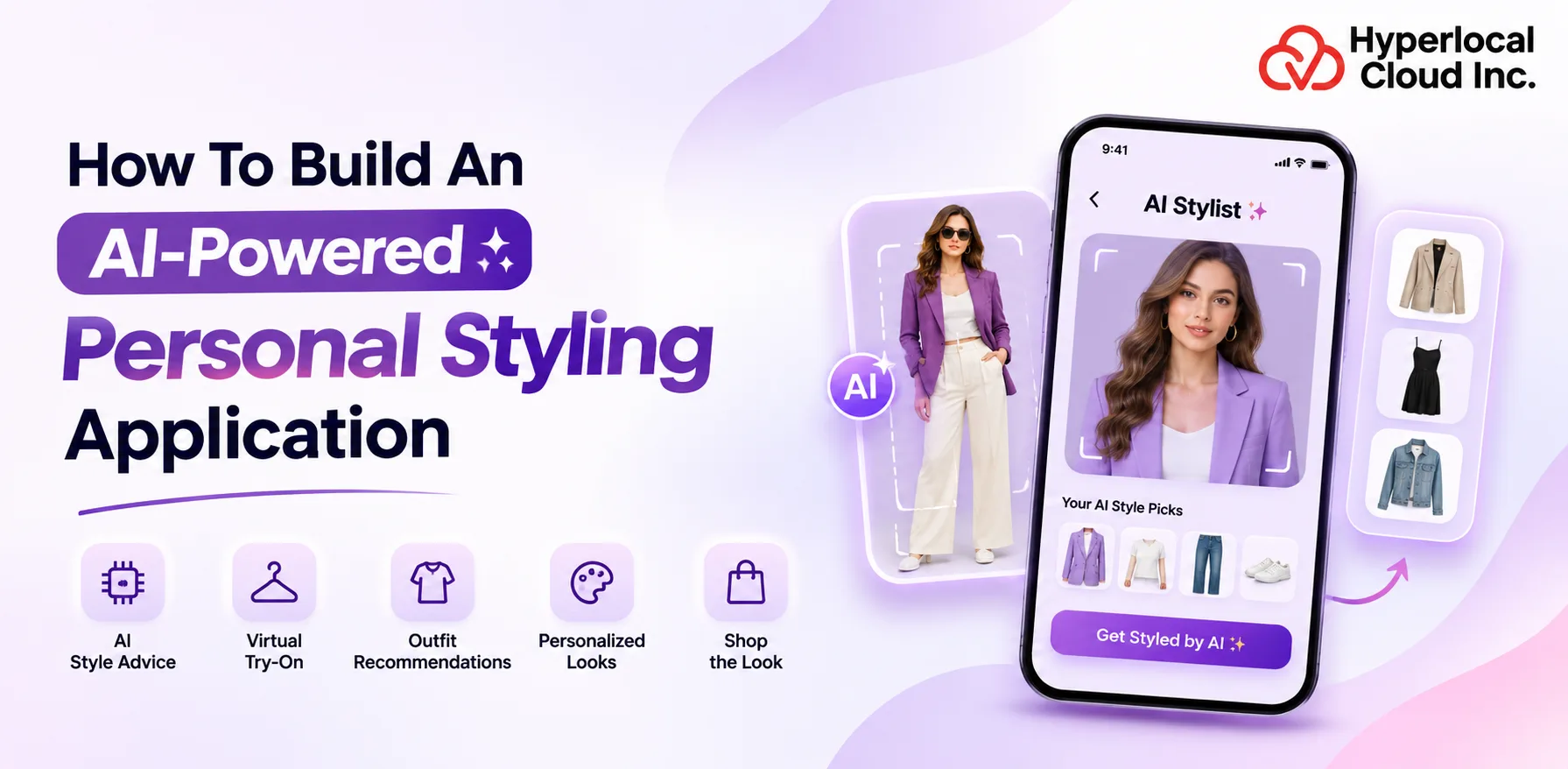
- AI-powered styling apps personalize fashion recommendations and outfit planning.
- Machine learning, computer vision, and generative AI power core styling features.
- Essential features include virtual wardrobes, outfit generators, and personalized shopping.
- Estimated development costs range from $15,000 to $150,000+.
- Subscriptions, affiliate commissions, and styling consultations offer monetization opportunities.
- AI shopping assistants, virtual try-on, and wardrobe automation are important areas to watch in 2027.
Artificial intelligence is transforming the fashion industry by changing how consumers discover clothing, select outfits, and make purchasing decisions. From personalized fashion recommendations to virtual try-on experiences, AI-powered personal styling applications are making fashion more accessible, convenient, and personalized.
Traditional personal styling services often require customers to consult professional stylists, visit physical stores, or spend hours browsing online fashion collections. However, AI-powered styling applications can analyze individual preferences, wardrobe collections, shopping behavior, and lifestyle requirements to recommend suitable outfits within seconds.
For fashion startups, online retailers, entrepreneurs, and established clothing brands, developing an AI-powered personal styling application presents an opportunity to improve customer engagement, strengthen brand loyalty, and introduce new revenue streams.
The growing adoption of AI in retail, combined with advances in computer vision, generative AI, and recommendation algorithms, is creating new possibilities for digital fashion businesses.
This comprehensive guide explains how to build an AI-powered personal styling application, including its essential features, AI technologies, development process, technology stack, estimated costs, monetization strategies, and emerging trends for 2027 and beyond.
What Is an AI-Powered Personal Styling Application?
An AI-powered personal styling application is a digital platform that uses artificial intelligence, machine learning, computer vision, and recommendation algorithms to provide personalized fashion suggestions based on individual preferences.
Unlike conventional fashion applications that primarily display product catalogs, AI styling platforms can analyze user-specific information, including clothing preferences, preferred colors, occasions, existing wardrobe items, and previous interactions.
For example, a user preparing for a business meeting can upload images of available clothing, specify the occasion, and receive outfit recommendations based on their wardrobe. Similarly, someone planning a vacation can receive clothing suggestions based on destination weather, travel activities, and personal fashion preferences.
Advanced applications may also include virtual fitting rooms, AI-generated fashion combinations, digital wardrobes, shopping recommendations, and conversational styling assistants.
Difference Between Traditional and AI-Powered Styling Applications
Traditional styling applications generally depend on manually curated collections, predefined fashion categories, and direct consultations with stylists.
AI-powered applications introduce automated recommendations that can adapt to changing user preferences. Instead of displaying identical fashion suggestions to every customer, these platforms use recommendation systems to create more relevant experiences.
However, recommendation accuracy depends on the quality of user information, product data, AI models, and ongoing feedback.
Transform Fashion Shopping With AI
How Does an AI-Powered Personal Styling Application Work?
AI-powered personal styling applications combine user information, clothing databases, machine learning algorithms, and recommendation systems to deliver personalized fashion experiences.
Step 1: User Registration and Profile Creation
Users begin by creating an account through email, phone numbers, or supported social authentication services. During onboarding, the application collects basic information such as fashion interests, preferred clothing categories, and shopping preferences.
An intuitive onboarding process helps businesses gather useful information without overwhelming users.
Step 2: Collection of Fashion Preferences
The application asks users about their favorite colors, preferred fashion styles, clothing sizes, budgets, and lifestyle requirements.
For example, users may select casual, formal, streetwear, minimalist, luxury, or athletic fashion preferences.
These inputs help establish an initial recommendation profile.
Step 3: Personal Style Analysis
Machine learning algorithms analyze the information provided by users and identify patterns in their fashion preferences.
Where users voluntarily provide photographs or measurements, computer vision systems may assist with clothing analysis or fit-related suggestions. Such estimates should not be treated as guaranteed measurements.
Step 4: AI-Powered Outfit Recommendations
The recommendation engine combines user preferences with clothing attributes, current trends, weather conditions, and available wardrobe items.
It then suggests clothing combinations suitable for specific occasions, such as office meetings, weddings, vacations, or everyday activities.
Step 5: Virtual Wardrobe Creation
Users upload photographs of their existing clothing items or import purchases from supported retailers.
Computer vision technology identifies clothing categories, colors, and other visual characteristics to organize items into a digital wardrobe.
Step 6: Personalized Shopping Suggestions
The platform identifies clothing products that complement the user’s existing wardrobe.
Retailer integrations allow customers to discover relevant products and, where supported, purchase them through connected shopping platforms.
Step 7: Continuous Learning Through Feedback
As users save outfits, reject recommendations, purchase products, or provide ratings, the recommendation system receives additional preference signals.
These interactions can improve future suggestions and make the styling experience increasingly personalized.
AI Personal Styling App Market Statistics and Growth Opportunities
The increasing adoption of artificial intelligence in online shopping creates opportunities for fashion businesses to introduce more personalized digital experiences.
Several industry reports demonstrate the growing importance of AI-powered recommendations, product discovery, and intelligent shopping assistance.
Increasing Adoption of AI Shopping Assistants
McKinsey’s 2026 consumer research found that 53% of surveyed consumers across 11 markets had used AI for shopping within the preceding three months. In the United States, the corresponding figure was 48%.
These findings suggest that AI-assisted shopping is moving beyond early experimentation, creating opportunities for businesses to offer intelligent product discovery and fashion recommendations.
Growing Demand for Personalized Shopping
According to Capgemini’s 2025 consumer research, 71% of consumers wanted generative AI integrated into their shopping experiences. The report also found that approximately two-thirds of Gen Z and millennial consumers wanted hyper-personalized content and product recommendations powered by generative AI.
For AI personal styling app developers, these findings highlight the importance of building platforms around individual customer preferences rather than generic product recommendations.
AI Is Changing Fashion Product Discovery
The BoF–McKinsey State of Fashion 2025 report found that 50% of surveyed fashion executives identified product discovery and customer search among the most promising generative AI applications. Additionally, 39% selected curated product recommendations.
This indicates that AI-driven discovery and personalized recommendations are commercially relevant investment areas for fashion companies.
Growth in AI-Driven Retail Traffic
Adobe reported that traffic referred to US retail websites from generative AI tools increased 693.4% year over year during the 2025 holiday shopping season.
Although AI-referred traffic remained relatively small compared with established channels, the growth demonstrated increasing consumer interest in using AI for purchasing research and product discovery.
Key Features of an AI-Powered Personal Styling Application
Developing a successful AI personal styling application requires features that simplify outfit selection, improve personalization, and help businesses manage customers and fashion recommendations.
The application can be divided into three major components: the user panel, stylist panel, and admin panel.
A. User Panel Features
1. AI-Powered Style Recommendations
This feature analyzes user preferences, clothing choices, selected occasions, and previous interactions to generate personalized outfit suggestions. Recommendation engines can combine collaborative filtering, content-based filtering, and machine learning techniques to identify relevant clothing combinations.
2. Personal Style Profile
Users can create personalized fashion profiles by selecting preferred clothing categories, favorite colors, brands, budgets, and lifestyle preferences. These profiles provide the foundation for accurate recommendations and allow users to update their fashion interests over time.
3. Virtual Wardrobe Management
A virtual wardrobe allows users to upload, organize, and manage their clothing collections digitally. AI-powered image recognition can classify clothing items into categories such as shirts, jackets, trousers, shoes, and accessories, making wardrobe management easier.
4. AI Outfit Generator
The AI outfit generator creates clothing combinations using available wardrobe items or connected retailer catalogs. Users can request outfits for different occasions, seasons, and fashion preferences, helping them discover new ways to wear existing clothing.
5. Body Shape Analysis
With user consent, the application can analyze voluntarily provided measurements or images to support fit-related suggestions. Businesses should provide manual measurement options and clearly communicate the limitations of automated body shape estimation.
6. Color and Pattern Recommendations
AI analyzes clothing colors, patterns, and combinations to suggest visually compatible outfits. Users can also specify preferred color palettes, helping the application recommend clothing that matches their individual style.
7. Virtual Try-On
Virtual try-on technology allows users to preview how selected clothing items might appear on a photograph or digital avatar. Advanced solutions use computer vision, image generation, and garment visualization models. However, visual previews do not guarantee accurate physical fit.
8. Smart Fashion Search
Users can search for clothing through text descriptions, images, or natural language queries. For example, a customer can request a minimalist black outfit under $150, and the application can identify relevant products from connected catalogs.
9. Weather-Based Outfit Suggestions
By integrating weather APIs, the application can recommend clothing based on temperature, precipitation, and seasonal conditions. This feature is particularly useful for daily outfit planning and travel-related fashion recommendations.
10. Shopping Integration
Shopping integration connects the styling application with fashion retailers and e-commerce platforms. Users can discover products that complement their wardrobe and access purchasing options without manually searching multiple websites.
11. Wishlist and Favorites
Users can save preferred outfits, clothing combinations, and fashion products for future reference. These interactions also provide valuable feedback signals for improving personalized recommendations.
12. Style Inspiration Feed
A personalized fashion inspiration feed displays outfit ideas, seasonal collections, and relevant fashion content. Businesses can combine editorial recommendations with AI-driven personalization to increase engagement.
13. Personalized Notifications
The application can notify users about new outfit suggestions, saved product availability, upcoming events, and relevant fashion collections. Notifications should be configurable to prevent excessive messaging.
Stylist Panel Features
1. Stylist Profile Management
Professional stylists can create profiles displaying their expertise, fashion specializations, portfolios, consultation charges, and availability. This allows customers to discover stylists who match their preferences.
2. Client Management
The client management dashboard helps stylists review customer preferences, wardrobe information, styling requests, and consultation history. Authorized access controls are essential to protecting personal information.
3. AI-Assisted Outfit Recommendations
Professional stylists can use AI-generated clothing suggestions as a starting point for personalized consultations. This reduces repetitive work while allowing stylists to apply human creativity and fashion expertise.
4. Virtual Styling Sessions
Integrated video consultations, messaging, and appointment scheduling allow customers to communicate with professional stylists remotely.
5. Wardrobe Analysis
Stylists can review customers’ digital wardrobes, identify outfit combinations, and recommend complementary clothing items.
6. Consultation Scheduling
A scheduling dashboard enables stylists to manage appointments, availability, cancellations, and consultation reminders.
7. Performance Analytics
Stylists can monitor consultation bookings, customer satisfaction, repeat appointments, and earnings through a centralized dashboard.
Admin Panel Features
1. User Management
Administrators can manage user accounts, verify profiles, resolve account issues, and enforce platform policies.
2. Stylist Management
The admin panel allows businesses to approve professional stylists, manage service categories, and monitor platform activity.
3. AI Model Management
Administrators can monitor recommendation performance, manage model versions, and review system-generated suggestions for quality and relevance.
4. Product Catalog Management
This feature supports product uploads, clothing categorization, pricing updates, availability management, and retailer integrations.
5. Subscription Management
Businesses can configure subscription plans, premium features, trial periods, renewals, and cancellations.
6. Payment Management
Administrators can manage payment transactions, refunds, consultation charges, and subscription billing through integrated payment providers.
7. Content Management
The content management system allows businesses to publish styling guides, fashion inspiration, promotional content, and seasonal collections.
8. Analytics and Reporting
Administrators can monitor active users, recommendation engagement, subscription conversions, revenue, and customer retention.
9. Customer Support Management
Support tools help administrators manage customer inquiries, complaints, technical problems, and service requests.
Partner With AI App Development Experts
Advanced AI Technologies Used in Personal Styling Applications
Artificial intelligence forms the technological foundation of modern personal styling platforms. Selecting the appropriate technologies is essential for developing accurate, scalable, and engaging applications.
1. Machine Learning
Machine learning enables styling applications to identify patterns in customer preferences and behavior. Algorithms analyze saved outfits, product interactions, purchase history, and user feedback to improve recommendations.
For example, if a customer consistently prefers neutral-colored clothing, the recommendation engine can prioritize similar products while introducing complementary styles.
2. Generative AI
Generative AI enables applications to create new outfit concepts, styling descriptions, and personalized fashion suggestions.
It can also power conversational assistants that respond to requests such as creating five business-casual outfits from a user’s existing wardrobe.
Image-generation capabilities may support visual outfit previews, although production systems need controls to prevent inaccurate garment representations.
3. Computer Vision
Computer vision allows applications to analyze clothing photographs and identify visual characteristics such as garment type, color, texture, and pattern.
This technology is particularly useful for virtual wardrobe organization, image-based fashion search, and clothing recognition.
4. Natural Language Processing
Natural language processing helps applications understand written or spoken styling requests.
For example, users can ask for a comfortable winter outfit suitable for a business trip. NLP systems interpret the request and identify relevant clothing categories, weather requirements, and occasion preferences.
5. Recommendation Engines
Recommendation engines generate personalized fashion suggestions using user profiles, product attributes, behavioral signals, and contextual information.
A hybrid recommendation engine can combine content-based recommendations with collaborative filtering to improve relevance.
6. Deep Learning
Deep learning models can identify complex relationships between clothing images, user preferences, and outfit combinations.
These models are particularly useful for visual similarity searches, garment classification, and advanced fashion recommendation systems.
7. Predictive Analytics
Predictive analytics uses historical data to estimate future customer interests and purchasing behavior.
Retailers can use these insights to identify likely product preferences, plan personalized campaigns, and anticipate demand for clothing categories.
8. Image Recognition
Image recognition automatically identifies and categorizes clothing items from uploaded photographs.
For example, an application may recognize a denim jacket, white sneakers, or formal trousers and assign appropriate wardrobe tags.
9. Virtual Try-On Technology
Virtual try-on systems combine image processing, segmentation, pose estimation, and generative models to create visual clothing previews.
More advanced implementations may use 3D garment simulation and avatar-based visualization.
10. Large Language Models
Large language models power conversational fashion assistants capable of understanding complex requests and generating natural-language recommendations.
For example, a user can ask an AI assistant to plan seven outfits for a vacation with a $300 shopping budget.
The system can interpret the request, access relevant wardrobe and catalog data, and generate a structured styling plan.
Step-by-Step Process to Build an AI-Powered Personal Styling Application
Developing an AI-powered personal styling application requires a structured approach that combines market research, business planning, software engineering, AI integration, and continuous improvement.
Step 1: Conduct Market Research and Identify Your Target Audience
Begin by identifying the audience your application will serve. Potential customer segments include fashion-conscious consumers, working professionals, online shoppers, frequent travelers, and individuals seeking convenient wardrobe management.
Analyze existing styling platforms to understand their strengths, limitations, monetization approaches, and customer experiences.
Research should focus on identifying unmet needs, such as affordable styling assistance, sustainable wardrobe planning, or personalized shopping within a specific budget.
Step 2: Define Your Business Model and App Requirements
Determine whether the application will operate as a subscription-based styling service, an AI fashion shopping assistant, a virtual wardrobe platform, or a marketplace connecting customers with professional stylists.
Define the essential features for the minimum viable product, including user registration, style preferences, wardrobe management, and outfit recommendations.
Advanced features such as virtual try-on and professional consultations can be introduced in later development phases.
Step 3: Choose the Right AI Features and Technologies
Identify the AI capabilities required to support your business objectives.
For example, wardrobe management applications may prioritize image recognition, while shopping assistants require recommendation engines and product catalog integrations.
Evaluate existing AI APIs and pretrained models before investing in custom model development.
This approach can reduce initial development complexity and accelerate product validation.
Step 4: Design an Intuitive UI/UX
Create a user-friendly interface that makes fashion discovery and outfit planning simple.
The design should include clear navigation, visual clothing catalogs, accessible recommendation screens, and straightforward wardrobe uploads.
Interactive prototypes can help validate the user experience before development begins.
Step 5: Develop the Application Architecture
Design an architecture that supports user profiles, clothing databases, AI inference services, recommendation engines, and external integrations.
A modular architecture allows businesses to upgrade individual components without rebuilding the entire platform.
Cloud infrastructure can support scalable image storage, API services, and AI processing workloads.
Step 6: Integrate AI and Machine Learning Models
Integrate selected AI models into the application.
Develop the recommendation workflow, clothing classification system, and conversational styling functionality.
Train or fine-tune models only when suitable datasets, permissions, and business requirements justify the additional investment.
Model evaluation should include recommendation relevance, clothing classification accuracy, response quality, and fairness across different users.
Step 7: Build the Backend and Frontend
Frontend developers implement the user interface, wardrobe screens, styling recommendations, and shopping experiences.
Backend developers create APIs, authentication systems, databases, subscription services, and integrations with AI models.
Both components must communicate securely to provide a reliable application experience.
Step 8: Integrate Third-Party APIs
Connect the application with relevant services, including payment gateways, weather information providers, retailer catalogs, analytics platforms, and authentication systems.
Third-party integrations should be evaluated for reliability, licensing conditions, usage limits, and long-term costs.
Step 9: Test the Application
Conduct functional, usability, performance, security, and AI model testing.
Test the application across supported devices and operating systems.
Special attention should be given to incorrect outfit recommendations, image upload failures, inaccurate product information, and potential exposure of sensitive user data.
Step 10: Launch and Maintain the Application
Release the application through the appropriate distribution channels, including the Apple App Store, Google Play, or a web platform.
Monitor application performance, customer feedback, recommendation engagement, and subscription conversions.
Continue improving AI models, fixing technical issues, updating retailer integrations, and introducing new styling capabilities based on actual user needs.
Development recommendation: Launch with a focused AI styling MVP before investing in expensive virtual try-on, 3D avatars, or custom generative AI infrastructure.
How to Integrate AI Into a Personal Styling Application?
AI integration is one of the most important stages of personal styling app development. Businesses must select technologies that support personalized recommendations, automated clothing recognition, and intelligent user interactions.
1. AI-Based Fashion Recommendation Integration
An AI fashion recommendation engine analyzes customer profiles, clothing preferences, browsing behavior, and previous interactions to suggest relevant outfits.
Developers can implement content-based filtering, collaborative filtering, or hybrid recommendation systems.
For example, if a customer frequently purchases minimalist clothing, the engine can prioritize products that match this preference while recommending complementary fashion items.
The system should also consider product availability, budget restrictions, clothing sizes, and seasonal requirements.
2. Computer Vision for Clothing Recognition
Computer vision enables applications to recognize clothing items from photographs.
Developers can integrate pretrained image classification and object detection models to identify clothing categories, colors, and visual characteristics.
This technology simplifies digital wardrobe management because users do not need to manually categorize every clothing item.
For better results, the application should allow users to correct inaccurate classifications.
3. Generative AI for Outfit Creation
Generative AI can create personalized styling concepts based on natural-language instructions.
For example, users can request three formal outfits suitable for a business conference or five casual outfits using their existing wardrobe.
The application can retrieve suitable garments, generate clothing combinations, and explain why particular items work together.
A reliable implementation should ground recommendations in actual wardrobe items and available retailer products rather than generating imaginary products.
4. AI-Powered Virtual Try-On Integration
Virtual try-on functionality allows users to preview selected garments on photographs or digital avatars.
Developers can use garment segmentation, pose estimation, image-generation models, and specialized virtual try-on APIs.
The implementation must account for different body positions, lighting conditions, garment types, and image quality.
Businesses should also explain that virtual try-on images are visual simulations and may not accurately represent garment fit, fabric behavior, or sizing.
5. Personalized Fashion Search
AI-powered fashion search enables users to discover products through conversational queries or reference images.
For example, a customer can search for a black leather jacket under $200 that matches blue jeans.
The system interprets the query, retrieves relevant products, and ranks results according to user preferences.
6. AI Chatbot for Fashion Assistance
An AI fashion chatbot acts as a virtual stylist available throughout the day.
It can answer styling questions, suggest outfit combinations, explain fashion trends, and recommend products.
Large language models can support conversational interactions, while retrieval systems connect the assistant to actual clothing catalogs and wardrobe information.
7. Continuous AI Model Optimization
AI models require regular monitoring to maintain recommendation quality.
Businesses should evaluate user feedback, outfit acceptance rates, recommendation relevance, and model errors.
Retraining or updating models can help the application adapt to changing fashion preferences, new clothing collections, and evolving customer behavior.
Build Your AI Fashion Styling App Today
Recommended Technology Stack for AI Personal Styling App Development
Selecting the right technology stack affects development efficiency, application performance, scalability, and long-term maintenance.
The following technologies can support different components of an AI-powered personal styling platform.
Frontend Development
The frontend determines how customers interact with the application. Flutter and React Native are suitable options for businesses developing applications for both Android and iOS.
Native technologies such as Swift and Kotlin may be preferable when applications require platform-specific functionality or highly optimized performance.
Backend Development
Backend technologies manage user accounts, wardrobe data, recommendations, payments, and third-party integrations.
Python is particularly useful for AI-focused applications because it provides access to extensive machine learning libraries.
Node.js and FastAPI are also practical options for developing scalable application programming interfaces.
AI and Machine Learning
TensorFlow and PyTorch support machine learning model development, training, and deployment.
Businesses can also use managed AI services or existing APIs to reduce the complexity of building models from scratch.
Database Management
Databases store user profiles, clothing information, shopping preferences, subscriptions, and interaction history.
Relational databases such as PostgreSQL are useful for structured application data, while vector databases support semantic clothing searches and similarity-based recommendations.
Cloud Infrastructure
Cloud platforms provide the computing resources needed for image processing, AI inference, data storage, and application hosting.
The infrastructure should support changing workloads while controlling ongoing AI processing costs.
Third-Party APIs and Integrations Required
Third-party integrations help businesses extend application functionality without developing every service internally.
1. Product Catalog APIs
Product catalog APIs connect the application with fashion retailers and e-commerce platforms.
They provide information about clothing products, prices, sizes, descriptions, and availability.
2. Payment Gateway APIs
Payment integrations support subscriptions, premium styling consultations, and in-app purchases.
Providers such as Stripe and PayPal can simplify payment processing, subject to regional availability and platform requirements.
3. Weather APIs
Weather APIs provide temperature, precipitation, and forecast information.
The application uses these details to suggest suitable clothing for daily activities and travel plans.
4. Image Recognition APIs
Image recognition services help classify uploaded clothing photographs and identify garment characteristics.
These integrations are useful for accelerating virtual wardrobe development.
5. AI Model APIs
AI APIs provide access to language models, image analysis systems, and other intelligent services.
They can reduce initial infrastructure requirements compared with training custom models.
6. Social Media APIs
Where permitted, social media integrations allow users to share outfit collections and fashion inspiration.
Businesses must follow each platform’s API policies and user authorization requirements.
7. Authentication APIs
Authentication services simplify account registration, login, and identity management.
Secure authentication is essential because styling applications may store personal photographs, preferences, and shopping information.
8. Analytics APIs
Analytics integrations track user engagement, feature adoption, subscription performance, and conversion rates.
These insights help businesses identify opportunities to improve application usability and monetization.
How Much Does It Cost to Build an AI-Powered Personal Styling Application?
The cost of developing an AI-powered personal styling application depends on the complexity of its features, AI technologies, application platforms, development team, and infrastructure requirements.
A basic application offering fashion recommendations and digital wardrobe management generally requires less investment than a sophisticated platform with generative AI, virtual try-on, and advanced retailer integrations.
The following estimates provide illustrative development budgets for planning purposes.
Basic AI Personal Styling Application: $15,000–$30,000
A basic application focuses on essential features such as user registration, personal style profiles, wardrobe uploads, and AI-powered outfit recommendations.
Businesses can integrate existing AI services instead of building custom machine learning models.
This approach is suitable for startups seeking to validate demand and launch a minimum viable product.
Mid-Level AI Personal Styling Application: $30,000–$70,000
A mid-level application offers more sophisticated personalization and additional customer engagement features.
It may include advanced recommendation engines, shopping integrations, conversational AI assistants, wardrobe analytics, and subscription management.
This development approach is appropriate for growing fashion businesses seeking a differentiated customer experience.
Advanced AI Personal Styling Platform: $70,000–$150,000+
An advanced platform may include high-quality virtual try-on, custom recommendation models, multiple retailer integrations, professional stylist marketplaces, and sophisticated analytics.
These applications require more extensive development, testing, AI infrastructure, and maintenance.
Projects involving custom 3D garment simulation, extensive proprietary model training, or large-scale enterprise integrations can exceed this budget.
Factors Affecting AI Personal Styling App Development Costs
Several technical and business requirements influence the total development budget.
1. Number of Application Panels
Applications with separate user, stylist, retailer, and administrator panels require additional interfaces, backend functionality, and testing.
A platform offering only automated AI styling recommendations may cost less than a marketplace connecting customers with professional stylists.
2. UI/UX Design Complexity
Custom animations, interactive wardrobe interfaces, advanced product visualization, and highly personalized onboarding experiences increase design and development requirements.
3. AI Model Selection and Integration
Using existing AI APIs can reduce initial development effort.
However, custom model training, fine-tuning, dataset preparation, and evaluation may require additional investment.
4. Computer Vision Implementation
Clothing classification, image segmentation, visual similarity search, and garment recognition require specialized image processing functionality.
More advanced computer vision capabilities generally increase development complexity.
5. Virtual Try-On Functionality
Virtual try-on can be among the most technically demanding features.
High-quality image generation, garment preservation, body positioning, and realistic rendering require significant engineering and computational resources.
6. Backend Infrastructure
The backend must support user accounts, wardrobe databases, AI inference requests, product catalogs, and subscription services.
Applications designed for high traffic may require additional infrastructure and performance optimization.
7. Third-Party API Integrations
Integrating retailer catalogs, payment gateways, weather services, and AI providers can increase development effort.
Some services also charge recurring usage fees.
8. Data Storage and Processing
Fashion applications may store large numbers of clothing photographs and product images.
Storage, image processing, and AI inference costs can increase as the user base grows.
9. Security and Privacy Requirements
Protecting customer photographs, personal preferences, and payment information requires secure architecture, access controls, encryption, and appropriate privacy practices.
10. Testing and Quality Assurance
Applications require functional testing, device compatibility testing, security assessments, and AI recommendation evaluations.
Virtual try-on and image recognition features may require additional quality assurance.
11. Post-Launch Maintenance
Ongoing maintenance includes security updates, infrastructure monitoring, model improvements, API upgrades, and feature enhancements.
Businesses should budget for these recurring expenses separately from initial development.
Develop Your Next-Generation Styling Platform
AI Personal Styling App Monetization Models
A well-designed monetization strategy helps businesses generate revenue while providing valuable styling services.
1. Monthly and Annual Subscriptions
Subscription models allow users to access premium styling features through recurring payments.
Premium plans may include unlimited outfit recommendations, advanced wardrobe analytics, exclusive styling tools, and personalized shopping assistance.
2. Freemium Model
The freemium model provides basic features at no cost while charging for advanced functionality.
For example, users may receive a limited number of outfit recommendations each month, with unlimited recommendations available through a paid plan.
3. Affiliate Marketing Commissions
AI styling applications can recommend products from partner fashion retailers.
When customers purchase products through eligible affiliate links, the application earns a commission.
This model works particularly well for platforms focused on personalized fashion discovery.
4. In-App Purchases
Businesses can sell individual styling reports, premium outfit collections, wardrobe organization tools, or special fashion consultation packages.
5. Personal Styling Consultation Fees
Applications connecting users with professional stylists can charge consultation fees or earn commissions from completed appointments.
This model combines automated AI recommendations with human fashion expertise.
6. Brand Partnerships
Fashion brands can collaborate with styling platforms to introduce relevant clothing collections and promotional campaigns.
Partnerships should prioritize customer relevance and clearly identify sponsored recommendations.
7. Sponsored Product Recommendations
Retailers can pay to promote selected products within the application.
Sponsored products should be transparently labeled and should not compromise the reliability of personalized recommendations.
8. E-Commerce Commission Model
Applications that support shopping transactions can earn commissions from purchases completed through connected retailers.
This approach creates opportunities to combine styling assistance with fashion commerce.
Popular AI-Powered Personal Styling Applications
Examining existing fashion technology platforms helps businesses identify successful features, competitive opportunities, and potential market gaps.
1. Stitch Fix
Stitch Fix is a personalized styling and fashion retail service that combines customer preferences, data-driven recommendations, and human styling expertise.
Customers provide information about their clothing sizes, fashion interests, budgets, and preferred styles. The service uses this information to help select relevant clothing products.
Its business model demonstrates how technology can support personalized fashion commerce while maintaining a role for professional stylists.
Key features: Personalized clothing selection, style profiles, data-driven recommendations, and fashion retail integration.
Business opportunity: Entrepreneurs can develop hybrid styling platforms that combine AI-generated recommendations with professional fashion consultations.
2. Whering
Whering focuses on digital wardrobe management and outfit planning.
Users can organize clothing collections, create outfits, and discover ways to combine existing wardrobe items.
The platform demonstrates the value of wardrobe-first fashion applications that encourage users to make better use of clothing they already own.
Key features: Digital wardrobe organization, outfit planning, clothing categorization, and wardrobe inspiration.
Business opportunity: Startups can develop AI-powered wardrobe management applications that help customers reduce unnecessary purchases and improve clothing utilization.
3. Acloset
Acloset is a digital wardrobe application that incorporates AI-assisted clothing organization and outfit planning.
Users can upload clothing photographs, categorize wardrobe items, and receive assistance creating outfit combinations.
Its approach highlights the potential of computer vision and recommendation technology in everyday wardrobe management.
Key features: Clothing image recognition, digital wardrobe management, AI-assisted outfit suggestions, and outfit planning.
Business opportunity: Developers can create applications that combine automated wardrobe organization with personalized fashion recommendations and shopping integration.
4. Style DNA
Style DNA focuses on personalized fashion recommendations and style analysis.
Its positioning illustrates how AI-based styling services can combine personal color analysis, fashion preferences, and curated shopping suggestions.
For businesses entering this market, personalized color recommendations can provide a distinctive feature beyond basic clothing discovery.
Key features: Personal style analysis, color recommendations, personalized fashion suggestions, and shopping assistance.
Business opportunity: Entrepreneurs can target customers seeking specialized fashion guidance through AI-supported styling profiles.
5. Alta
Alta represents the emerging category of AI-powered personal styling platforms that combine wardrobe management with intelligent outfit planning.
The concept focuses on helping users organize clothing collections and discover suitable combinations through personalized digital assistance.
Applications in this category demonstrate how AI can support daily fashion decisions rather than functioning solely as a product recommendation tool.
Key features: Digital wardrobe management, personalized outfit planning, and AI-assisted styling.
Business opportunity: Startups can develop conversational styling assistants that provide context-aware recommendations for daily activities, events, and travel.
Challenges in Developing an AI-Powered Personal Styling Application
Although AI styling applications offer significant business opportunities, developers must address several technical and operational challenges.
Maintaining Accurate Fashion Recommendations
Fashion preferences are subjective and change over time. Recommendation systems must account for individual tastes, occasions, clothing availability, and customer feedback.
Businesses should continuously evaluate recommendation quality rather than relying exclusively on initial model training.
Collecting High-Quality Fashion Datasets
AI models require relevant clothing images, product attributes, and user interaction data.
Poorly labeled or incomplete datasets can reduce recommendation accuracy and create inconsistent results.
Businesses must also ensure they have appropriate rights to use training images and product information.
Ensuring Body Measurement Accuracy
Estimating body measurements from photographs can be unreliable because camera angles, clothing, lighting, and image quality affect results.
Applications should provide manual sizing options and avoid guaranteeing accurate measurements based solely on image analysis.
Managing Virtual Try-On Accuracy
Virtual try-on systems may struggle to reproduce garment textures, folds, proportions, and physical fit accurately.
Developers should test multiple garment categories and clearly communicate visualization limitations.
Protecting User Information
Personal styling applications may process photographs, measurements, clothing preferences, and purchase histories.
Businesses should implement appropriate consent mechanisms, data minimization, secure storage, and deletion controls.
For US-focused services, relevant state privacy laws and other applicable requirements should be considered.
Integrating Multiple Fashion Retailers
Different retailers use different product data structures, inventory systems, and integration requirements.
Maintaining accurate pricing, availability, and product information across multiple retailers can be technically challenging.
Maintaining AI Model Performance
Fashion trends and customer preferences evolve continuously.
Businesses must monitor model quality, update product datasets, and improve recommendation systems to maintain useful styling experiences.
Future Trends in AI-Powered Personal Styling Applications: 2027 and Beyond
AI technology is expected to play an increasingly important role in personalized fashion experiences.
McKinsey’s 2026 fashion analysis identifies AI-powered product discovery, consumer search, content creation, and automation as important areas of industry development.
The following trends represent potential directions for AI personal styling applications in 2027 and beyond, rather than guaranteed outcomes.
1. Hyper-Personalized AI Fashion Recommendations
Future styling applications are likely to combine wardrobe information, personal preferences, occasions, weather conditions, and shopping behavior to create more context-aware recommendations.
This could help users discover clothing combinations that match both their preferences and daily requirements.
2. AI Fashion Assistants and Shopping Agents
Conversational AI assistants may become more capable of managing complete styling workflows.
For example, users could ask an assistant to plan outfits for a week-long business trip, identify missing wardrobe items, and compare available products within a specified budget.
McKinsey’s 2026 research found that 48% of US consumers surveyed had used AI for shopping in the preceding three months, suggesting a foundation for further adoption of AI-assisted commerce.
3. Real-Time Virtual Try-On
Advances in computer vision and image generation may improve virtual try-on experiences.
Future applications could provide more interactive clothing previews, allowing users to compare multiple garments and visualize different outfit combinations.
However, achieving consistently accurate physical fit simulation remains a technical challenge.
4. AI-Generated Custom Outfits
Generative AI may support personalized outfit concepts based on individual preferences, available clothing, and specific occasions.
This could enable customers to explore fashion combinations that would otherwise require professional styling assistance.
5. Sustainable Fashion Recommendations
AI styling applications can help users discover new ways to combine existing clothing items.
Future platforms may increasingly incorporate wardrobe reuse, secondhand shopping, repair recommendations, and sustainability-related product information.
6. Predictive Fashion Trends
AI systems can analyze historical fashion data, retail activity, and other permitted information sources to identify emerging patterns.
Fashion retailers may use these insights to inform product recommendations, merchandising strategies, and inventory planning.
7. Voice-Based Styling Assistants
Voice interfaces could allow customers to request outfit recommendations without typing.
For example, users may ask their application to recommend a comfortable outfit for a rainy afternoon or a formal event.
8. 3D Body Modeling and Digital Avatars
More advanced styling platforms may introduce customizable digital avatars and 3D garment visualization.
These capabilities could help users explore clothing combinations and understand garment proportions.
9. AI-Powered Wardrobe Automation
Future applications may automatically organize clothing collections, identify rarely used items, suggest outfit rotations, and recommend complementary purchases.
This could transform styling applications into broader wardrobe management assistants.
Create a Smart Fashion Recommendation App
Why Invest in AI-Powered Personal Styling App Development?
Investing in AI-powered personal styling technology can help fashion businesses introduce new digital services and improve the shopping experience.
1. Growing Demand for Personalized Shopping
Consumers increasingly expect digital platforms to understand their preferences and simplify product discovery.
Capgemini’s 2025 research found that 71% of surveyed consumers wanted generative AI integrated into shopping experiences. This supports the business case for exploring personalized AI shopping services.
2. Improved Customer Engagement
Personalized outfit recommendations, wardrobe planning, and conversational styling assistance provide users with reasons to interact with an application regularly.
Businesses can measure engagement through outfit saves, recommendation interactions, and repeat sessions.
3. Better Fashion Product Discovery
AI-powered search and recommendation systems help customers identify relevant clothing without browsing extensive product catalogs.
This can improve the shopping experience and potentially support conversion when recommendations are accurate and useful.
4. Increased Customer Retention
Features such as digital wardrobes, personalized style profiles, and outfit histories can encourage customers to return.
However, long-term retention depends on recommendation quality, ease of use, and the value delivered to users.
5. Multiple Revenue Opportunities
AI styling applications can generate revenue through subscriptions, affiliate commissions, consultations, premium features, and retailer partnerships.
Combining multiple revenue models may help businesses reduce dependence on a single income source.
6. Scalable Fashion Technology Business
Cloud infrastructure and automated recommendation systems can support growing user bases without requiring a proportional increase in human styling staff.
Businesses must nevertheless manage AI inference expenses, infrastructure requirements, and customer support as they scale.
Conclusion
AI-powered personal styling applications are creating new opportunities for fashion businesses to deliver personalized shopping experiences, automate wardrobe management, and simplify everyday outfit decisions.
By combining machine learning, computer vision, generative AI, recommendation engines, and intuitive application design, businesses can build platforms that help customers discover clothing and create outfits based on their individual preferences.
However, successful AI personal styling app development requires more than integrating advanced technologies. Businesses must understand their target audiences, prioritize valuable features, protect user information, and continuously evaluate recommendation quality.
Development costs can range from approximately $15,000 for a limited MVP to more than $150,000 for sophisticated platforms, depending on the selected features and technical requirements.
As AI-assisted shopping continues to evolve toward 2027 and beyond, businesses that focus on practical personalization, reliable recommendations, and convenient user experiences will be better positioned to compete in the digital fashion market.
FAQs (Frequently Asked Questions)

Patt Cummins is an experienced content writer with over 10 years of experience creating clear and engaging content for technology-focused industries. He specializes in simplifying complex technical topics into easy-to-understand stories that educate readers, support brand communication, and help businesses effectively share their solutions.

Need Help With
Development?