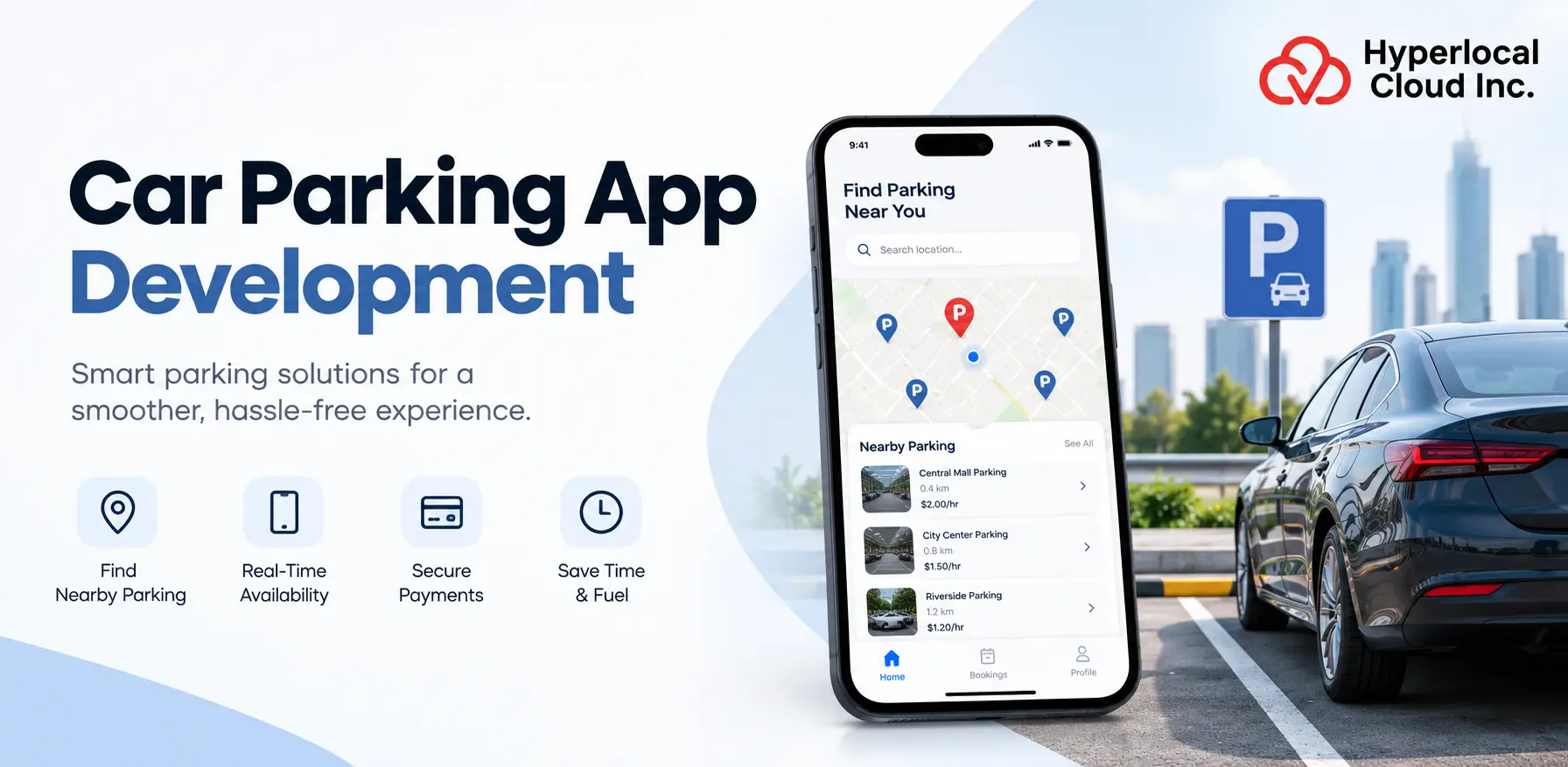
Finding a parking space can frustrate drivers, but it also creates a business opportunity for entrepreneurs. From crowded commercial districts and shopping centers to airports and residential neighborhoods, people need convenient ways to locate, reserve, and pay for parking. At the same time, parking lot owners want to improve occupancy, simplify daily operations, and generate more revenue from their available spaces.
Car parking app development meets these needs through a digital platform where drivers can find parking spaces, compare prices, reserve spots, and pay. Entrepreneurs can build a marketplace connecting drivers with parking providers or create a dedicated solution for businesses that manage multiple parking facilities.
The demand for more convenient parking experiences is reflected in industry research. According to a January 2026 study by T2 Systems, 66% of surveyed drivers who frequently use municipal parking facilities in US cities spend up to 15 minutes searching for a parking space. The study surveyed 2,000 drivers and found that 90% expressed interest in ticketless parking and digital tools.
These findings highlight a problem that digital parking services can help address. However, building a successful parking business requires more than creating an app with a map. Entrepreneurs must identify a viable market, secure parking inventory, choose the right revenue model, and develop a reliable booking experience.
This guide explains how to approach parking app development, including business opportunities, essential features, development costs, monetization strategies, and the steps required to launch a competitive platform.
What Is Car Parking App Development?
Car parking app development involves creating a mobile or web application that helps drivers find parking spaces while enabling parking providers to manage availability, reservations, payments, and customer interactions.
Depending on the business model, the application may connect users with public parking facilities, private garages, commercial lots, hotels, office buildings, or individual property owners. Some platforms focus on finding and reserving spaces, while others include parking access control, vehicle recognition, occupancy monitoring, and operational analytics.
A typical parking platform includes three main components: a user application for drivers, an operator dashboard for parking providers, and an administrative panel for managing the overall service. These components work together to coordinate bookings, pricing, payments, and customer support.
For entrepreneurs, the objective is to solve a specific parking problem and create a service that people or businesses are willing to use. For example, a startup might help office workers reserve weekday parking, offer bookings near event venues, or allow property owners to rent out unused spaces.
Build Your Car Parking App Today and Turn Your Business Idea Into Reality
Why Should Entrepreneurs Invest in Car Parking App Development?
Parking is a recurring need in cities, commercial areas, residential communities, and transport hubs. This creates opportunities for businesses that can make parking easier to find and more efficient to manage.
Growing Demand for Convenient Parking
Drivers often struggle to compare parking locations, understand rates, and confirm whether a space will be available when they arrive. A parking application can bring this information into one place, allowing users to make better decisions before reaching their destination.
For entrepreneurs, the value lies in reducing uncertainty for drivers while helping parking operators reach potential customers. Features such as reservations, digital payments, and location-based search can improve convenience and create opportunities for repeat usage.
Better Utilization of Existing Parking Spaces
Not every parking facility operates at full capacity throughout the day. An office building might have unused spaces during evenings, while a commercial property could have additional availability on weekends.
A parking lot application can help providers list available inventory and make it accessible to drivers who need parking during those periods. This creates a potential revenue opportunity without requiring businesses to construct new parking infrastructure.
Opportunities for Recurring Revenue
Parking is often a repeated activity rather than a one-time purchase. Entrepreneurs can serve commuters, residents, business travelers, event visitors, and fleet operators with different booking needs.
Depending on the target market, revenue may come from booking commissions, subscriptions, corporate parking agreements, or parking management software. A business that earns repeat customers and maintains reliable parking inventory can build a more predictable operating model.
Potential for Smart City Integration
Cities and commercial property operators increasingly need better information about parking usage, payment activity, and space availability. Digital parking platforms can support these objectives by collecting operational data and connecting compatible parking infrastructure.
Entrepreneurs can explore integrations with parking sensors, access barriers, electric vehicle charging stations, and traffic management systems. These integrations require additional investment, so validating the core business first is generally a more practical approach.
Types of Car Parking Apps Entrepreneurs Can Build
Before starting development, decide which type of parking solution fits your target audience, budget, and available resources. Each model has different technical requirements, customer acquisition challenges, and revenue opportunities.
1. On-Demand Parking Apps
An on-demand parking app helps drivers discover available parking spaces near their current location or destination. Users can compare facilities, view prices, and navigate to a suitable location.
This model can work well in areas with multiple parking providers, such as business districts, shopping centers, hospitals, and entertainment zones. The platform can earn commissions on completed bookings or charge providers for additional services.
2. Parking Reservation Apps
A reservation-focused app allows customers to book a space for a future date and time. Users can arrange parking before attending a meeting, visiting an airport, or going to an event.
The main advantage is greater certainty for drivers and better demand planning for parking operators. The application needs accurate inventory management, booking confirmations, cancellation policies, and mechanisms to prevent double bookings.
Entrepreneurs exploring this model can review a SpotHero-like parking app to understand the types of features and workflows relevant to a parking reservation marketplace. The final functionality should reflect the target market rather than simply replicate an existing platform.
3. Peer-to-Peer Parking Marketplace Apps
A peer-to-peer marketplace connects people who have unused parking spaces with drivers who need them. Space owners can publish availability, set prices, and receive bookings through the platform.
This approach can be attractive in residential areas, near universities, and around busy venues. However, entrepreneurs must verify listings, establish clear usage terms, and consider local regulations before allowing private spaces to be rented commercially.
4. Commercial Parking Management Apps
A commercial parking application is designed for garages, shopping malls, office complexes, hotels, and parking management companies. Rather than operating primarily as a public marketplace, it helps businesses manage their own parking facilities.
Depending on the requirements, features may include capacity tracking, digital permits, employee parking allocation, payment management, vehicle entry records, and occupancy reports. This model may support monthly software subscriptions or business-to-business contracts.
5. EV Parking and Charging Apps
An electric vehicle parking app combines parking discovery with information about compatible charging facilities. Drivers may be able to check charging availability, compare tariffs, and reserve a parking space with charging access.
This model requires accurate charger information and, where supported, integration with charging networks. Entrepreneurs should assess local EV adoption, charging infrastructure, and partnership opportunities before selecting this niche.
How Does a Car Parking App Work?
The user journey should be simple enough for drivers to complete a booking without unnecessary steps. A typical workflow includes the following stages.
Step 1: Search for parking. The user enters a destination, selects a location on the map, or uses their current position to discover nearby parking facilities.
Step 2: Compare available options. The application displays relevant information such as distance, price, operating hours, vehicle restrictions, and available spaces. Results should reflect the requested parking duration wherever possible.
Step 3: Select a parking space. The driver chooses a facility and enters the expected arrival and departure times. The system checks availability and calculates the applicable charges.
Step 4: Confirm and pay. The customer reviews the booking details, selects a payment method, and receives confirmation after the transaction succeeds.
Step 5: Navigate to the facility. The application provides directions and any required entry instructions, such as a QR code, digital permit, or booking reference.
Step 6: Complete the parking session. Depending on the business model, the session may end automatically, require confirmation, or be recorded through an integrated parking management system.
Step 7: Collect feedback. After the booking, users may receive a receipt and an invitation to rate the facility. This information helps the platform monitor service quality and identify operational problems.
For the business owner, the same transaction updates booking records, payment information, parking availability, and reporting data. Accurate synchronization is essential because an app that confirms unavailable spaces will quickly lose customer trust.
Essential Features of a Car Parking App
The features you choose should reflect your business model rather than simply copying every capability found in established parking platforms. An MVP can start with essential booking and payment functionality, while more advanced features can be introduced after demand is validated.
User Panel Features
User registration and profile management: Customers should be able to create accounts, manage vehicle details, save preferences, and review their booking history. A straightforward registration process can reduce friction for first-time users.
GPS-based parking discovery: Location services help drivers find nearby parking facilities. Users should also be able to search manually when planning a journey in advance or when they prefer not to share their current location.
Real-time availability: The application should display current availability when reliable data is available. Depending on the operator, this information may come from a reservation system, manual updates, entry and exit records, or connected sensors.
Interactive maps and navigation: Maps help users compare facilities based on their distance from a destination. Directions and clear entrance details can reduce confusion, particularly at large garages or multi-level parking facilities.
Booking and scheduling: Users should be able to reserve spaces for specified dates and durations. The system needs clear rules for booking windows, extensions, cancellations, and late arrivals.
Digital payments and receipts: Payment integration allows customers to pay through supported cards, digital wallets, or regional payment methods. The platform should provide transaction confirmations, refunds where applicable, and transparent fee information.
Notifications and reminders: Booking confirmations, upcoming reservation reminders, expiry alerts, and cancellation updates keep users informed throughout the parking session.
Ratings and customer support: Reviews help users compare facilities, while accessible support gives customers a way to resolve booking errors, payment issues, and entry problems.
Parking Owner or Operator Panel Features
Parking space management: Operators need tools to create listings, specify space types, set operating hours, and manage restrictions such as vehicle size or permitted usage.
Availability and capacity management: The dashboard should reflect reservations and available inventory accurately. Automated updates can reduce the risk of accepting more bookings than the facility can accommodate.
Pricing and promotion management: Providers may need to set hourly, daily, overnight, or monthly rates. Promotional pricing can help attract customers during quieter periods.
Reservation and cancellation management: Operators should be able to review upcoming bookings, handle changes, and understand cancellation activity without relying on manual spreadsheets.
Revenue and payout tracking: A clear financial dashboard helps providers review bookings, platform commissions, payment status, and scheduled payouts.
Occupancy analytics: Reports showing utilization by time, day, or parking area can help operators identify underused inventory and make better pricing or staffing decisions.
Admin Panel Features
User and provider management: Administrators need tools to review accounts, verify parking operators, handle complaints, and restrict accounts when necessary.
Listing verification: The platform should provide a process for checking ownership or authorization, location accuracy, photographs, and the conditions attached to each parking space.
Commission and payment management: Administrators should be able to configure platform fees, review transactions, monitor refunds, and reconcile provider payouts.
Dispute resolution: A centralized system for handling complaints, failed bookings, access problems, and payment disputes helps maintain accountability.
Reporting and analytics: Business reports should cover booking volume, revenue, cancellations, repeat customers, and provider performance.
Security and access controls: Role-based permissions, secure authentication, audit logs, and appropriate data protection practices help protect customer and business information.
Explore Smart Parking Solutions to Launch Your Parking Business With Confidence
Advanced Features That Can Make Your Parking App Stand Out
Once the core booking experience works reliably, entrepreneurs can consider advanced features that improve convenience or provide additional value to parking operators.
AI-Based Parking Recommendations
Artificial intelligence can help recommend parking facilities based on a user’s destination, preferences, previous bookings, and available inventory. If sufficient historical data exists, predictive models may also help estimate demand during busy periods.
These capabilities should be introduced only when the platform has reliable data and a clear business reason to use them. An MVP does not need AI simply to display nearby parking spaces.
IoT-Enabled Parking Detection
Internet of Things sensors can detect whether individual parking spaces are occupied. When connected to a compatible backend, they can help update availability without depending entirely on manual reporting.
Hardware introduces additional costs for installation, connectivity, calibration, and maintenance. Entrepreneurs should compare these expenses with simpler options, such as integrating an existing operator’s parking management system.
Businesses considering this approach can explore a white-label smart parking app solution to assess whether an existing platform could meet their operational requirements. Before choosing a solution, evaluate its available features, customization options, integration capabilities, and ongoing costs.
Automatic Number Plate Recognition
Automatic number plate recognition can identify vehicles as they enter or leave compatible facilities. This may support ticketless access, automated session tracking, and improved operational records.
Implementation requires suitable cameras, reliable recognition software, secure handling of vehicle information, and compliance with applicable privacy requirements.
Dynamic Parking Pricing
Dynamic pricing enables operators to adjust rates according to demand, time, location, and booking duration. For example, a facility may offer lower rates during quieter hours while maintaining higher rates during major events.
Pricing rules should remain transparent to customers. Entrepreneurs also need to consider contractual restrictions, local regulations, and the effect of price changes on customer retention.
Contactless Entry and Exit
Digital permits, QR codes, mobile credentials, and compatible access barriers can reduce manual verification at participating facilities. These features may be particularly useful for busy commercial garages and prebooked parking.
The application must clearly explain entry instructions and provide a fallback process for customers who encounter access problems.
EV Charging Station Integration
Integrating EV charging information allows users to identify parking spaces with compatible chargers. Where the charging provider supports it, the app may also display connector types, charging status, availability, and pricing.
This can help differentiate the platform, especially in markets where EV adoption and charging infrastructure support the business case.
Best Business Models for a Car Parking App
Choosing the right business model determines how the company earns revenue, which customers it serves, and how much operational support it needs to provide.
Entrepreneurs should evaluate each model based on local parking demand, provider availability, competition, and the cost of acquiring customers.
| Business Model | How It Works | Revenue Opportunity |
| Commission-based model | The platform earns a percentage from completed parking reservations. | Revenue grows with successful bookings. |
| Subscription model | Users or parking operators pay recurring fees for selected services. | Predictable monthly or annual income. |
| Listing fee model | Parking owners pay to list or promote their spaces. | Listing and promotional charges. |
| Convenience fee model | Customers pay a disclosed service fee on eligible bookings. | Additional revenue per transaction. |
| Corporate parking model | Businesses purchase parking access or management services for employees and visitors. | Contract-based recurring revenue. |
| White-label model | The platform licenses its parking software to other operators. | Licensing fees and ongoing support contracts. |
Which Business Model Is Best for Startups?
A commission-based marketplace can be a practical starting point when the business can partner with existing parking operators and attract local users. It avoids the need to own parking facilities, although acquiring sufficient parking inventory and generating bookings remain significant challenges.
A subscription-based model may suit businesses that want to provide parking management software directly to facility owners. Instead of depending entirely on transaction volume, the company can charge for dashboards, reporting, booking management, and other operational tools.
Entrepreneurs can also combine models. For example, a platform could earn booking commissions from driver reservations while charging commercial operators a monthly fee for advanced management features. The right combination depends on what customers are willing to pay for.
How Can a Car Parking App Generate Revenue?
A clear monetization strategy helps turn a useful application into a sustainable business. The following revenue streams can be considered individually or combined as the platform grows.
Booking Commissions
The platform can collect a percentage of each completed booking from the parking provider or another agreed party. For example, if a customer pays $20 for parking and the platform charges a 10% commission, the platform earns $2 before payment processing, refunds, support, and other expenses.
This model works best when the platform can generate enough completed reservations to cover its operating costs. Commission terms should be agreed upon with providers before launch.
Premium Parking Listings
Parking operators can pay to improve the visibility of their facilities in search results or promotional placements. Premium listings may help providers reach more customers, particularly in locations with several competing parking options.
Paid placements should be clearly identified, and search relevance should remain useful to drivers.
Monthly Business Subscriptions
Parking operators may pay recurring fees for access to management tools, performance reports, booking controls, digital permits, or multi-location dashboards.
Subscription packages can be organized according to facility size, number of locations, or included functionality. This approach is particularly relevant to a business-focused parking management platform.
Corporate Parking Contracts
Employers, hotels, hospitals, property managers, and fleet operators may need parking for employees, guests, or business vehicles. A platform can negotiate contracts that provide reserved spaces, monthly passes, centralized billing, or reporting.
Corporate partnerships can create repeat business, although the sales cycle may be longer than acquiring individual users.
Additional Services and Partnerships
The platform can explore partnerships involving EV charging, valet services, car washing, parking passes, and other relevant services. These offerings should be introduced when they address an actual customer need rather than adding complexity without clear demand.
Entrepreneurs should also distinguish gross booking value from actual business revenue. A platform processing $100,000 in parking transactions does not necessarily earn $100,000. Its revenue may consist only of commissions and fees, from which operating expenses must still be deducted.
How Much Does Car Parking App Development Cost?
The cost of car parking app development depends on the features, supported platforms, integrations, and business model. A simple parking finder requires less development effort than a marketplace that handles reservations, payments, provider payouts, and live availability.
For early planning, entrepreneurs can use the following illustrative budget ranges.
|
Type of Parking Application |
Estimated Development Cost |
|---|---|
|
Basic Parking Finder MVP |
$25,000–$35,000 |
|
Parking Booking and Payment App |
$35,000–$50,000 |
|
Multi-Provider Parking Marketplace |
$50,000–$65,000 |
|
Advanced Smart Parking Platform |
$65,000–$80,000 |
These are planning estimates rather than fixed market prices. Actual quotations vary according to the development team’s location, product scope, technical requirements, and existing systems that can be reused. Hardware procurement and installation may be additional expenses.
Entrepreneurs planning their budget should also review this guide to parking app development cost to understand the factors that influence the overall investment, including feature complexity, platform selection, and third-party integrations.
Factors That Affect Development Costs
Feature complexity: An app with parking listings, maps, and basic search is simpler to build than one with reservations, automated refunds, dynamic pricing, and multiple operator dashboards.
Platform selection: Developing for Android, iOS, and the web requires decisions about native development, cross-platform frameworks, and the functionality needed on each platform.
Third-party integrations: Maps, navigation, payment gateways, SMS notifications, access control, and parking management systems can introduce integration and usage costs.
Real-time availability: Reliable availability information may require integration with existing operator software, manual reporting workflows, cameras, or IoT sensors. The complexity depends on the data sources and how frequently they update.
Security and testing: Payment handling, personal information, booking accuracy, and access permissions need careful testing before launch.
Maintenance and infrastructure: Hosting, monitoring, API usage, security updates, bug fixes, and new operating-system requirements create ongoing expenses after development.
Get a Customized Parking App Cost Estimate for Your Business Requirements
Step-by-Step Process to Build a Parking App
Developing a parking platform involves business planning, product design, engineering, testing, and market launch. A structured process helps entrepreneurs control scope and avoid investing in unnecessary features.
Step 1: Conduct Market and Competitor Research
Identify the parking problems potential customers experience in your target market. Research busy commercial districts, airports, event venues, residential neighborhoods, and office areas to understand when and where parking demand occurs.
Examine existing applications, parking operators, pricing structures, booking policies, and customer complaints. The purpose is not simply to copy competing products but to find a specific gap that your business can address.
Step 2: Choose Your Business Model
Decide whether the platform will operate as a consumer marketplace, a parking management solution, a private-space rental service, or a combination of these models.
The decision affects how the app manages listings, payments, subscriptions, provider relationships, and customer support. It also determines whether your team needs to acquire individual space owners, commercial parking operators, or corporate clients.
Step 3: Define the MVP Scope
List the features required to validate your business idea. For a booking marketplace, the MVP might include account registration, parking listings, availability management, reservation booking, payments, notifications, and an administrative dashboard.
Separate essential features from enhancements that can be introduced later. This makes it easier to estimate the budget, manage development, and collect meaningful feedback after launch.
Step 4: Design the User Experience
Create user journeys for drivers, parking operators, and administrators before beginning full development. The driver should be able to find a suitable location, understand the price, and complete a booking without unnecessary steps.
Operator workflows should make it easy to update availability, manage reservations, and review earnings. Clear instructions are especially important when a customer needs to enter a facility using a QR code, booking reference, or access barrier.
Step 5: Select the Technology Stack
Choose technologies according to the required functionality, team expertise, and long-term maintenance needs. Consider mobile frameworks, backend services, databases, cloud infrastructure, mapping APIs, payment providers, and notification services.
For a hardware-connected parking solution, confirm that the selected technology can communicate with the relevant sensors, cameras, barriers, or existing parking management systems.
Step 6: Develop the Application and Integrations
Build the user interface, backend, database, operator dashboard, and admin panel. The backend should manage reservations, availability, pricing rules, payment status, and booking changes consistently across the platform.
Integrations should be tested against real-world conditions. For example, the system needs to handle failed payments, canceled reservations, delayed availability updates, and customers arriving outside their scheduled booking windows.
Step 7: Test Before Launch
Test the application on supported devices and network conditions. Check booking accuracy, payment processing, notifications, security, accessibility, and application performance.
Conduct pilot tests with actual parking providers and a small group of users. This can reveal operational issues that are difficult to identify through technical testing alone, such as unclear entrance instructions or inaccurate space listings.
Step 8: Launch in a Defined Market
Start in a location where you can secure enough parking inventory and reach a relevant group of users. Establish relationships with parking operators before spending heavily on customer acquisition.
Monitor completed bookings, cancellation rates, complaints, repeat usage, and provider satisfaction during the first weeks. These indicators help determine whether the platform is solving a real problem.
Step 9: Expand Based on Results
Once the business demonstrates consistent demand, consider expanding into nearby locations, additional parking categories, corporate accounts, or advanced management features.
Expansion should follow evidence from actual usage. Adding more cities without sufficient provider coverage, reliable operations, or customer demand can increase costs without improving profitability.
Technology Stack Required for Parking App Development
The technology stack determines how the application handles location services, reservations, payments, data storage, and future growth. The final selection should be based on project requirements rather than popularity alone.
| Technology Layer | Possible Technologies | Purpose |
| Mobile application | Flutter, React Native, Swift, Kotlin | Build driver-facing mobile experiences. |
| Web interface | React, Angular, Vue.js | Develop operator dashboards and administrative tools. |
| Backend | Node.js, Python, Java | Handle bookings, pricing, accounts, and business logic. |
| Database | PostgreSQL, MySQL, MongoDB | Store users, listings, transactions, and reservations. |
| Maps and navigation | Google Maps Platform, Mapbox | Support location search and directions. |
| Payments | Stripe or regional payment providers | Process supported payments and refunds. |
| Cloud infrastructure | AWS, Microsoft Azure, Google Cloud | Host services, data, and application infrastructure. |
| Notifications | Firebase Cloud Messaging or equivalent services | Send booking confirmations and reminders. |
| IoT integration | Compatible device APIs and gateways | Receive occupancy data from supported hardware. |
Not every parking app needs every technology listed above. A basic marketplace may operate without IoT sensors, while an automated garage system may need specialized hardware integration and additional infrastructure.
Challenges in Building a Car Parking App and How to Address Them
A parking app connects digital transactions with physical spaces. This means that technical reliability and real-world operations are equally important.
Maintaining Accurate Parking Availability
A booking platform becomes unreliable when it displays spaces that are already occupied. Availability can change because of late departures, walk-in customers, canceled reservations, or delays in operator updates.
Use clear inventory rules, timely synchronization, and booking buffers where appropriate. If the platform depends on manual updates, give operators straightforward tools and monitor the accuracy of their listings.
Acquiring Parking Space Providers
Drivers will have limited reasons to use a marketplace if it offers few relevant parking options. At the same time, providers may hesitate to join a platform that has not yet attracted customers.
Start by partnering with a manageable number of facilities in a focused area. Explain how the platform can support bookings and reporting, and make provider onboarding simple enough to encourage participation.
Managing Payments and Refunds
Payment failures, duplicate charges, and disputed bookings can damage customer trust. Define clear cancellation policies, implement reliable transaction tracking, and ensure the platform can reconcile payments with bookings.
The business should also establish transparent rules for commissions, refunds, and provider payouts before launch.
Ensuring Data Security and Privacy
Parking applications may handle personal details, vehicle information, location data, and payment-related records. Collect only the information needed to operate the service and restrict access according to user roles.
Use secure authentication, appropriate encryption, access logging, and trusted payment integrations. Where vehicle recognition or location tracking is involved, assess the relevant privacy and data protection requirements.
Competing With Established Platforms
Competing across an entire city from day one can be expensive. Instead, focus on an underserved audience or a specific parking problem, such as event reservations, residential parking, employee parking, or EV charging access.
A focused service can establish stronger local partnerships and gather useful customer feedback before expanding into broader markets.
Handling Local Regulations
Parking rules, private-space rental requirements, permits, taxes, accessibility obligations, and payment regulations vary by jurisdiction. Entrepreneurs should verify which rules apply to their business model and target locations.
This is especially important when dealing with municipal parking, public curbside spaces, automated enforcement, or private residential properties.
How to Market and Launch Your Car Parking App
A technically sound product still needs parking providers and active users. Marketing should therefore focus on building local supply, reaching drivers with relevant needs, and encouraging repeat bookings.
Start With a Specific Geographic Market
Choose an area where parking availability is difficult to compare or where drivers frequently need reservations. Business districts, hospitals, entertainment venues, and transport hubs may offer useful starting points, depending on the competitive landscape.
A focused launch makes it easier to establish provider relationships, monitor customer behavior, and improve the service without spreading resources across too many locations.
Partner With Parking Operators
Reach out to garages, hotels, commercial buildings, and other eligible parking providers. Explain how your platform handles bookings, payments, availability, and reporting.
A provider onboarding process should clearly outline commission rates, payout schedules, cancellation policies, and the responsibilities of each party.
Use Introductory Promotions
Discounts and referral incentives can encourage customers to try the service. However, promotions should be designed to attract customers who are likely to book again rather than generating one-time transactions that are unprofitable.
Measure the cost of acquiring each customer against their actual booking activity and contribution to revenue.
Build Local Search Visibility
Create useful location-specific pages that explain parking options, pricing considerations, facility types, and reservation procedures. Optimize these pages for relevant searches without making unsupported claims about availability or pricing.
Partnerships with local businesses and useful parking guides can also help bring qualified visitors to the platform.
Track Business Performance
Monitor completed bookings, booking conversion rates, repeat usage, cancellation rates, provider retention, customer acquisition cost, and contribution margin.
These metrics help distinguish genuine business growth from increased downloads or traffic that does not translate into paying customers.
How to Choose the Right Car Parking App Development Company
Choosing a development partner is an important decision because parking platforms combine mobile experiences, backend business rules, payments, and sometimes physical infrastructure.
Look for a company with experience in booking platforms, marketplace applications, location-based services, or parking management software. Ask how its team would handle availability synchronization, double-booking prevention, payment reconciliation, and operational exceptions.
Request a detailed project scope that identifies the features, integrations, deliverables, timeline, and estimated cost. Review relevant case studies and ask who will maintain the application after launch.
Before signing a contract, clarify source-code ownership, intellectual property rights, third-party licensing, data access, security responsibilities, and ongoing support arrangements. A development partner should be able to explain technical trade-offs in business terms rather than recommending complex features without a clear purpose.
Future Trends in Car Parking App Development
Parking technology is evolving beyond simple location search and digital payments. Entrepreneurs should monitor emerging capabilities, but investment should depend on customer demand and the practical needs of their target market.
AI-Powered Parking Management
AI can help analyze historical booking patterns, identify demand peaks, and recommend suitable spaces. Operators may use these insights to plan staffing or adjust pricing, provided the underlying data is reliable enough to support useful decisions.
Connected Parking Infrastructure
Sensors, cameras, and automated access systems can help operators monitor occupancy and reduce manual processes. The benefits depend on hardware compatibility, installation costs, and the reliability of the connected systems.
EV-Ready Parking Solutions
As charging infrastructure develops, parking platforms may offer more detailed information about charging availability, connector compatibility, and combined parking and charging costs. Partnerships with charging operators can be important to maintaining accurate information.
Integrated Urban Mobility
Parking applications may connect with public transport, ride-hailing, navigation, and other mobility services. Such integrations can help users plan more of their journey in one place, although they introduce additional technical and commercial dependencies.
Data-Driven Parking Operations
Usage reports can help facility owners understand when spaces are occupied, which rates attract customers, and where demand remains unmet. Businesses can use these insights to make more informed decisions about pricing, capacity, and partnerships.
Choose the Right Parking App Solution to Accelerate Your Business Growth
Final Thoughts
Car parking app development can offer entrepreneurs a practical way to address everyday parking challenges while creating digital services for drivers and parking operators. The opportunity extends beyond locating spaces to include reservations, payment processing, commercial parking management, private-space marketplaces, and smart parking integrations.
However, the success of the business will depend on more than its feature set. Entrepreneurs need to secure useful parking inventory, establish accurate availability, choose a suitable revenue model, and create a convenient booking experience. They must also account for customer acquisition, provider relationships, local regulations, and ongoing operating costs.
The most practical approach is to begin with a focused market and a clearly defined MVP. Validate demand, build relationships with parking providers, and measure actual booking activity before investing in advanced automation or expanding into additional locations.
With a well-defined business model and a realistic development roadmap, a parking platform can evolve from a simple reservation service into a broader solution for parking management and urban mobility.
FAQs (Frequently Asked Questions)

Patt Cummins is an experienced content writer with over 10 years of experience creating clear and engaging content for technology-focused industries. He specializes in simplifying complex technical topics into easy-to-understand stories that educate readers, support brand communication, and help businesses effectively share their solutions.

Need Help With
Development?