


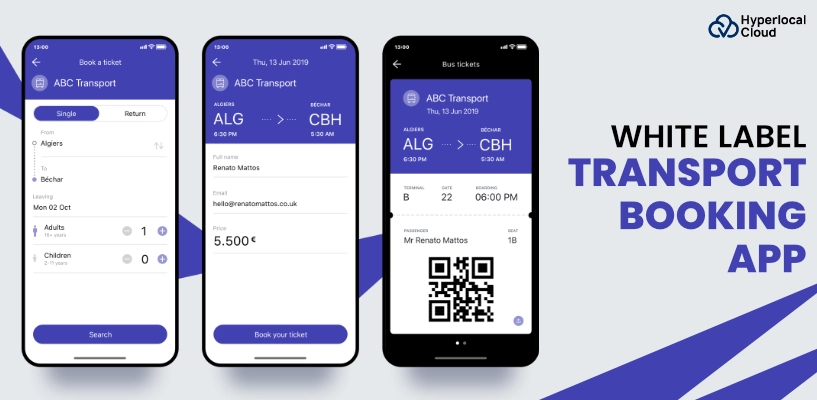
The transportation industry is rapidly adopting digital booking solutions to simplify reservations, improve fleet utilization, and deliver convenient travel experiences. From taxi services and bus operators to shuttle providers and transportation startups, businesses are investing in digital platforms to manage bookings and connect customers with transport services more efficiently.
A white label transport booking app offers a practical way to enter this market without developing an entire platform from scratch. Businesses can launch a branded solution with their own name, logo, colors, and business identity while using ready-made booking functionality and customizable features.
Hyperlocal Cloud offers a white label transport booking app solution starting at $7,000, helping businesses establish their own transport booking platform with a foundation for customization and growth. Depending on the business model, the solution can support booking management, customer accounts, payment integration, scheduling, and administrative operations.
Whether you want to launch a taxi booking service, bus reservation platform, airport transfer business, or a broader transportation marketplace, a white label solution can help you establish your digital presence and streamline operations.
What Is a White Label Transport Booking App?
A white label transport booking app is a ready-made or pre-developed software solution that businesses can customize and launch under their own brand. Instead of creating every component independently, companies use an existing software foundation and adapt it to their operational requirements.
The platform can be configured to support different transportation services, including passenger transfers, taxi bookings, bus reservations, shuttle services, and selected logistics or freight booking workflows.
For example, a transportation entrepreneur can launch an app that allows customers to select a destination, compare available services, choose a suitable time, and complete a reservation. Transport operators can manage bookings, while administrators oversee the platform through a centralized dashboard.
How Does a White Label Transport Booking App Work?
The general workflow includes the following steps:
- Business branding: Customize the platform with your business name, logo, brand colors, and other supported visual elements.
- Service configuration: Define the transportation categories, operating areas, vehicle types, pricing rules, and booking policies.
- Customer registration: Allow users to create accounts, manage their profiles, and access booking information.
- Booking management: Enable customers to search for transport options, enter trip details, select available services, and confirm reservations.
- Payment processing: Integrate supported payment gateways to collect payments or deposits.
- Operational management: Give administrators and transport operators tools to manage bookings, service availability, customer requests, and operational information.
- Performance monitoring: Review booking activity, transactions, cancellations, and other available business metrics.
The precise functionality depends on the selected modules, integrations, and customization scope.
Build Your Own Branded Transport Booking Platform Today
Types of Transport Booking Services You Can Offer
A white label transport booking platform can support different transportation business models. The appropriate configuration depends on the services you intend to offer and the booking workflows your customers need.
Taxi and Private Ride Booking
A taxi booking app allows customers to request local rides, schedule trips, and receive booking confirmations. Depending on the configuration, the platform may support fare estimates, driver assignment, location tracking, and trip status updates.
This model suits local taxi operators, private transportation companies, chauffeur services, and ride-booking startups.
Bus Ticket Booking
Bus booking functionality helps customers search routes, select travel dates, review schedules, and reserve seats. Operators can manage route information, departures, ticket availability, and passenger reservations.
Businesses can use this model to digitize intercity travel, regional transportation, private bus services, or scheduled passenger routes.
Airport Transfer and Shuttle Booking
Airport transfers and shuttle services often require advance reservations, pickup scheduling, passenger information, and destination management.
A dedicated booking workflow can help customers reserve airport pickups, hotel transfers, corporate shuttles, or event transportation before their journey.
Train and Other Passenger Transport Reservations
Businesses building a broader travel booking platform may want to incorporate train or other passenger transportation reservations. Such functionality may require access to authorized third-party inventory, schedule data, and reservation APIs.
The availability of these integrations depends on the relevant transport provider, commercial agreements, and technical requirements.
Truck and Freight Booking
Freight booking serves a different operational purpose from passenger transportation. It may involve shipment details, pickup and delivery locations, vehicle capacity, scheduling, and delivery status management.
Companies targeting logistics businesses should define these requirements separately because freight workflows may require additional modules and integrations.
Multi-Service Transportation Marketplace
A multi-service marketplace brings different transport providers or service categories together under one platform. Customers can explore available options through a unified interface, while administrators manage providers, booking activity, and business rules.
This model may suit entrepreneurs who want to build a transportation marketplace rather than operate a single fleet.
Essential Features of a White Label Transport Booking App
Features directly influence usability, operational efficiency, and the overall cost of a transportation booking solution. Businesses should prioritize features according to their service model instead of adding unnecessary functionality at launch.
User Registration and Profile Management
Customers should be able to register, sign in, maintain their personal details, and access their booking history. A clear account experience makes it easier to manage reservations and retrieve trip information.
Where applicable, profile management can also support saved passenger details, preferred locations, and communication preferences.
Search and Booking Management
The booking system should allow customers to enter their travel requirements, review available options, select a suitable service, and submit a reservation.
Depending on the transport category, booking fields may include pickup and drop-off locations, travel dates, departure times, passenger counts, vehicle categories, and special requests.
Real-Time Location Tracking
Location tracking can help customers and operators monitor vehicle movement during supported trips. It can also improve pickup coordination and provide visibility into trip progress.
This functionality generally requires suitable mapping, geolocation, device permissions, and connectivity integrations.
Scheduling and Advance Reservations
Scheduled booking allows customers to reserve transportation for a future date or time. This is particularly useful for airport transfers, corporate transportation, scheduled shuttles, and pre-booked private rides.
Administrators should be able to configure availability, booking windows, cancellation rules, and other applicable operational settings.
Fare Estimation and Pricing Management
Transparent pricing helps customers understand the expected cost before confirming a booking. Depending on the business model, fares may be based on distance, duration, route, vehicle category, passenger count, or a fixed service rate.
A configurable pricing system can help businesses manage service-specific charges and promotional offers.
Secure Payment Integration
Payment integration can support online payments, deposits, or other approved transaction methods. The available options depend on the payment provider, business location, currency requirements, and compliance obligations.
Businesses should also consider transaction records, refunds, cancellation adjustments, and reconciliation processes.
Booking Notifications
Automated notifications can inform customers about reservation confirmations, schedule changes, cancellations, and other important updates.
Notifications may be delivered through supported push notifications, email, or SMS services, depending on the integrations selected.
Reviews and Ratings
A rating and review system can allow customers to share feedback about their transportation experience. Businesses can use this information to identify service issues and evaluate provider performance.
Moderation and complaint-handling processes should be established to keep feedback useful and appropriate.
Admin Dashboard
The administrative dashboard serves as the central management interface for the platform. Depending on the solution configuration, it may provide tools for managing users, transport providers, bookings, pricing, transactions, service categories, and reports.
A well-organized dashboard helps administrators oversee daily operations without relying on multiple disconnected systems.
Multilingual and Multi-Currency Support
Businesses serving international customers may benefit from multilingual interfaces and multi-currency pricing. These capabilities can improve accessibility across markets, although translation, exchange-rate handling, and payment support may require additional configuration.
Cancellation and Refund Management
Clear cancellation policies help customers understand the terms of a booking. Administrative tools can support cancellation requests, refund processing, and applicable fee calculations according to business rules and payment-provider capabilities.
Different Panels of a Transport Booking Platform
A transport booking solution commonly involves separate interfaces for customers, transport providers, and administrators. Each interface serves a distinct purpose.
Customer Booking App
The customer-facing app enables users to discover transport services and manage their reservations.
Key capabilities may include:
- Registration and profile management
- Transport search and service selection
- Booking creation and confirmation
- Fare and payment information
- Booking history and cancellation requests
- Trip notifications and status updates
- Ratings and feedback
The interface should prioritize simple navigation, clear pricing, and a smooth booking process.
Driver or Transport Operator App
The driver or operator interface helps service providers manage their assigned work. Its exact functionality depends on whether the business offers on-demand rides, scheduled transport, or advance reservations.
Possible capabilities include:
- Provider registration and profile management
- Booking requests and assignment details
- Availability management
- Trip acceptance and status updates
- Navigation and location sharing
- Earnings or transaction summaries, where applicable
- Customer communication and service notifications
For bus reservation businesses, the operator interface may instead focus on routes, schedules, vehicle assignments, and passenger manifests.
Admin Dashboard
The admin dashboard gives the business owner or operations team centralized control over platform activity.
Potential capabilities include:
- Customer and provider management
- Booking and cancellation oversight
- Transport categories and service-area configuration
- Pricing and commission settings
- Payment and refund records
- Promotional offers
- Reporting and analytics
- Customer support and dispute management
The final dashboard should reflect the selected transport model rather than forcing every business into the same operational workflow.
Request a Personalized Transport Booking App Demo
Benefits of White Label Transport Booking Software
Faster Market Entry
Using an existing software solution can reduce the amount of development required compared with creating every component from the beginning. This may help businesses progress toward launch with a more defined scope.
Actual launch time depends on branding, testing, integrations, deployment requirements, and customization.
Lower Initial Development Effort
Building a complete booking ecosystem from scratch can require substantial investment in design, engineering, testing, and maintenance. A white label solution can reduce duplicated development work by providing reusable software components.
The total cost still depends on the features, third-party services, and support requirements selected.
Stronger Brand Identity
A branded application gives businesses greater control over how customers recognize and interact with their service. Customization may include the app name, logo, colors, and supported interface elements.
Brand consistency can help build recognition across customer touchpoints.
Centralized Booking Operations
A unified management dashboard can bring bookings, service providers, customer information, and transaction records into a common workflow.
This can reduce manual coordination and make it easier to monitor operational activity.
Improved Customer Convenience
Online booking lets customers review available services and make reservations without relying entirely on telephone calls or manual booking processes.
Clear confirmations, accessible booking records, and timely notifications can also improve the customer experience.
Flexible Business Models
A transportation platform can be configured for a single operator, a multi-provider marketplace, scheduled transportation, or a combination of supported services.
This flexibility allows businesses to align their booking workflows with their intended market.
Scalability for Future Expansion
As a business grows, it may need additional service categories, new operating areas, more providers, or more sophisticated integrations.
A scalable technical foundation can help accommodate these changes, subject to infrastructure capacity and the platform’s architecture.
Better Operational Visibility
Digital records and reporting can help businesses review booking volumes, cancellations, payment activity, and service performance.
These insights can inform operational improvements and business planning.
Who Can Benefit From a White Label Transport Booking Solution?
Transportation Startups
Entrepreneurs entering the mobility sector can use a white label platform to establish their own branded booking service. Starting with a focused market or transport category can help keep initial requirements manageable.
Taxi and Cab Companies
Existing taxi operators can introduce digital reservations, manage bookings centrally, and offer customers a convenient alternative to telephone-based booking.
Bus Operators
Bus businesses can use booking software to organize routes, departures, reservations, and passenger information, subject to the modules included in the solution.
Airport Transfer Companies
Airport transfer providers can manage advance reservations, pickup details, passenger requirements, and trip schedules through a structured booking workflow.
Corporate Transportation Providers
Companies providing employee shuttles, business travel, or scheduled transport may benefit from centralized reservations and service coordination.
Fleet Owners
Fleet businesses can use booking and operator management tools to coordinate service requests, vehicle availability, and trip information. Dedicated fleet maintenance and telematics features may require separate modules.
Travel Agencies
Travel agencies can expand their service offerings by incorporating transport reservations into their digital customer experience. Access to third-party inventory may require separate integrations and agreements.
Multi-Provider Marketplaces
Entrepreneurs can establish a marketplace that connects customers with independent transport providers. Provider onboarding, service-area rules, commission management, and payment distribution should be planned according to the business model.
How to Launch Your Own Transport Booking App
Launching a transport booking platform requires more than deploying an application. Businesses should plan the operational model, customer experience, provider workflows, and ongoing service management.
Step 1: Define Your Business Model
Determine whether you will offer taxi bookings, bus reservations, airport transfers, scheduled shuttles, freight services, or a multi-provider marketplace.
Your business model will determine the booking workflow, required users, pricing rules, and operational controls.
Step 2: Identify Your Target Market
Research the customers and transport providers you intend to serve. Consider demand, local competition, transportation regulations, customer expectations, and the operating areas you can support.
For a new business, beginning with a clearly defined market can simplify the launch plan.
Step 3: Select the Essential Features
Prioritize the capabilities required to run your service effectively. These may include customer registration, booking management, payment processing, notifications, provider management, and an admin dashboard.
Advanced functionality can be evaluated according to the initial budget and operational priorities.
Step 4: Customize the Platform
Work with your software provider to configure supported branding elements, service categories, booking fields, pricing rules, and operational workflows.
Document any functionality that requires additional development before confirming the project scope.
Step 5: Configure Integrations
Select appropriate payment gateways, mapping tools, notification services, and other required third-party systems.
Confirm API access, licensing, usage costs, and any regional restrictions before implementation.
Step 6: Test the Booking Workflow
Test the full customer journey, from registration and search to booking confirmation, payment, cancellation, and notifications.
Where applicable, also test provider assignment, trip status updates, refund handling, and administrative reporting.
Step 7: Prepare for Launch
Configure the production environment, publish supported applications, establish customer support procedures, and onboard transport providers.
Businesses should also prepare booking policies, privacy notices, terms of service, and other documentation appropriate to their markets.
Step 8: Monitor and Improve
After launch, review booking completion, cancellations, customer feedback, service reliability, and provider performance.
Use the findings to prioritize improvements and decide when additional features or operating areas should be introduced.
How Much Does a White Label Transport Booking App Cost?
The cost of a white label transport booking app depends on the platform’s existing capabilities, required features, integrations, branding, and deployment requirements.
Hyperlocal Cloud’s white label transport booking app solution starts at $7,000. This provides a defined starting point for businesses planning to launch their own branded transportation booking platform.
What Influences the Total Cost?
1. Core platform functionality
The selected customer, operator, and admin features influence the overall project scope. Businesses should identify which capabilities are essential for the initial launch.
2. Branding and customization
Visual branding and adjustments to supported workflows may affect the final price, depending on the extent of customization required.
3. Third-party integrations
Mapping services, payment gateways, SMS providers, notifications, and transport inventory APIs may involve additional implementation work and recurring third-party charges.
4. Platform requirements
Mobile applications, web-based booking, and administrative interfaces should be scoped according to the business’s needs and the existing solution’s supported capabilities.
5. Advanced transportation workflows
Features such as complex dispatch logic, route optimization, multi-provider settlement, or specialized freight management may increase project complexity.
6. Hosting, maintenance, and support
Infrastructure, monitoring, ongoing maintenance, software updates, and support arrangements should be evaluated separately where they are not included in the selected package.
Example Budget Planning
For planning purposes, businesses can start with the following cost framework:
- White label solution starting price: $7,000
- Additional customization: Based on the confirmed scope
- Third-party API and service fees: Based on usage and provider pricing
- Hosting and maintenance: Based on the selected arrangement
- Future enhancements: Based on business requirements
The $7,000 figure is the starting price, not a guarantee that every possible feature, integration, or recurring expense is included. Request a detailed quotation to confirm the deliverables, implementation scope, and payment terms.
Is a $7,000 White Label Transport Booking App a Good Investment?
A $7,000 starting price may be attractive to businesses that want a branded transport booking platform without funding a fully custom-built system from the outset.
However, the value depends on how closely the available functionality matches the business model. Before purchasing, review the customer and operator workflows, branding options, payment capabilities, integration requirements, source-code or licensing terms, support arrangements, and future customization options.
The right decision should be based on the total cost of ownership and operational fit, rather than the initial price alone.
Discuss Your Transport App Requirements With Our Experts
White Label Solution vs. Custom Transport App Development
Both white label software and custom development can support a transportation booking business, but they differ in implementation approach and resource requirements.
White Label Transport Booking Solution
A white label platform is generally appropriate when a business wants to use an existing software foundation and adapt it to its brand and operational needs.
Potential advantages include:
- Reuse of existing booking workflows
- Less need to build standard functionality from scratch
- A defined starting budget
- Branding and supported customization
- A practical starting point for market validation
Businesses should verify the available features and licensing terms before making a decision.
Custom Transport App Development
Custom development involves building software around the business’s specific requirements. It may be suitable for organizations that need highly specialized workflows, unique system architecture, or extensive integrations.
Potential considerations include:
- Greater control over system design
- Flexibility to implement specialized business rules
- More extensive design and engineering requirements
- A potentially higher initial investment
- Greater responsibility for long-term maintenance and technical decisions
Which Approach Should You Choose?
Choose a white label solution if the existing capabilities fit your core business requirements and you want a branded platform with a defined starting price.
Consider custom development if your operations require substantial functionality that cannot be accommodated through the existing product or reasonable customization.
The most appropriate approach depends on feature fit, launch priorities, technical requirements, and long-term business plans.
Why Choose Hyperlocal Cloud for a White Label Transport Booking App?
Selecting a software partner is an important decision because the platform must support both the customer experience and the business’s daily operations.
Hyperlocal Cloud offers a white label transport booking app solution starting at $7,000 for businesses planning to establish their own branded booking platform.
Branded Platform Approach
A white label approach allows businesses to establish a digital presence under their own identity, subject to the branding capabilities included in the selected solution.
Configurable Booking Workflows
Different transportation businesses have different booking requirements. Define the services, reservation rules, and administrative workflows your business needs, then confirm how they can be configured within the solution.
Business-Focused Feature Planning
A clear feature scope helps align the platform with your operational model. Prioritizing essential booking, payment, customer, and administrative functionality can help keep the initial project focused.
Defined Starting Investment
With pricing starting at $7,000, businesses have an initial budget reference for evaluating the solution. The final quotation should specify the included deliverables and any additional costs.
Support for Future Business Needs
Before implementation, discuss expected growth, integrations, technical support, maintenance, and the process for adding functionality later.
FAQs (Frequently Asked Questions)

Patt Cummins is an experienced content writer with over 10 years of experience creating clear and engaging content for technology-focused industries. He specializes in simplifying complex technical topics into easy-to-understand stories that educate readers, support brand communication, and help businesses effectively share their solutions.

Need Help With
Development?