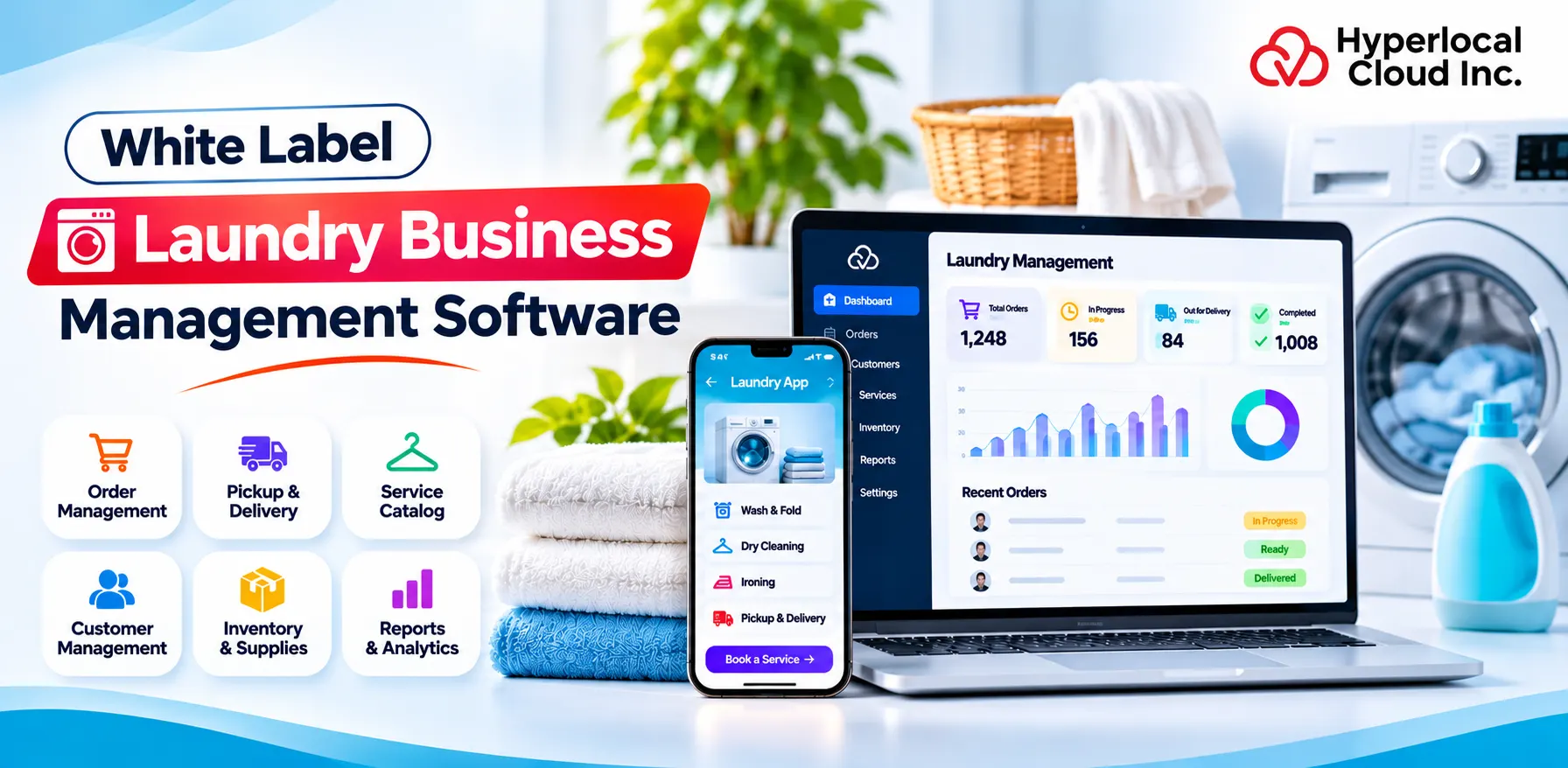
The laundry industry is evolving as customers increasingly prefer convenient, technology-driven services for washing, ironing, dry cleaning, and doorstep garment care. Traditional laundry businesses are gradually moving toward digital platforms that simplify order management, improve service delivery, and create better customer experiences.
Launching a digital laundry business requires more than a customer-facing mobile application. Business owners need a complete management system that connects customers, laundry staff, delivery partners, and administrators through a centralized platform.
White Label Laundry Business Management Software provides a ready-made solution that allows entrepreneurs, laundry service providers, and established businesses to launch their own branded laundry management platform. Instead of investing time and resources in building software from scratch, businesses can use an existing solution, customize its appearance, and configure its functionality according to their operational requirements.
Hyperlocal Cloud offers a white label laundry business management solution for $7,000, helping businesses establish their digital presence with an integrated platform for managing laundry operations, customer orders, staff activities, and delivery services.
Introduction to White Label Laundry Business Management Software
White label laundry business management software is a ready-made digital platform that businesses can customize with their own brand identity and use to manage laundry-related operations. It connects different participants involved in the laundry service process, including customers, administrators, laundry professionals, and delivery partners.
The software helps businesses manage activities such as service selection, order booking, garment collection, washing, ironing, dry cleaning, billing, and final delivery. Rather than handling these processes through separate tools or manual records, businesses can coordinate their operations through one centralized system.
For example, a laundry startup can launch its own branded application where customers schedule garment pickups, select cleaning services, make payments, and monitor order progress. At the same time, the business administrator can manage orders, assign delivery partners, monitor staff activities, and review operational performance.
The growing demand for convenient laundry services makes digital management solutions valuable for businesses looking to expand their reach.
With a white label solution, entrepreneurs can focus on building their customer base, developing partnerships, and expanding service coverage instead of spending months developing core software infrastructure.
Take Your First Step Toward a Successful Laundry Business
What Makes White Label Laundry Management Software Different?
White label software gives businesses access to an existing software foundation that can be customized and launched under their own brand name.
Unlike traditional software development, where every component must be planned and built independently, a white label solution provides an established starting point. Businesses can configure the platform based on their service offerings, operational requirements, and target customers.
Here are the major characteristics that distinguish white label laundry software.
Ready-Made Software Infrastructure
Businesses receive an existing software foundation with essential laundry management capabilities. This reduces the effort involved in developing common functionalities independently.
Business Branding and Identity
Companies can incorporate their logo, brand name, application colors, and other visual elements to create a consistent customer experience.
Configurable Business Operations
Laundry businesses can organize their services, pricing, operating locations, order workflows, and delivery arrangements according to their business model.
Faster Business Launch
Since the core software is already developed, businesses can focus on configuration, testing, branding, and deployment rather than beginning the entire development process from zero.
Flexible Expansion Opportunities
A well-configured platform can support business growth through additional service categories, operational locations, and customer acquisition strategies.
White Label Software vs. Custom Laundry Software Development
Both approaches can help businesses establish digital laundry operations, but their implementation processes differ.
| Comparison | White Label Software | Custom Software |
|---|---|---|
| Starting point | Existing software | Built from scratch |
| Development effort | Lower | Higher |
| Branding | Customizable | Fully customizable |
| Initial investment | Generally lower | Generally higher |
| Implementation | Typically faster | Usually longer |
| Functionality | Based on existing solution and customization | Designed around specific requirements |
| Best suited for | Startups and established laundry businesses | Businesses requiring highly specialized systems |
A white label solution is a practical choice for businesses that want to enter the digital laundry market with a defined initial investment and an established software foundation.
Common Operational Challenges in the Laundry Industry
Managing a laundry business involves several interconnected activities. From receiving garments to completing deliveries, every stage requires proper coordination. When these processes depend heavily on manual communication, businesses may experience delays, errors, and operational inefficiencies.
Understanding these challenges helps explain why digital laundry management software has become an important business investment.
Manual Order Booking and Record Management
Traditional laundry businesses often receive orders through telephone calls, messaging applications, or physical store visits. Maintaining customer details and order records manually becomes difficult as the number of daily bookings increases.
A centralized ordering system helps organize customer information, service selections, booking details, and order histories.
Lost Garments and Incorrect Order Identification
Laundry businesses process garments from multiple customers simultaneously. Without a reliable identification process, staff members may accidentally mix orders or misplace individual items.
Digital order identification and garment tagging can help employees associate garments with the correct customer and booking.
Inefficient Pickup and Delivery Coordination
Coordinating pickups and deliveries across different locations requires effective scheduling and communication. Manual assignments can create unnecessary travel, missed appointments, and delivery delays.
A digital platform can simplify delivery assignments and provide visibility into order progress.
Payment Collection and Billing Errors
Calculating service charges, applying discounts, and maintaining payment records manually can create accounting inconsistencies.
Integrated billing and payment management help businesses maintain more organized transaction records.
Difficulty Managing Multiple Laundry Outlets
Businesses operating across multiple branches need visibility into orders, staff activities, service availability, and revenue from different locations.
Without centralized management, coordinating these operations can become increasingly complicated.
Limited Customer Communication and Retention
Customers want to know when their garments have been collected, processed, and delivered. Poor communication can reduce confidence and affect repeat business.
Automated notifications and order-status updates help maintain communication throughout the service journey.
How Our Laundry Business Management Software Works
A digital laundry platform coordinates the entire service lifecycle, from the moment a customer books a service to the final delivery of cleaned garments.
The workflow connects customers, administrators, laundry staff, and delivery partners to ensure that every order moves through the appropriate stages.
Step 1: Customer Places a Laundry Order
Customers access the branded mobile application or supported ordering interface, select the required laundry services, choose their garments or service preferences, and provide pickup details.
They can review available services, check estimated charges, and select a suitable collection time.
Step 2: Pickup Is Scheduled
Once the customer confirms the booking, the system records the order and pickup information.
The administrator can review the booking and arrange collection according to delivery availability and business operating schedules.
Step 3: Driver Collects the Garments
A delivery partner receives the assigned pickup request and travels to the customer’s location.
After collecting the garments, the driver updates the order status so the business and customer can follow the collection process.
Step 4: Staff Receives and Tags Garments
Laundry staff receive the collected garments and associate them with the corresponding order.
Garment tagging or QR-based identification, where configured, helps maintain accurate order identification throughout processing.
Step 5: Washing, Ironing, and Dry Cleaning
The laundry team processes garments according to the selected services and business-specific cleaning procedures.
Staff can update processing statuses to maintain visibility into the order’s progress.
Step 6: Quality Checks and Packaging
After cleaning, garments undergo the required inspection process. The team checks whether the requested services have been completed and prepares the order for packaging.
Step 7: Delivery Is Assigned
Once an order is ready, the administrator can assign a delivery partner to complete the return journey.
The delivery partner receives the necessary order and customer information.
Step 8: Customer Receives the Completed Order
The driver delivers the garments to the customer and updates the final order status.
The customer can review the completed service, access order information, and provide feedback.
Request a Demo of Our White Label Laundry Solution
Essential Features of White Label Laundry Business Management Software
A successful laundry management platform needs dedicated functionality for every participant involved in service delivery. Instead of managing customer bookings, laundry processing, and deliveries independently, the software connects all these activities.
The following features are organized according to individual user panels.
1. Admin Management Panel
The admin panel provides business owners and authorized managers with centralized control over laundry operations.
Centralized Business Dashboard
Administrators can access an overview of important business information, including order activity, customer records, service operations, and business performance.
Order and Service Management
Manage incoming bookings, review customer requirements, update order statuses, and coordinate the different stages of laundry processing.
Revenue and Expense Tracking
Maintain financial records and review business transactions to understand revenue performance and operational expenses.
Branch and Location Management
Manage multiple laundry outlets and configure location-specific services, pricing, and operational information.
Staff and Role Management
Create staff accounts, assign responsibilities, and control access permissions according to employee roles.
Customer Database
Maintain customer profiles, contact details, booking histories, and service preferences in one centralized location.
Promotional Campaign Management
Configure promotional offers, discounts, and marketing campaigns to attract new customers and encourage repeat bookings.
2. Customer Application
The customer application provides a convenient way for users to discover laundry services and manage their bookings.
Easy Registration and Login
Customers can create accounts and access the application through supported authentication methods.
Laundry Service Selection
Browse available services such as washing, ironing, dry cleaning, and specialized garment care.
Pickup and Delivery Scheduling
Select preferred collection and delivery dates or time slots according to business availability.
Real-Time Order Updates
Follow order progress through available status notifications and tracking functionality.
Multiple Payment Options
Make payments through the supported payment methods configured for the business.
Order History and Repeat Booking
Review previous transactions and conveniently place new orders using past service preferences.
Ratings and Feedback
Share experiences and feedback to help businesses understand customer satisfaction.
3. Delivery Partner Application
The delivery application helps drivers manage garment pickups and completed laundry deliveries.
Pickup and Delivery Assignments
View assigned tasks and access the relevant customer and order information.
GPS Navigation
Use integrated mapping functionality to navigate toward pickup and delivery locations.
Route Management
Organize delivery activities and coordinate assigned stops according to available routing capabilities.
Order Status Updates
Update pickup, transit, and delivery statuses to maintain operational visibility.
Digital Delivery Confirmation
Record successful deliveries through supported confirmation methods.
Payment Collection
Manage applicable payment collection activities when enabled for the business.
4. Laundry Staff Panel
The laundry staff panel helps employees organize garment processing activities and maintain order accuracy.
Garment Receiving and Tagging
Record incoming garments and associate them with their corresponding customer orders.
Washing and Cleaning Status
Update processing stages to help administrators monitor the progress of each booking.
Order Sorting and Processing
Organize garments according to customer requirements, selected services, and processing categories.
Quality Inspection
Record inspection progress before garments move to packaging.
Packaging Management
Organize completed garments for collection or delivery.
Ready-for-Delivery Notifications
Update order readiness so administrators and delivery partners can coordinate the next operational stage.
Advanced Technologies That Improve Laundry Business Operations
Modern laundry management software can incorporate advanced technologies to improve operational planning, reduce repetitive tasks, and provide better visibility into business activities.
These technologies help laundry businesses move beyond basic order management and build more efficient service operations.
AI-Powered Demand Forecasting
Artificial intelligence can analyze historical order information, customer booking patterns, and seasonal demand to estimate future service requirements.
For example, a laundry business may experience increased demand during weekends, holidays, or particular seasons. Demand forecasting can help managers plan staff availability, cleaning capacity, and delivery resources accordingly.
Automated Pickup and Delivery Scheduling
Intelligent scheduling capabilities can help businesses organize collection and delivery appointments based on customer preferences, driver availability, and service locations.
This can reduce scheduling conflicts and improve the coordination of daily delivery activities.
Smart Garment Identification Using QR Codes
QR code-based garment identification can help laundry employees associate individual garments or customer batches with the correct orders.
Staff members can scan the relevant codes to retrieve order information, update processing stages, and reduce garment identification errors.
Predictive Equipment Maintenance
Laundry businesses that operate commercial washing machines, dryers, and other equipment can benefit from predictive maintenance capabilities.
Where equipment sensor data and suitable integrations are available, analytics can help identify unusual operating patterns and indicate when maintenance may be required.
Data-Driven Business Analytics
Business analytics can help managers understand order volumes, popular services, customer activity, revenue trends, and operational performance.
These insights support better decisions about service pricing, staffing, marketing campaigns, and business expansion.
Automated Customer Support
Automated communication and chatbot integrations can help customers find answers to common questions about service availability, pricing, booking procedures, and order statuses.
This can reduce repetitive customer service inquiries and allow employees to focus on more complex requests.
Types of Laundry Businesses That Can Use This Software
White label laundry business management software can support different business models, from small local laundromats to large commercial laundry service providers.
Businesses can configure their services, operating workflows, and delivery arrangements according to their target market.
Self-Service Laundromats
Self-service laundromats allow customers to access washing and drying facilities independently. Digital software can help these businesses manage customer accounts, service information, bookings, payments, and operational records.
Dry Cleaning Businesses
Dry cleaning businesses handle garments that require specialized cleaning procedures. A digital management platform can help organize customer requests, garment identification, processing stages, billing, and delivery arrangements.
Doorstep Laundry Service Providers
Doorstep laundry businesses collect garments directly from customer locations and return them after cleaning. They can use the software to manage online bookings, pickup scheduling, delivery assignments, and customer notifications.
Laundry Franchises and Chains
Laundry franchises operating across different locations need centralized management and consistent service workflows. A management platform can help coordinate branch-level activities while providing administrators with broader business visibility.
Commercial Laundry Operators
Commercial laundry businesses serve organizations that require regular garment and linen cleaning. These may include hospitals, restaurants, hotels, and corporate facilities.
The software can help manage recurring orders, institutional customer information, service records, and delivery coordination.
Hotel and Hospitality Laundry Services
Hotels and hospitality businesses process large quantities of linen, towels, uniforms, and other washable items. Digital tracking and processing records can help organize these operations and improve accountability.
Industrial Laundry Facilities
Industrial laundry facilities manage high-volume cleaning operations for commercial and institutional customers. A configurable management platform can support order coordination, customer accounts, processing records, and operational reporting.
Get a Ready-Made Laundry Platform at an Affordable Cost
Business Benefits of Launching Your Own White Label Laundry Platform
Launching a branded laundry management platform is not just about offering customers another way to place orders. It creates an opportunity to improve internal processes, establish a recognizable business identity, and develop new revenue opportunities.
Here are the major benefits businesses can achieve.
Faster Market Entry
Developing an entire software platform independently can require considerable time, technical expertise, and financial resources.
A ready-made white label solution provides an established foundation that businesses can configure and prepare for deployment. This allows entrepreneurs to concentrate on service operations, marketing, and customer acquisition.
Lower Initial Development Investment
Custom software development requires planning, designing, coding, testing, and deploying different components.
A white label solution can reduce the need to develop standard functionalities from scratch. Businesses can use their initial investment more strategically while customizing the platform to meet their requirements.
Stronger Brand Recognition
A branded mobile application and management platform help businesses establish a consistent digital identity.
Customers can interact with the business through its own logo, colors, name, and service presentation rather than relying entirely on third-party marketplaces.
Improved Operational Efficiency
Centralized order management makes it easier to coordinate customer bookings, garment processing, staff assignments, and delivery activities.
Businesses can reduce their dependence on disconnected spreadsheets, manual records, and repetitive communication.
Better Customer Retention
Convenient booking, clear service information, order updates, and repeat-order functionality can encourage customers to use the platform regularly.
Businesses can also introduce membership programs, promotional offers, and personalized service packages to strengthen customer relationships.
Centralized Business Control
Administrators can manage important business activities through a centralized interface. This provides better visibility into order progress, customer information, staff activities, and business transactions.
Opportunities for Multi-Location Expansion
As the business grows, additional locations and service areas can be incorporated according to the platform’s supported configuration.
This makes it easier to establish a consistent management approach across multiple outlets.
Revenue Models for a Laundry Business
Selecting an appropriate revenue model is essential for building a sustainable laundry business. A digital platform allows business owners to experiment with different pricing strategies based on customer demand, service categories, and operating expenses.
The following models can help businesses generate revenue through their laundry services.
Pay-Per-Order Model
Customers pay for each laundry booking according to the selected services, garment quantities, or applicable weight-based pricing.
For example, customers may pay separate charges for washing, ironing, dry cleaning, or specialized garment care.
This model is suitable for businesses serving customers with different laundry requirements.
Monthly Subscription Packages
Businesses can offer monthly packages that include a predefined number of laundry services or cleaning allowances.
For example, a subscription package may include weekly garment collection and a specified monthly laundry allowance.
Recurring packages can help businesses establish predictable customer relationships and revenue opportunities.
Laundry Membership Plans
Membership programs can provide customers with exclusive discounts, priority booking, reduced delivery charges, or special service benefits.
Businesses can offer different membership levels according to customer usage patterns and spending preferences.
Premium Service Charges
Laundry providers can charge additional fees for specialized services such as express cleaning, delicate garment care, stain treatment, or urgent delivery.
These services can create additional revenue opportunities while catering to customers with specific requirements.
Express Laundry Services
Customers who require faster turnaround times may be willing to pay additional charges for priority processing.
Businesses can introduce express service categories with clearly defined availability and operational conditions.
Corporate and Institutional Contracts
Laundry businesses can partner with hotels, hospitals, restaurants, salons, gyms, and other organizations that require regular cleaning services.
These partnerships can generate recurring business through scheduled service agreements and bulk orders.
Franchise-Based Expansion
Established laundry businesses can expand through franchise arrangements.
They can introduce their brand and operational model into new locations while generating revenue through franchise fees, licensing arrangements, or other agreed commercial terms.
Customization Options Available in White Label Laundry Software
Every laundry business operates differently. A local dry cleaning store may require a different workflow from a doorstep laundry service or a multi-location commercial laundry company.
White label customization helps businesses align the software with their brand identity and operational requirements.
Logo, Brand Name, and Color Customization
Businesses can incorporate their own logo, application name, brand colors, and visual elements to create a consistent experience across supported interfaces.
Custom Service Categories and Pricing
Configure laundry services according to the business offerings. This may include washing, ironing, dry cleaning, stain removal, delicate garment care, and specialized cleaning packages.
Businesses can also define applicable service charges and pricing structures.
Location-Based Service Availability
Configure service coverage according to operational locations and delivery capabilities.
For businesses operating across multiple areas, location-based configurations can help manage service availability and customer bookings.
Payment Gateway Configuration
Integrate supported payment gateways to allow customers to complete transactions through available online payment methods.
Payment options can be configured according to the business’s target market and payment requirements.
Custom Notification Settings
Configure customer notifications for important order events, including booking confirmation, garment collection, processing updates, and delivery completion.
Third-Party API Integrations
Businesses may require external services for payment processing, maps, communication, analytics, and other operational requirements.
Supported third-party integrations can be configured according to the project scope.
Business-Specific Workflow Configuration
Laundry businesses can define how orders move through different operational stages.
For example, a dry cleaning business may require additional garment inspection and specialized processing stages compared with a standard washing service.
Customization helps align the software with these specific operational differences.
Turn Your Laundry Business Idea into a Digital Platform
White Label Laundry Business Management Software Development Process
Although white label software provides an existing foundation, businesses still need a structured implementation process to ensure that the platform aligns with their operational requirements.
A systematic approach helps identify configuration requirements, establish the desired brand experience, and prepare the solution for launch.
Step 1: Business Requirement Analysis
The process begins with understanding the business model, target audience, service categories, operating locations, and delivery requirements.
The development team identifies the required panels, workflows, integrations, and customization needs.
Step 2: Platform Configuration and Customization
The existing software is configured according to the identified requirements.
This may involve adjusting service categories, pricing rules, order workflows, delivery settings, and other business-specific parameters.
Step 3: UI/UX Branding
The platform’s visual presentation is aligned with the business identity.
The team incorporates the approved logo, colors, brand elements, and interface adjustments to create a consistent user experience.
Step 4: Third-Party Integration
Required external services are configured according to the project scope.
These may include payment gateways, mapping services, push notifications, communication tools, and other supported APIs.
Step 5: Testing and Quality Assurance
The platform undergoes functional testing to identify issues before deployment.
The testing process can cover registration, order booking, payment processing, order-status updates, administrative operations, and delivery workflows.
Step 6: Deployment and Launch
After configuration and testing, the software is prepared for deployment.
The business can complete the required launch activities, including domain configuration, app publishing where applicable, and operational setup.
Step 7: Post-Launch Technical Support
After deployment, businesses may require assistance with configuration adjustments, technical issues, integrations, and operational questions.
The available support arrangements should be confirmed according to the selected service agreement.
Technology Stack Behind Our Laundry Management Platform
A reliable laundry management platform requires an appropriate technology foundation to support its interfaces, business logic, data management, integrations, and deployment requirements.
The exact technology stack depends on the existing solution architecture and the selected implementation requirements.
Frontend Technologies
Frontend technologies are responsible for the visual interfaces that customers, administrators, laundry employees, and delivery partners interact with.
Common technologies include React.js, HTML5, CSS3, and JavaScript.
Backend Technologies
Backend technologies handle business logic, user authentication, order processing, service management, and communication between different application components.
Common backend options include Node.js, PHP, Python, and other suitable server-side technologies.
Database Management
The database stores important information such as customer profiles, service details, orders, transactions, delivery information, and operational records.
Depending on the architecture, database technologies may include MySQL, PostgreSQL, or MongoDB.
Mobile Application Frameworks
Mobile application frameworks support the development and maintenance of customer and operational applications.
Technologies such as Flutter and React Native can be considered according to the required application architecture.
Cloud Infrastructure
Cloud infrastructure provides hosting resources for application deployment, database operations, storage, and other backend services.
Infrastructure selection depends on expected traffic, performance requirements, security considerations, and scalability needs.
Payment Integrations
Payment integrations allow businesses to accept online transactions through supported payment gateways.
The selected provider depends on the target market, supported currencies, transaction requirements, and business preferences.
Maps and Notification APIs
Mapping services can support address selection, location identification, and delivery navigation.
Notification services help communicate important booking updates and operational information to customers and relevant staff members.
White Label Laundry Business Management Software Cost – $7,000
The cost of launching a laundry management app depends on the software architecture, required functionality, customization requirements, integrations, and deployment preferences.
For entrepreneurs and established laundry businesses looking for a ready-made solution, Hyperlocal Cloud offers White Label Laundry Business Management Software for $7,000.
This solution provides a starting point for businesses that want to establish their own branded laundry platform without investing in developing every core component independently.
What Do You Get for $7,000?
The $7,000 white label solution is designed to help businesses manage their digital laundry operations through an integrated software platform.
Key solution components include:
-
Ready-Made Software Solution: An existing laundry management platform that reduces the need to build standard functionality from scratch.
-
Business Branding: Customization of supported brand elements, including logo, business name, and visual identity.
-
Admin Management: Tools for managing customers, services, orders, and business operations.
-
Customer Application: A digital interface for customers to explore services and manage laundry bookings.
-
Delivery Management: Functionality for coordinating garment pickups and completed deliveries.
-
Laundry Staff Management: Tools to organize garment processing and operational activities.
-
Order Management: Support for tracking orders through different service stages.
-
Payment Integration: Configuration of supported payment options according to project requirements.
Why Choose a Ready-Made Solution for $7,000?
Building a laundry management app from scratch requires businesses to invest in planning, interface development, backend engineering, integrations, and quality assurance.
A white label solution offers an alternative by providing an existing software solution that can be customized according to business needs.
This approach can help businesses:
-
Reduce initial software development effort.
-
Establish their own digital brand.
-
Organize laundry operations through a centralized platform.
-
Introduce online booking and delivery services.
-
Focus on customer acquisition and business expansion.
Are There Any Additional Costs?
Apart from the initial software investment, businesses should consider other expenses that may apply to their deployment and operating requirements.
These may include:
-
Cloud hosting and server infrastructure.
-
Domain registration.
-
Third-party API subscriptions.
-
Payment gateway transaction charges.
-
App store publishing fees, where applicable.
-
Additional customization and integration work.
-
Ongoing maintenance and support arrangements.
The final project scope and inclusions should be confirmed before implementation.
Transform Traditional Laundry Operations with Smart Software
Why Choose Hyperlocal Cloud for Laundry Management Software?
Choosing the right technology partner is an important decision when launching a digital laundry business. Businesses need a solution that supports their operational requirements while providing flexibility for future improvements.
Hyperlocal Cloud offers white label software solutions designed to help entrepreneurs and established businesses introduce digital platforms across different industries.
Here are some reasons to consider Hyperlocal Cloud for your laundry management software requirements.
Ready-Made Software Expertise
A ready-made software solution helps businesses avoid developing standard platform components independently. This provides a practical starting point for launching a digital laundry operation.
Business-Focused Customization
Different laundry businesses have different requirements. Customization options help align the software with specific services, branding preferences, operational workflows, and business models.
Scalable Architecture
Businesses should consider their future requirements when selecting software. A suitable architecture can support planned improvements, additional services, and expansion according to technical capacity.
Branding Flexibility
White label capabilities allow businesses to establish their own identity through supported branding customizations.
Technical Assistance
Implementation may require assistance with platform configuration, integrations, deployment, and technical troubleshooting. Businesses can discuss the available support arrangements with the Hyperlocal Cloud team.
Faster Implementation
Using an existing software foundation can reduce the development effort associated with building standard functionality from scratch.
This allows businesses to focus on preparing their services, organizing operations, and establishing their market presence.
FAQs (Frequently Asked Questions)

Patt Cummins is an experienced content writer with over 10 years of experience creating clear and engaging content for technology-focused industries. He specializes in simplifying complex technical topics into easy-to-understand stories that educate readers, support brand communication, and help businesses effectively share their solutions.

Need Help With
Development?