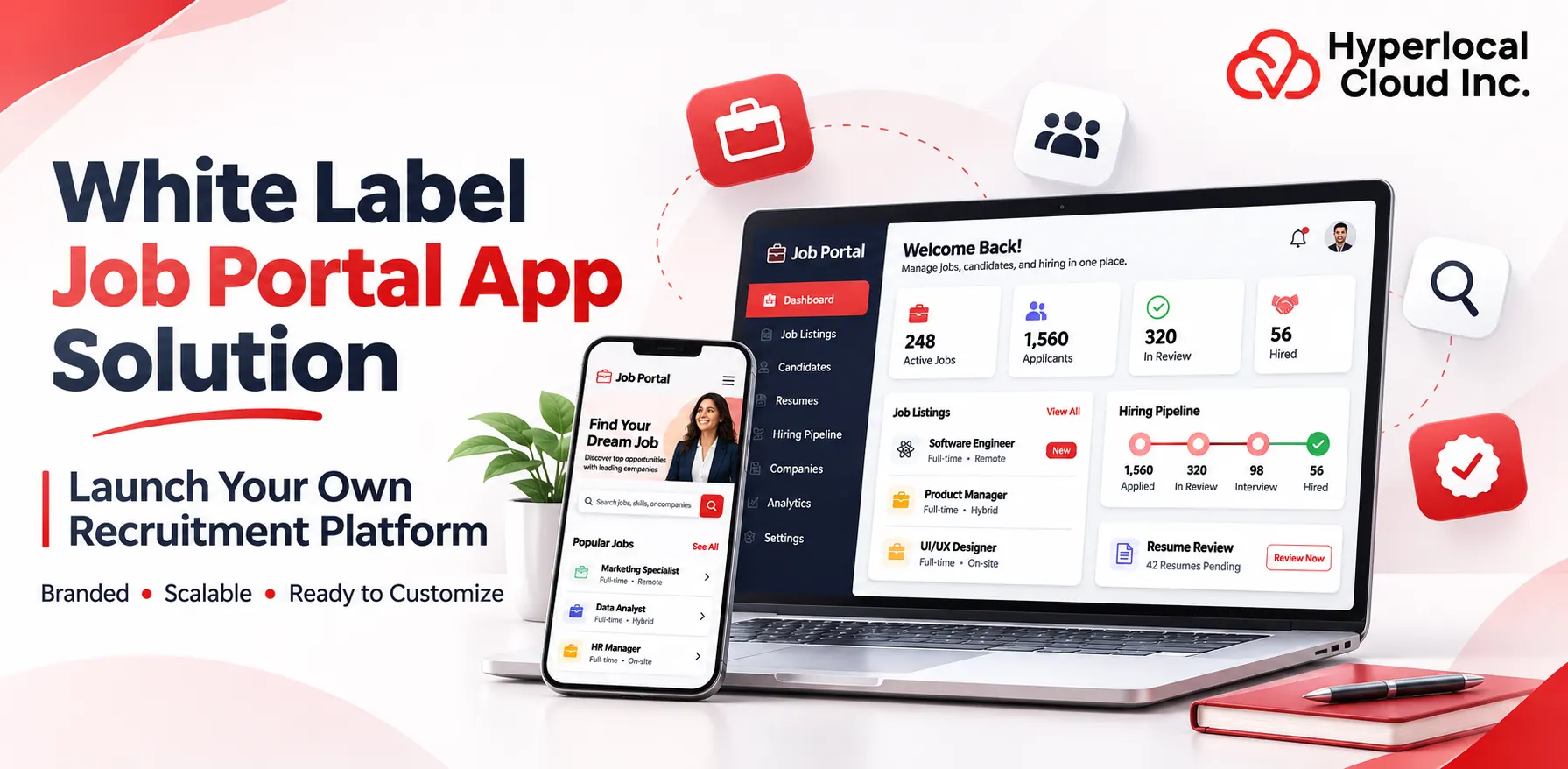
Launch your own recruitment business with a powerful white label job portal app designed to connect employers with qualified candidates. Whether you operate a recruitment agency, staffing company, employment marketplace, or startup, our ready-to-launch job portal solution provides the essential tools to manage job listings, candidate profiles, employer accounts, and recruitment activities through a centralized platform.
With Hyperlocal Cloud’s white label job portal software, you can establish a recruitment platform under your own brand without building every component from scratch. Customize the platform’s appearance, configure business workflows, manage job postings, and provide employers and job seekers with convenient digital experiences.
Our job portal platform is designed to support different recruitment business models, offering functionality for candidate registration, employer management, job discovery, application tracking, and administrative control.
What Is White Label Job Portal Software?
White label job portal software is a ready-made recruitment platform that businesses can customize and launch under their own brand identity. It provides the infrastructure and functionality required to operate an online job marketplace where employers can publish vacancies and candidates can discover employment opportunities.
Instead of investing in building an entire recruitment platform from the beginning, entrepreneurs can use a white label solution to establish their job portal with an existing software foundation. Depending on the product configuration, businesses can customize the interface, branding, features, user roles, and monetization options.
A white label job portal can serve recruitment agencies, staffing companies, employment marketplaces, educational institutions, and niche hiring businesses.
The platform typically includes three major components: a candidate interface, an employer dashboard, and an administrative panel. These components work together to simplify recruitment activities, improve communication, and organize job application workflows.
With job portal app development, businesses can focus on building their recruitment brand, attracting employers, growing their candidate network, and creating a sustainable employment marketplace.
Start Building Your Recruitment Marketplace Today!
How Does Our Job Portal Platform Work?
A successful recruitment marketplace needs an efficient connection between job seekers, employers, and administrators. Our job portal software organizes these activities through dedicated user interfaces and centralized management capabilities.
1. Job Seekers Register and Apply
Candidates create accounts, complete their professional profiles, upload resumes, explore available vacancies, and submit applications for suitable positions.
2. Employers Publish Job Opportunities
Employers register their companies, create job listings, define candidate requirements, review applications, and manage their recruitment activities.
3. Administrators Manage the Platform
Administrators oversee candidate and employer accounts, monitor job listings, manage subscriptions, configure platform settings, and review business performance.
This connected workflow helps businesses operate their recruitment marketplace while providing a structured experience for employers and job seekers.
Powerful Features of Our White Label Job Portal App
A feature-rich recruitment platform makes it easier to manage job vacancies, candidate profiles, employer accounts, and hiring activities. Our job portal software brings together dedicated functionalities for job seekers, employers, and administrators to support the complete recruitment journey.
Job Seeker App Features
Provide candidates with a convenient way to discover employment opportunities, manage professional profiles, and connect with potential employers.
1. Easy Registration and Login
Allow candidates to register using their email addresses, phone numbers, or supported social login options. A straightforward onboarding experience helps new users access the platform and begin exploring available opportunities.
2. Candidate Profile Management
Enable job seekers to create professional profiles containing their educational qualifications, employment history, skills, certifications, and career preferences. Employers can use this information to evaluate potential candidates.
3. Resume Upload and Resume Builder
Allow candidates to upload existing resumes or create professional resumes using available profile information. This functionality helps job seekers present their qualifications when applying for vacancies.
4. Advanced Job Search and Filters
Provide search functionality that allows users to discover jobs based on job titles, industries, experience levels, employment types, salary expectations, and locations.
5. Location-Based Job Discovery
Help candidates discover employment opportunities in preferred locations. Location filters can make it easier to identify nearby vacancies or explore opportunities in other cities and regions.
6. Personalized Job Recommendations
Recommend relevant vacancies based on candidate skills, experience, qualifications, and selected preferences, subject to the platform’s recommendation capabilities.
7. Job Alerts and Notifications
Keep candidates informed about new vacancies, application updates, interview invitations, and other important recruitment activities through supported notification channels.
8. Save and Apply for Jobs
Allow users to bookmark interesting vacancies and submit applications when they find suitable positions. This makes the job search process more organized and convenient.
9. Application Status Tracking
Provide candidates with visibility into their application progress, such as submitted, under review, shortlisted, or other employer-defined statuses.
10. In-App Messaging
Enable communication between candidates and employers through supported messaging functionality, helping both parties coordinate recruitment-related discussions.
Employer Dashboard Features
An employer dashboard gives companies and recruiters the tools they need to publish vacancies, discover potential candidates, and manage recruitment activities.
1. Employer Registration and Login
Allow businesses and recruiters to create accounts and access dedicated employer dashboards. The onboarding process can collect essential company information and account details.
2. Company Profile Management
Employers can create company profiles featuring business descriptions, logos, industry information, contact details, and other relevant information to establish credibility among candidates.
3. Job Posting and Management
Provide employers with tools to publish job vacancies, edit descriptions, update hiring requirements, and manage active or expired job listings.
4. Candidate Search
Allow employers to explore candidate profiles using available search filters, qualifications, experience, skills, and other relevant criteria.
5. Resume Database Access
Give authorized employers access to candidate resumes and professional profiles according to subscription permissions and platform privacy settings.
6. Applicant Management
Organize applications received for different job vacancies. Employers can review candidate information, shortlist applicants, update application statuses, and manage their hiring pipeline.
7. Interview Scheduling
Help recruiters coordinate interviews with shortlisted candidates through scheduling functionality and relevant notifications.
8. Featured Job Listings
Allow employers to promote selected vacancies through featured or sponsored job placements, depending on the platform’s monetization configuration.
9. Subscription Management
Provide access to employer subscription packages, job posting limits, premium features, and payment history.
10. Candidate Communication
Support communication between recruiters and applicants through available messaging or notification features.
Admin Panel Features
The admin panel provides centralized control over the recruitment marketplace. Platform owners can manage users, oversee activities, configure business settings, and monitor platform performance.
1. Centralized Admin Dashboard
Access important platform information, including user registrations, employer accounts, job listings, subscriptions, and recruitment activities.
2. Candidate and Employer Management
View and manage registered candidates and employers. Administrators can review account information, handle account-related issues, and manage user permissions.
3. Job Listing Management
Monitor published vacancies, review submitted job listings, manage inappropriate content, and control job publication settings.
4. Subscription and Package Management
Create employer subscription plans, define job posting limits, configure package benefits, and manage available membership options.
5. Payment Management
Monitor transactions, subscription payments, payment records, and supported payment gateway activities.
6. Content Management System
Manage important website content, informational pages, banners, categories, and other platform resources through available administrative tools.
7. Reports and Analytics
Review business performance indicators, user activity, job posting trends, employer engagement, and subscription-related information.
8. Notification Management
Configure relevant notifications for account activities, job updates, applications, and other platform events.
9. Platform Configuration
Manage business settings, branding elements, job categories, location preferences, and other configurable platform options.
10. Security and Access Control
Manage administrative permissions and access levels to help protect sensitive platform information and maintain controlled operations.
Launch a Feature-Rich Job Portal Without Building from Scratch
Why Choose Our White Label Job Portal Solution?
Launching a recruitment marketplace requires more than publishing job vacancies. Businesses need a reliable platform that simplifies recruitment operations, supports branding requirements, and provides opportunities for business growth.
Our white label job portal software provides a ready-made solution that businesses can configure according to their recruitment objectives.
Faster Business Launch
Starting with a ready-made platform can reduce the time required to establish core recruitment functionality compared with developing every component from scratch. You can focus on branding, platform configuration, and business preparation.
Reduced Initial Development Effort
A white label solution provides an existing software foundation, helping businesses avoid the need to build every standard recruitment feature independently. This can reduce initial development effort and simplify project planning.
Complete Brand Customization
Establish your own identity with customized logos, colors, platform branding, and supported interface elements. Build a recognizable recruitment marketplace under your business name.
Flexible Business Models
Configure different revenue opportunities through employer subscriptions, paid job listings, featured vacancies, premium accounts, and other supported monetization options.
Centralized Recruitment Management
Manage candidate accounts, employer profiles, job listings, applications, and platform operations through a centralized administrative environment.
Scalable Business Operations
Build a foundation that can accommodate evolving recruitment requirements. As your marketplace grows, you can evaluate additional functionality, infrastructure capacity, and integrations.
Improved User Experience
Provide candidates and employers with dedicated interfaces that simplify important activities, from searching for vacancies to managing applications.
Simplified Employer Management
Give recruiters access to tools for job publishing, candidate discovery, application review, and recruitment coordination.
How to Make Money with a Job Portal App?
A job portal business can generate revenue through multiple monetization strategies. Selecting the right model depends on your target audience, recruitment niche, employer requirements, and platform positioning.
With a properly configured job marketplace platform, you can combine different revenue streams to build a sustainable recruitment business.
1. Paid Job Posting Packages
Charge employers for publishing vacancies on your recruitment platform. You can create different packages based on job listing limits, listing duration, and promotional benefits.
2. Employer Subscription Plans
Offer monthly, quarterly, or annual subscription packages that provide access to selected recruitment features. Premium packages can include additional job postings, candidate search capabilities, and account benefits.
3. Featured Job Advertisements
Generate revenue by allowing employers to promote vacancies through featured placements. Highlighted listings can receive greater visibility within designated sections of your job portal.
4. Premium Employer Accounts
Offer premium employer accounts with additional recruitment management capabilities, enhanced company profiles, or access to selected platform features.
5. Resume Database Access
Provide eligible employers with paid access to searchable candidate profiles and resumes, subject to user consent, privacy requirements, and platform permissions.
6. Recruitment and Placement Commissions
If your business operates as a recruitment intermediary, you can charge placement fees or agreed commissions for successful hiring services.
7. Sponsored Listings and Advertising
Generate additional income through sponsored recruitment campaigns, promotional employer placements, and relevant advertising opportunities.
8. Employer Branding Services
Offer companies additional promotional opportunities, such as enhanced employer profiles, branded recruitment campaigns, and dedicated visibility packages.
By combining appropriate monetization models, you can create multiple income opportunities while providing value to both employers and job seekers.
Industries That Can Benefit from Job Portal Software
Different industries have unique recruitment requirements. A flexible job portal platform can help businesses create specialized employment marketplaces for specific sectors, professions, or geographical markets.
1. Recruitment and Staffing Agencies
Manage employer relationships, publish vacancies, discover qualified candidates, and organize recruitment activities through a dedicated platform.
2. IT and Software Companies
Build specialized job marketplaces for software developers, designers, engineers, cybersecurity professionals, and other technology specialists.
3. Healthcare Recruitment
Connect hospitals, clinics, healthcare organizations, and medical professionals through a specialized employment platform.
4. Educational Institutions
Help universities, colleges, and educational organizations connect students and graduates with internships, placements, and employment opportunities.
5. Manufacturing and Industrial Hiring
Create recruitment platforms for factory workers, technicians, production managers, engineers, and industrial specialists.
6. Hospitality and Tourism
Connect hotels, restaurants, travel companies, and hospitality professionals with suitable employment opportunities.
7. Freelance and Gig Marketplaces
Build specialized platforms for freelancers, independent professionals, temporary workers, and businesses seeking project-based talent.
8. Niche Recruitment Businesses
Develop industry-specific recruitment portals for legal professionals, finance specialists, construction workers, sales teams, and other professional categories.
With industry-specific customization, businesses can create recruitment experiences that address the requirements of their chosen employment market.
Discuss Your Job Portal Requirements with Our Team
Advanced Technology Behind Our Job Portal App
Technology plays an important role in building a reliable, secure, and scalable recruitment marketplace. Our job portal app development approach focuses on creating an organized software architecture that supports candidate activities, employer operations, and administrative management.
The technology stack and integrations can be configured according to the project scope and product requirements.
Frontend Development
The frontend provides the interface through which candidates, employers, and administrators interact with the platform. A responsive interface helps users access important recruitment functionalities across supported devices.
Backend Architecture
The backend manages application workflows, user authentication, job listings, candidate profiles, employer accounts, and other essential platform operations.
Database Management
A structured database helps organize candidate information, employer records, job vacancies, applications, subscriptions, and other platform data.
Cloud Hosting and Infrastructure
Cloud infrastructure can support platform deployment, resource management, data storage, and infrastructure scaling based on business requirements.
Payment Gateway Integration
Integrate supported payment gateways to facilitate subscription purchases, paid job postings, premium packages, and other platform transactions.
Push Notifications
Use supported notification services to inform candidates and employers about relevant activities, application updates, job alerts, and account-related events.
Third-Party API Integration
Connect external services where required, including email services, mapping solutions, analytics tools, and other business applications.
Security and Data Protection
Implement appropriate authentication, access controls, data protection practices, and security measures to protect user information and platform operations.
Our Job Portal App Development Process
Launching a recruitment platform involves several stages, from understanding your business requirements to deploying the final product. A structured development process helps ensure that the platform aligns with your business goals and user expectations.
Step 1: Requirement Analysis
We begin by understanding your recruitment business model, target audience, platform objectives, required functionalities, and customization preferences. This helps establish the project scope and implementation priorities.
Step 2: Platform Customization
The platform is configured according to your brand identity and business requirements. This may include logos, colors, interface elements, recruitment workflows, user roles, and selected functionality.
Step 3: Development and Integration
The required platform components and integrations are configured or developed according to the agreed scope. This stage focuses on connecting candidate, employer, and administrative functionalities.
Step 4: Testing and Quality Assurance
The platform undergoes functional and usability testing to identify issues and verify important workflows. Testing can cover account registration, job publishing, candidate applications, payment activities, and administrative operations.
Step 5: Deployment and Launch
After the required testing and approvals, the platform is prepared for deployment. Your branded recruitment marketplace can then be made available to its intended users.
Step 6: Support and Maintenance
Post-launch assistance helps address technical issues, maintain platform performance, and manage future updates according to the agreed support arrangement.
How Much Does It Cost to Develop a Job Portal App?
The cost of developing a job portal app depends on the platform’s features, customization requirements, integrations, and business model. Traditional custom job portal development may require a significant investment in design, development, testing, and deployment.
However, with Hyperlocal Cloud’s White Label Job Portal App, you can launch your own branded recruitment platform for just $8,000.
Our ready-made white label solution provides a cost-effective way to enter the recruitment technology market without building the entire platform from scratch.
What Factors Affect Job Portal Development Costs?
-
Customization Requirements: Additional features and tailored workflows can affect the overall investment.
-
Platform Selection: Web, Android, and iOS requirements influence implementation costs.
-
Third-Party Integrations: Payment gateways, notifications, and external APIs may require additional configuration.
-
Hosting and Maintenance: Infrastructure, ongoing maintenance, and technical support should be considered separately where applicable.
Create Your Own Niche Job Portal and Reach More Employers
Why Choose Hyperlocal Cloud for Job Portal App Development?
Choosing the right technology partner is an important step toward establishing a successful recruitment marketplace. You need a solution that supports your business objectives, provides relevant functionalities, and offers flexibility as your recruitment operations evolve.
Hyperlocal Cloud helps businesses explore white label software solutions designed around their operational requirements and branding preferences.
Business-Focused Software Solutions
Build a recruitment platform around your business model, whether you want to serve recruitment agencies, staffing companies, niche employment markets, or a broader audience.
White Label Customization
Establish your own brand identity with supported customization options, including platform branding, visual elements, and selected business workflows.
Comprehensive Recruitment Functionality
Bring candidate management, employer operations, job posting, application workflows, and administrative controls together through an integrated platform.
Flexible Platform Configuration
Configure available functionalities and integrations according to your project scope, user requirements, and recruitment business objectives.
Development and Deployment Assistance
Get assistance with platform configuration, implementation, testing, and deployment based on the selected solution and service agreement.
Ongoing Technical Assistance
Access post-launch technical support and maintenance options to help manage your recruitment platform as your business requirements change.
FAQs (Frequently Asked Questions)

Nisha Bagga is a technical writer with more than 7 years of experience creating high-quality content for a wide range of industries. She specializes in developing clear, engaging, and well-researched technical and business content tailored to diverse audiences and industry requirements.

Need Help With
Development?