
Get 30% OFF on All Development Services – Limited Time!
Build a secure, multi-asset trading platform with real-time market data, portfolio management, order execution, and social trading features. An eToro-like app can support stocks, ETFs, crypto, currencies, and other supported assets through suitable market and brokerage integrations. Our highly skilled tech experts deliver synchronized web and mobile experiences to create a scalable investment platform.
Step into the trading industry by leveraging our technical expertise, but before doing so, review the success numbers of the development services we have mentioned below. Approach us and rely on our experience to get your dream trading platform like eToro.
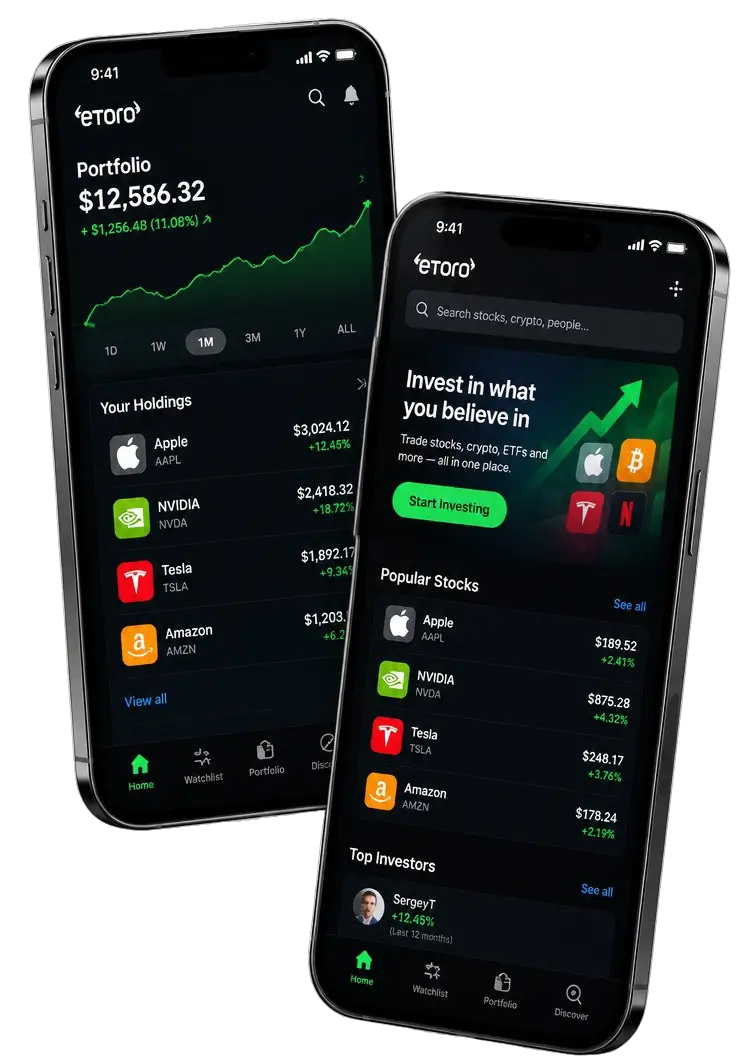
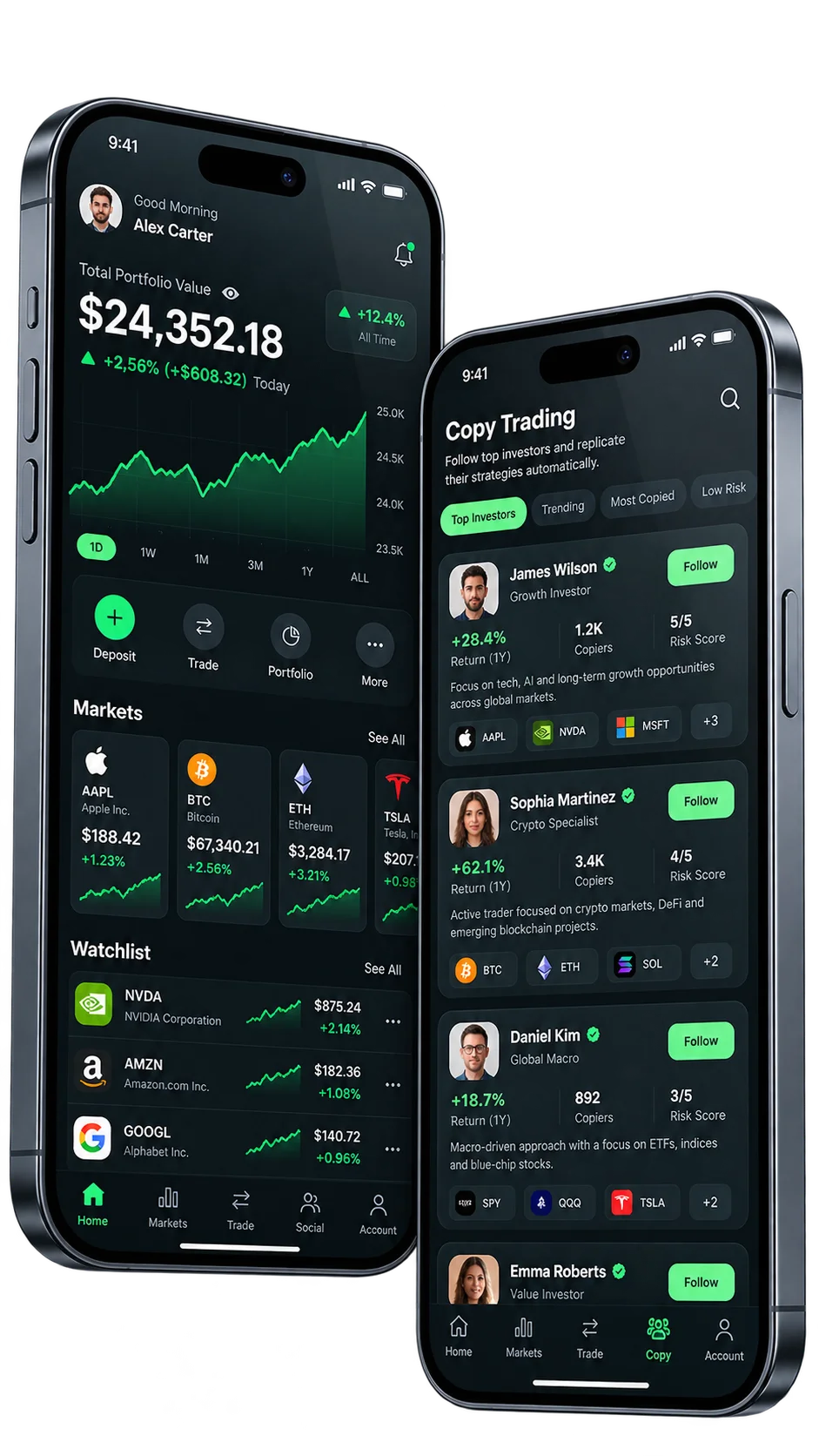
An eToro-like trading platform is a digital investment system that combines trading, portfolio management, and social investing in one place. The platform can include real-time market data, order management, investor profiles, social feeds, copy trading, watchlists, and portfolio tracking.
We develop such platforms with secure backend architecture, API-based market and brokerage integrations, role-based access, and responsive web and mobile interfaces. Our development process covers core trading modules, third-party integrations, testing, launch, and post-launch support to help businesses launch a scalable trading product aligned with their operational and regulatory needs.
Build an app like eToro to deliver seamless digital investing, attract more users, diversify revenue streams, and establish a scalable online trading business with competitive market capabilities.
Digital trading platforms bring market access, portfolio tools, and trading workflows into one interface. A well-designed platform can serve both new and experienced investors across web and mobile.
Social feeds, investor profiles, comments, performance data, and discovery tools can make trading more interactive. These features also help users explore market ideas within the same platform.

Copy-trading lets users select an investor and automatically replicate their portfolio activity based on defined rules. With clear controls, risk disclosures, and reliable trade execution, it can become a strong product differentiator.

A multi-asset platform can bring stocks, ETFs, crypto, currencies, commodities, and other supported instruments into one portfolio view. This gives users a single place to monitor holdings, performance, and trading activity.

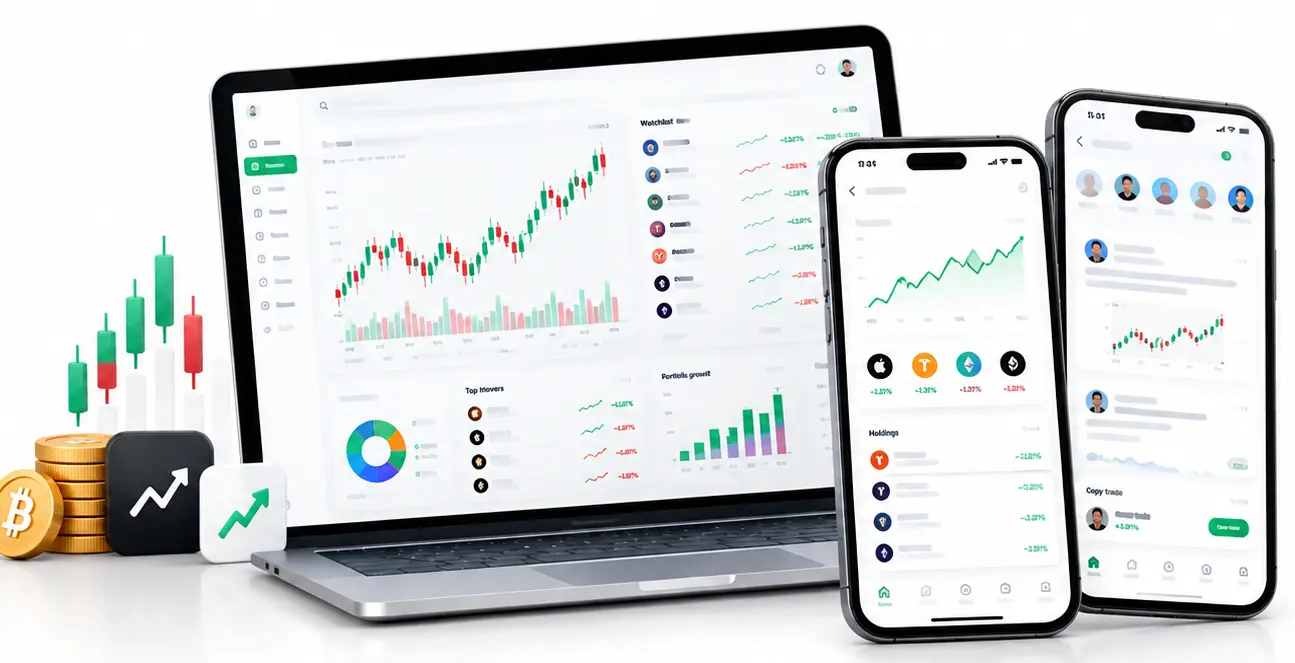
Users expect trading accounts to work smoothly across browsers and mobile devices. Synchronized portfolios, watchlists, orders, alerts, and account data can provide a consistent experience across platforms.

A trading platform can support recurring revenue through applicable trading fees, spreads, subscriptions, premium tools, data services, or other regulated revenue models. The right model depends on the target market, licensing structure, and services offered.

Create an engaging trading experience with portfolio management, real-time market data, social trading, copy trading, analytics, secure payments, notifications, and intuitive tools designed for modern investors.

Let users create accounts and securely access their trading profiles.

Allow users to submit identity details and complete the required verification process.

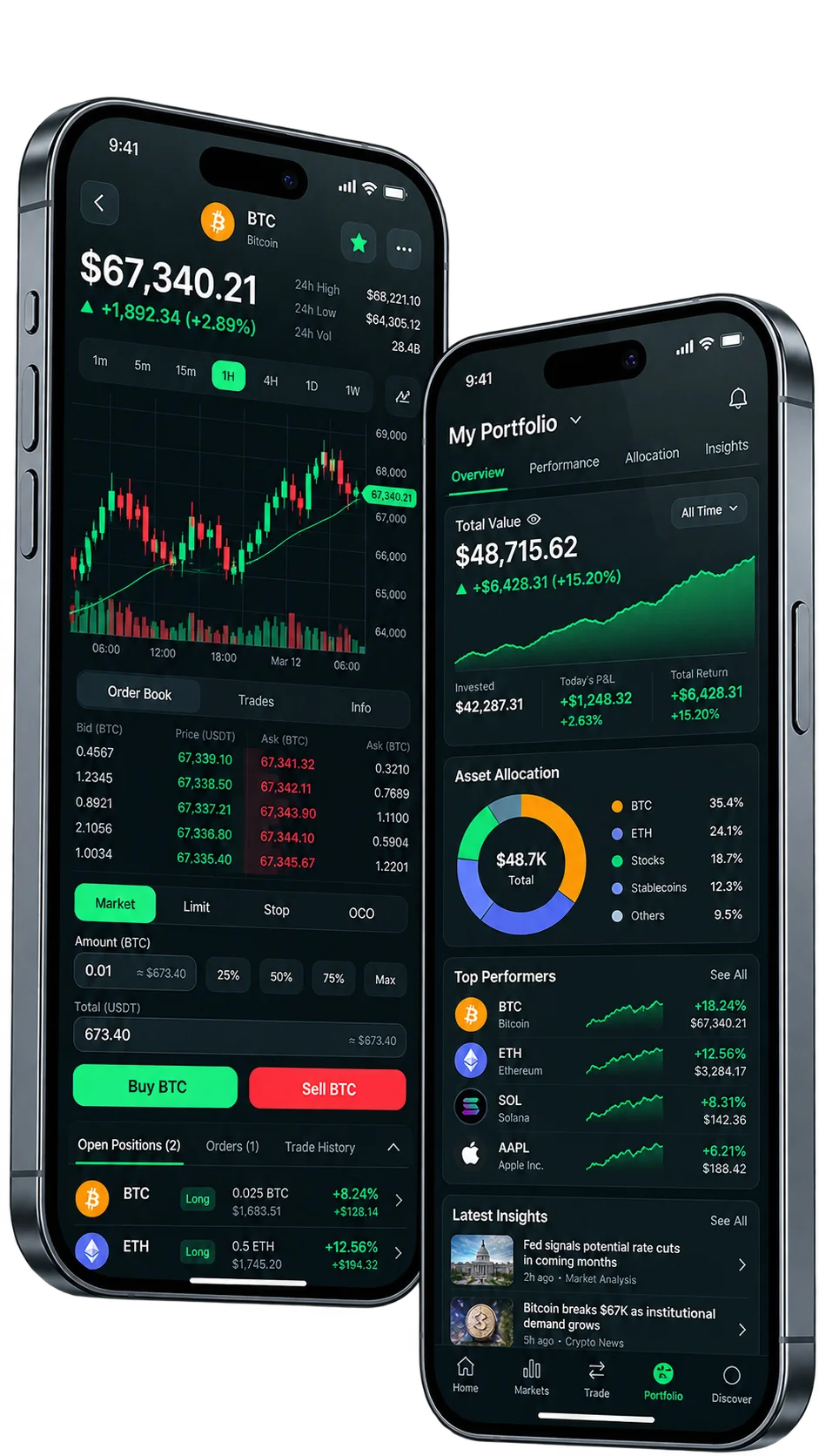
Show balances, market prices, orders, holdings, and portfolio performance in one place.

Enable users to place and manage supported asset orders with ease.

Help users track holdings, allocation, profit, loss, and transaction history.
Allow users to discover eligible traders and copy their trading activity.

Let users save selected assets and monitor their prices and market movements.

Enable users to view, share, and engage with trading updates and market content.

Send alerts for price changes, order updates, portfolio activity, and account events.
Give traders a clear view of portfolio value, performance, followers, and trading activity.

Allow traders to manage their profile, bio, trading preferences, and public information.

Let eligible traders share approved portfolio details with other platform users.

Enable traders to place, modify, and monitor supported trading orders.
Show returns, risk levels, trading history, and portfolio performance.
Help traders manage their participation in the platform's copy-trading program.

Let traders view follower activity and monitor their copy-trading audience.

Provide a detailed record of completed orders and past trading activity.

Alert traders about copied trades, followers, orders, and important account updates.
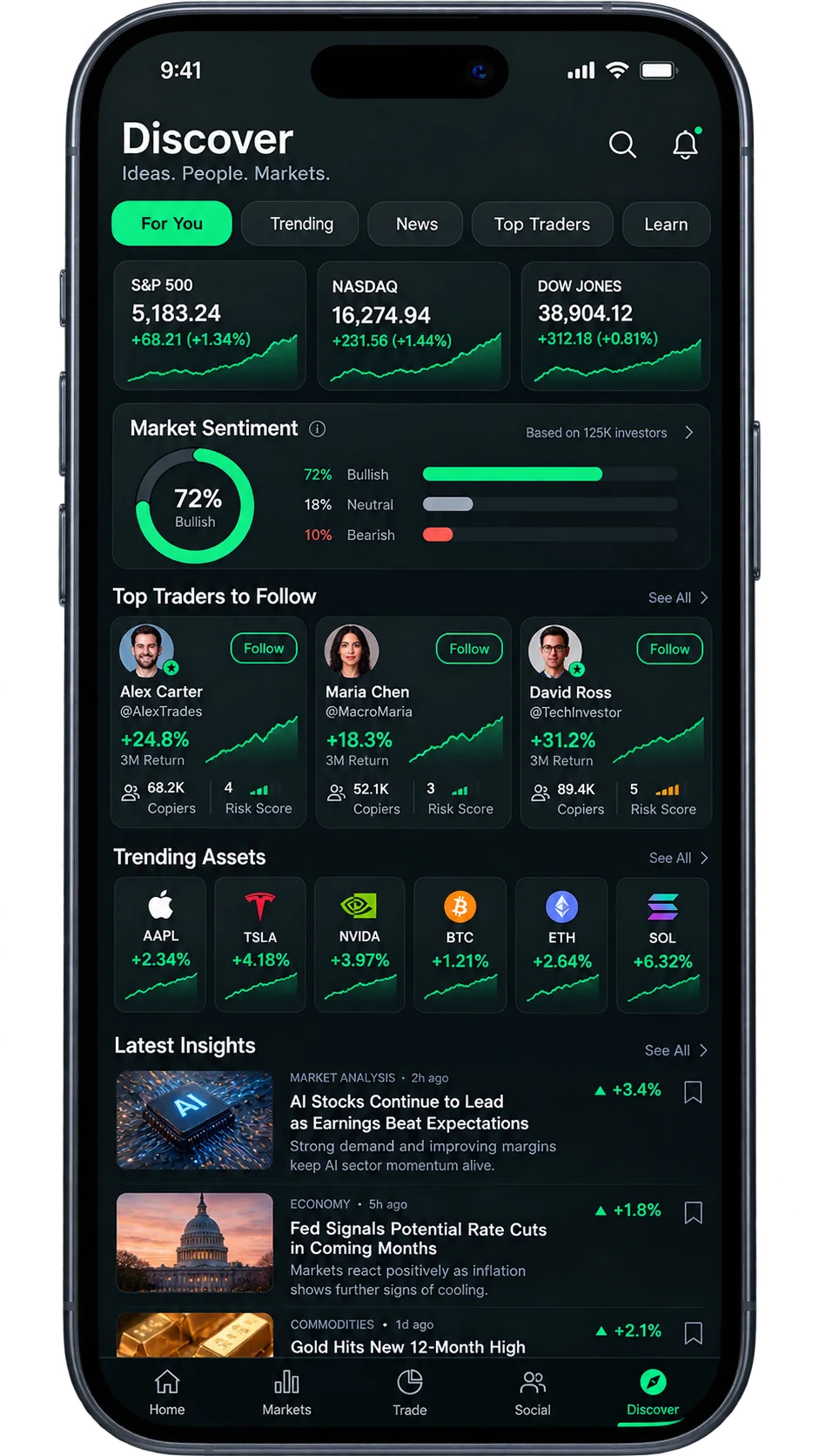
Provide an overview of users, trades, transactions, assets, and platform activity.

Allow admins to manage user accounts, permissions, profiles, and account status.

Help admins review identity documents and manage user verification workflows.

Enable admins to monitor orders, transactions, and trading activity across the platform.

Allow admins to add, update, enable, or disable supported trading assets.
Let admins manage eligible traders, copy-trading settings, and related activities.

Track deposits, withdrawals, payment status, and financial transactions.

Provide insights into users, trading volume, platform activity, and business performance.

Help admins manage access controls, authentication, alerts, and platform security settings.
AI can improve an eToro-like trading app by making market data easier to understand, improving user engagement, and supporting faster platform operations. These capabilities should be designed with proper controls and should not replace required financial compliance processes.
AI models can process large volumes of market data to identify price patterns, trends, and signals, helping users review market information more efficiently.
Recommendation engines can analyze user activity, watchlists, and stated preferences to surface relevant assets while applying suitable risk and compliance rules.
An AI assistant can answer questions about platform features, portfolio data, and market information using approved and up-to-date data sources.
Machine learning models can detect unusual login, payment, and trading patterns and flag potentially risky activity for further review.
AI can analyze portfolio exposure, trading behavior, and market conditions to identify risk patterns and trigger configurable alerts.
AI can summarize portfolio performance, asset allocation, and historical activity in simple language to help users understand their account data.
AI-powered support can handle common account and platform queries, while routing complex or sensitive cases to human support teams.
Natural language processing can analyze approved news and social content to identify market sentiment and present it as an additional data point.
A robust technology stack powers reliable eToro trading app development with scalable architecture, secure APIs, real-time data processing, cloud infrastructure, advanced analytics, and seamless third-party integrations.
React / Next.js, React Native or Flutter
Node.js / Java / .NET, REST APIs, WebSockets
AWS / Azure / Google Cloud, Containers, Kubernetes, CDN
PostgreSQL, Redis
KYC, AML, Payment gateways, Brokerage/execution APIs, Notification services
Our trading app development process combines strategic planning, intuitive UI/UX, secure development, API integration, rigorous testing, and deployment to create scalable platforms aligned with your business objectives.
We define the target market, business model, supported assets, user types, and applicable regulatory requirements before development begins.

We convert business goals into clear product requirements covering user journeys, trading workflows, admin controls, integrations, and platform functionality.
We design the backend, databases, APIs, cloud infrastructure, security layers, and service architecture needed to support a scalable trading platform.

We create simple trading interfaces for users, traders, and admins, with clear navigation, dashboards, charts, order flows, and responsive layouts.

We build the core version with essential trading, account, portfolio, payment, and management features to validate the product before wider expansion.
We connect the platform with suitable brokerage, exchange, market-data, payment, custody, and order-execution providers through secure APIs.

We integrate required KYC/AML, transaction monitoring, user verification, reporting, and other compliance workflows based on the target market.

We test authentication, authorization, APIs, data protection, payment flows, and other critical areas to identify and address security weaknesses.
We test trading workflows, integrations, mobile and web interfaces, API performance, system load, and failure scenarios before release.

We review the product against defined business, technical, operational, and regulatory requirements to identify gaps before production launch.

We deploy the tested platform to the production environment with secure infrastructure, controlled releases, backups, and deployment checks.

We monitor system health, APIs, performance, security events, and errors while providing updates, fixes, optimization, and feature enhancements.
The cost of developing an app like eToro specifically depends on the development approach, which means a custom-built application is slightly more expensive than that of an app that is built with the utilization of a white label solution. A complete cost breakdown for both approaches is listed below.
| Development Approach | Estimate Cost |
| White Label eToro-Like App | $7,000 |
| Custom-built App | $20,000 – $70,000+ |
A trading platform must meet the rules of each market where it operates. We design the product with the target jurisdiction, business model, asset types, and required licenses in mind.
Choose the target countries and operating entity first, as licensing, tax, reporting, and investor-protection rules vary by jurisdiction.
If the platform provides brokerage or order-execution services, the business may need the appropriate authorization from the financial regulator in its target market.
Stock, ETF, and other securities services must follow applicable rules covering trading, investor protection, disclosures, reporting, and market conduct.
If crypto assets are supported, the platform must assess the licensing, custody, trading, and reporting rules that apply to those assets in each target market.
Build identity verification, customer due diligence, transaction monitoring, and suspicious-activity controls into the platform where required.
Protect personal and financial data through suitable security controls and follow applicable privacy and data-protection laws.
Determine who holds customer assets and how they are safeguarded, segregated, transferred, and reported under applicable rules.
Use properly licensed market data for prices, charts, news, and other financial information instead of relying on unauthorized data sources.
Choose regulated payment providers and design deposits, withdrawals, refunds, and transaction monitoring according to applicable payment rules.
Provide clear information about fees, risks, products, trading conditions, and other disclosures required for the target market.
A trading platform can combine several revenue streams based on its services, target market, and applicable regulations. Each model should be reviewed for licensing and disclosure requirements before launch.
Generate revenue through permitted transaction or trading fees while clearly showing applicable charges to users.
Revenue can come from the difference between buy and sell prices where the business model and applicable rules allow this structure.
Offer paid plans with additional tools, higher limits, advanced features, or other platform benefits.
Charge users for advanced charts, market insights, portfolio analysis, research tools, or other premium data features.
Apply transparent fees for selected platform services, account features, or other value-added functionality where permitted.
A platform may charge eligible management or copy-trading fees where the business has the required permissions and follows applicable financial regulations.
Choose white-label solutions for faster market entry or custom development for greater flexibility, unique features, and long-term scalability. We help businesses select the right approach.
| Factor | White Label | Custom Development |
| Launch Speed | Faster | Longer |
| Customization | Limited/Moderate | High |
| Branding | High | High |
| Infrastructure Control | Lower | Higher |
| Feature Flexibility | Limited by provider | Extensive |
| Integration Flexibility | Provider-dependent | High |
| Long-term Control | Lower | Higher |
| Initial Investment | Usually lower | Usually higher |
Protect your users and business with robust encryption, secure authentication, data protection, compliance-ready architecture, transaction monitoring, and industry-standard security measures throughout your trading platform.
We align development and security processes with relevant security standards and certifications based on the project and applicable requirements.
Penetration testing helps identify vulnerabilities across applications, APIs, infrastructure, authentication, and other critical platform components.
We protect sensitive user and financial data with encryption, controlled access, secure storage, monitoring, and other suitable security measures.
Where required, we work with applicable compliance frameworks and controls to support the platform's regulatory and operational needs.
Regular technical and security audits can help identify control gaps, configuration issues, and areas that require improvement before and after launch.
We follow secure coding, access control, dependency management, code review, and testing practices throughout the development lifecycle.
Partner with our experienced development team to build a secure, scalable, and feature-rich app like eToro, tailored to your business model, target market, and growth objectives.
We build trading and investment platforms with features for portfolios, orders, market data, payments, and user account management.
We use secure application architecture with strong authentication, access controls, API security, and data protection built into the platform.
We design the platform to handle growing users, trading activity, market data, and API traffic without limiting future expansion.
We integrate brokerage, exchange, market-data, payment, KYC, AML, and other third-party services through secure APIs.
We consider applicable regulatory and compliance requirements during product design so key controls can be built into the platform from the start.
Our QA process covers trading flows, APIs, integrations, security controls, device compatibility, and system performance before launch.
We provide ongoing support for bug fixes, security updates, performance improvements, API changes, and new feature releases.
We set up cloud infrastructure, deployment pipelines, monitoring, backups, and operational processes to support reliable platform performance.
We develop the platform around your business model, target market, asset classes, user roles, workflows, and integration requirements.
We define project scope, milestones, deliverables, technology requirements, and development stages clearly to keep the project predictable.
We can develop a custom trading platform with user accounts, trading workflows, portfolios, market data, payments, admin controls, and third-party integrations based on your business requirements.
Yes. We can develop copy-trading workflows that connect eligible trader profiles with follower accounts and replicate supported trading actions based on defined allocation and risk settings.
Yes. We can develop a social feed with trader profiles, posts, comments, likes, portfolio updates, content controls, reporting, and moderation features for a social trading experience.
Yes. We can integrate licensed market-data providers through APIs or streaming connections to display prices, charts, quotes, and other supported market information with suitable latency.
KYC verifies a user's identity during onboarding, while AML controls help monitor and manage financial crime risks. The platform can support document checks, identity verification, transaction monitoring, risk scoring, and required reporting workflows.
A white-label solution can be configured with your brand, UI, selected features, and supported integrations. This can help reduce development time compared with building every component from the ground up.
The platform can support multiple asset classes, such as stocks, ETFs, crypto, currencies, and other supported instruments, through suitable brokerage, exchange, and market-data integrations.
We can build native or cross-platform mobile applications for iOS and Android, with features such as trading, portfolio tracking, notifications, watchlists, and account management.
Licensing depends on the countries served, the financial products offered, the custody model, order execution, and the business structure. The required authorizations should be confirmed with qualified legal and regulatory professionals for each target market.
Yes. We can connect third-party KYC and AML providers through APIs to automate identity checks, document verification, screening, and verification-status updates within the platform.
Hyperlocal Cloud is a tech leader harnessing the power of state-of-the-art technologies and delivering innovative app solutions to businesses.