


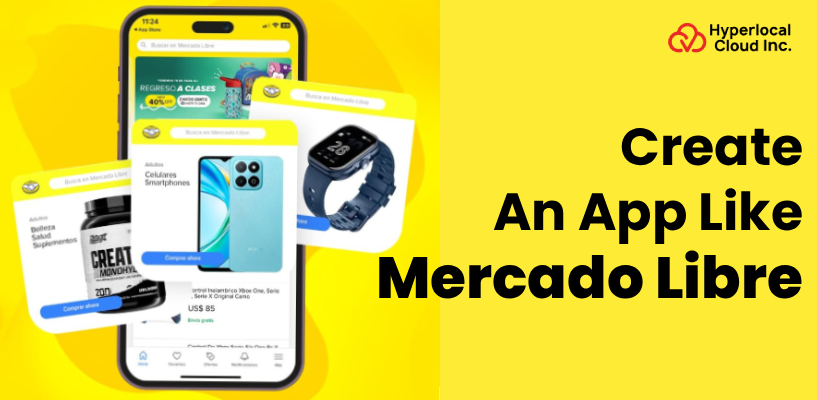
The e-commerce industry in Latin America currently experiences rapid growth. A Mercado Libre Clone App serves as the best initial choice for anyone wanting to create an online marketplace that can compete in this market. Mercado Libre is the largest e-commerce platform in Latin America, with over 218 million registered users as of recent data. The outstanding size of that user base demonstrates the existence of an extremely large business opportunity.
Entrepreneurs and businesses can take advantage of this growing market by launching a platform based on a proven model. Because the online shopping industry in Latin America is projected to reach $215.31 billion by this year. This guide will help you understand everything about Mercado Libre Clone App development, including features, tech stack, costs, and revenue models.
What is a Mercado Libre?
The Mercado Libre app operates as the top e-commerce platform in Latin America, and it is also called the “Amazon of the region”. It functions as an all-encompassing system that allows users to purchase, sell, make payments, and deliver products throughout 18 countries that include Brazil, Mexico, and Argentina.
Users will be able to search through available products and create new listings for items that include electronics, clothing, vehicles, and real estate, and they will be able to complete secure payments through Mercado Pago and follow their rapid delivery through Mercado Envios. They will have access to credit and installment payment options, and they can use Mercado Ads to improve their product visibility and reach.
Launch Your Own Marketplace Like Mercado Libre
How Does a Mercado Libre Clone Marketplace Operate?
You need to understand the complete functioning of the platform before you start your development work. The following points show how a standard Mercado Libre Clone operates through its various stages.
User Onboarding
The registration process for buyers and sellers includes a basic sign-up procedure. Social login options such as Google and Facebook. The platform maintains trust through identity verification, which sellers and buyers must complete.
Product Listing
Sellers create detailed product listings. The process requires them to include product images, determine product prices, establish stock levels, and choose appropriate product categories. The product listing involves both new and used items, similar to the original platform.
Discovery and Purchase
Buyers use filters and categories together to search for products that they want to browse. Buyers can read the reviews from previous buyers until they discover the required item, which they then add to their shopping cart before completing the payment process through various available payment methods.
Payment Processing
The platform enables secure payments through integrated payment gateways and protects both buyers and sellers using escrow, which holds funds until delivery is confirmed. It supports multiple payment options, including credit cards, digital wallets, Buy Now Pay Later (BNPL), and bank transfers.
Delivery and Logistics
Once a seller receives an order, they ship it to the buyer. The platform works with third-party delivery partners to provide live tracking, and buyers get updates at every step of the delivery process.
Admin Oversight
Admins manage user accounts, approve seller registrations, resolve disputes, track revenue, and control system settings. Through a central admin panel, they monitor all marketplace activities and ensure the platform runs smoothly and securely.
Advantages That Empower Both Users and Businesses
For Users
(Buyers)
- Shop from a wide range of categories all in one place
- Compare prices from multiple sellers before buying
- Payments are protected- your money is safe until the order is delivered
- Read real reviews from other buyers before making a decision
- Search is fast, and the app suggests products based on what the buyer actually likes
(Sellers):
- List products easily without any technical knowledge
- Shipping tools are built in, no need to manage logistics separately
- Track the sales and earnings in real time from your dashboard
For Businesses
- The platform will simultaneously grow with your business and attract a wide range of users to automate the process of buying and selling.
- You can earn money immediately by charging commissions, listing fees, ad payments, and other in-app purchases. As there are multiple revenue models, if one source slows down, the others will let your business grow.
Key Features for Optimal Mercado Libre Clone Panel Performance
Buyer Panel:
Smart Search and Filters
Buyers can search through the system using keyword searches, category filters, price range checks, location filters, and seller rating assessments. The advanced filter system enables users to find their desired results within the shortest time possible.
Product Detail Pages
Each listing page displays several high-quality images together with complete product descriptions, seller performance ratings, different shipping methods, and their corresponding delivery time estimates. Buyers receive all necessary information to make a confident purchasing choice while remaining on the same page.
Secure Checkout and Multiple Payment Options
After selecting a product and adding it to the cart, customers can pay using credit or debit cards, digital wallets, bank transfers, or choose easy installment payment options.
Order Tracking
The buyers receive real-time order status updates that show the progress from dispatch through delivery of their order. The system uses push notifications together with email alerts to provide users with automatic updates throughout the entire process without requiring them to check the app manually.
Ratings and Reviews
After delivery, the buyers have the option to give their ratings for both the product and the seller. The two-sided review system establishes accountability between users while it enables future customers to recognize reliable sellers within the marketplace.
Seller Panel:
Seller Dashboard
Sellers receive a specialized dashboard that displays their sales results together with their active products, current orders, and their total earnings. The interface provides basic functionality for first-time users while delivering advanced features for sellers.
Inventory Management
Sellers can control their inventory, receive notifications when their stock reaches low levels, and execute mass updates for their product information. The system prevents overselling by automatically matching available inventory with current product listings.
Promotions and Discounts
Sellers have the ability to establish discount campaigns, which allow them to create coupon codes. The tools enable sellers to increase their product visibility, which helps them sell their products more efficiently during times of market competition.
Payout Management
Sellers can view their earnings, request withdrawals, and track transaction history from a single screen. The platform supports multiple payout methods, including bank transfer and digital wallets.
Admin Panel:
User and Seller Management
Buyer and seller accounts can be approved, suspended, or banned by admins. The members of the admin panel possess the ability to examine seller and buyer verification documents while they resolve escalated disputes and control access permissions based on user roles.
Commission and Fee Configuration
Admins manage commission rates based on different categories, while they also establish listing fees and handle order placement charges.
Content and Category Management
The administrators who control the marketplace product listings have complete power over the system. The admins possess the ability to create new product categories, modify existing categories, and remove product categories from the system. Admins ensure the quality of the application so that it can be free from any kind of offensive content.
Join the E-commerce Revolution With a Powerful Mercado Libre Clone App
Smart AI Integrations That Make a Mercado Libre Clone App Stand Out
Artificial intelligence is no longer a premium feature, it is a standard expectation in competitive marketplace apps. Here is how AI adds real value in a Mercado Libre Clone App.
Personalized Recommendations
The artificial intelligence system evaluates each customer’s online activity, their previous buying patterns, and their saved items to identify the products that customers will probably purchase. AI-powered features helps businesses boost their average order value while customers spend more time using their services.
Dynamic Pricing Engine
Machine learning models track competitor prices, market demand changes, and inventory levels to determine the best-selling prices for vendors. The system maintains competitive marketplace operations for you without requiring any manual work.
Fraud Detection
The system uses artificial intelligence to observe transaction activities at all times, which helps detect any potential fraudulent activities. The system can detect fake listings and payment scams before they can harm the platform’s standing.
Smart Search with NLP
Natural Language Processing enhances search results by interpreting the user’s intent, which drives their search queries. The buyer who searches for ‘running shoes for rainy weather’ receives search results that match his needs through contextual searching instead of using basic keyword matching.
Automated Customer Support
The system uses AI chatbots that work automatically to provide round-the-clock support for customer inquiries from buyers and sellers. The system can handle order status inquiries, return requests, and listing problems without the need for human help.
The Complete Development Process of a Mercado Libre Clone App
Planning and Requirement Analysis
The project starts with an extensive discovery phase. This process requires your business to identify its target audience, create user accounts, determine essential requirements for its minimum viable product, and establish project timelines and cost-effective solutions. The product roadmap establishes clear boundaries that protect against future expensive scope modifications.
UI/UX Design
Designers create wireframes and interactive prototypes for all three panels: buyer, seller, and admin. The interface needs to provide users with an intuitive experience that works across all their devices. Mobile-first design is essential since the majority of marketplace traffic comes from smartphones.
Development Approach
Businesses these days need to decide between creating their own application from scratch or selecting a white-label solution. The process of creating an application from scratch provides businesses with complete design control yet requires extended development time and financial resources. A white-label app, on the other hand, delivers a faster time-to-market with the core functionality already built and tested.
Backend Development
The platform’s central operational functions are managed by the backend system. The system handles user authentication together with product catalog management, order processing, payment workflows, and notification systems. The system uses a microservices architecture because it enables developers to update or expand system components independently.
Frontend Development
Frontend engineers create responsive web and mobile app interfaces by implementing their design work. The current stage requires performance optimization because page loading speed affects e-commerce conversion rates.
Testing and Quality Assurance
The testing process checks how well the system works, including its features, security, performance under heavy user traffic, and compatibility across different devices. Special attention is given to payment gateways and checkout processes to ensure they run smoothly without any errors at this critical stage.
Launch and Post-Launch Support
After initial testing with a limited group of users, the platform is officially launched and becomes fully operational. Post-launch, ongoing support includes monitoring the system, fixing bugs, improving performance, and adding new features based on user feedback.
Powering Your Marketplace: The Tech Stack of a Mercado Libre Clone
A well-chosen tech stack ensures your Mercado Libre clone is scalable, secure, and high-performing from day one.
| Layer / Component | Tech Stack Options |
| Frontend (Web) | React, Next.js, Vue.js |
| Mobile Apps | React Native, Flutter, Swift (iOS), Kotlin (Android) |
| Backend (API Layer) | Node.js (Express/NestJS), Java (Spring Boot), Python (Django/FastAPI) |
| Microservices Architecture | Docker, Kubernetes, gRPC, REST APIs |
| Database (Primary) | PostgreSQL, MySQL |
| NoSQL Database | MongoDB, Cassandra |
| Search Engine | Elasticsearch, OpenSearch |
| Caching Layer | Redis, Memcached |
| Message Queues / Streaming | Apache Kafka, RabbitMQ |
| Authentication & Security | Auth 2.0, JWT, Auth0 |
| Payment Integration | Stripe, PayPal, Adyen (or a custom wallet like Mercado Pago) |
| Cloud Infrastructure | AWS, Google Cloud Platform, Azure |
| DevOps & CI/CD | GitHub Actions, Jenkins |
| Monitoring & Logging | Prometheus, Grafana |
| Analytics & Data Pipeline | BigQuery, Snowflake |
| Notifications | Firebase Cloud Messaging, Twilio |
Who Should Consider a Mercado Libre Clone App? (Use Cases Explained)
The Mercado Libre Clone App model is versatile enough to power a wide range of marketplace concepts. Here are some of the most compelling use cases.
Multi-Vendor Marketplace
Businesses can establish a platform that enables multiple vendors to display their products across different categories, including electronics, fashion, real estate, and vehicles, to give customers an easy way to compare products for purchase.
B2B Wholesale Marketplace
The business model enables companies to establish a wholesale marketplace that connects manufacturers and distributors with retailers for bulk sales. The system supports three operational functions, which include tiered pricing, minimum order quantities, and invoice-based payment.
Mobile-First Commerce
Startups can establish a mobile-focused marketplace that provides services to customers who prefer to make purchases through mobile applications instead of using web browsers.
Niche Marketplace Development
Entrepreneurs can create industry-specific platforms through apps like Mercado Libre because it enables them to build fashion-only, electronics-only marketplaces, and real estate marketplaces.
Second-Hand and Recommerce Marketplace
The resale economy is expanding throughout the world. A clone app that enables users to sell used goods through its peer-to-peer system establishes a sustainable market that maintains high customer activity.
Get Your Mercado Libre Clone App With AI Features
Trending and Latest Aspects of the Mercado Libre Clone app
The marketplace technology landscape evolves quickly. Here are the trends that are shaping how platforms like a Mercado Libre Clone App operate.
Social Commerce Integration
Social media platforms currently offer users the ability to shop through their social media feeds. Businesses now use marketplace apps to combine their products with live selling and influencer storefronts.
Buy Now, Pay Later (BNPL)
The Mercado Libre clone uses Buy Now Pay Later BNPL to establish its unique identity in markets where people use credit cards less frequently. The flexible payment options that businesses provide during the checkout process drive higher conversion rates while increasing the total value of customer orders.
Hyperlocal Delivery
Customers today demand delivery services that can deliver their packages on the same day or the following day. Marketplaces establish partnerships with hyperlocal logistics networks while they develop warehouses to fulfill customer delivery requirements in urban locations.
Voice and Visual Search
An emerging trend in Mercado Libre–style apps uses AI-based visual and voice search to improve customer experience. The advanced search capabilities of this system help users find products more easily as they match current user behavior patterns, which results in better user engagement and higher conversion rates.
Challenges & Considerations When Building a Mercado Libre Clone App
Building a marketplace like Mercado Libre is exciting, but it comes with real challenges. Being aware of them upfront helps you plan better.
AI Adoption Challenges:
The implementation of AI systems for customer service and automatic categorization functions faces challenges because of the need for high-quality training data and the requirement to meet various customer requirements.
Trust and Safety
The marketplace faces continuous threats from fake listings, products, and payment fraud activities. The business requires investment in strong user verification systems, AI-powered fraud detection technologies, and user protection programs to achieve sustainable growth.
Scalability & High Performance:
The app needs to support millions of users who perform transactions at the same time during peak sales times, which requires the system to use a microservices architecture to ensure it stays operational.
Logistics Complexity
Shipping across multiple sellers, regions, and delivery timelines results in operational difficulties. The selection of proper logistics API integrations, together with the establishment of precise shipping regulations from the beginning, will result in significant advantages during your business expansion.
Regulatory Compliance
E-commerce platforms must comply with data privacy laws and consumer protection regulations, together with payment processing requirements, which differ across various countries. Before launching an app like Mercado Libre, it’s important to get legal advice from experts familiar with your target market.
Complex Search & Categorization:
The business needs machine learning–based search to help users find products easily in its large catalog and boost sales.
How Do Mercado Libre Clone Apps Monetize Successfully?
One of the strongest reasons for choosing to create an app like Mercado Libre is the diversity of monetization options available to platform operators.
Commission on Transactions
The platform generates its main revenue stream by taking a share of all sales that buyers complete through its marketplace. The platform charges commission fees that vary between 5% to 15% based on the specific product category.
Listing Fees
Sellers pay a small fee to list products, which applies mainly to products in high-traffic areas and premium product categories. The system performs best when it uses tiered seller plans as its primary operational method.
Subscription Plans for Sellers
Sellers can choose between monthly or yearly subscription plans, each offering different benefits. The platform benefits from these two subscription plans because it generates dependable recurring income streams.
Promoted Listings and Banner Ads
Sellers make payments to attain improved visibility results through search engines and product category pages. Brands can tie up with businesses to run banner advertisements on the homepage or category landing pages, generating high-margin advertising revenue.
Payment Processing Fees
The platform earns revenue through its built-in payment system, similar to Mercado Pago, by charging a fee on each transaction. This makes it one of the most profitable income sources in this marketplace model.
Logistics and Fulfillment Services
The business earns revenue by offering warehousing and fulfillment services to sellers, which also helps improve delivery across the platform.
Build a Scalable, Secure, and Feature-rich Marketplace
What Are the Development Costs of a Mercado Libre Clone App?
The development costs for a Mercado start at $6000 and increase according to the required platform complexity.
The price to develop a Mercado Libre Clone App fluctuates according to your requirements, preferred development methods, and selected development team.
Other than creating an app from scratch, there is another solution too, which is called a white-label solution. The white-label solution provides time and cost advantages to your project. The process requires you to customize an existing functional system instead of developing a new solution from scratch.
Factors That Affect the Development Cost
- Features and Functionality: The total expenses of a project will increase whenever you add additional features to the app. A basic marketplace with listings and payments costs less than a platform with AI recommendations, live chat, and a built-in logistics system.
- UI/UX Design Complexity: The basic design requires lower expenses because it consists of straightforward elements. The creation of a custom interface needs additional time and costs because it includes distinct animated features and branded display elements, and supports multiple languages.
- Platform Choice: The development costs for web-only projects are lower than those for projects that include iOS and Android app development. The main reason businesses choose cross-platform development is to expand their customer base.
- Third-Party Integrations: The integration process requires work to connect payment gateways, shipping APIs, analytics tools, and SMS notifications. The process of connecting external services requires additional time for development work.
The Bottom Line
Developing an ecommerce marketplace that is a Mercado Libre clone app has become easier than ever before. The correct method enables you to create a platform that can handle multiple vendors while achieving revenue generation within a short period.
A Mercado Libre Clone App provides you with essential tools that enable you to build your business and succeed in competitive eCommerce markets.
Do you have a project idea? Contact us at Hyperlocal Cloud for assistance with your Mercado Libre Clone App development project.
FAQs (Frequently Asked Questions)

Patt Cummins is an experienced content writer with over 10 years of experience creating clear and engaging content for technology-focused industries. He specializes in simplifying complex technical topics into easy-to-understand stories that educate readers, support brand communication, and help businesses effectively share their solutions.

Need Help With
Development?