

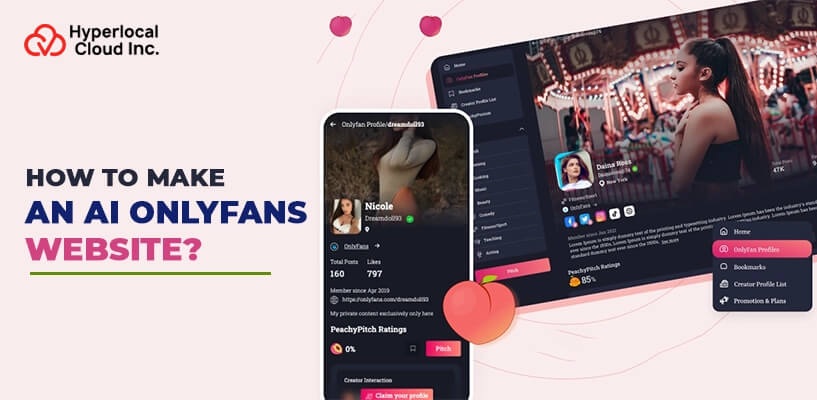
Artificial intelligence is creating new opportunities for subscription-based creator platforms by enabling personalized interactions, automated content workflows, intelligent recommendations, and virtual creator experiences. Entrepreneurs can use these capabilities to build platforms where creators and fans connect through memberships, premium content, messaging, and other digital experiences.
Building an AI OnlyFans website involves more than developing a subscription portal. It requires a scalable technology infrastructure, secure payment processing, AI integration, content management, privacy controls, and a sustainable monetization strategy.
Businesses exploring this opportunity must also consider age verification, consent, intellectual property, AI-generated content disclosure, and the policies of their payment providers.
This guide explains how to make an AI OnlyFans website, which features to prioritize, how to select a suitable technology stack, which business models to consider, and how to launch a reliable AI-powered creator platform.
What Is an AI OnlyFans Website?
An AI OnlyFans website is an AI-enabled creator subscription platform that combines membership features with artificial intelligence technologies. It can support human creators, clearly disclosed virtual personas, or a combination of both, depending on the platform’s business model.
Unlike a conventional subscription website, an AI-powered platform can automate selected interactions, improve content discovery, assist creators with routine tasks, and deliver personalized experiences.
For example, a virtual creator platform might offer an AI character with a consistent personality, automated conversations, and a library of AI-generated content. A platform designed for human creators might instead use AI to recommend relevant content, organize media libraries, generate captions, or help manage subscriber communications.
The platform’s functionality should match its target audience and business objectives. AI is most valuable when it solves a genuine user problem rather than being added simply as a marketing feature.
Integrate AI Features Into Your Creator Platform
How Does an AI Creator Platform Work?
An AI creator platform typically brings together four primary components.
User management: Fans create accounts, explore creator profiles, purchase memberships, and manage subscriptions. Creators can maintain profiles, publish content, and track engagement.
AI-powered services: Integrated AI models can assist with recommendations, conversational interfaces, content tagging, and approved content-generation workflows.
Payment and access management: The platform processes supported payments, checks subscription status, controls access to premium content, and manages creator payouts.
Content management and moderation: Administrative tools manage uploads, permissions, reports, content restrictions, and policy enforcement.
These components work together to provide a consistent experience for users while allowing administrators to maintain oversight of the platform.
Why Build an AI OnlyFans-Like Website?
Developing an AI-powered creator platform can offer several business opportunities when the product solves a clear market need.
1. Personalized User Experiences
AI can recommend creators, content categories, and subscription options based on permitted user activity and stated preferences. Better discovery can help users find relevant content without navigating a large library manually.
Personalization should remain transparent and respect privacy settings. Users should have appropriate controls over recommendations and data use.
2. More Efficient Creator Workflows
Creators often spend time organizing media, writing captions, scheduling posts, and responding to routine questions. AI-assisted tools can reduce some of this administrative work.
For example, a creator dashboard could suggest captions, categorize uploaded media, and prepare scheduled posts for approval. Human review remains important for accuracy, consent, and brand consistency.
3. New Revenue Opportunities
An AI creator website can generate revenue through subscriptions, premium features, pay-per-view access, tips, and other permitted services.
Virtual creators may also support differentiated experiences, provided users understand when they are interacting with an AI-generated persona rather than a human creator.
4. Scalable Digital Experiences
Automation can help a platform handle routine interactions and content discovery as its user base expands. However, growth still depends on infrastructure capacity, moderation resources, customer support, payment reliability, and creator acquisition.
AI can improve operational efficiency, but it does not guarantee profitability or eliminate the need for human oversight.
Business Models for an AI Creator Website
Selecting the right monetization strategy is an important part of platform planning. A business can begin with one revenue stream and introduce additional options after validating user demand.
Monthly and Annual Subscriptions
Users pay a recurring fee to access a creator’s profile, exclusive posts, or other membership benefits. Annual plans can provide a longer commitment period, while monthly subscriptions offer greater flexibility.
The platform should clearly communicate renewal dates, cancellation procedures, and subscription terms.
Pay-Per-View Content
Creators can offer selected content separately from their standard memberships. Users pay to unlock individual items or collections.
Access permissions should be enforced by the backend so that unpaid users cannot access restricted media through direct URLs or manipulated requests.
Tips and Creator Support
Fans can send voluntary payments to support creators. The platform may charge a disclosed service fee where permitted.
Clear transaction records, refund rules, fraud controls, and creator payout procedures help establish trust.
Premium Messaging and AI Features
The platform may offer paid messaging, advanced personalization, or additional AI-assisted experiences. If AI participates in a conversation, users should be informed appropriately.
Automated interactions should not falsely represent an AI persona as a real human responding personally.
Platform Commissions
The business can retain a defined percentage of eligible transactions processed through the platform. Commission terms should be transparent to creators, and the system should provide accurate earnings statements.
Before selecting any monetization model, verify that the activities and content involved are permitted by the selected payment provider and applicable laws.
Essential Features of an AI OnlyFans Website
A successful platform needs a strong foundation before introducing advanced AI functionality.
1. User Registration and Authentication
Users should be able to register, sign in securely, recover accounts, and manage their profiles. Depending on the platform’s audience and applicable requirements, additional verification may be necessary.
Security measures should include appropriate password handling, session management, rate limiting, and optional multi-factor authentication.
2. Creator Profiles and Dashboards
Creator profiles should support biographies, profile images, membership options, content categories, and permitted media formats.
A dedicated dashboard can help creators manage subscriptions, review earnings, organize content, and monitor engagement.
3. Subscription Management
The subscription system should support membership plans, renewals, cancellation, payment status, and controlled access to premium content.
It should also handle failed payments, expired subscriptions, refunds, and disputes without creating inconsistent account permissions.
4. Secure Content Management
Creators need tools to upload, categorize, preview, schedule, and publish content.
The system should enforce access permissions and protect private media through controlled delivery, secure storage, and appropriately configured content delivery infrastructure.
5. Messaging and Notifications
Messaging can help creators communicate with subscribers. Notifications may alert users about new posts, membership changes, or other relevant activity.
Spam prevention, user blocking, reporting, and privacy controls are essential for maintaining a safe communication environment.
6. Payment Processing and Creator Payouts
The platform should integrate a payment provider that explicitly supports its business model and content categories.
Important capabilities include transaction records, subscription billing, refunds, dispute handling, payout reconciliation, and fraud monitoring.
Do not assume that every payment processor permits adult-oriented or AI-generated content. Obtain approval for the intended business model before launch.
7. Admin Dashboard
Administrators need a central interface to manage users, creators, subscriptions, reports, content policies, and platform performance.
Role-based access control helps ensure that staff can access only the information and functions required for their responsibilities.
Discuss Your AI Integration Requirements With Our Team
Advanced AI Features to Integrate
AI features should address specific platform needs and be introduced in stages based on user demand, risk, and operational complexity.
AI Chat Assistants and Virtual Personas
Conversational AI can power clearly disclosed virtual personas that interact with users according to defined character guidelines.
Developers can configure the model’s instructions, response boundaries, conversation context, and escalation rules. The platform should distinguish AI interactions from communications written by human creators.
Controls should prevent impersonation, deceptive claims, and prohibited interactions. Users should also be able to report inappropriate behavior.
AI-Generated Avatars and Media
Generative AI can help create original virtual characters, illustrations, and other media when the relevant tools and licenses permit commercial use.
The platform should maintain records of content provenance where appropriate and verify that uploaded or generated material does not unlawfully reproduce another person’s likeness or copyrighted work.
Realistic depictions of identifiable people require particular care. Obtain appropriate authorization and never create or distribute non-consensual intimate imagery.
Intelligent Content Recommendations
Recommendation models can use permitted engagement signals and content metadata to suggest relevant creators or media.
A recommendation system may begin with simple category matching and popularity signals before progressing to more advanced models. This approach reduces initial complexity and allows the business to measure whether personalization improves discovery.
Users should have suitable privacy controls, and recommendations should not override content restrictions or access permissions.
AI-Assisted Content Management
AI can categorize media, generate draft captions, identify potential duplicates, and assist with content moderation.
Automated moderation should support, rather than completely replace, human review for difficult or high-impact decisions. The platform should provide a process for reporting errors and appealing moderation decisions.
Analytics and Business Insights
AI-assisted analytics can help identify subscription trends, content engagement, and possible churn patterns.
For example, the system may flag a decline in membership renewals or identify content categories that attract sustained interest. These insights should support business decisions rather than make unsupported predictions about individual users.
How to Make an AI OnlyFans Website Step by Step
A structured development process helps businesses manage costs, reduce risk, and launch with the right features.
Step 1: Research the Market and Choose a Niche
Start by identifying your intended users, the problem your platform solves, and the types of creators you want to support.
Research competing platforms, their membership models, creator tools, user experience, and content policies. Look for a meaningful differentiation opportunity instead of copying every feature offered by an established platform.
Define your initial audience and validate demand through interviews, landing-page experiments, or discussions with prospective creators.
Deliverable: A clear value proposition, target audience, and initial product requirements.
Step 2: Define the Business Model
Choose how the platform will earn revenue and determine which features are necessary for the first release.
Estimate operational expenses such as infrastructure, AI usage, payment processing, moderation, support, and creator acquisition. Consider how refunds, chargebacks, and payment-provider restrictions may affect the business.
Prepare a simple financial model that estimates revenue per subscriber, customer acquisition costs, recurring expenses, and potential break-even requirements.
Deliverable: A monetization strategy and initial business plan.
Step 3: Choose Custom Development or a White-Label Solution
Businesses can approach development through custom software or a suitable white-label platform.
Custom development provides greater control over architecture, workflows, AI integrations, and the user experience. It may require more planning, engineering effort, and ongoing maintenance.
A white-label onlyfans like platform solution can accelerate the launch if it already supports the required business model and can be configured to meet the project’s needs. However, its customization options, licensing terms, source-code access, and security controls should be assessed carefully.
Compare both options based on time to market, flexibility, total cost of ownership, compliance needs, and long-term scalability.
Deliverable: A documented platform approach and implementation scope.
Step 4: Design the User Interface and Experience
Create wireframes and interactive prototypes for the main user journeys.
These should include registration, creator discovery, profile browsing, subscriptions, content access, messaging, account management, and cancellation.
Design the creator dashboard and admin interface separately because each has different operational needs. Ensure the experience works well on mobile devices, provides clear navigation, and includes accessible interface elements.
Deliverable: Approved wireframes, user flows, and design specifications.
Step 5: Develop the Platform Architecture
Build the core application around secure authentication, user management, creator profiles, subscriptions, content permissions, and administration.
A modular architecture can separate the main application from services such as AI processing, notifications, media delivery, and payment integrations.
For an initial product, a well-structured backend application may be sufficient. Microservices can be introduced later when scale or independent deployment requirements justify the added complexity.
Deliverable: A functional application foundation with clearly defined services and data flows.
Step 6: Integrate AI Models and APIs
Identify the AI capabilities required for the initial release. These may include conversational assistants, content tagging, recommendations, or approved media-generation workflows.
Choose models and providers based on performance, cost, privacy, licensing, and commercial-use policies. Implement server-side API calls, access controls, rate limits, usage monitoring, and failure handling.
For conversational features, define persona instructions, permitted topics, conversation limits, and escalation procedures. For generative media, establish consent, rights verification, and content review requirements.
Deliverable: Tested AI functionality connected to the platform’s core workflows.
Step 7: Implement Security and Content Moderation
Security and moderation should be built into the platform rather than added just before launch.
Use encrypted connections, appropriate data protection, least-privilege access, secure secrets management, and monitoring for suspicious activity. Protect sensitive user information and restrict access to private content.
Create policies for creator verification, consent, copyright complaints, prohibited content, reporting, and appeals. Implement age verification and age-appropriate access restrictions where required.
Deliverable: Documented security controls, moderation procedures, and incident-response plans.
Step 8: Integrate Payments and Test Transactions
Connect an approved payment provider and implement subscription management, refunds, creator payouts, and transaction reconciliation.
Test successful payments, declined transactions, duplicate requests, failed renewals, cancellations, chargebacks, and expired memberships. Confirm that access permissions update correctly after every relevant payment event.
Use test environments before processing real transactions. Validate the provider’s policies and obtain necessary approval for the actual platform content and business model.
Deliverable: A reliable payment workflow and verified subscription access controls.
Step 9: Test, Deploy, and Optimize
Conduct functional, usability, security, and performance testing before launch.
Test the application under realistic traffic conditions, particularly during media uploads, AI requests, subscription renewals, and concurrent user sessions. Confirm that moderation, reporting, account recovery, and customer support workflows operate correctly.
Deploy the application using appropriate monitoring, backups, logging, and recovery procedures. After launch, use feedback and analytics to prioritize improvements.
Deliverable: A production-ready platform with a documented maintenance and improvement plan.
Recommended Technology Stack for an AI Creator Platform
The technology stack should reflect the platform’s expected traffic, development team’s experience, privacy requirements, and planned AI features. There is no single stack that is ideal for every project.
Frontend Development
React or Next.js can support responsive web interfaces, creator dashboards, account management, and subscription experiences.
The design should prioritize performance, accessibility, mobile usability, and consistent navigation.
Backend Development
Node.js with a suitable framework, Python with FastAPI or Django, or another mature backend technology can handle application logic, authentication, subscriptions, and AI integrations.
The selection should depend on engineering expertise, ecosystem support, and operational requirements rather than trends alone.
Database and Caching
PostgreSQL is a strong option for structured records such as users, creators, subscriptions, and transaction references.
Redis can support caching, rate limiting, session-related workloads, and background-job coordination when needed. Object storage should be used for media rather than storing large files directly in the relational database.
AI and Machine Learning
AI capabilities can be integrated through commercial APIs or self-hosted models, depending on privacy, licensing, performance, and cost requirements.
A model gateway or service layer can make it easier to manage provider credentials, monitor usage, enforce policies, and change providers without rewriting the entire application.
Cloud Infrastructure and Media Delivery
Cloud hosting, object storage, a content delivery network, monitoring, and automated backups help support a reliable service.
Video-heavy platforms may require adaptive streaming, transcoding, and lifecycle policies for stored media. Private content should be delivered through appropriately authorized mechanisms.
Payment and Analytics Integrations
Select a payment provider that approves the intended content and monetization model. Integrate analytics to monitor acquisition, subscriptions, retention, transaction failures, and infrastructure costs.
All integrations should follow the relevant privacy, security, and contractual requirements.
Legal, Privacy, and Safety Considerations
Legal and safety requirements are particularly important when a platform supports adult-oriented content, realistic virtual personas, or AI-generated media.
Age Verification and Access Restrictions
Establish an appropriate process to prevent minors from accessing restricted services or content. The exact obligations depend on the countries served and the nature of the platform.
Use proportionate verification methods, protect verification records, and avoid collecting unnecessary identity information.
Consent and Likeness Rights
Obtain the necessary rights and permissions before publishing content that depicts identifiable individuals. Maintain clear creator agreements and procedures for handling complaints about unauthorized use of a person’s likeness.
Do not permit non-consensual intimate imagery, including synthetic imagery that violates a person’s rights.
AI-Generated Content Disclosure
Clearly communicate when a user is interacting with an AI persona or viewing AI-generated media where disclosure is required or necessary to avoid misleading users.
Establish policies covering impersonation, synthetic media, deceptive representations, and content ownership.
Privacy and Data Protection
Collect only the information necessary to operate the platform and define appropriate retention periods. Protect account information, private communications, verification records, and payment-related data.
Determine which privacy and data protection laws apply to the platform’s users and operations. Provide clear privacy notices and processes for applicable data rights requests.
Copyright and Content Moderation
Create a process for handling copyright complaints, unauthorized uploads, prohibited material, and requests to remove content.
Moderation procedures should identify the responsible team, response process, escalation path, and recordkeeping requirements. AI moderation tools can assist with detection but should not be treated as infallible.
Payment Provider and Platform Policies
Review the applicable terms of payment processors, cloud providers, app marketplaces, and AI services before committing to an architecture.
Some providers restrict particular adult-oriented activities or types of generated media. Verify eligibility in advance and select vendors whose documented policies support the intended business model.
This section provides general product-planning guidance, not legal advice. Consult qualified legal professionals about the specific jurisdictions and content categories your platform will serve.
Choose the Right Development Approach for Your Platform
How to Market and Grow an AI Creator Platform
A successful launch requires both a reliable product and a repeatable approach to acquiring creators and subscribers.
Search Engine Optimization
Develop useful pages around creator tools, subscription features, platform capabilities, and relevant user questions.
Use descriptive titles, logical headings, internal links, and technically sound pages. Publish original content that demonstrates the platform’s value instead of producing repetitive articles targeting nearly identical keywords.
Creator Acquisition
Identify creators whose audiences and content align with the platform’s intended niche.
Offer a clear onboarding process, transparent revenue terms, useful analytics, and responsive support. Early creator partnerships can help validate the platform before investing heavily in paid promotion.
Referral and Partnership Programs
Consider transparent referral programs or partnerships that reward legitimate customer acquisition.
Define eligibility, attribution, payouts, and anti-fraud rules clearly. Promotion should comply with advertising rules and the policies of the channels being used.
Subscriber Retention
Monitor subscription renewals, cancellations, engagement, support requests, and payment failures.
Improve the user experience based on observed problems. Useful creator discovery, consistent content availability, reliable billing, and clear account controls can contribute to long-term retention.
Avoid manipulative cancellation flows or misleading subscription practices.
Common Challenges When Building an AI Creator Platform
High AI Usage Costs
Frequent AI requests can increase operational expenses. Set usage limits, monitor costs per active subscriber, cache suitable results, and select models appropriate to each task.
Content Moderation at Scale
As the platform grows, moderation volume and complexity can increase. Combine clear policies, reporting tools, automated detection, human review, and an escalation process.
Payment Restrictions and Chargebacks
Some business models may face limited payment-provider availability or higher dispute risk. Confirm eligibility before launch and maintain accurate transaction records, transparent billing, and responsive support.
Privacy and Security Risks
Creator platforms may handle sensitive content and private communications. Apply least-privilege access, protect media delivery, test authorization controls, and establish an incident-response plan.
Building Trust in AI Interactions
Users need to understand whether they are interacting with a human creator or an AI persona. Provide appropriate disclosures, clear platform rules, and controls over automated interactions.
AI OnlyFans Website Development Checklist
Before launching the platform, review the following essentials.
Validate the target market and business model.
Define the initial feature set and development approach.
Build secure user registration and creator profiles.
Implement subscriptions and restricted-content access.
Integrate an approved payment provider.
Add relevant AI features with usage controls.
Establish age verification and consent procedures.
Create content moderation and complaint-handling workflows.
Review privacy, copyright, and applicable legal obligations.
Test payments, security, performance, and recovery procedures.
Set up analytics, monitoring, and backups.
Prepare creator onboarding and customer support.
Launch with a focused audience and improve using real feedback.
AI OnlyFans Website Development Cost: White-Label vs. Custom Development
The cost of building an AI OnlyFans website depends on whether you choose a white-label solution or develop the platform from scratch. Both approaches can support a subscription-based creator business, but they differ in initial investment, customization, development time, and long-term flexibility.
A white-label solution can help businesses launch using an existing platform, while custom development offers greater control over AI integrations, workflows, and the overall user experience.
White-Label AI OnlyFans
The estimated cost of launching an AI OnlyFans website with a white-label AI solution ranges from $8,000 to $25,000, depending on the existing software, customization requirements, AI integrations, and deployment scope.
A white-label solution typically provides an existing foundation that can be branded and configured for your business. Instead of developing every component from scratch, businesses can adapt available features to their requirements.
Features that may be included:
- Custom branding and website design
- User registration and creator profiles
- Subscription and membership management
- Content publishing and restricted access
- Payment integration, subject to provider approval
- Basic creator and administrator dashboards
- Selected AI chatbot or recommendation integrations
- Initial testing and deployment
Best suited for: Entrepreneurs, startups, and businesses that want to validate their business model and launch without building every core feature independently.
The final price depends on the solution’s licensing model, feature availability, customization limits, source-code access, and recurring fees. Advanced AI functionality, extensive redesigns, and specialized integrations may increase the investment.
Custom AI OnlyFans Website Development Cost
The estimated cost of custom AI OnlyFans website development ranges from $20,000 to $120,000 or more, depending on the platform’s complexity and technical requirements.
Custom development involves designing and building the application around your business model. It offers greater flexibility for implementing specialized AI functionality, unique user journeys, custom monetization workflows, and advanced administrative controls.
Features that may be included:
- Fully customized user interface and experience
- Custom creator profiles and subscription workflows
- Advanced payment and payout management
- AI-powered chat assistants and virtual personas
- Personalized content recommendations
- AI-assisted content management and moderation
- Custom analytics and administrative dashboards
- Scalable backend architecture and media delivery
- Security testing, deployment, and ongoing maintenance planning
Best suited for: Businesses that require differentiated features, extensive AI integrations, custom workflows, and greater control over their product roadmap.
Custom development generally requires more upfront planning, engineering, testing, and maintenance. However, it can provide greater flexibility when the business needs features that an existing white-label solution cannot support.
White-Label vs. Custom AI OnlyFans Website Cost Comparison
White-label development: Estimated at $5,000–$25,000, with a potential launch timeline of approximately 4–10 weeks.
Custom development: Estimated at $20,000–$120,000+, with a potential development timeline of approximately 3–8 months or longer.
These are illustrative planning ranges, not fixed quotations. Actual timelines and costs depend on the project scope, team, existing software, integrations, and testing requirements.
Which Development Approach Should You Choose?
Choose a white-label AI OnlyFans solution if your priority is a faster launch, standard creator subscription features, and limited initial customization. Before committing, verify that the platform supports your intended content category, AI functionality, payment provider, and licensing requirements.
Choose custom AI OnlyFans website development if your business requires a unique product experience, specialized AI capabilities, complex monetization, or greater architectural control.
You should also compare total cost of ownership rather than focusing only on the initial price. White-label licensing, recurring software fees, third-party AI usage, and customization charges can affect long-term costs. Custom platforms may require a larger upfront investment but offer more control over future development.
How to Plan Your AI OnlyFans Website Development Budget
Before selecting a development approach, prepare a budget that covers both the initial launch and ongoing operations.
Consider the following expenses:
- Initial software development or white-label licensing
- AI model and API integration
- Hosting, databases, storage, and content delivery
- Payment processing and creator payouts
- Security, age verification, and moderation
- Maintenance, support, and future enhancements
- Marketing, customer acquisition, and creator onboarding
A practical strategy is to launch with essential features, validate demand, and introduce more advanced AI capabilities as the platform grows.
Why Choose Hyperlocal Cloud for AI Creator Platform Development?
Building a subscription platform requires coordination across product design, application development, AI integrations, payments, media delivery, and administrative tools.
Hyperlocal Cloud can be positioned as a development partner for businesses exploring customized creator platforms and subscription-based digital products. The appropriate engagement depends on the project’s scope, required integrations, technical constraints, and compliance needs.
When evaluating a development partner, ask about:
- Business requirements: Can the team translate your target audience and monetization model into a defined product scope?
- AI integration: Can it implement suitable AI capabilities with clear controls, usage monitoring, and fallback behavior?
- Scalable architecture: Can the solution support secure subscriptions, content delivery, and future growth?
- Security and privacy: Are access controls, testing, data protection, and incident response addressed?
- Post-launch support: Is there a clear plan for maintenance, monitoring, updates, and future enhancements?
Discuss your business goals, desired features, and launch requirements with Hyperlocal Cloud to determine an appropriate development approach. Confirm the proposed scope, deliverables, licensing, security responsibilities, and support terms before beginning the project.
FAQs (Frequently Asked Questions)

Nisha Bagga is a technical writer with more than 7 years of experience creating high-quality content for a wide range of industries. She specializes in developing clear, engaging, and well-researched technical and business content tailored to diverse audiences and industry requirements.

Need Help With
Development?