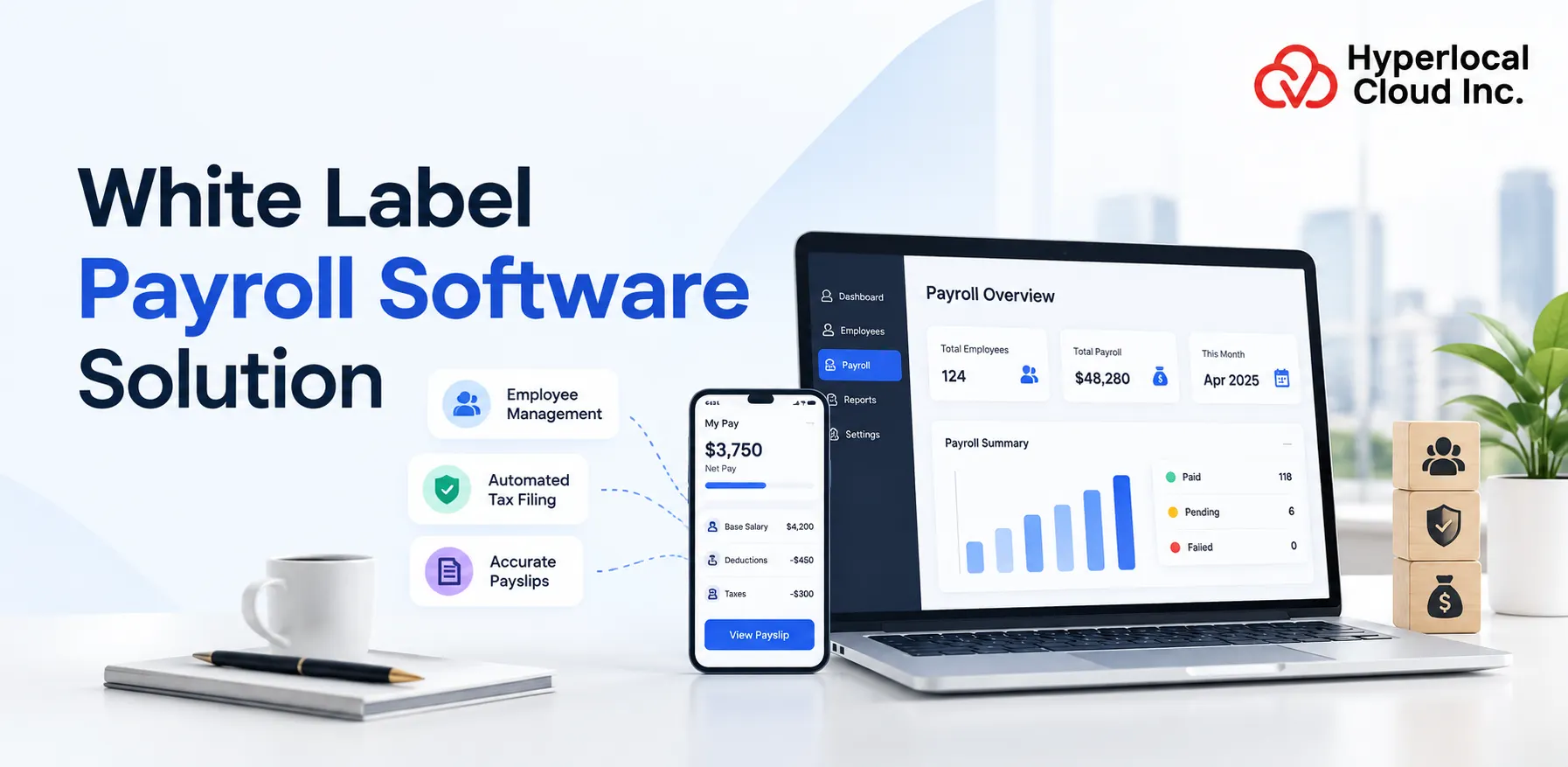
White Label Payroll Software Solution
Technology and automation have transformed the way businesses manage everyday operations, making many tasks faster, easier, and more accurate. Payroll processing, which was once a time-consuming and largely manual responsibility, has also evolved with the adoption of modern payroll software.
The global HR payroll software market is growing rapidly. According to The Business Research Company, the market is expected to grow from $38.82 billion in 2025 to $42.78 billion in 2026, a 10.2% increase. This growing demand for digital payroll solutions creates new opportunities for businesses to launch branded payroll platforms.
With features such as payroll processing, employee management, attendance, leave, payslips, reporting, self-service portals, and APIs, a white-label payroll platform can help businesses expand their services, improve customer experience, and create new recurring revenue opportunities.
An Overview of White Label Payroll Software
White-label payroll software is a ready-to-customize payroll platform that businesses can offer under their own brand. Instead of developing a complete payroll system from scratch, companies can customize the platform with their logo, colors, domain, dashboards, workflows, and other branding elements. This makes it a practical option for payroll providers, accounting firms, HR companies, and SaaS businesses looking to launch or expand their payroll services.
A white-label payroll platform can bring essential payroll functions such as employee management, salary processing, payslip generation, attendance, leave management, reporting, client management, and employee self-service into one solution. With the right integrations and customization options, businesses can provide a branded payroll experience, serve multiple clients, and scale their services while reducing the time and resources required to build payroll software from the ground up.
Reasons To Choose A White Label Payroll Software Solution
Building a payroll platform from scratch requires significant investment in development, testing, integrations, security, maintenance, and ongoing product management. A white label payroll software solution provides an alternative by giving businesses a customizable technology foundation that can be adapted to their brand and operational requirements.
Launch Faster
A ready-to-customize payroll platform can reduce the time and resources required to develop core payroll functionality from the ground up. Instead of starting with an empty codebase, businesses can focus on configuring the platform, adding required integrations, and creating a user experience that meets their customers’ needs.
Build Under Your Own Brand
White label software allows businesses to create a consistent experience under their own identity. Depending on the platform and customization requirements, businesses can personalize elements such as:
- Logo and brand colors
- Domain and login experience
- Dashboard and user interface
- Client and employee portals
- Emails, payslips, and reports
This helps payroll providers and other businesses maintain ownership of the customer-facing experience.
Reduce Development Complexity
Payroll software involves multiple interconnected processes, from employee management and salary calculations to attendance, leave, reporting, and integrations. Starting with an established software foundation can reduce the complexity of developing each component independently.
Businesses can instead focus their development resources on customization, integrations, workflows, and features that are specific to their customers and business model.
Create New Revenue Opportunities
A branded payroll platform can become part of a broader service offering for payroll providers, accounting firms, HR companies, and SaaS businesses. Depending on the target market, businesses can build revenue models around subscriptions, per-client or per-employee pricing, payroll services, premium features, implementation, and ongoing support.
The right pricing model will depend on your customers, services, market, and overall business strategy.
Scale With Your Customers
As your business grows, your payroll platform needs to support increasing numbers of organizations, employees, users, and payroll processes. A scalable architecture can help businesses accommodate this growth without having to replace the underlying platform.
For businesses managing payroll for multiple organizations, multi-tenant architecture can be particularly valuable because it allows different client businesses to operate within the same platform while maintaining separate users, configurations, and data.
What Features Make This Payroll Software Solution Effective?
Payroll software comes with several features for admins, employees, and businesses. The following are the features that payroll software offers:
For Administrator
Automated Payroll Processing: The automated system helps deal with the calculations for wages, taxes, and deductions. It makes payments on time and with accuracy, including direct deposits and check printing.
Tax & Compliance Management: This takes care of the tax calculations and helps keep the business in line with the labor laws and tax regulations, along with the provision of the tax forms and pre-formatted reports for filing.
Time and Attendance Tracking: Enables administrators to oversee the working hours of employees, leave management, and the handling of the attendance data. It is part of the self-service module for employees to request time off.
Employee Data Management: An employee database that stores the data from various departments on employees, including personal information, employment history, and salary components.
Salary Component Customization: An attribute through which an employee can set up and maintain the account of their special allowances, reimbursements, and other salary components that are different from those of other employees or groups.
Employee Self-Service Portal Administration: Authorizing and managing the employee portal that is assigned to the staff, where they can easily find their payslips, tax forms, and even change their personal information.
Expense Management: Managing the company costs that employees report and handling the reimbursement process. The whole process is usually done through a digital version of the submission and approval processes.
Reporting and Analytics: A platform that allows organizations to generate reports for analytical purposes. It provides insights into labor costs and supports strategic decision-making, sometimes complemented by AI-driven capabilities.
Payroll Auditing: The introduction of tools that make it possible to audit the payroll process, find mistakes, and ensure the accuracy of the financial records.
Data Security: Confidential payroll and employee data security at the highest level with features like multi-factor authentication and role-based access.
For Employees
Access Payslips & Tax Documents: The opportunity for employees to obtain, store, and generate their wage details, tax forms, and other required payroll documents is provided.
Update Personal Information: Employees can change their address, bank details, and other personal details by using the portal.
Leave and Attendance Management: The portal has enabled employees to take the initiative and apply for leave as well as keep track of their attendance, which is automatically updated in the system.
Reimbursement and Expense Submission: Employees can go online to submit their expense reimbursement and other claim requests.
Automated Salary Notifications: Employees who are authorized to receive salary payments and access their payslips get instant alerts.
Document Expiration Alerts: This tool is created to inform workers when their documents are close to the expiry date, thus allowing them to always be updated and keep the accuracy of their records.
Mobile Access: Any employee can log into the payroll portal and access the services using any device, which also includes their smartphones.
Reduced HR Burden: Empowering employees with the software that enables them to accomplish payroll-related tasks can be a significant advantage in decreasing the administrative load on the HR department.
Increased Transparency: The implementation of an employee self-service portal leads to a clean and open environment since the employees are given unrestricted access to their payroll details and other related procedures; hence, they have authority over it.
For Businesses
Automated Calculations: The accurate and detailed calculation that includes wages, bonuses, and deductions is automated through the software. This also includes the process of tax deduction at source (TDS).
Regulatory Compliance: The tools help in compliance with the local, state, and national labor laws as well as the tax rules. Part of this compliance is the automated report generation for statutory filings.
Payroll Reporting: Reports and payslips in all formats support data and the decision-making process.
Time and Attendance Tracking: The functionalities that allow for on-the-spot recording and management of staff attendance.
Direct Deposit: It makes the direct transfer of salaries to employee bank accounts the easiest and most secure way.
Scalability and Integrations: The features of a business that can keep up with the changes of a growing company and can link up with the in-house HR or accounting software.
Data Security: The methods that are put in place to avoid any cyber attack on the sensitive employee and payroll data.
Salary Revision and Arrears: The functions that are capable of making the necessary adjustments as per request, be it for past or future dates.
Document Management: A system that is used for managing and storing employee as well as organizational documents in one place.
How Does AI Enhance The Features Of The Payroll Software Solution?
Here’s a breakdown of key AI features that businesses can integrate into their payroll software:
1. Automated Data Entry and Validation
AI-powered algorithms can automatically fetch, input, and validate payroll data that comes from various sources, thus minimizing manual input and the risk of errors.
2. Robotic Process Automation (RPA)
RPA thoroughly handles the automation of the repetitive cycle of rule-based tasks in the payroll process, including data transfer and processing.
3. Intelligent Calculations
Besides, AI can do the complicated calculations needed for overtime, bonuses, and benefits; it can change according to the rules and definitely keep the accuracy of calculations.
4. Real-Time Tax and Legal Updates
AI-powered machine learning models can detect and automatically execute changes in labor laws and tax regulations in any area; thus, no matter the changes, the system will always be in compliance.
5. Anomaly and Fraud Detection
Sophisticated algorithms can pick out unusual patterns, discrepancies, or suspicious moves in the payroll data that are the source of fraud; thus, fraudulent activities can be prevented, as well as unauthorized access.
6. Smart Deduction Mapping
AI can effectively map necessary deductions and benefits for specific employees based on their roles and local laws.
7. Predictive Analytics for Workforce Planning
AI builds on past information to project future labor costs, workforce requirements, and payroll that might increase, thus creating a scenario for improved budgeting and strategic planning.
8. Strategic Insights
Trends provide a valuable resource of data-backed insights for benefits utilization, staff, and other operational areas of the workforce, helping organizations to make the right way.
9. AI-Powered Chatbots
NLP enables AI chatbots to handle employee queries about payroll, benefits, and HR policy in an instant, 24/7, thus offering continuous support and enhancing the employee experience.
10. Enhanced Self-Service Portals
Employee access to pay stubs, updating personal information, and requesting leave becomes simplified, leaving less work for HR.
11. Seamless System Integration
Modern AI payroll solutions effortlessly join with other HR and accounting tools for better data flow and consistency, thus producing an integrated ecosystem.
White Label Payroll Software vs. Custom Payroll Software
| Factor | White Label Payroll Software | Custom Payroll Software |
| Time to launch | Generally faster | Generally longer |
| Initial development | Lower than building everything from scratch | Higher |
| Branding | Customizable | Fully customizable |
| Core platform | Existing technology foundation | Built specifically for you |
| Customization | Depends on platform | Maximum flexibility |
| Integrations | Existing/API-based options | Built to requirements |
| Maintenance | Provider/development partner supported | Your team or development partner |
| Product ownership | Depends on agreement | Depends on development agreement |
| Best for | Faster market entry and configurable products | Highly specific requirements |
Choosing between white label and custom development depends on your business goals.
Discover the Steps to Build A Payroll Software Solution
White label payroll software typically involves more than simply adding a company logo to an existing application. The platform needs to be aligned with your business model, customer requirements, payroll workflows, branding, integrations, and operational processes before it is ready for launch.
1. Discovery & Planning
In this step, the team recognizes needs, gathers requirements and suggestions from stakeholders like HR and Finance. They comprehend the trends to create a solution that is competitive and durable in the market.
2. Design
The team of developers now creates wireframes and prototypes of the software’s user interface and workflows through pictures. After this, they decide on the technologies to be used in creating an interactive UI.
3. Development
Here are two of the processes generally used in software development:
| Aspect | White Label Solution | Custom-Based Solution |
| Time to Market | Quick (ready-made, rebranded) | Longer (built from scratch) |
| Cost | Lower upfront investment | Higher upfront investment |
| Customization | Limited (branding, minor tweaks) | Full customization possible |
| Ownership | Vendor-owned businesses rebrand. | Full ownership & control |
| Scalability | Limited to the vendor’s capabilities | Fully scalable as per needs |
4. Testing & Quality Assurance (QA)
The team of QA tests the software after development to ensure that there are no bugs, and if any are found, they fix those bugs. This testing process is followed if the software is developed from scratch. If the software is a white-label solution, then it is pre-tested, as it is a ready-made solution and is ready to use.
5. Launch
The software is launched in the market and can be used by companies to streamline their business processes. Enterprises can start training users, such as HR staff, on how to operate the system effectively.
6. Maintenance & Support
Ensuring that the software performs well by checking the software resources and services that contribute to the uptime of the system. We provide frequent updates to cover changes in tax laws, security holes, and future enhancements.
Which Technologies Are Used in Payroll Software Development?
Using the right technologies to build payroll software is essential. Here are the technologies that are required to build payroll software:
| Component | Tech Stack |
| Frontend | HTML, CSS, JavaScript, React, Angular, Vue.js |
| Backend | Node.js, C# (.NET), Django, Flask, Express.js, and ASP.NET |
| Database | MSSQL, PostgreSQL, MongoDB |
| Payment Gateway | Stripe, PayPal, Razorpay, or digital wallets |
| Cloud Platforms | AWS, Microsoft Azure, or Google Cloud Platform (GCP) |
| Push Notifications | Firebase Cloud Messaging (FCM), Apple Push Notification Service (APNS) |
| APIs | ADP, Gusto, Paychex, Patriot, and Paycor |
What Are The Real-World Use Cases Of A Payroll Software Solution?
Payroll software can be created for organizations of all sizes and complexities, or even businesses that have employees working from home, or a company that is located in different countries. Here are the businesses that can invest in building this software:
Payroll Service Providers
Payroll companies can provide customers with a branded payroll portal instead of sending them to a third-party application.
A branded platform can help payroll providers centralize client management, payroll workflows, employee information, reports, and communication.
Accounting Firms
Accounting firms can add payroll technology to their existing accounting and financial services.
A white-label platform can help firms offer payroll as an additional recurring service while keeping the customer experience within their own brand.
HR & HCM Companies
HR technology providers can add payroll capabilities to an existing HR ecosystem.
Integrating employee management, attendance, leave, payroll, and reporting can provide customers with a more connected experience.
SaaS Companies
SaaS businesses can integrate payroll capabilities into an existing software platform.
APIs and integrations can allow payroll functionality to become part of a larger business application.
Entrepreneurs & Startups
Businesses entering the payroll technology market can use a white label approach to reduce the amount of technology that needs to be developed before launch.
This lets the business focus more on its target market, customer acquisition, sales, service, and product positioning.
Tech Companies
For tech companies that need to have a global workforce or demand smooth and flawless integration with their other business systems, one of the most favored and commonly chosen payroll software with advanced features and integrations is a valuable investment.
Businesses with Remote or Global Workforces
Any enterprise having staff in different locations can be a perfect user of payroll software, which may be helpful in accomplishing international payments and ensuring that various tax laws are fully complied with.
How Much Does White Label Payroll Software Cost?
Building payroll software using a white label solution costs starting from $10,000. This is just an estimate, as the final cost is dependent on the features that the business wants to add to the software. We not only offer our services to large organizations but also help launch a payroll system for small businesses, streamlining their business processes.
Several software development companies engage in the process of software development in one of two ways. These processes are choosing a white-label solution or building a platform from scratch.
Besides these factors, the complexity of the platform, the kind of design and user experience a business wants, the duration of the project, the abilities of the team, the incorporation of AI features, and any third-party integrations will also affect the total price.
How Can Payroll Providers Generate Revenue With White Label Software?
Here is how businesses can generate revenue using this payroll software solution:
Subscription Models
Tiered Pricing: Providers create multiple pricing plans, such as basic, standard, and professional, with different feature levels and support that are usually sold on a monthly or yearly basis.Per-Employee Fees: Most providers not only want a subscription fee as the base of their revenue model but also a recurring charge for each employee processed. This creates a flexible revenue model that increases as the client’s workforce expands.
Freemium Models
Free Basic Version: To attract a large user base, some providers may offer a limited-functionality free tier.
Paid Upgrades: Users buy access to advanced features, extended reporting, or tailored services.
Add-On Fees
Per-Employee Fees: For additional workers beyond a base number, usually with a fixed cost per employee per month.
Service-Specific Fees: Fees for standard services become extra services, such as direct deposit, specialized tax filing, and complete compliance management.
Why Choose Our White Label Payroll Software Solution?
Our white-label payroll software enables payroll providers, accounting firms, HR companies, staffing agencies, and fintech businesses to offer a powerful payroll platform under their own brand—without the time, cost, and complexity of building one from scratch. Modern white-label payroll platforms can combine branded experiences with payroll automation, tax management, employee management, integrations, and scalable infrastructure.
1. Fully Customized Branding
Make the platform completely yours with your logo, colors, domain, emails, dashboards, and payroll documents. Your customers interact with your brand throughout the payroll journey rather than a third-party provider.
2. Faster Time to Market
Launch a professional payroll solution without spending years developing payroll infrastructure. White-label technology gives you ready-to-use functionality while your team focuses on sales, customer relationships, and business growth.
3. Reduce Development & Operational Costs
Avoid the significant investment required to build, maintain, test, and continuously update a payroll platform internally. A white-label model lets you leverage existing infrastructure while maintaining your own customer-facing brand.
4. Automated Payroll Processing
Simplify payroll with automated salary calculations, deductions, benefits, timesheets, payroll history, reports, and other recurring workflows. Automation can reduce repetitive manual work and help create consistent payroll processes.
5. Tax & Compliance Support
Payroll regulations change frequently. A strong solution can provide automated tax calculations, filing workflows, regulatory updates, and compliance-focused tools to reduce administrative burden and payroll risk.
6. Scalable Multi-Tenant Architecture
Manage multiple businesses, employers, employees, and payroll accounts from a centralized platform. This makes the solution suitable for payroll bureaus, accounting firms, PEOs, staffing companies, and SaaS platforms that need to grow their customer base.
7. Seamless API & Third-Party Integrations
Connect payroll with accounting software, HR systems, payment platforms, time-tracking applications, and your existing business ecosystem through APIs and integrations.
8. Better Client Experience
Give clients convenient self-service access to payslips, payroll reports, employee information, PTO, deductions, and other payroll data. A unified experience can reduce unnecessary back-and-forth and strengthen your client relationship.
9. New Recurring Revenue Opportunities
Turn payroll into an additional revenue stream by offering it as part of your existing services or SaaS platform. You can package payroll with accounting, HR, staffing, financial, or business-management services.
10. Built for Long-Term Growth
Our white-label approach allows you to start with essential payroll functionality and expand as your business grows—with additional integrations, HR capabilities, reporting, benefits, automation, and customized workflows.
With our white-label payroll software, you own the brand and customer relationship while the technology handles the complex payroll infrastructure behind the scenes.

Patt Cummins is an experienced content writer with over 10 years of experience creating clear and engaging content for technology-focused industries. He specializes in simplifying complex technical topics into easy-to-understand stories that educate readers, support brand communication, and help businesses effectively share their solutions.

Need Help With
Development?