

- A Letgo clone app connects buyers and sellers through a digital marketplace.
- C2C, B2C, and hybrid models offer different business opportunities.
- Buyer, seller, and admin panels are essential marketplace components.
- AI can improve product discovery, categorization, and recommendations.
- Featured listings, subscriptions, and commissions create revenue opportunities.
- White-label solutions can reduce development effort and accelerate market entry.
- Hyperlocal Cloud offers a customizable foundation for launching a buy-and-sell marketplace.
The growing popularity of online marketplaces has changed how people buy and sell new and pre-owned products. From electronics and furniture to vehicles, clothing, and household essentials, consumers increasingly prefer convenient digital platforms that connect buyers and sellers directly. This creates an excellent opportunity for entrepreneurs and startups to launch their own classified marketplace applications.
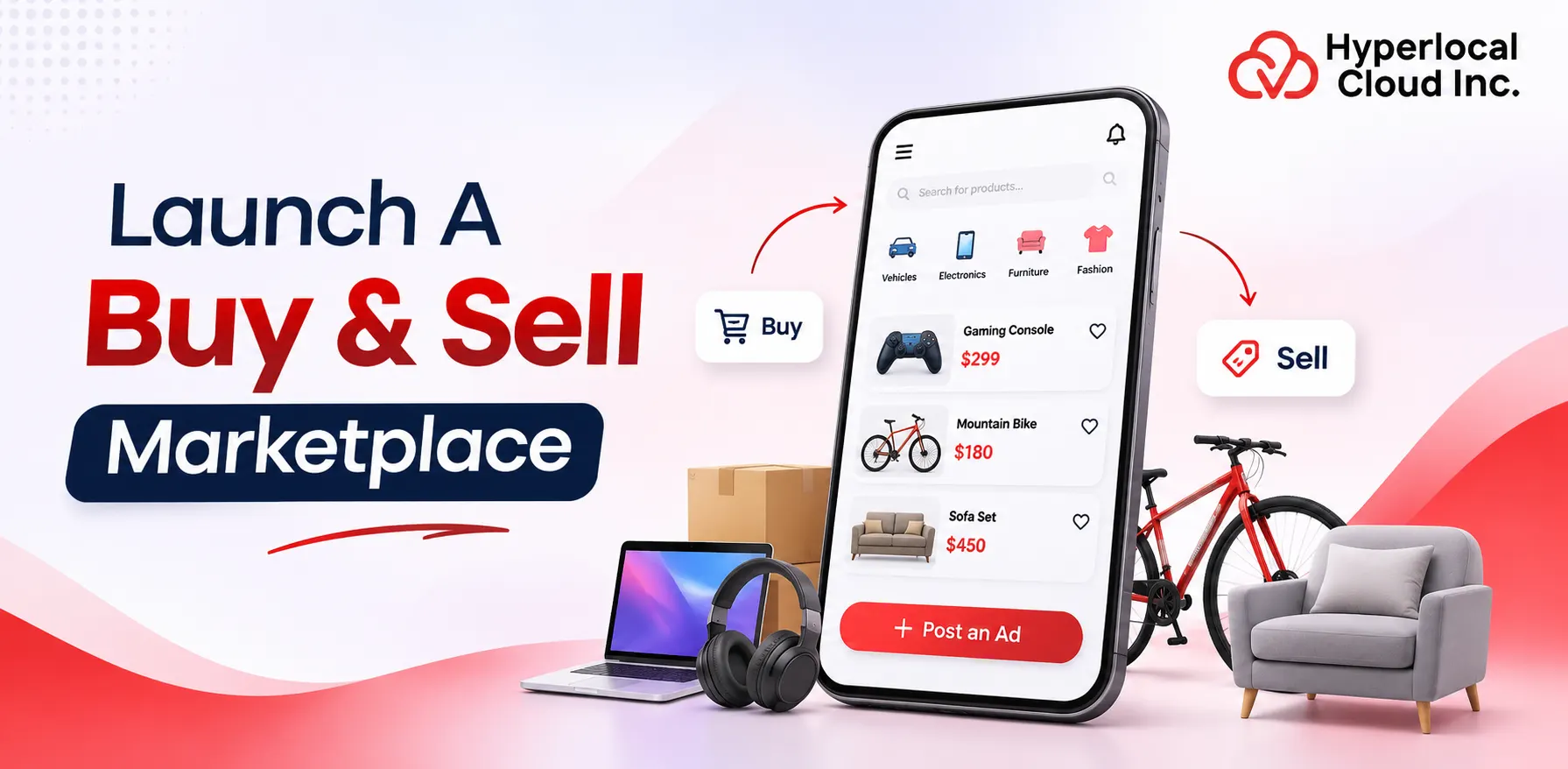
Letgo clone app development offers a practical way to enter this growing industry with a feature-rich buy-and-sell platform. Inspired by the convenience of the Letgo marketplace, a Letgo clone enables users to list products, discover nearby deals, communicate with sellers, negotiate prices, and complete transactions through a mobile application.
With Hyperlocal Cloud, businesses can launch a Letgo clone with essential marketplace features, intuitive interfaces, secure communication, and scalable technology. Whether you want to build a local classified platform or a multi-category resale marketplace, this solution provides a foundation for establishing your digital marketplace business.
What Is a Letgo Clone App?
A Letgo clone app is a ready-made or customizable marketplace application that allows individuals and businesses to buy and sell products online. It connects buyers and sellers through a centralized digital platform where users can publish product listings, upload images, set prices, explore available products, and communicate directly.
The application follows a peer-to-peer marketplace model, allowing users to participate as buyers, sellers, or both. Entrepreneurs can customize the platform according to their target audience, product categories, geographical coverage, and revenue strategy.
Understanding the Letgo Marketplace Business Model
The Letgo-inspired marketplace operates primarily on a consumer-to-consumer (C2C) model. Individual users can create accounts, publish product advertisements, and connect with interested buyers.
Businesses can also adopt a business-to-consumer (B2C) approach by allowing retailers, dealers, and professional sellers to promote their products.
The platform owner manages the marketplace infrastructure, user accounts, listings, advertisements, subscriptions, and administrative operations. Revenue can be generated through featured listings, advertising, premium memberships, and other monetization options.
How Does a Letgo-Like Buy and Sell App Work?
A typical marketplace application follows a straightforward process:
- Users register using their email address, phone number, or supported social login options.
- Sellers create product listings with descriptions, images, prices, and locations.
- Buyers browse products through categories, search filters, and location-based discovery.
- Interested buyers contact sellers through in-app messaging.
- Both parties discuss product details, negotiate prices, and arrange payment or delivery.
- Users can rate their experiences and report suspicious activities.
Key Differences Between Traditional Classifieds and Digital Marketplaces
Traditional classified platforms primarily focus on publishing advertisements and connecting interested parties. Modern marketplace applications offer more advanced capabilities, including real-time communication, personalized recommendations, user verification, payment integration, and location-based product discovery.
A customized Letgo clone can combine these capabilities into one platform, creating a more engaging and convenient buying and selling experience.
Connect Buyers and Sellers Through Your Own App
Why Invest in a Letgo Clone App in 2027?
The secondhand economy, local commerce, and digital resale industry provide several opportunities for entrepreneurs. Consumers are increasingly interested in affordable products, sustainable shopping, and convenient ways to sell unused belongings.
Launching a Letgo-like marketplace allows businesses to participate in this changing consumer landscape.
Growing Demand for Secondhand Products
Consumers increasingly explore pre-owned products to save money and access affordable alternatives. Electronics, furniture, clothing, vehicles, and household products are popular categories for resale marketplaces.
Entrepreneurs can establish platforms that make discovering, purchasing, and selling pre-owned products easier.
Increasing Popularity of Local Marketplaces
Location-based marketplaces help users discover products available within their surrounding areas. Buyers can find nearby sellers, communicate directly, and arrange convenient exchanges.
This creates opportunities for businesses to develop city-specific, regional, and community-focused marketplace applications.
Opportunities for Entrepreneurs and Startups
A Letgo clone provides startups with an opportunity to establish a digital marketplace without developing every component from scratch.
Business owners can customize product categories, user permissions, listing policies, and revenue models according to their business objectives.
Potential for Scalable Marketplace Businesses
A well-planned marketplace can expand from a local platform into a regional or multi-country business. Entrepreneurs can introduce additional categories, languages, currencies, payment options, and seller management capabilities as their user base grows.
Essential Features of a Letgo Clone App
Features play an important role in creating a convenient and reliable marketplace experience. A successful application should provide separate functionalities for buyers, sellers, and administrators.
Buyer Panel Features
User Registration and Login: Buyers can create accounts through email, mobile numbers, or supported social authentication methods.
Smart Product Search: Users can search for products using keywords, categories, locations, and other relevant filters.
Advanced Filters: Buyers can narrow search results according to price, condition, category, distance, and product availability.
Product Details: Detailed product pages display images, descriptions, prices, seller information, and location details.
Wishlist and Favorites: Users can save interesting products and revisit them later.
In-App Messaging: Buyers can communicate with sellers to ask questions, request additional information, and negotiate prices.
Push Notifications: Buyers receive updates about messages, saved searches, price changes, and relevant product listings.
Ratings and Reviews: Users can share feedback about their buying experiences and interactions with sellers.
Seller Panel Features
Easy Product Listing: Sellers can publish advertisements by adding product names, descriptions, photographs, prices, and categories.
Product Management: Sellers can edit, update, pause, or remove their existing listings.
Image Upload: Multiple product images help sellers present their items more effectively.
Listing Performance Analytics: Sellers can monitor listing views, inquiries, and engagement.
Chat Management: A centralized messaging system helps sellers respond to buyer inquiries.
Featured Listings: Sellers can promote selected products to improve their visibility.
Seller Profile Management: Sellers can update personal details, profile photographs, contact information, and business descriptions.
Admin Panel Features
Dashboard Management: Administrators can monitor users, listings, categories, transactions, and marketplace activities.
User Management: Admins can approve, suspend, verify, or manage user accounts.
Product Listing Management: Administrators can review advertisements, remove prohibited listings, and manage product categories.
Commission and Revenue Management: The admin panel provides tools to manage listing fees, subscription plans, advertising, and other revenue streams.
Content Management: Administrators can update banners, promotional content, policies, and informational pages.
Reports and Analytics: Business owners can monitor marketplace performance, user activity, listing engagement, and revenue.
Complaint Management: Administrators can review user reports, resolve disputes, and investigate suspicious marketplace activities.
AI-Powered Features to Include in a Letgo Clone App
Artificial intelligence can improve marketplace discovery, automate repetitive activities, and create more personalized shopping experiences.
AI-Based Product Recommendations
AI-powered recommendation engines can analyze browsing activity, saved products, search history, and user preferences to suggest relevant listings.
This helps buyers discover products that match their interests.
Automatic Product Categorization
AI can analyze product titles, descriptions, and images to recommend suitable listing categories. This simplifies the publishing process and helps maintain an organized marketplace.
AI-Powered Image Recognition
Image recognition technology can identify product characteristics from uploaded photographs. Depending on the implementation, it can suggest relevant categories, identify duplicate images, and assist with listing creation.
Smart Pricing Suggestions
AI-based pricing tools can analyze available product information and comparable listings to suggest suitable price ranges.
Sellers can use these recommendations to make more informed pricing decisions.
Fraud Detection and Prevention
Machine learning models can help identify unusual listing patterns, suspicious account activity, duplicate advertisements, and potentially fraudulent behavior.
Automated alerts can help administrators investigate potential risks.
Personalized Product Discovery
AI can personalize product feeds according to user preferences, browsing history, location, and interactions. This creates a more relevant marketplace experience and can improve engagement.
Launch Your Own C2C Marketplace with Advanced Features
How Does a Letgo Clone App Make Money?
A marketplace can generate revenue through multiple monetization strategies. Businesses should select revenue models according to their target audience and marketplace activity.
Featured and Promoted Listings
Sellers can pay additional fees to promote their products. Featured advertisements can receive better visibility in search results, category pages, or promotional sections.
Subscription Plans
Businesses can introduce monthly or annual subscription packages for professional sellers.
Different plans can offer listing limits, advanced analytics, promotional opportunities, and additional seller tools.
Commission-Based Revenue
The marketplace owner can collect a percentage of completed transactions when payments are processed through the platform.
Commission rates can vary according to product categories and business policies.
In-App Advertising
The platform can display relevant advertisements through banner placements, sponsored listings, or promotional sections.
Advertising partnerships can create additional income opportunities.
Premium Seller Accounts
Professional sellers can purchase premium accounts to access enhanced marketplace features, additional listings, seller analytics, and promotional tools.
Listing Fees
Businesses can charge sellers a fixed fee for publishing advertisements. Free listing allowances can also be provided to encourage new users to join the marketplace.
Technology Stack for Letgo Clone App Development
The technology stack determines the application’s performance, scalability, security, and maintenance requirements. Technologies should be selected according to business objectives and expected marketplace traffic.
Frontend Technologies
- React Native
- Flutter
- Swift
- Kotlin
- React.js
- Next.js
Backend Technologies
- Node.js
- Python
- Java
- PHP
- .NET
Database Technologies
- PostgreSQL
- MySQL
- MongoDB
- Redis
Cloud Infrastructure
- Amazon Web Services
- Google Cloud Platform
- Microsoft Azure
AI and Machine Learning Integrations
- Python-based machine learning frameworks
- Recommendation engines
- Image recognition APIs
- Natural language processing tools
- Fraud detection models
Payment Gateway and Third-Party APIs
Depending on the target market, the application can integrate payment services, maps, geolocation, push notifications, analytics, SMS verification, and logistics APIs.
The final technology selection should depend on security requirements, regional availability, integration compatibility, and scalability goals.
Steps to Develop a Buy and Sell Marketplace App Like Letgo
Developing a marketplace requires proper planning, feature selection, technical implementation, and continuous improvement.
Market Research and Business Planning
Start by identifying the target audience, marketplace niche, competitors, geographical coverage, and business objectives.
Define the revenue model, product categories, user roles, and essential marketplace features before starting development.
UI/UX Design and Prototyping
Create an intuitive interface that simplifies product discovery, listing creation, and buyer-seller communication.
Develop wireframes and interactive prototypes to evaluate the user journey before implementation.
Feature Planning and Development
Build buyer, seller, and admin functionalities according to the approved project scope.
Prioritize essential features such as registration, product listings, search, filters, messaging, and listing management.
Payment and API Integration
Integrate suitable payment gateways, location services, push notifications, authentication tools, and third-party services.
Test all integrations to ensure they work correctly across supported devices and regions.
Testing and Quality Assurance
Conduct functional, performance, usability, compatibility, and security testing.
Identify technical issues, resolve bugs, and verify that the platform performs reliably under expected user loads.
App Deployment and Launch
Prepare the application for deployment on supported platforms, configure production infrastructure, and complete the necessary store submission processes.
Businesses should also prepare customer support and marketplace moderation policies before launch.
Maintenance and Ongoing Support
Monitor application performance, introduce updates, improve security, and resolve technical issues.
Use marketplace analytics and customer feedback to identify opportunities for new features and better user experiences.
Develop an AI-Powered Marketplace for Modern Consumers
How Much Does a Letgo Clone App Cost?
Launching a buy-and-sell marketplace doesn’t necessarily require investing in custom app development from scratch. With Hyperlocal Cloud, businesses can get started with a ready-made, customizable white-label solution for $8,000.
This solution provides an opportunity for startups, entrepreneurs, and established businesses to launch their own marketplace with a pre-built technology foundation.
White Label Solution – $8,000
For a one-time solution price of $8,000, businesses can explore a ready-made marketplace platform that can be customized according to their branding and business requirements.
What Influences Marketplace Development Costs?
For businesses considering additional customization or custom development, the overall investment may depend on:
- Additional feature requirements
- UI/UX customization
- Third-party API integrations
- Payment gateway integrations
- AI-powered functionalities
- Advanced marketplace workflows
- Additional platform requirements
Why Choose a White Label Solution?
A white-label solution can help businesses reduce initial development effort, accelerate time to market, and establish their own branded marketplace without building the entire application from scratch.
Why Choose Hyperlocal Cloud for Letgo Clone App Development?
Launching a successful marketplace requires more than a mobile application. Businesses need a reliable technology foundation that supports product listings, user interactions, administration, and future expansion.
Hyperlocal Cloud provides customizable marketplace solutions designed to help entrepreneurs and businesses establish their own digital platforms.
Ready-Made Marketplace Solution
Get started with a pre-built marketplace solution instead of developing every component from scratch.
Customizable Features and Branding
Adapt the application according to your business identity, target audience, product categories, and operational requirements.
Scalable Architecture
Build a marketplace foundation that can accommodate growing user activity, product listings, and additional functionalities.
Secure Marketplace Infrastructure
Implement suitable authentication, access controls, secure communication, and other security measures to support reliable marketplace operations.
Technical Support and Maintenance
Get assistance with implementation, configuration, updates, and ongoing technical requirements according to your selected service agreement.
Ready to launch your own marketplace app? Contact Hyperlocal Cloud today to discuss your Letgo clone app requirements and explore a suitable solution for your business.
FAQs (Frequently Asked Questions)


Need Help With
Development?