

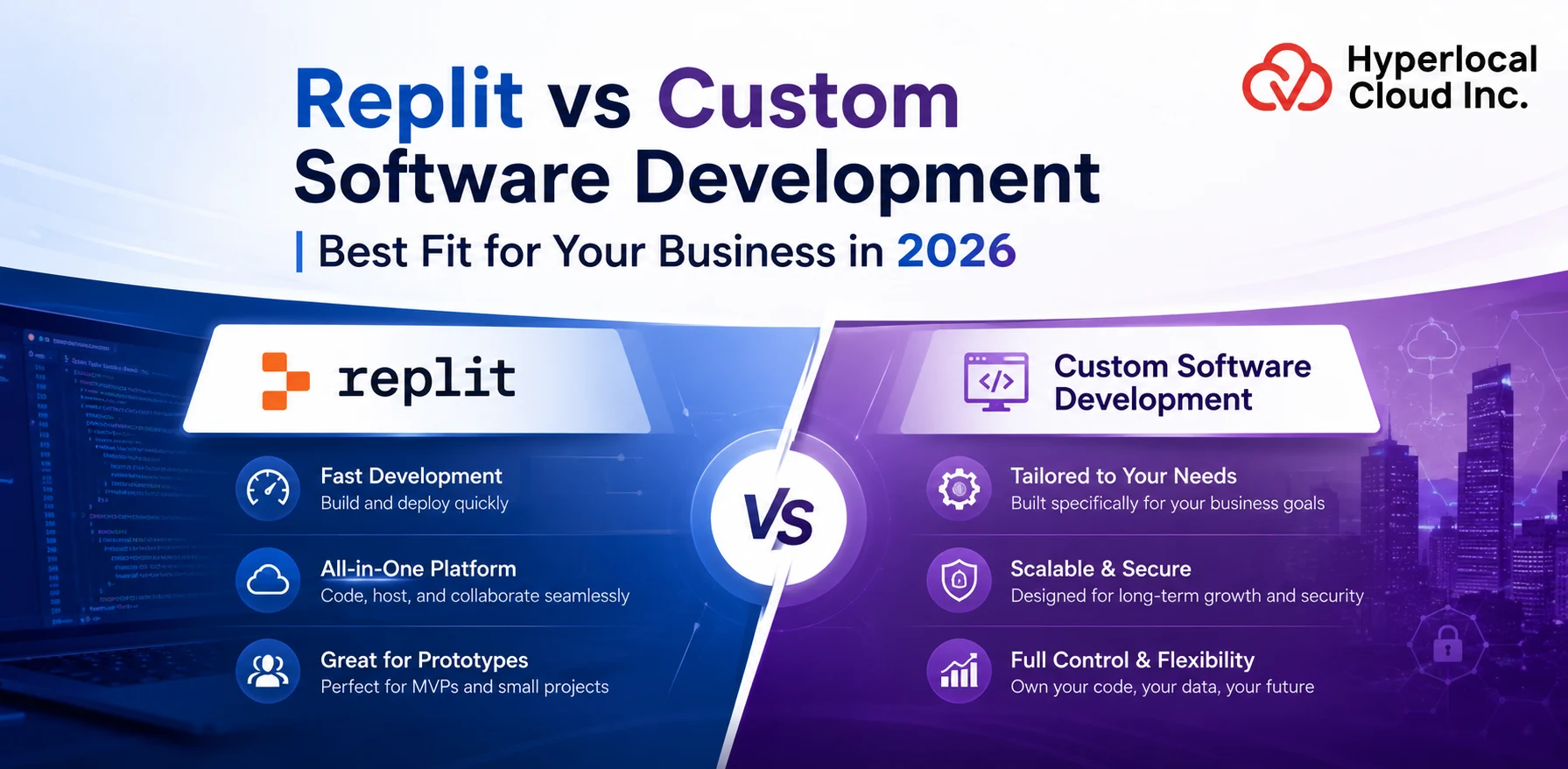
- Replit and custom software development serve very different stages of the product lifecycle speed vs long-term scalability.
- Replit is best suited for rapid prototyping, MVPs, and early-stage validation with minimal upfront cost.
- Custom software development is designed for scalable, secure, and fully tailored business applications.
- Development speed and cost are the main short-term advantages of Replit, while ownership and flexibility favor custom development.
- Replit can introduce limitations in scalability, customization, and enterprise-grade security as products grow.
- Custom-built systems require a higher initial investment but offer better long-term control and cost efficiency.
- The right choice depends on business stage, product complexity, and long-term growth goals.
- Many businesses benefit from a hybrid approach—starting fast with Replit and transitioning to custom development as they scale.
The way businesses make software has changed a lot because of platforms that use AI to help with development. Tools like Replit help teams make, test, and put out applications faster by combining development environments with coding that is assisted by artificial intelligence. This has made it easier for companies, entrepreneurs, and businesses to try out ideas quickly. At the time, custom software development is still the best way for companies that need special functions, strong security, and applications that can help their business grow in the long term.
As businesses evaluate these two approaches, the decision extends beyond development speed or initial costs. Factors such as scalability, customization, data security, ownership of the source code, integration capabilities, and ongoing maintenance play a significant role in determining the right solution. While Replit can accelerate prototyping and MVP development, custom software development provides the flexibility to build solutions that align with unique business processes and evolving market demands. Understanding these differences is essential before investing time and resources into a software project.
This guide offers a detailed comparison of Replit vs custom software development, examining their advantages, limitations, and ideal use cases. We’ll compare both approaches across key business considerations, including cost, development timelines, scalability, security, and long-term value to help founders, business leaders, and investors choose the solution that best supports their objectives.
What Is Replit?
Replit is an AI-powered cloud development platform that enables users to write, test, debug, and deploy applications from a browser-based workspace. By combining an online integrated development environment (IDE) with AI-assisted coding, Replit simplifies the software development process and reduces the need for complex local setups. This makes it easier for individuals and teams to start building applications quickly while collaborating in real time.
Core Features
Some of Replit’s key features include:
- AI-powered coding assistance to generate, explain, and improve code.
- Cloud-based development environment with no local installation required.
- Support for multiple programming languages such as Python, JavaScript, Java, C++, and more.
- Real-time collaboration allows multiple developers to work on the same project simultaneously.
- Built-in deployment and hosting for publishing applications directly from the platform.
- Integrated version control and project management tools to streamline development workflows.
Best Use Cases for Replit
Replit is particularly effective for projects that require rapid development and quick iteration, including:
- Minimum Viable Products (MVPs): Launch and validate new product ideas without significant upfront investment.
- Internal Tools: Build dashboards, automation tools, and business utilities for internal operations.
- Startup Validation: Test business concepts and gather user feedback before committing to large-scale development.
- Learning and Experimentation: Explore new programming languages, frameworks, and AI-assisted development workflows.
- Rapid Prototyping: Quickly create functional prototypes to demonstrate concepts to stakeholders, investors, or potential customers.
While Replit excels at accelerating early-stage development, businesses planning to build scalable, highly customized, or mission-critical software should carefully evaluate whether a custom software development approach is better suited to their long-term objectives.
What Is Custom Software Development?
Custom software development is the process of designing, developing, and maintaining software solutions tailored to an organization’s specific business requirements. Unlike off-the-shelf software or low-code platforms, custom applications are built from the ground up to address unique workflows, operational challenges, and business goals. This approach gives companies complete control over the application’s functionality, architecture, and future enhancements, making it a preferred choice for businesses that need scalable and differentiated digital solutions.
Key Characteristics of Custom Software Development
Custom software development typically includes an end-to-end development process, ensuring the final product aligns with business objectives. This process often involves:
- Business requirement analysis to understand goals and user needs.
- UI/UX design for an intuitive user experience.
- Custom application development using the most suitable technologies.
- Third-party integrations with existing business systems and APIs.
- Quality assurance and testing to ensure reliability and performance.
- Deployment, maintenance, and ongoing support for continuous improvements.
Since the software is built specifically for the business, organizations retain full ownership of the source code, intellectual property, and product roadmap, allowing them to scale and adapt without platform limitations.
Best Use Cases for Custom Software Development
Custom software development is ideal for businesses that require flexibility, security, and long-term scalability. Common use cases include:
- Enterprise software for managing complex business operations.
- SaaS platforms designed to serve a growing customer base.
- Customer-facing applications such as web portals and mobile apps.
- Regulated industries like healthcare, finance, and insurance that require strict compliance and data security.
- Long-term digital products that need continuous feature enhancements and the ability to scale with business growth.
Replit vs Custom Software Development: Quick Comparison
| Feature | Replit | Custom Software Development |
| Development Speed | Extremely fast for prototypes and MVPs with AI-assisted coding and a prebuilt cloud environment | Slower initial development due to planning, design, and engineering cycles |
| Initial Cost | Low to very low; minimal setup and infrastructure costs | Higher upfront investment due to design, development, and engineering resources |
| Long-term Cost | Can increase over time as scaling and limitations require migration or workarounds | More predictable and optimized for long-term cost efficiency at scale |
| Scalability | Suitable for small to mid-scale projects; limited for complex enterprise scaling | Highly scalable, designed to handle growing users, data, and workloads |
| Security | Basic to moderate security, depending on configuration and usage | Enterprise-grade security tailored to business and compliance requirements |
| Customization | Limited by platform constraints and environmental capabilities | Fully customizable based on business logic and requirements |
| AI Assistance | Strong AI integration for code generation, debugging, and suggestions | Optional AI integration depending on project architecture and requirements |
| Third-party Integrations | Supports common APIs but may have limitations for complex integrations | Fully flexible integration with any APIs, systems, or enterprise tools |
| Maintenance | Platform-managed infrastructure, but limited control over the underlying system | Fully controlled maintenance strategy with dedicated support and updates |
| Performance | Good for lightweight applications and prototypes | Optimized for high-performance, production-grade applications |
| Ownership | Platform-dependent, with some limitations on full control | Full ownership of source code, infrastructure, and IP |
| Best For | MVPs, prototypes, internal tools, learning, and early-stage validation | Scalable SaaS products, enterprise systems, and long-term business applications |
Not Sure Whether to Build on Replit or Custom Software? Book Free Consultation
Replit vs Custom Software Development: Detailed Comparison
This comparison breaks down how the two approaches differ on key technical and business factors to help you make an informed decision.
1. Development Speed
Replit significantly accelerates early-stage development through its AI-powered coding assistant and browser-based environment. Developers can generate boilerplate code, debug issues, and deploy applications quickly without spending time on local setup or infrastructure configuration. This makes it highly effective for building MVPs and validating ideas in a short time frame.
Custom software development, on the other hand, follows a structured lifecycle that includes planning, design, architecture, development, and testing. While this results in a slower initial build, it ensures the final product is stable, scalable, and aligned with long-term business goals. In cases where speed to market is critical, Replit has an advantage; however, for products expected to evolve into full-scale platforms, custom development offers more sustainable velocity over time.
2. Cost Comparison
Replit offers a low upfront cost since it eliminates the need for complex infrastructure, DevOps setup, and large development teams. This makes it attractive for startups and early-stage projects. However, as the product grows, hidden costs may emerge in the form of platform limitations, scaling workarounds, or eventual migration to a more robust system.
Custom software development requires a higher initial investment due to engineering resources, design, and architecture planning. However, it provides better cost efficiency in the long term. Businesses gain full control over infrastructure optimization, feature prioritization, and scaling strategies, which reduces the total cost of ownership (TCO) as the product matures.
3. Flexibility & Customization
Replit provides flexibility within its platform boundaries, but it is still constrained by the tools, frameworks, and deployment environment it offers. This can limit complex workflows or highly specific business requirements.
Custom software development is built entirely around business needs. Whether it is custom workflows, advanced automation, or deep system integrations, everything can be tailored. This makes it ideal for businesses with unique operational models or evolving product strategies.
4. Scalability
Replit works well for small to medium-scale applications, especially during early validation stages. However, scaling large user bases or handling complex distributed systems may require architectural migration to a more robust infrastructure.
Custom-built systems are designed with scalability in mind from the ground up. This includes database optimization, modular architecture, load balancing, and performance tuning to support high traffic and long-term growth.
5. Security & Compliance
Replit provides standard security features suitable for prototypes and internal tools, but it may not meet strict enterprise or regulatory requirements.
Custom software development allows full control over security architecture, including authentication systems, encryption, and access control. It also enables compliance with industry standards such as GDPR, HIPAA, SOC 2, and other regulatory frameworks, making it suitable for enterprise and regulated industries.
6. Ownership & Intellectual Property
With Replit, developers operate within a managed platform environment, which can introduce some level of dependency on the platform ecosystem.
Custom software development provides complete ownership of source code, infrastructure, and intellectual property. This eliminates vendor lock-in and ensures full long-term control over the product roadmap, technology stack, and deployment strategy.
7. AI Capabilities
Replit leverages AI heavily through its coding assistant, which helps generate code, fix errors, and speed up development tasks. This is especially useful for rapid prototyping and small-scale applications.
Custom development teams may also integrate AI tools into the product or development workflow, but they are not limited to a single AI system. Experienced engineers combine AI assistance with architectural thinking, system design, and performance optimization—areas where AI alone is not sufficient.
AI accelerates development in both approaches, but human engineering expertise remains essential for building scalable, secure, and production-grade systems.
8. Maintenance & Future Updates
Replit reduces infrastructure maintenance overhead since hosting and deployment are handled within the platform. However, limitations may arise when managing complex updates or long-term system evolution.
Custom software development allows full control over maintenance, bug fixing, and feature expansion. While it requires dedicated effort, it also ensures that technical debt is managed strategically, system upgrades are planned properly, and new features can be integrated without platform constraints.
Replit vs Custom Software Development: Pros and Cons
Choosing between Replit and custom software development becomes clearer when you evaluate the practical advantages and limitations of each approach in real-world business scenarios.
Replit:
Pros
- Fast development with AI-assisted coding and a ready-to-use cloud environment
- Built-in AI support for generating, debugging, and improving code
- Lower initial cost with minimal infrastructure setup
- Ideal for quickly building prototypes and MVPs
Cons
- Limited customization for complex or highly specific business requirements
- Scaling challenges for large user bases or enterprise-grade systems
- Less suitable for mission-critical or highly regulated applications
Custom Software Development
Pros
- Fully tailored to specific business needs and workflows
- Highly scalable architecture designed for long-term growth
- Strong security and compliance capabilities for enterprise use
- Complete ownership of source code and intellectual property
- Creates a long-term competitive advantage through differentiation
Cons
- Higher upfront investment compared to platform-based solutions
- Longer development timeline due to structured engineering process
- Requires an experienced development team or technology partner to execute effectively
Which Option Is Right for Your Business? Choosing the Right Development Approach
The right choice between Replit and custom software development largely depends on your business stage, product complexity, and long-term goals. While both approaches have value, they serve very different purposes in the product lifecycle.
Choose Replit if:
Replit is best suited for early-stage experimentation and fast execution, especially when speed matters more than scalability or deep customization.
- You need to build and launch an MVP quickly to test an idea in the market
- You are in the validation stage and want to gather user feedback before investing heavily
- You are developing internal tools or lightweight applications for operational use
- Your budget is limited, and you want to minimize upfront development costs
- Your product requirements are still evolving and likely to change frequently
In these cases, Replit helps reduce time-to-market and allows faster iteration without heavy engineering overhead.
Choose Custom Software Development if:
Custom software development is the better choice when your business requires scalability, performance, and long-term control over the product.
- You are building a scalable SaaS or long-term digital product
- You need a high-performance architecture that can handle growth
- Security and compliance are critical (finance, healthcare, enterprise systems)
- You require complex workflows and deep customization
- You want full ownership of code, infrastructure, and IP
- You are planning for investor-backed or high-growth scaling
This approach ensures your product is not limited by platform constraints and can evolve as your business grows.
Can You Combine Both? The Hybrid Approach Explained
Most businesses don’t actually start with a perfect roadmap for their product. What usually happens is simple: you have an idea, you want to see if people care about it, and you need something working quickly without spending too much upfront. This is where a hybrid approach between Replit and custom software development often makes more sense than picking one side too early.
A common path is to start with Replit to build a basic version of the product—something functional enough to show users, investors, or internal stakeholders. The goal here isn’t perfection; it’s validation. You test the core idea, observe how users interact with it, and figure out what actually matters before committing serious engineering time and budget.
Once there’s clear demand and the product starts gaining traction, that’s usually the point where teams move toward custom software development. This shift allows you to rebuild or expand the product in a way that supports real scale—better performance, stronger security, cleaner architecture, and features that go beyond what a rapid development platform is designed for.
In practice, this approach reduces risk. You don’t over-invest in a complex system before knowing if the idea works, and at the same time, you avoid getting stuck with limitations when the product starts growing. It’s a more flexible way to start fast, learn quickly, and then invest properly when it actually makes sense.
Let’s Help You Design a Replit-to-custom Scaling Roadmap for Your Product
Why Businesses Partner with a Custom Software Development Company
As products move from idea to real traction, the challenges shift quickly. It’s no longer just about building something that works; it’s about building something that can grow, handle users reliably, and support the business long term. This is where working with an experienced custom software development partner often makes a real difference.
One of the biggest advantages is having access to end-to-end product thinking, not just coding. A strong development partner helps shape product strategy, define the right feature set, and avoid building unnecessary complexity early on. Along with that, UI/UX design plays a key role in making sure the product is not only functional but also easy and intuitive for users to adopt.
On the technical side, experienced teams focus on architecture planning from the beginning. This includes choosing the right tech stack, designing scalable systems, and ensuring performance doesn’t break as usage grows. Many modern development partners also bring in AI integration capabilities, helping businesses add automation, intelligence, and efficiency directly into their products instead of treating AI as an afterthought.
Beyond the build phase, the value continues through dedicated engineering support, ongoing maintenance, and scalability planning. Instead of reacting to issues later, systems are proactively maintained and improved over time. In many cases, businesses also gain access to CTO-level consulting, which helps them make better long-term decisions around technology, product direction, and scaling strategy.
For most growing companies, this combination of strategic guidance and technical execution is what turns a simple idea into a stable, scalable, and investor-ready product.
What Happens If You Choose the Wrong Approach?
Choosing between Replit and custom software development isn’t just a technical decision; it quietly shapes how your product behaves a few months or years down the line. The impact usually doesn’t show up immediately, but it becomes very real once your product starts to grow.
If you go with custom software development too early, the main risk is overbuilding. Teams often spend time and money creating complex systems, features, or infrastructure before the product has even proven itself in the market. Later, when priorities change, a lot of that early work either gets rebuilt or never gets fully used.
On the other hand, sticking with Replit for too long can also create problems. It works well in the beginning, but as users increase and the product becomes more serious, limitations start to show. What once felt fast and flexible can turn into bottlenecks, and at that point, moving to a more scalable system isn’t just an upgrade; it often becomes a full rebuild.
The most expensive mistake, though, is not choosing the wrong tool, but choosing the wrong foundation for where your product is actually heading. When the architecture doesn’t match the scale or seriousness of your business, growth starts to feel harder than it should be. That’s why it’s important to think beyond just “what works today” and also consider what will still work when your product starts to succeed.
We Help Startups Go From Idea to Scalable Product Without Costly Mistakes
Final Verdict
Both Replit and custom software development have a clear place in modern product building, but they serve very different purposes. Replit works best when speed is the priority, making it a strong option for quickly building MVPs, testing ideas, and experimenting without heavy upfront investment. For early-stage validation, it helps teams move fast and learn what users actually want before committing significant resources.
Custom software development, on the other hand, becomes the better choice when a product is expected to grow beyond the experimental stage. It offers the scalability, security, flexibility, and long-term control needed for serious business applications, especially when performance, compliance, and ownership matter. In many cases, the right decision depends on where your business stands today and where you want it to go next, which is why discussing your requirements and growth plans with an experienced development team can often help clarify the best path forward.

Patt Cummins is an experienced content writer with over 10 years of experience creating clear and engaging content for technology-focused industries. He specializes in simplifying complex technical topics into easy-to-understand stories that educate readers, support brand communication, and help businesses effectively share their solutions.

Need Help With
Development?