

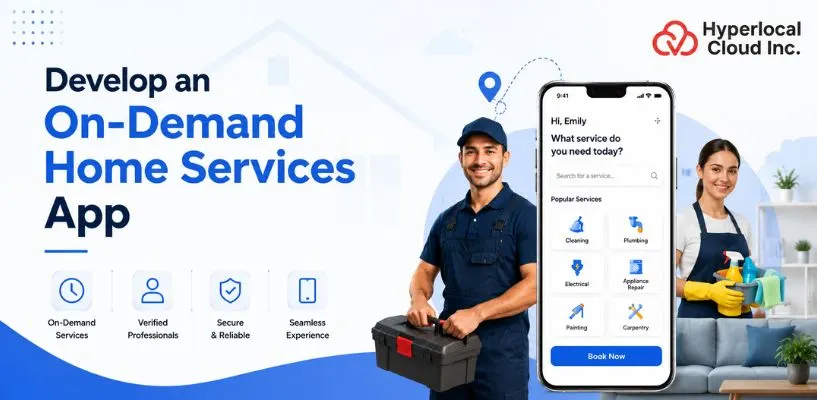
The on-demand economy has transformed how people access everyday services, and by the end of 2026, it will continue to grow rapidly. Users now prefer instant, app-based solutions for tasks like cleaning, repairs, and household maintenance instead of relying on traditional offline methods. This shift has created strong demand for digital platforms that connect customers with verified service providers quickly and efficiently.
Home services apps, such as those offering house cleaning, handyman support, plumbing, and electrical services are booming due to busy urban lifestyles and the need for convenience and trust. Platforms built on the TaskRabbit-style model have shown how powerful this space can be by enabling users to book services in minutes, track professionals in real time, and pay securely within the app.
If you’re planning to build a home service, here’s what actually matters before you spend money. It includes key features, technology choices, development steps, and monetization strategies. Whether you’re building a house cleaning services app or a full-scale on-demand home services marketplace, this article will help you understand what it takes to launch and scale successfully.
Understanding the On-Demand Home Services Market
An on-demand home services app is a digital marketplace that connects customers with service professionals for household tasks in real time or scheduled formats. These platforms simplify discovery, comparison, booking, and payment through a single mobile interface instead of fragmented offline coordination.
The market typically splits into segments such as home cleaning platforms, handyman and repair services, and specialized categories like plumbing, electrical work, and general maintenance. While each segment serves different needs, they all rely on the same foundation: fast access, verified professionals, and predictable service delivery.
In 2026, growth is driven by urbanization, digital adoption, and expectation shifts toward convenience-first services. Users no longer compare only availability—they compare speed, transparency, pricing clarity, trust, and real-time visibility. These factors now define how successful platforms are designed and scaled.
Latest Statistics (2026):
The on-demand home services industry continues to grow rapidly in 2026, driven by mobile adoption, gig economy expansion, and demand for instant household services like cleaning, repairs, and maintenance. (Source: Business Research Insights)
Global Market Size & Growth
- The global on-demand home services market is valued at ~USD 26.68 billion in 2026
- It is projected to reach ~USD 49.73 billion by 2035, growing at a CAGR of ~6.7%
- Another estimate shows the broader digital home services ecosystem reaching ~USD 164.9 billion in 2026 with steady long-term expansion
Turn Your Idea Into a Successful Home Services Platform With Expert Help
Why Most On-Demand Home Services Apps Fail?
Most on-demand home services apps don’t fail because the idea is wrong; they fail because a few critical marketplace fundamentals are not handled properly from the beginning.
Poor Provider Onboarding
A common mistake is not building a strong and reliable supply base early. If the onboarding process is slow, confusing, or lacks proper verification, it becomes difficult to attract skilled professionals.
Without enough active and reliable service providers, even a well-designed app struggles to deliver consistent service quality or quick fulfillment.
Weak Trust System
Trust is the foundation of any home services platform. If users don’t feel confident about who is entering their home, they won’t complete bookings or will avoid repeat usage.
Issues like unverified providers, fake reviews, or unclear accountability can quickly damage user confidence and reduce long-term retention.
Imbalanced Supply and Demand
Many platforms focus heavily on acquiring users but fail to maintain a healthy balance between customers and service providers.
This creates problems such as:
- long waiting times for bookings
- low job acceptance rates for providers
- frustration on both sides of the platform
A sustainable marketplace needs both sides to grow in sync.
Weak Unit Economics
Even if an app gains users, it may still fail if the numbers don’t work.
Common issues include:
- high customer acquisition costs
- low booking frequency per user
- thin commission margins
- high operational support costs
If each transaction doesn’t contribute enough margin to support growth, scaling becomes financially unsustainable.
Types of On-Demand Apps Like TaskRabbit
On-demand home services platforms can be built using different business models depending on how much control, scalability, and service quality the business wants to maintain. Each model impacts how users interact with the app, how providers are onboarded, and how revenue is generated.
1. Marketplace-Based Model
- Connects customers directly with independent service providers
- Providers control availability and pricing within platform rules
- The platform earns commission per completed booking
- Highly scalable, but service quality can vary
2. Aggregator Model
- Platform vets and approves all service professionals
- Only verified providers are listed
- Strong emphasis on trust and quality control
- Best suited for sensitive services like plumbing or electrical work
3. Dedicated Service Apps
- Focuses on a single category such as cleaning or repairs
- Optimized workflows for one service type
- Easier to build brand authority in a niche
- Common examples: cleaning-only or maintenance-only platforms
4. Hybrid Model
A combination of marketplace and aggregator approaches.
| Feature | Description |
| Provider Type | Mix of freelancers + verified professionals |
| Control Level | Medium to high |
| Scalability | High |
| Service Quality | Balanced through verification layers |
| Revenue Potential | Strong due to wider service coverage |
Key Features of a Home Services App
A successful on-demand home services app (like TaskRabbit-style platforms) relies on a well-structured feature set across three core components: Customer App, Service Provider App, and Admin Panel. Each module plays a critical role in ensuring smooth operations, trust, and scalability.
1. Customer App Features
These features define the user experience and directly impact engagement and retention.
User Registration & Profiles
Easy sign-up using email, phone, or social login with personal profile management.
Service Browsing & Search
Users can explore categories like cleaning, handyman, plumbing, and electrical services.
Real-Time Booking
Instant or scheduled booking of services based on availability.
Price Estimation
Transparent cost estimation before confirming a booking.
In-App Payments
Secure payment integration with multiple options (cards, wallets, UPI, etc.).
Ratings & Reviews
Users can rate service providers and leave feedback to build trust.
Live Tracking & Notifications
Real-time updates on provider arrival, job status, and completion alerts.
2. Service Provider App Features
These features help professionals manage their services efficiently.
Provider Onboarding & Verification
Identity verification, skill validation, and background checks for trust-building.
Service Listing Management
Providers can define services offered, pricing, and service areas.
Job Requests & Acceptance
Receive booking requests and accept or reject based on availability.
Earnings Dashboard
Track daily, weekly, and monthly income with transaction history.
Availability Toggle
Easily switch availability status to manage workload.
3. Admin Panel Features
The admin panel acts as the control center for the entire platform.
User & Provider Management
Manage customer accounts and service providers.
Commission Tracking
Monitor earnings from each booking and overall platform revenue.
Analytics Dashboard
Insights into bookings, revenue, user behavior, and growth metrics.
Dispute Management
Handle complaints, refunds, and service-related conflicts.
Content & Category Control
Manage service categories, pricing rules, and platform content.
Get a Custom on-demand Home Services App Built for Your Business Growth
Technology Stack for On-Demand Home Services App
Choosing the right technology stack is critical when building an on-demand home services app, as it directly impacts performance, scalability, and user experience. A modern TaskRabbit-like platform typically relies on a combination of cross-platform mobile frameworks, robust backend systems, and cloud-based infrastructure.
1. Frontend (Mobile App Development)
React Native or Flutter
- Cross-platform development for iOS and Android
- Faster iteration with a shared codebase
- Smooth performance for booking and tracking flows
- Used for both customer and provider apps
2. Backend (Server-Side Development)
Node.js / Django / Laravel
- Handles authentication, bookings, payments, and matching logic
- Node.js supports real-time scalability
- Django provides structured, security-focused development
- Laravel enables rapid MVP development
3. Database (Data Storage)
| Type | Options | Use Case |
| SQL | PostgreSQL | Structured data like bookings, payments |
| NoSQL | MongoDB | Flexible data like service listings, logs |
Key principle:
- SQL ensures financial accuracy
- NoSQL enables scalable flexibility
4. Cloud Infrastructure
AWS / Google Cloud Platform
- Scalable infrastructure for growing demand
- Storage for media and documents
- Load balancing and auto-scaling
- Backup and security management
5. Payment Integrations
Stripe / Razorpay
- Secure in-app payment processing
- UPI, card, and wallet support (especially India-focused systems)
- Split payments between the platform and providers
- Refund and dispute handling
6. Real-Time Tracking & Communication
- WebSockets – for live updates (job status, chat, tracking)
- Firebase – real-time database + push notifications
Used for:
- Live provider tracking
- Booking status updates
- In-app messaging between users and providers
Steps to Develop an On-Demand Home Services App
Building a scalable marketplace requires structured execution from validation to post-launch optimization.
Step 1: Market Research & Competitor Analysis
Understand existing platforms across cleaning, handyman, and repair services. The goal is not just analysis but identifying gaps around trust, pricing clarity, and service speed that users consistently struggle with.
Step 2: Define Business Model & Revenue Streams
Selecting the right revenue model is essential for long-term sustainability.
| Model | Description | Use Case |
| Commission-based | Earn percentage per booking | Marketplace platforms |
| Subscription model | Monthly/annual fees | Providers or premium users |
| Surge pricing | Higher charges during peak demand | Emergency or high-demand services |
Most modern TaskRabbit-like apps use a hybrid approach to maximize revenue and flexibility.
Step 3: UI/UX Design Strategy
Design should minimize friction between search and booking. Every extra step reduces conversion. Trust signals like verified badges, pricing transparency, and visible ratings directly impact user decisions.
Step 4: MVP Development (Minimum Viable Product)
Start with only essential features: authentication, service listings, booking flow, payments, and basic provider onboarding. The goal is to validate real demand before scaling complexity.
Step 5: App Development (Frontend + Backend)
Build scalable frontend and backend systems with proper API integrations for payments, notifications, and location tracking. Ensure architecture supports both customer and provider workflows without bottlenecks.
Step 6: Testing & Quality Assurance (QA)
Testing must cover functionality, load performance, and security. Payment flows and data handling require extra validation since they directly affect trust and retention.
Step 7: Deployment & Launch
Deploy on cloud infrastructure and release apps on the Play Store and App Store. Early monitoring is critical to track system stability, user behavior, and operational gaps.
Step 8: Post-Launch Maintenance & Updates
After launch, focus shifts to performance tuning, bug fixes, feature expansion, and geographic scaling. Marketplaces improve through iteration, not static releases.
Hire Experts to Develop Your Home Services App and Accelerate Business Success
Cost of Developing an On-Demand Home Services App
The cost of building an on-demand home services app (like TaskRabbit-style platforms) depends heavily on the scope, features, and scalability requirements. In 2026, pricing varies widely based on whether you are building a basic MVP or a full enterprise-level marketplace with advanced features like real-time tracking, AI matching, and multi-vendor management.
Estimated Cost Ranges (2026)
| App Type | Features Included | Estimated Cost |
| MVP App | User login, booking, payments, simple admin panel | $5,000 – $15,000 |
| Mid-Level App | Real-time tracking, chat, reviews, provider app, full admin panel | $20,000 – $40,000 |
| Advanced App | AI matching, multi-vendor system, analytics, scalable architecture | $40,000+ |
Future Trends in On-Demand Home Services Apps
The on-demand home services industry is evolving rapidly, and by 2026 and beyond, technology is playing a central role in improving speed, trust, and personalization. Modern TaskRabbit-like platforms are no longer just booking apps—they are becoming intelligent service ecosystems.
AI-Powered Service Matching
Artificial intelligence is increasingly being used to match customers with the most suitable service providers. Instead of simple location-based matching, AI considers factors like skill level, past ratings, availability, pricing behavior, and customer preferences. This results in faster bookings, better service quality, and higher customer satisfaction.
Predictive Booking Systems
Predictive systems use user behavior and historical data to anticipate service needs before users even request them. For example, an app may suggest house cleaning before weekends or remind users about periodic maintenance tasks. This helps increase engagement and repeat usage while improving convenience for customers.
Smart Home Integration
With the rise of IoT devices, home services apps are integrating with smart home ecosystems. Users can schedule maintenance or repairs directly from smart devices or receive alerts when something requires attention. This creates a seamless connection between physical home systems and digital service platforms.
Automation in Customer Support (Chatbots)
AI-driven chatbots are becoming a standard feature in on-demand apps. They handle common queries like booking status, pricing details, cancellation requests, and issue resolution. This reduces dependency on human support teams and ensures 24/7 availability for users.
Blockchain-Based Trust Verification
Trust is one of the biggest challenges in home services platforms. Blockchain technology is being explored to create transparent and tamper-proof records of service provider credentials, reviews, and transaction history. This improves accountability and builds stronger trust between customers and service providers.
Selecting the right on-demand app development company is one of the most critical decisions when building a home services platform. The right partner not only builds your app but also helps you define architecture, scalability, and long-term product strategy.
What to Look for in a Development Partner
Choosing the right on-demand app development company starts with evaluating their technical expertise and understanding of marketplace-based platforms. The ideal partner should have experience in building multi-sided systems that include customers, service providers, and admin panels. They should also be proficient in integrating essential features like real-time booking, payments, location tracking, and notifications while maintaining strong performance and scalability.
Equally important is their experience with on-demand apps similar to TaskRabbit. A development team that has previously built home services or marketplace platforms will already understand critical workflows such as provider matching, commission handling, and service scheduling. This reduces development risks and ensures a smoother and faster build process.
Finally, a good development partner should offer transparency in their portfolio, including relevant case studies that demonstrate their problem-solving approach and ability to deliver scalable solutions. Post-launch support is also essential, as ongoing maintenance, bug fixes, and feature upgrades are necessary to keep the app competitive and reliable in the long run.
Transform Your Vision Into a Powerful on-demand Service App With Professionals
Conclusion
Building an on-demand home services app requires a structured approach, from market research and feature planning to development, testing, and scaling. Each stage plays a crucial role in ensuring the platform is reliable, efficient, and user-friendly.
The key to success lies in building a scalable and user-centric app that prioritizes convenience, trust, and speed. Today, the users expect seamless digital experiences, and apps that fail to meet these expectations struggle to compete in the market.
Overall, the home services industry continues to present strong opportunities for startups and enterprises. With the right strategy, technology stack, and development partner, it is possible to build a highly profitable and scalable on-demand platform similar to TaskRabbit and other leading service marketplaces.

Patt Cummins is an experienced content writer with over 10 years of experience creating clear and engaging content for technology-focused industries. He specializes in simplifying complex technical topics into easy-to-understand stories that educate readers, support brand communication, and help businesses effectively share their solutions.

Need Help With
Development?