

The healthcare industry depends on an efficient and reliable supply chain to ensure that medicines, medical devices, laboratory equipment, surgical products, and other essential supplies reach the right facility at the right time. However, fragmented procurement processes, inaccurate inventory records, limited supplier visibility, manual workflows, and poor coordination between stakeholders can create significant operational challenges.
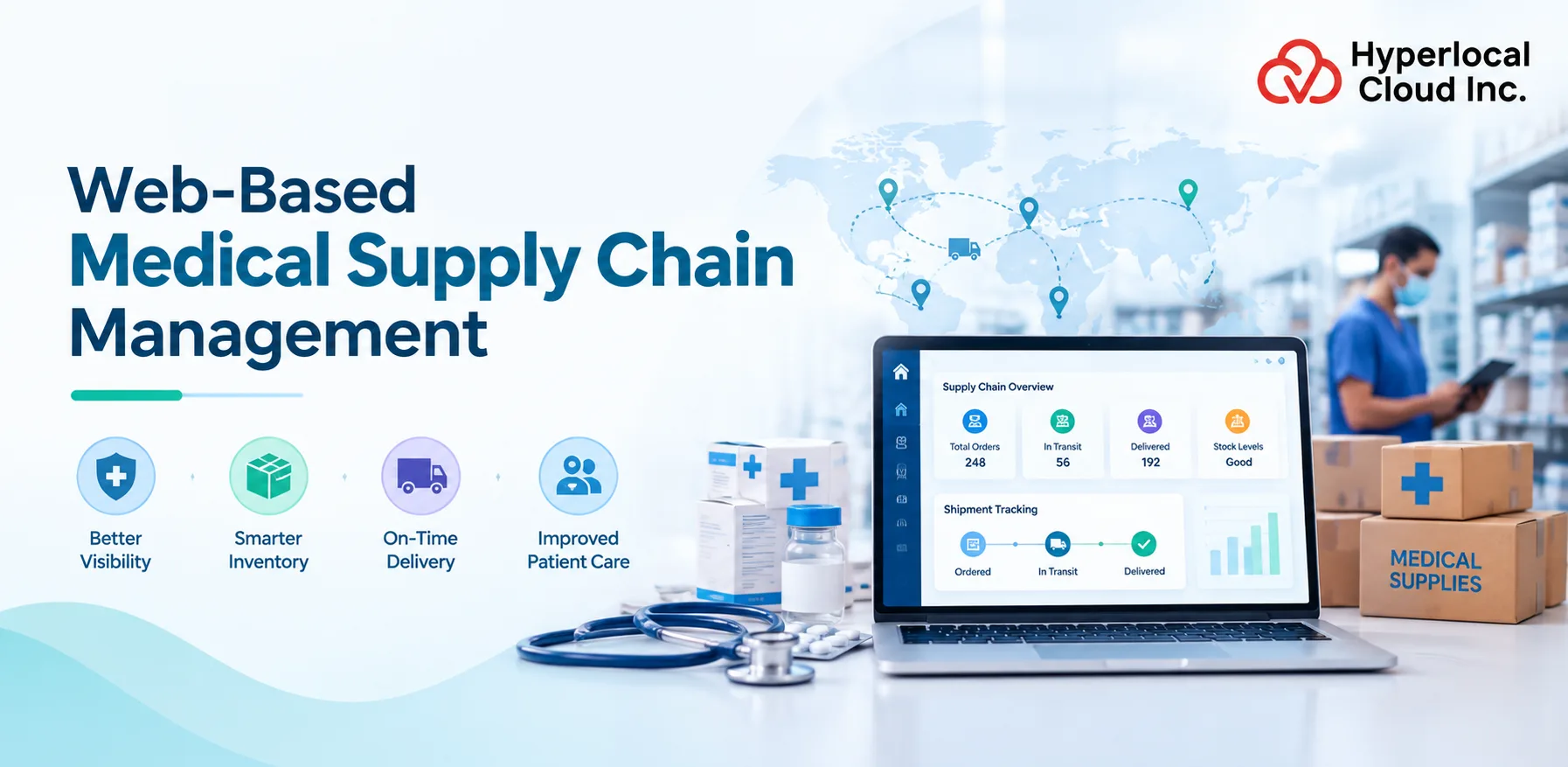
A web-based medical supply chain management platform provides a centralized digital environment where healthcare organizations, suppliers, distributors, warehouses, procurement teams, and logistics providers can manage supply chain operations from a single system.
From inventory and procurement to supplier management, order processing, warehouse operations, shipment tracking, and analytics, such a platform can help organizations create a more connected and transparent healthcare supply chain.
This guide explains how to build a web-based medical supply chain management platform, its essential features, technology stack, development process, security requirements, costs, and future opportunities.
What Is a Web-Based Medical Supply Chain Management Platform?
A web-based medical supply chain management platform is an online software solution designed to manage and coordinate the movement of healthcare products throughout the supply chain.
Unlike traditional systems that may depend on spreadsheets, disconnected applications, or locally installed software, a web-based platform allows authorized users to access supply chain information through a browser.
The platform can connect:
Suppliers → Procurement Teams → Warehouses → Distributors → Healthcare Facilities → Logistics Providers
A centralized system gives stakeholders access to relevant information about product availability, purchase orders, inventory levels, shipments, suppliers, deliveries, and other operational activities.
The platform can be designed for hospitals, pharmaceutical distributors, medical equipment suppliers, healthcare networks, clinics, laboratories, wholesalers, and other organizations involved in healthcare supply chain operations.
Turn Your Supply Chain Idea Into a Scalable Platform
Why Build a Medical Supply Chain Management Platform?
Healthcare supply chains involve large product catalogs, multiple suppliers, complex procurement processes, strict inventory requirements, and time-sensitive deliveries. Digitalizing these operations can provide several business and operational benefits.
Reduce Inventory Shortages
Real-time inventory monitoring helps organizations identify low-stock products before they become critical. Automated alerts can notify procurement teams when stock reaches predefined thresholds.
Prevent Overstocking
Inventory analytics and demand forecasting can help organizations purchase products according to expected requirements instead of relying entirely on manual estimates.
Improve Medical Product Traceability
Batch numbers, lot numbers, serial numbers, expiry dates, and movement records can be tracked through the platform, improving visibility throughout the product lifecycle.
Automate Procurement
Instead of managing purchase requests through emails and spreadsheets, organizations can create digital procurement workflows with approval rules, purchase orders, quotations, and supplier communication.
Improve Supplier Coordination
Suppliers can access relevant orders, product requests, quotation requirements, and delivery information through dedicated portals.
Increase Supply Chain Visibility
A centralized dashboard can provide procurement managers and administrators with real-time information about inventory, orders, shipments, suppliers, and operational performance.
Support Data-Driven Decisions
Reports and analytics can help organizations identify purchasing patterns, supplier performance, inventory trends, and operational inefficiencies.
How Does a Medical Supply Chain Management Platform Work?
A medical supply chain platform typically manages the complete lifecycle of a product from procurement to delivery.
Step 1: Supplier Onboarding
Suppliers register on the platform and provide their business information, product catalog, certifications, pricing, and other required details.
Step 2: Product Management
Medical products are added to the centralized catalog with information such as SKU, category, manufacturer, batch number, expiry date, unit price, and stock availability.
Step 3: Procurement Request
A healthcare facility or procurement department creates a supply request based on inventory requirements or projected demand.
Step 4: Supplier Selection
The procurement team can review available suppliers, quotations, pricing, delivery timelines, and other criteria.
Step 5: Purchase Order
Once the supplier is selected, the platform generates a purchase order and routes it through the required approval workflow.
Step 6: Warehouse Receiving
When the shipment reaches the warehouse, staff can record received quantities, batches, serial numbers, and expiry dates.
Step 7: Inventory Management
The received products are added to inventory and can be tracked across warehouses or healthcare facilities.
Step 8: Order Fulfillment
Healthcare facilities can place supply orders, which are processed by warehouses or distributors.
Step 9: Shipment Tracking
Logistics teams can update shipment status and provide tracking information.
Step 10: Delivery Confirmation
Once products reach their destination, delivery status can be updated and proof of delivery can be stored digitally.
This workflow creates a connected supply chain where stakeholders can track products and transactions throughout the process.
Key Modules of a Medical Supply Chain Management Platform
A successful platform should provide different interfaces for different stakeholders.
Admin Panel
The admin panel provides centralized control over the entire platform.
Key functions can include:
- Dashboard management
- User management
- Supplier management
- Product catalog management
- Order management
- Warehouse management
- Reports and analytics
- Roles and permissions
- System configuration
- Audit logs
Administrators can monitor platform activity and manage access for different stakeholders.
Supplier Panel
The supplier portal allows medical product suppliers to manage their operations.
Features may include:
- Supplier registration
- Product catalog
- Pricing management
- Inventory availability
- Quote management
- Purchase orders
- Invoice management
- Shipment updates
- Order history
- Performance reports
Healthcare Facility Panel
Hospitals, clinics, laboratories, and healthcare facilities can use this panel to manage supply requirements.
Features can include:
- Product search
- Supply requests
- Purchase orders
- Order tracking
- Inventory visibility
- Delivery management
- Reorder functionality
- Invoice access
- Request history
Warehouse Panel
The warehouse panel focuses on stock receiving, storage, movement, and fulfillment.
It can include:
- Stock management
- Batch management
- Lot tracking
- Expiry tracking
- Barcode scanning
- Stock transfers
- Picking and packing
- Warehouse reports
- Inventory adjustments
Logistics Panel
The logistics panel can help coordinate transportation and delivery.
Features may include:
- Shipment management
- Driver assignment
- Delivery scheduling
- Tracking
- Delivery status
- Route information
- Proof of delivery
- Delivery history
Transform Your Medical Supply Chain With Digital Technology
Key Features to Include
The feature set should be determined by the organization’s supply chain workflows and target users.
1. Real-Time Inventory Tracking
The platform should provide current inventory information across warehouses and healthcare facilities.
Users can view:
- Available stock
- Reserved stock
- Incoming stock
- Damaged stock
- Expired stock
- Reorder levels
2. Multi-Location Inventory
Large healthcare organizations may operate multiple warehouses, hospitals, clinics, or distribution centers.
Multi-location inventory management allows administrators to monitor stock across different locations from one platform.
3. Low-Stock Alerts
Automated notifications can be triggered when inventory reaches a predefined threshold.
This allows procurement teams to initiate replenishment before critical shortages occur.
4. Batch and Lot Tracking
Medical products often require detailed batch-level tracking.
The platform can store:
- Batch numbers
- Manufacturing dates
- Expiry dates
- Supplier information
- Quantity
- Warehouse location
- Movement history
5. Expiry Management
The system can identify products approaching their expiration date and notify responsible teams.
This can help organizations reduce product wastage.
6. Purchase Order Management
Procurement teams can create, approve, modify, and track purchase orders digitally.
The workflow can include:
Request → Approval → Purchase Order → Supplier Confirmation → Shipment → Receiving
7. Supplier Management
Organizations can maintain centralized supplier profiles containing:
- Company details
- Products
- Pricing
- Certifications
- Performance history
- Contracts
- Orders
- Delivery records
8. Automated Procurement Workflows
Procurement workflows can be configured according to organizational rules.
For example, purchases above a predefined value can automatically require approval from a procurement manager.
9. Order Management
Users can create and manage supply orders through the platform.
The system can display:
- Order status
- Product quantities
- Supplier
- Delivery date
- Payment status
- Shipment details
10. Barcode and QR Code Scanning
Barcode and QR-code functionality can simplify product identification, receiving, stock movement, and order fulfillment.
11. Shipment Tracking
The platform can integrate with logistics providers to provide shipment updates.
Users can track orders from dispatch through delivery.
12. Reporting and Analytics
Business intelligence dashboards can provide information about:
- Inventory turnover
- Procurement spending
- Supplier performance
- Product demand
- Order fulfillment
- Delivery performance
- Stock wastage
Advanced Features for a Modern Medical Supply Chain Platform
A modern platform can go beyond basic inventory and procurement management by incorporating automation, AI, and connected technologies.
AI-Powered Demand Forecasting
AI algorithms can analyze historical orders, seasonal patterns, product demand, and other relevant data to estimate future requirements.
Predictive Inventory Management
Predictive models can help identify products that may experience increased demand or potential shortages.
Automated Replenishment
The platform can generate replenishment recommendations when inventory reaches specific thresholds.
IoT-Enabled Monitoring
IoT devices can be connected to monitor environmental conditions for products that require controlled storage conditions.
RFID Integration
RFID technology can help organizations track products and inventory movements with less manual scanning.
Intelligent Supplier Recommendations
The system can analyze supplier pricing, fulfillment history, delivery performance, and availability to support procurement decisions.
AI-Based Anomaly Detection
Machine learning models can identify unusual purchasing patterns, inventory discrepancies, or transaction anomalies for further review.
Real-Time Logistics Tracking
GPS and logistics APIs can provide shipment visibility and delivery updates.
User Roles and Access Management
Because medical supply chain platforms handle operational and potentially sensitive business information, role-based access control is essential.
Typical roles include:
Super Admin
Manages the entire platform, users, configurations, and permissions.
Procurement Manager
Manages procurement requests, suppliers, quotations, and purchase orders.
Warehouse Manager
Controls inventory receiving, storage, transfers, and stock adjustments.
Supplier
Manages products, quotations, purchase orders, invoices, and shipments.
Healthcare Facility
Creates supply requests and monitors orders and deliveries.
Distributor
Manages product distribution and fulfillment.
Logistics Manager
Coordinates shipments, routes, drivers, and delivery operations.
Finance Team
Handles invoices, payments, purchase costs, and financial reports.
Role-based access ensures that each user can access only the information and functions required for their responsibilities.
Get a Free Medical Supply Chain Software Consultation
Technology Stack for Building the Platform
The technology stack should be selected based on scalability, security, integrations, performance, and business requirements.
Frontend
Possible technologies include:
- React.js
- Next.js
- Angular
- Vue.js
A modern JavaScript framework can provide responsive dashboards and interactive user interfaces.
Backend
Possible backend technologies include:
- Node.js
- Python
- Laravel
- Java
- .NET
The backend manages business logic, authentication, workflows, APIs, integrations, and data processing.
Database
Depending on requirements, developers can use:
- PostgreSQL
- MySQL
- MongoDB
A relational database can be useful for structured transactional data, while NoSQL technologies may be suitable for specific high-volume or flexible data requirements.
Cloud Infrastructure
The platform can be deployed using:
- AWS
- Microsoft Azure
- Google Cloud
Cloud infrastructure can support scalability, backups, monitoring, security, and high availability.
APIs
REST APIs or GraphQL can connect the platform with external systems such as ERP software, hospital management systems, logistics providers, payment systems, and analytics tools.
Real-Time Technologies
WebSockets and event-driven architectures can support real-time inventory, order, and shipment updates.
Healthcare Data Security and Compliance
Security should be considered from the architecture and design stage rather than added after development.
Important security mechanisms can include:
- Data encryption
- Secure authentication
- Multi-factor authentication
- Role-based access control
- API authentication
- Audit logs
- Secure backups
- Session management
- Network security
- Vulnerability testing
Organizations operating in regulated markets may also need to consider healthcare privacy and security regulations applicable to their jurisdiction and business model, such as HIPAA in the United States or GDPR where applicable.
Compliance requirements should be assessed with qualified legal and compliance professionals because requirements vary according to location, data type, organization, and platform functionality.
How to Build a Web-Based Medical Supply Chain Management Platform
Step 1: Define Business Requirements
Start by identifying the supply chain problems the platform needs to solve.
Define:
- Target users
- Products
- Supply chain workflows
- Procurement processes
- Warehouse requirements
- Logistics requirements
- Reporting requirements
- Integration requirements
Step 2: Identify Users and Workflows
Map the activities of each stakeholder.
For example:
Healthcare Facility → Request → Procurement Approval → Supplier → Purchase Order → Warehouse → Shipment → Delivery
Clearly defining workflows helps prevent unnecessary features and development complexity.
Step 3: Design UI/UX
Create wireframes and prototypes for each user panel.
The design should focus on:
- Simple navigation
- Clear dashboards
- Responsive layouts
- Fast access to important information
- Accessible data visualization
- Efficient workflows
Step 4: Select the Technology Stack
Choose frontend, backend, database, cloud infrastructure, APIs, security technologies, and third-party services based on the platform’s requirements.
Step 5: Develop the MVP
Start with essential features such as:
- User management
- Product catalog
- Inventory management
- Supplier management
- Procurement
- Orders
- Warehouse management
- Basic reporting
An MVP allows organizations to validate workflows before investing in advanced functionality.
Step 6: Integrate APIs and Third-Party Systems
Connect the platform with required external systems, such as ERP, hospital software, logistics providers, accounting platforms, barcode systems, or communication services.
Step 7: Implement Security
Configure authentication, authorization, encryption, audit trails, secure APIs, backups, and monitoring.
Step 8: Test the Platform
Testing should cover:
- Functional testing
- API testing
- Security testing
- Performance testing
- Usability testing
- Cross-browser testing
- Integration testing
Step 9: Deploy to the Cloud
Deploy the platform to a secure cloud infrastructure and configure monitoring, backups, logging, and scaling mechanisms.
Step 10: Monitor and Scale
After launch, monitor platform performance and user behavior.
New capabilities can then be introduced based on actual business requirements.
Third-Party Integrations
A medical supply chain platform may need to integrate with several external systems.
ERP Systems
ERP integration can synchronize purchasing, finance, inventory, and other enterprise data.
Hospital Management Systems
Integration can help connect healthcare facility requirements with supply chain operations.
Accounting Software
Accounting integrations can support invoices, expenses, payments, and financial reporting.
Shipping APIs
Shipping integrations can provide tracking information and delivery status.
Barcode and RFID Systems
These technologies can simplify product identification and inventory movement.
Communication APIs
Email, SMS, and push notification services can send alerts about orders, approvals, inventory, and deliveries.
Business Intelligence Tools
BI integrations can provide advanced reporting and visualization capabilities.
How AI Can Improve Medical Supply Chain Management
Artificial intelligence can make supply chain operations more predictive and automated.
Demand Forecasting
AI can analyze historical purchasing patterns and other business data to estimate future product requirements.
Inventory Optimization
Machine learning can help identify inventory levels and replenishment patterns that organizations may want to investigate.
Predictive Procurement
AI-based recommendations can support procurement teams by highlighting potential upcoming requirements.
Supplier Performance Analysis
AI can analyze supplier delivery times, order accuracy, pricing, and fulfillment patterns.
Shortage Prediction
Predictive models can identify potential supply risks based on historical and current data.
Automated Purchase Recommendations
When stock levels fall below defined thresholds, the system can recommend products for replenishment.
Delivery Optimization
AI can analyze delivery information to support logistics planning and route optimization.
Build Your Medical Supply Chain Platform Today
Challenges in Medical Supply Chain Platform Development
Building a healthcare supply chain platform involves several challenges.
Data Security
Healthcare-related systems require strong security controls and careful handling of sensitive information.
Complex Workflows
Different healthcare organizations may follow different procurement, approval, inventory, and distribution processes.
Multiple Stakeholders
The platform may need to support suppliers, healthcare facilities, distributors, warehouses, logistics teams, and administrators.
Product Traceability
Medical products may require detailed tracking across batches, lots, serial numbers, and expiration dates.
Regulatory Requirements
The platform may need to satisfy industry and jurisdiction-specific requirements.
Legacy-System Integration
Healthcare organizations may already use ERP, hospital management, accounting, or inventory systems that need to exchange data with the new platform.
Data Accuracy
Incorrect inventory or product information can affect procurement and supply chain decisions. Validation and synchronization mechanisms are therefore important.
Scalability
The architecture should be capable of supporting additional facilities, warehouses, suppliers, users, products, and transactions as the business grows.
Benefits of a Web-Based Medical Supply Chain Platform
A centralized platform can provide several operational benefits.
Centralized Operations
All supply chain activities can be managed through a unified system.
Better Inventory Visibility
Organizations can view inventory across multiple locations.
Faster Procurement
Digital workflows can reduce manual procurement activities.
Reduced Product Wastage
Expiry tracking and inventory analytics can help organizations manage products more efficiently.
Improved Traceability
Batch, lot, and serial tracking can provide greater visibility into product movement.
Better Supplier Collaboration
Suppliers and procurement teams can communicate through centralized workflows.
Lower Operational Costs
Automation can reduce repetitive administrative tasks.
Improved Scalability
Cloud-based architecture can make it easier to expand the platform as the organization grows.
How to Monetize a Medical Supply Chain Platform
If the platform is developed as a SaaS product, several monetization models can be considered.
Monthly Subscription
Charge organizations a recurring monthly fee based on features or usage.
Annual Plans
Offer discounted annual subscriptions for long-term customers.
Per-User Pricing
Charge according to the number of users or staff members using the system.
Transaction Fees
A platform connecting suppliers and buyers may charge transaction-based fees depending on the business model.
Enterprise Licensing
Large healthcare organizations can receive customized enterprise plans.
Premium Analytics
Advanced forecasting, analytics, and reporting can be offered as premium features.
API Access
Organizations can be charged for advanced API access or high-volume integrations.
Custom Integrations
Additional charges can apply for customized ERP, hospital, logistics, or accounting integrations.
Medical Supply Chain Management Platform: MVP vs Advanced Version
An MVP should focus on the essential workflows needed to validate the platform.
MVP Features
- User registration and login
- Role-based access
- Product management
- Supplier management
- Inventory management
- Purchase orders
- Order management
- Warehouse management
- Basic reporting
- Notifications
Advanced Version
The platform can later include:
- AI demand forecasting
- Predictive inventory management
- Automated procurement
- RFID integration
- IoT monitoring
- Advanced analytics
- AI-based anomaly detection
- Real-time logistics tracking
- Advanced supplier intelligence
- Enterprise integrations
This phased approach can help businesses launch faster while creating room for future expansion.
Launch Your Medical Supply Chain Platform Faster
Future Trends in Medical Supply Chain Management
The medical supply chain industry is increasingly moving toward connected and intelligent digital systems.
AI-Powered Supply Chains
AI can support forecasting, procurement analysis, inventory optimization, and operational decision-making.
IoT-Connected Warehouses
Connected devices can provide real-time information about inventory and storage environments.
Blockchain-Based Traceability
Blockchain technology may be considered for specific use cases requiring tamper-resistant transaction or provenance records.
Autonomous Inventory Management
Future platforms may automate more replenishment and inventory workflows based on predefined rules and predictive models.
Digital Twins
Digital representations of supply chain operations can help organizations model processes and evaluate potential operational changes.
Cloud-Native Healthcare Platforms
Cloud infrastructure enables organizations to build scalable and accessible supply chain systems.
Real-Time Supply Chain Visibility
Organizations are increasingly seeking unified views of procurement, inventory, warehouse, and logistics activities.
Why Choose an Experienced Healthcare Software Development Company?
Developing a medical supply chain management platform requires more than standard web development.
An experienced development partner can help with:
- Healthcare-focused architecture
- Custom supply chain workflows
- Secure application development
- Cloud infrastructure
- API development
- ERP and healthcare integrations
- Inventory management
- AI implementation
- Testing and quality assurance
- Post-launch maintenance
The development team should understand both the technical requirements and the operational complexity of healthcare supply chains.
FAQs (Frequently Asked Questions)


Need Help With
Development?